

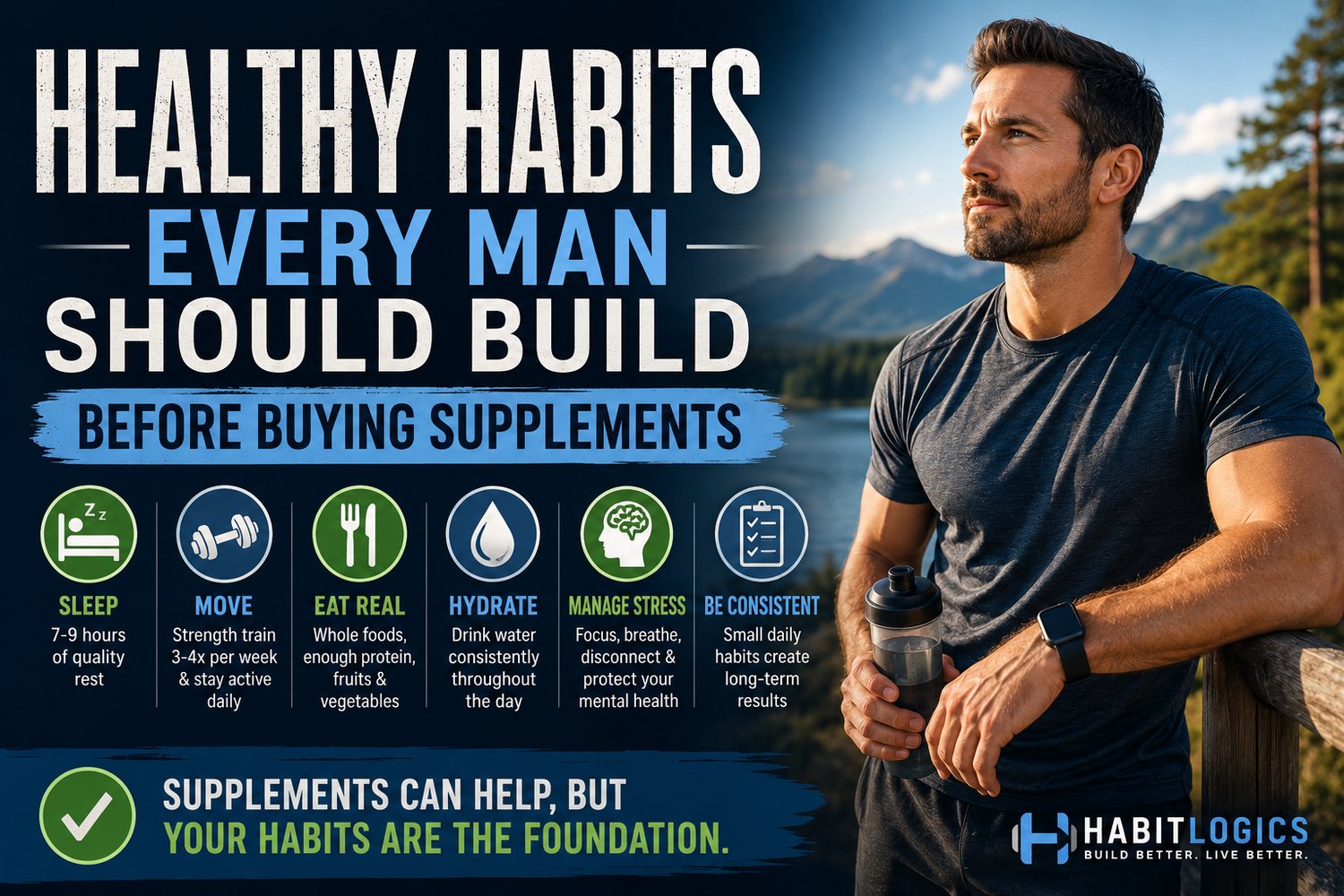
Healthy Habits Every Man Should Build Before Buying Supplements
Walk through the supplement aisle—or spend five minutes scrolling men's-health content online—and you'll find a product for almost everything.
Low energy?
There's a supplement.
Want more testosterone?
There's a supplement.
Want to build muscle?
Another supplement.
Sleep better?
There's one for that too.
Some supplements can absolutely have a place in a healthy lifestyle.
But there's a problem with starting there.
Supplements are supposed to supplement a solid foundation—not replace one.
Before spending hundreds of dollars trying to optimize your health, make sure you've addressed the habits that influence your body every day:
- Sleep
- Strength training
- Walking and aerobic activity
- Nutrition
- Protein intake
- Body composition
- Stress
- Blood pressure
- Preventive healthcare
- Smoking and alcohol
- Consistency
That's usually where the bigger opportunity is.
If you're new to the men's-health pillar, start with What Is Men's Wellness?.
Then use this guide to build the foundation.
Why Supplements Are So Appealing
Supplements have one enormous advantage over lifestyle changes:
They're easy.
Taking a capsule takes seconds.
Compare that with:
- Going to bed earlier
- Strength training consistently
- Losing excess body fat
- Preparing healthier meals
- Walking regularly
- Drinking less alcohol
- Managing chronic stress
- Getting appropriate medical care
Those require behavior change.
Behavior change takes time.
That's why the promise of a shortcut is so appealing.
Unfortunately, you can't reliably supplement your way around consistently poor habits.
Habit #1: Take Sleep Seriously
If you're trying to improve:
- Energy
- Recovery
- Gym performance
- Mood
- Sexual health
- Overall well-being
while sleeping five hours per night, start with sleep.
Not another supplement.
Poor sleep can affect:
- Energy
- Concentration
- Mood
- Appetite
- Exercise performance
- Recovery
- Decision-making
- Sexual function
A reasonable foundation includes:
- Giving yourself enough time to sleep
- Keeping a reasonably consistent sleep schedule
- Maintaining a dark, comfortable bedroom
- Limiting caffeine late in the day
- Reducing unnecessary late-night stimulation
- Developing a repeatable wind-down routine
For the complete guide, read Sleep for Men.
Don't Ignore Possible Sleep Apnea
There's a difference between occasionally sleeping badly and routinely waking exhausted.
Symptoms worth discussing with a healthcare professional can include:
- Loud habitual snoring
- Gasping during sleep
- Witnessed breathing pauses
- Morning headaches
- Excessive daytime sleepiness
- Waking unrefreshed despite enough time in bed
If a sleep disorder is contributing to fatigue, adding caffeine, testosterone boosters, or another energy supplement doesn't fix the underlying problem.
Habit #2: Strength Train Consistently
If you want one habit that helps preserve your ability to remain physically capable as you age, resistance training belongs near the top of the list.
Strength training supports:
- Muscle
- Strength
- Bone health
- Physical function
- Body composition
- Metabolic health
You don't need to live in the gym.
For many men, a simple program built around major movement patterns can go a long way:
- Squat
- Hinge
- Push
- Pull
- Carry
- Appropriate core work
The goal is:
Progression + consistency
not:
Destroy yourself every workout.
Read Strength Training for Men Over 30.
If you're already in midlife, Building Muscle After 40 goes deeper into training, protein, and recovery.
Habit #3: Walk More
Walking isn't flashy enough to dominate fitness social media.
That's part of what makes it useful.
You can walk:
- Before work
- During lunch
- After dinner
- While talking on the phone
- With family
- While listening to a podcast
You don't need special equipment.
You don't need a gym.
And you don't need every walk to become a maximal workout.
Regular walking supports:
- Cardiovascular health
- Daily energy expenditure
- Blood glucose management
- Weight management
- Stress reduction
- General activity
For the men's-health angle, read Walking for Men's Health.
For a deeper weight-loss strategy, use the Complete Walking for Weight Loss Guide.
Habit #4: Eat Enough Protein
If your goals include:
- Maintaining muscle
- Building muscle
- Improving body composition
- Recovering from training
- Staying full
protein matters.
Before buying:
- BCAAs
- Amino-acid powders
- Exotic muscle supplements
look at your meals.
Ask:
Where is the protein?
Useful sources include:
- Eggs
- Greek yogurt
- Cottage cheese
- Milk
- Chicken
- Turkey
- Lean beef
- Fish
- Beans
- Lentils
- Tofu
- Tempeh
Protein powder can be useful.
But think of it as convenient food, not a magical muscle-building supplement.
Read Protein for Men.
For broader meal planning, visit the Complete High-Protein Guide.
Habit #5: Eat Like an Adult Most of the Time
You don't need a flawless diet.
And you probably don't need to eliminate:
- Carbohydrates
- Fruit
- Gluten
- Dairy
- Seed oils
- Every processed food
- Whatever ingredient social media hates this month
A practical meal can be built around:
Protein + produce + fiber-rich carbohydrate + healthy fat
Examples:
- Chicken + vegetables + potatoes
- Greek yogurt + fruit + oats + nuts
- Fish + rice + vegetables
- Eggs + whole-grain toast + fruit
- Beans + vegetables + avocado
Then leave room for foods you simply enjoy.
A nutritious diet followed consistently for years beats a “perfect” diet abandoned after three weeks.
Habit #6: Know Your Blood Pressure
You can feel completely normal while having high blood pressure.
That's why knowing your number matters.
Men's-health marketing gives testosterone enormous attention.
Blood pressure isn't nearly as exciting.
But high blood pressure affects:
- Cardiovascular health
- Kidney health
- Brain health
- Blood vessels
- Erectile health
Don't obsess over it.
Know it.
If it is repeatedly elevated, address it appropriately.
Habit #7: Stop Guessing About Your Health
Men often bounce between two extremes.
Extreme #1:
Ignore symptoms completely.
Extreme #2:
Diagnose ourselves from the internet.
Neither is particularly useful.
If you're experiencing persistent:
- Low energy
- Reduced libido
- Erectile problems
- Poor recovery
- Significant weight changes
- Sleep problems
- Other unexplained symptoms
don't automatically assume you know the cause.
Symptoms overlap.
Evaluation provides context.
Fatigue Doesn't Automatically Mean Low Testosterone
Testosterone marketing has turned almost every male complaint into a hormone symptom.
Tired?
Testosterone.
Low motivation?
Testosterone.
Gaining weight?
Testosterone.
Bad workout?
Testosterone.
But fatigue can also occur with:
- Poor sleep
- Sleep apnea
- Anemia
- Thyroid disease
- Depression
- Chronic illness
- Medication effects
- Inadequate nutrition
- Excessive training
- Chronic stress
If testosterone is genuinely a concern, start with:
For broader testing information, visit the Men's Bloodwork Hub.
The Everlywell Testosterone Test provides one at-home option.
An at-home result can provide information.
It doesn't automatically provide a diagnosis.
Habit #8: Track Important Trends
You don't need to turn your life into a spreadsheet.
Some tracking can still be useful.
Consider monitoring things such as:
- Weight
- Waist circumference
- Blood pressure
- Sleep
- Steps
- Strength
- Exercise
- Energy
- Relevant bloodwork
The purpose isn't obsession.
It's pattern recognition.
One:
- Bad night of sleep
- High weigh-in
- Poor workout
- Testosterone result
may tell you relatively little.
A trend can tell you much more.
For laboratory results, the Men's Bloodwork Dashboard helps organize health markers over time.
For broader fitness and wellness tracking, the Men's Health & Performance Dashboard combines health, fitness, energy, body composition, and recovery data.
Habit #9: Manage Body Composition Without Obsessing Over the Scale
Body weight is useful.
It isn't everything.
Also consider:
- Waist circumference
- Strength
- Fitness
- Muscle mass
- Metabolic health
- How weight is trending over time
A sustainable body-composition strategy generally includes:
- Resistance training
- Adequate protein
- Regular activity
- Appropriate calorie intake
- Good sleep
- Consistency
Avoid endlessly bouncing between aggressive bulks and crash diets.
Most men are better served by habits they can maintain year-round.
For the midlife body-composition side, read Why Belly Fat Gets Harder to Lose After 30.
Habit #10: Manage Stress Before Buying a “Cortisol” Supplement
Cortisol has become another wellness buzzword.
Cortisol is a real and important hormone.
That doesn't mean you need an expensive supplement marketed as:
“cortisol control.”
Look first at what's creating chronic stress.
Possibilities include:
- Work
- Finances
- Relationships
- Poor sleep
- Overscheduling
- Lack of recovery
- Constant phone use
- No downtime
Useful stress-management strategies can include:
- Exercise
- Walking
- Time outdoors
- Journaling
- Hobbies
- Better boundaries
- Social connection
- Professional mental-health support when appropriate
Sometimes the most effective wellness intervention is addressing the thing actually making your life stressful.
Habit #11: Remove Behaviors Working Against You
Men's wellness isn't only about adding healthy behaviors.
Sometimes the biggest improvement comes from removing a harmful one.
That might mean reducing or eliminating:
- Smoking
- Excessive alcohol
- Chronic sleep deprivation
- Excessive sedentary time
- Repeated overeating
- Highly restrictive dieting
- Other habits interfering with your goals
You don't need to become a monk.
But ask whether one repeated behavior is quietly undoing several good ones.
Habit #12: Build a Routine You Can Repeat
You shouldn't have to renegotiate your health with yourself every morning.
Build routines.
For example:
Morning
- Get some light.
- Eat a nutritious meal when appropriate.
- Move.
During the Day
- Walk.
- Eat reasonably.
- Take breaks from prolonged sitting.
Training Days
- Strength train according to schedule.
Evening
- Prepare for tomorrow.
- Reduce stimulation.
- Begin winding down for sleep.
The exact routine matters less than repeatability.
The Men's Momentum System Bundle is built around daily planning, habit tracking, walking, fitness, and goal-setting.
The Testosterone Lifestyle Guide focuses specifically on sleep, nutrition, strength training, stress, and recovery.
Habit #13: Keep Up With Preventive Healthcare
Healthy habits don't replace medical care.
Preventive health may involve:
- Blood-pressure screening
- Appropriate bloodwork
- Diabetes assessment
- Cholesterol evaluation
- Cancer screening
- Vaccinations
- Dental care
- Other age- and risk-appropriate services
You don't have to turn healthcare into a hobby.
You do need to stop waiting until something is obviously wrong before paying attention.
For the laboratory side, read Blood Work for Men.
For the broader aging and screening perspective, read Healthy Aging for Men.
Start Free Before Buying Anything
If you're thinking:
“Fine. Where do I actually start?”
don't buy ten supplements.
Establish a baseline.
The FREE Men's Hormone & Energy Starter Kit includes tools for tracking:
- Sleep
- Strength
- Nutrition
- Daily habits
- Energy
- Bloodwork
Use it to identify which part of your foundation actually needs attention.
When Supplements Can Make Sense
None of this means supplements are useless.
They can be valuable when they solve a specific problem.
Examples may include:
- Correcting a diagnosed nutrient deficiency
- Filling a genuine dietary gap
- Supporting a specific performance goal with an evidence-based ingredient
- Providing convenient nutrition, such as protein powder
NIH's Office of Dietary Supplements notes that performance supplements cannot replace a healthy diet, though some products may have value depending on the activity and individual circumstances.
That's the right framework.
Use supplements because you have a reason.
Not because somebody convinced you that every man needs a stack.
Supplements Can Also Have Downsides
“Over the counter” doesn't mean:
- Risk-free
- Interaction-free
- Proven effective
- Appropriate for everyone
Supplements can:
- Cause side effects
- Interact with medications
- Contain multiple ingredients
- Provide doses you don't need
- Cost a lot of money without doing much
NIH also notes that multi-ingredient performance supplements often contain combinations that haven't been adequately studied together.
That's another reason to prefer specific products for specific reasons rather than throwing twelve ingredients at yourself at once.
What About Testosterone Boosters?
Be especially skeptical of products marketed as testosterone boosters.
Some nutrients contribute to normal testosterone production.
If someone has a genuine deficiency, correcting it may matter.
That's very different from claiming a supplement can reliably:
- Dramatically increase testosterone
- Build muscle
- Burn fat
- Restore libido
- Increase energy
all at once.
If you're concerned about testosterone, a better sequence is:
Symptoms → appropriate testing → determine the cause → treatment when indicated
Read:
And if appropriately diagnosed testosterone deficiency is present, learn about actual medical treatment in What Is TRT?.
The Supplement Filter
Before buying a supplement, ask five questions.
1. What Problem Am I Trying to Solve?
If you can't answer that, stop.
2. Is There Good Evidence It Helps With That Problem?
Marketing isn't evidence.
3. Am I Trying to Compensate for a Lifestyle Problem?
Think:
- Sleep
- Nutrition
- Training
- Stress
- Alcohol
- Recovery
4. Could It Interact With Medication or a Medical Condition?
This matters particularly with multi-ingredient products.
5. Am I Buying It Because I Need It—or Because Marketing Made Me Feel Deficient?
That question alone can save you quite a bit of money.
A Better Men's Wellness Hierarchy
Instead of starting with supplements, think about health in this order.
Foundation
Sleep → Nutrition → Movement → Strength → Stress Management
Measurement
Weight → Waist → Blood Pressure → Fitness → Appropriate Bloodwork
Evaluation
Persistent symptoms → Qualified healthcare professional → Appropriate testing
Intervention
Lifestyle changes → Medical treatment when appropriate → Targeted supplements when justified
That's a much stronger system than starting with:
Shopping cart → twelve bottles → hope.
A Simple 30-Day Men's Health Reset
Don't try to become a completely different person.
For the next month, focus on five things.
1. Strength Train Twice Per Week
That's roughly eight or nine sessions.
Very manageable.
2. Walk Most Days
Short walks count.
Consistency matters more than heroic distances.
3. Eat Protein With Every Major Meal
Make the protein source obvious.
4. Maintain a Reasonably Consistent Sleep Schedule
Especially your wake time.
5. Track One Useful Health Metric
Choose something relevant:
- Weight
- Waist
- Blood pressure
- Sleep
- Steps
- Strength
At the end of 30 days, look at what changed.
Then decide what deserves attention next.
Frequently Asked Questions
What Are the Most Important Healthy Habits for Men?
A strong foundation includes:
- Adequate sleep
- Resistance training
- Aerobic activity
- Regular walking
- Nutritious eating
- Adequate protein
- Healthy body composition
- Stress management
- Preventive healthcare
- Avoiding tobacco and excessive alcohol
You don't need perfection in every category.
Consistency across the basics matters.
Should Men Take a Daily Multivitamin?
Not every man automatically needs one.
Whether a multivitamin is useful depends on factors such as:
- Diet
- Nutritional needs
- Medical conditions
- Deficiencies
- Other supplements or medications
A multivitamin shouldn't replace a nutritious diet.
What Supplements Increase Testosterone?
Be cautious with products marketed specifically as testosterone boosters.
Correcting a genuine nutritional deficiency may support normal hormone function.
That's different from a commercial supplement reliably treating clinical testosterone deficiency.
If you're experiencing symptoms of low testosterone, appropriate evaluation is more useful than randomly trying boosters.
Is Protein Powder Worth Taking?
Protein powder can be useful when it makes meeting your protein needs easier.
It isn't required if you're already getting enough protein through food.
Think of protein powder as:
Convenient nutrition.
Not:
A magic muscle supplement.
Is Creatine Worth Taking?
Creatine is one of the better-studied sports supplements and can be useful for strength, power, and resistance-training performance in appropriate users.
But the same rule applies:
Creatine adds to training. It doesn't replace training.
Handle the foundation first.
How Much Exercise Do Men Need?
General U.S. guidance recommends adults work toward at least:
- 150 minutes of moderate-intensity aerobic activity per week, or an equivalent amount of vigorous activity
- Muscle-strengthening activity on at least two days per week
You can build toward those targets gradually if you're currently inactive.
What's the Single Best Habit for Men's Health?
There isn't one.
Sleep, physical activity, strength, nutrition, cardiovascular health, body composition, stress, and preventive care influence one another.
The best place to start is often:
The major area you're currently neglecting most.
Key Takeaways
- Supplements should complement healthy habits rather than replace them.
- Sleep, strength training, walking, nutrition, body composition, stress management, and preventive healthcare form the foundation of men's wellness.
- Don't automatically attribute fatigue or poor performance to testosterone.
- Use appropriate testing and medical evaluation when persistent symptoms deserve investigation.
- Track useful trends instead of obsessing over isolated numbers.
- Supplements make the most sense when there's a specific reason for using them.
- Protein powder can be useful as convenient nutrition.
- Some evidence-based performance supplements can add value, but they work on top of good training and nutrition.
- Testosterone boosters shouldn't replace appropriate evaluation for suspected testosterone deficiency.
- A sustainable health system beats a cabinet full of pills.
Final Thoughts
Men's health doesn't need to be complicated.
Before buying another supplement, ask yourself:
Am I sleeping enough?
Am I strength training?
Am I walking?
Am I doing enough aerobic activity?
Am I eating reasonably well?
Am I getting enough protein?
Am I maintaining a sustainable body composition?
Am I managing stress?
Do I know my blood pressure?
Am I staying current with basic healthcare?
If several answers are no, you've already found your starting point.
Build the foundation first.
Then use:
- Supplements
- Testing
- Technology
- Medication
strategically when they genuinely add value.
That's slower than buying a bottle promising to fix everything.
It's also a much stronger long-term strategy.
Continue the Men's Wellness Series
For the foundation:
- What Is Men's Wellness?
- Sleep for Men
- Walking for Men's Health
- Strength Training for Men Over 30
- Protein for Men
- Healthy Aging for Men
For testosterone:
- Low Testosterone Symptoms
- How Testosterone Is Tested and Diagnosed
- How to Support Testosterone Naturally
- Testosterone Myths
- What Is TRT?
For body composition:
For testing and tracking:
- Blood Work for Men
- HabitLogics Men's Bloodwork Hub
- Men's Bloodwork Dashboard
- Men's Health & Performance Dashboard
- FREE Men's Hormone & Energy Starter Kit
For the complete pillar, visit the Complete Men's Wellness Guide.
Affiliate Disclosure
Some links in this article are affiliate links. If you purchase through one of these links, HabitLogics may earn a commission at no additional cost to you. Recommendations are included only where they naturally fit the topic.
Educational Disclaimer
This article is intended for educational purposes only and should not be considered medical advice. Supplements can cause side effects, interact with medications, or be inappropriate for certain health conditions. Persistent symptoms, suspected nutritional deficiencies, abnormal testing, medication changes, and hormone concerns should be discussed with a qualified healthcare professional.