

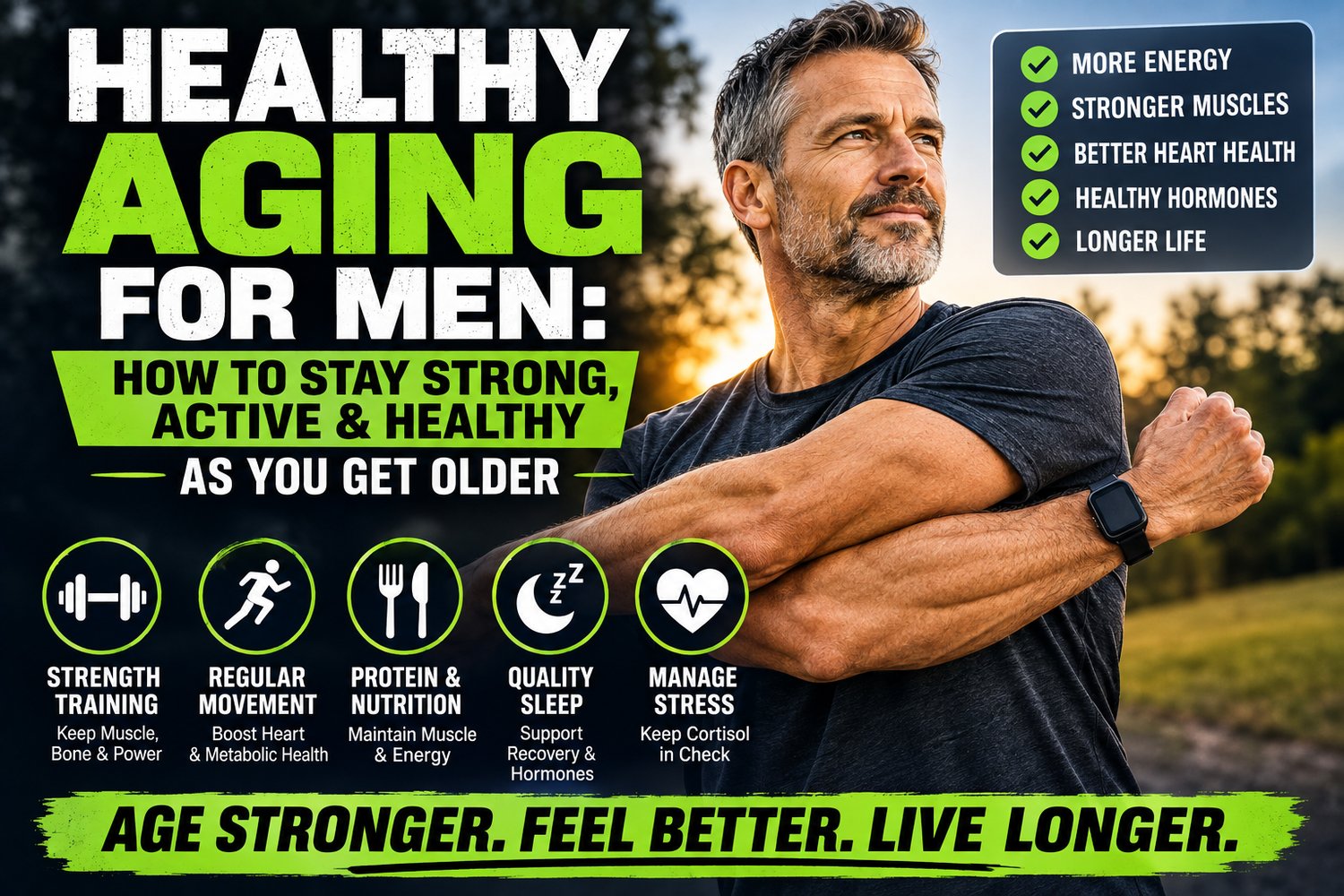
Healthy Aging for Men: How to Stay Strong, Active & Healthy as You Get Older
Healthy aging for men is less about trying to stop aging and more about preserving the physical and metabolic capacity you want to keep using. That means maintaining strength, muscle, cardiovascular fitness, mobility, sleep, metabolic health, sexual health, social connection, and independence as the years pass.
Most men don't suddenly become unhealthy because they turn 40, 50, or 60.
Aging is usually quieter than that.
Activity declines a little.
Strength slips.
The waist expands.
Blood pressure creeps upward.
Sleep becomes less reliable.
Recovery takes longer.
Then one day the things that used to feel effortless aren't quite so effortless anymore.
That's why a useful healthy-aging strategy isn't:
“How do I stay young forever?”
It's:
“How much physical and mental capacity can I preserve while I age?”
That's a much better target.
Healthy Aging Is Really About Healthspan
Living longer matters.
But most men don't simply want more birthdays.
They want to remain able to:
- Carry groceries
- Climb stairs
- Travel
- Work around the house
- Exercise
- Play with children or grandchildren
- Maintain sexual function
- Get off the floor
- Think clearly
- Live independently
That's the idea behind healthspan.
Not merely adding years.
Adding years you can actually use.
1. Treat Muscle and Strength Like Long-Term Assets
You can save money for retirement.
You should also save muscle.
Muscle mass and strength tend to decline with age, especially when physical activity declines.
The goal doesn't need to be bodybuilding.
You need enough muscular reserve to remain capable.
That means resistance training becomes less of an appearance hobby and more of a long-term function strategy.
Think about what strength allows you to do:
- Carry things
- Get up from a chair
- Climb stairs
- Maintain balance
- Protect bone health
- Stay physically independent
- Continue recreational activities
Building and preserving strength now gives you more reserve later.
Strength Train Before You Feel Old
A lot of men postpone this.
At 35:
“I'll worry about that later.”
At 45:
“I'm still doing fine.”
At 55:
“I should probably start exercising again.”
A better strategy is building strength before you desperately need it.
Current physical-activity guidelines recommend muscle-strengthening activity involving the major muscle groups on at least two days per week.
If you're currently inactive, you don't need an extreme program.
Start with basic movements such as:
- Squats or leg presses
- Hip hinges
- Rows
- Presses
- Pulldowns
- Carries
- Appropriate core work
Then progress gradually.
For the practical foundation, read Strength Training for Men Over 30.
If you're already over 40, use Building Muscle After 40.
You Don't Need to Train Like You're 20
Healthy aging doesn't mean becoming afraid of effort.
You can still train hard.
But training intelligently becomes increasingly useful.
Pay attention to:
- Technique
- Previous injuries
- Exercise selection
- Training volume
- Recovery
- Sleep
- Pain patterns
At 22, you might have ignored a sore shoulder for six months.
At 52, repeatedly aggravating it isn't toughness.
It's bad programming.
The goal isn't winning today's workout.
The goal is accumulating years of productive workouts.
2. Keep Walking and Build Cardiovascular Fitness
Walking is simple enough that people underestimate it.
Don't.
Regular walking gives you a relatively low-fatigue way to:
- Increase daily movement
- Accumulate aerobic activity
- Support cardiovascular fitness
- Manage body weight
- Improve blood glucose
- Spend less time sitting
- Support mental health
Current federal guidance recommends at least 150 minutes of moderate-intensity aerobic activity each week for adults, alongside strength training. More activity can provide additional benefit.
Walking can provide a large portion of that aerobic work.
Read Walking for Men's Health.
For a deeper walking strategy, visit the Complete Walking for Weight Loss Guide.
Don't Let Retirement Eliminate Your Movement
This is easy to miss.
A physically active job may give you:
- Thousands of daily steps
- Lifting
- Standing
- Carrying
- General movement
Then retirement happens.
The built-in movement disappears.
Suddenly:
- Steps fall
- Strength falls
- Weight rises
- Fitness declines
If work currently supplies a large portion of your activity, think ahead.
Eventually you may need to deliberately replace it with:
- Walking
- Strength training
- Hiking
- Cycling
- Sports
- Yard work
- Recreation
- Other active hobbies
Retirement shouldn't mean retiring from movement.
3. Balance and Mobility Become More Important With Age
Most men in their 30s don't think about balance.
Eventually, that changes.
Older adults benefit from a combination of:
- Aerobic activity
- Strength training
- Balance work
You don't need an elaborate balance routine at 40.
But movements that preserve:
- Leg strength
- Coordination
- Single-leg stability
- Range of motion
are worth maintaining.
Exercises such as:
- Split squats
- Lunges
- Step-ups
- Carries
- Single-leg exercises
already challenge many of these abilities.
The idea isn't to prepare for frailty.
It's to delay it.
4. Eat Enough Protein to Preserve Muscle
Protein isn't only for bodybuilders.
As you age, preserving muscle becomes more important.
Protein supports:
- Muscle maintenance
- Recovery
- Strength-training adaptations
- Satiety
- Body-composition goals
Useful protein sources include:
- Fish
- Chicken
- Lean meat
- Eggs
- Greek yogurt
- Cottage cheese
- Milk
- Beans
- Lentils
- Tofu
- Tempeh
Your exact needs depend on:
- Body size
- Activity
- Overall calorie intake
- Health status
- Training goals
For a practical men's framework, read Protein for Men.
For meal ideas and broader nutrition guidance, use the Complete High-Protein Guide.
5. Healthy Eating Doesn't Require an Extreme Diet
You don't need to choose a nutritional identity to age well.
You can eat:
- Lower-carb
- Mediterranean-style
- Vegetarian
- Higher-protein
- Another balanced pattern
if it fits your preferences and health needs.
The useful foundation is much simpler.
Build most meals around:
Protein + produce + fiber-rich carbohydrate + healthy fat
That might look like:
- Chicken + vegetables + potatoes + olive oil
- Greek yogurt + fruit + oats + nuts
- Fish + rice + vegetables
- Eggs + whole-grain toast + fruit
- Beans + vegetables + avocado
Consistency matters more than dietary ideology.
The best healthy-aging diet is one you can eat nutritiously for years.
6. Maintain a Sustainable Body Composition
Body weight isn't merely cosmetic.
Excess abdominal fat commonly overlaps with:
- High blood pressure
- Insulin resistance
- Type 2 diabetes
- Abnormal cholesterol
- Sleep apnea
- Cardiovascular risk
You don't need visible abs.
You do want to avoid allowing body composition to drift indefinitely without noticing.
The goal is:
Healthy, strong, metabolically fit, and sustainable.
Read Why Belly Fat Gets Harder to Lose After 30.
Watch Your Waist Trend
The scale gives useful information.
Waist circumference gives different information.
The most useful thing may be the trend.
A gradual increase can happen so slowly that you barely notice it.
Then several years pass.
It's much easier to address:
+2 inches
than:
+8 inches.
You don't need to measure obsessively.
Occasional awareness is enough.
7. Cardiovascular Health Deserves More Attention Than “Optimization”
Men can spend hours discussing:
- Testosterone
- Creatine timing
- Fasting
- Supplements
- Cold plunges
- Peptides
while having no idea what their blood pressure is.
That's backwards.
Cardiovascular health influences:
- Longevity
- Brain health
- Kidney health
- Exercise capacity
- Erectile function
- Independence
At minimum, understand:
- Blood pressure
- Cholesterol
- Blood glucose
- Smoking status
- Family history
- Physical activity
The USPSTF suggests annual hypertension screening for adults 40 and older, as well as younger adults at increased risk.
That's a health metric worth knowing.
Sexual Health Is Part of Cardiovascular Health Too
Erectile function depends partly on:
- Blood vessels
- Nerves
- Hormones
- Metabolic health
- Psychological health
So persistent changes can sometimes provide useful broader health information.
Read Erectile Dysfunction: Causes, Treatment & When to Get Help.
For spontaneous erections specifically, see Morning Erections: What They Can Tell You About Your Health.
Sexual health isn't a separate embarrassing category.
It's part of health.
8. Testosterone Changes With Age—But Aging Isn't a Testosterone Disorder
Testosterone receives enormous attention in men's aging discussions.
Some men genuinely develop testosterone deficiency.
But healthy aging isn't:
“Get testosterone as high as possible.”
It's maintaining function and treating actual disease when it exists.
Symptoms that may justify evaluation include:
- Persistent reduced libido
- Fewer spontaneous erections
- Other compatible sexual symptoms
- Unexplained loss of muscle
- Other signs associated with testosterone deficiency
If those appear, start with Low Testosterone Symptoms.
Then read How Testosterone Is Tested and Diagnosed.
TRT Is Treatment, Not an Anti-Aging Requirement
Testosterone replacement therapy can be appropriate for men with properly diagnosed hypogonadism.
That does not mean every man eventually needs TRT.
Treatment decisions should consider:
- Symptoms
- Repeat testing
- Cause
- Fertility
- Medical history
- Risks
- Benefits
- Monitoring
Read What Is TRT? Testosterone Replacement Therapy Explained.
Healthy aging doesn't mean rejecting medicine.
It means using treatment when there's a legitimate indication.
9. Know Your Basic Health Numbers
You don't need 70 biomarkers.
But you should probably know something about:
- Blood pressure
- Lipids
- Blood glucose
- A1C when appropriate
- Weight
- Waist circumference
- Kidney and liver function when tested
- Other risk-based measures
Testosterone can be added when symptoms make it relevant.
For a full guide, read Blood Work for Men: Key Health Tests, What They Measure & When They Matter.
10. Preventive Healthcare Matters More as You Age
One of the worst men's-health strategies is:
“If something's wrong, I'll know.”
Many health problems develop quietly.
Preventive healthcare may include:
- Blood-pressure screening
- Cholesterol assessment
- Diabetes screening
- Cancer screening
- Vaccinations
- Dental care
- Vision care
- Other age- and risk-appropriate services
You don't need to become anxious about disease.
You do need to stop treating routine healthcare as optional maintenance.
Colorectal Cancer Screening Starts at 45 for Average-Risk Adults
For average-risk adults, current USPSTF guidance recommends colorectal cancer screening beginning at age 45 and continuing through 75. Screening from 76 to 85 becomes more individualized based on health, prior screening, and preferences.
Several screening strategies are available, including:
- Stool-based tests
- Colonoscopy
- CT colonography
- Other recommended approaches
You don't need to wait until symptoms appear.
That's the point of screening.
Prostate Screening Should Be a Conversation
PSA screening is more nuanced.
It's not:
“Every man gets a PSA every year starting at X.”
Whether screening makes sense depends on factors such as:
- Age
- Family history
- Individual risk
- Health status
- Preferences
Discuss the benefits and possible downsides with your healthcare professional.
Preventive care should be individualized.
Dental Care Counts Too
Dental health isn't glamorous.
It still matters.
Routine dental care can help identify and manage:
- Tooth decay
- Gum disease
- Other oral-health problems
If your longevity plan includes:
- Twelve supplements
- A wearable
- Quarterly bloodwork
- A sauna
but you haven't seen a dentist in six years, priorities may be out of order.
Vision and Hearing Matter
Healthy aging isn't only about muscle and bloodwork.
Vision and hearing affect:
- Safety
- Social engagement
- Communication
- Independence
- Quality of life
If they change, get them evaluated.
Don't simply turn the television louder every year and call it aging.
11. Protect Your Sleep
Sleep becomes increasingly valuable when recovery becomes less forgiving.
Poor sleep affects:
- Energy
- Training
- Appetite
- Mood
- Sexual health
- Recovery
- Cardiometabolic health
If you consistently wake exhausted, don't assume:
“This is what being 50 feels like.”
Especially if you:
- Snore loudly
- Gasp during sleep
- Have witnessed breathing pauses
- Experience severe daytime sleepiness
sleep apnea may be worth investigating.
Read Sleep for Men.
12. Don't Smoke
There is no longevity protocol that compensates for smoking.
If you smoke, quitting is one of the highest-value things you can do for long-term health.
Smoking increases risk across multiple systems.
Don't spend enormous energy trying to optimize minor longevity variables while continuing a major known risk.
Fix big problems before tiny ones.
13. Be Reasonable With Alcohol
Alcohol doesn't have to disappear from every person's life.
But pay attention to what it does to you.
As you age, you may notice stronger effects on:
- Sleep
- Blood pressure
- Calories
- Recovery
- Mood
- Training
If a couple drinks consistently destroy your sleep and make the next day worse, that matters.
Your body gets a vote.
14. Maintain Relationships and Social Connection
Healthy aging isn't purely biological.
Social circles sometimes shrink with age.
Work changes.
Children grow.
Friends move.
Relationships drift.
Make an effort to maintain:
- Friendships
- Family relationships
- Shared activities
- Community involvement
You don't need dozens of friends.
You do need meaningful connection.
Healthy aging shouldn't mean slowly disappearing into your recliner.
15. Maintain Purpose
You can have excellent cholesterol and still feel disconnected from life.
Purpose may come from:
- Family
- Work
- Volunteering
- Hobbies
- Learning
- Community
- Projects
- Relationships
You need reasons to keep engaging.
Physical capacity is more useful when you have something you want to use it for.
16. Keep Learning and Doing Difficult Things
Don't decide your development ended when school did.
Learn:
- Technology
- A language
- Music
- Cooking
- A practical skill
- A hobby
- Something related to work
And continue doing things that require effort.
That might mean:
- Hiking
- Lifting
- Traveling
- Taking on projects
- Learning something unfamiliar
- Completing physical challenges
You don't need artificial suffering.
You need enough challenge to keep proving to yourself that you're still capable.
17. Don't Chase Every Longevity Trend
Longevity is now an industry.
So someone will happily sell you:
- Supplements
- Peptides
- Hormones
- Cold therapy
- Red-light therapy
- Elaborate fasting plans
- Expensive diagnostic packages
Some emerging approaches may prove useful.
But they belong on top of the fundamentals.
Before spending thousands of dollars on theoretical longevity gains, ask:
- Do I exercise?
- Do I strength train?
- Do I walk?
- Do I sleep enough?
- Is my body composition reasonable?
- Do I know my blood pressure?
- Do I smoke?
- Am I getting preventive care?
If those aren't handled, start there.
Healthy Aging by Decade
You don't suddenly need a completely different body at each birthday.
But priorities can shift.
Your 40s: Build the Reserve
Your 40s are an excellent time to become deliberate about aging.
Not because you're old.
Because you still have plenty of time to build reserve.
Focus on:
- Building or preserving muscle
- Establishing aerobic fitness
- Maintaining a manageable waist
- Improving sleep
- Learning your basic health numbers
- Addressing bad habits before they become deeply entrenched
- Beginning age-appropriate preventive screening
Think of your 40s as:
Build capacity while you still have plenty of capacity to build.
Your 50s: Protect What You've Built
By your 50s, prevention and consistency become increasingly valuable.
Priorities may include:
- Maintaining strength
- Staying aerobically active
- Preserving mobility
- Managing cardiovascular risk
- Monitoring metabolic health
- Staying current with screening
- Avoiding long periods of inactivity
You don't need to train timidly because you're 55.
You need to train intelligently enough to keep training.
Your 60s and Beyond: Preserve Independence
The priority increasingly becomes:
Keep doing things yourself.
Strength matters.
Balance matters.
Walking matters.
Cardiovascular fitness matters.
Mobility matters.
Social engagement matters.
You don't need to chase personal records forever.
But don't stop challenging your body simply because the calendar changed.
A Simple Healthy Aging Workout Week
You don't need an elaborate longevity program.
Here's one example.
Monday
Strength training
Tuesday
30–45 minute brisk walk or other moderate aerobic activity
Wednesday
Strength training
Thursday
30–45 minute walk, cycling, or similar aerobic activity
Friday
Strength training or lighter full-body resistance work
Saturday
Long recreational walk, hike, bike ride, sport, or active hobby
Sunday
Easy movement and recovery
That combination gives you:
- Resistance training
- Aerobic activity
- Regular movement
- Recovery
Adjust volume and intensity to your fitness, health, and experience.
The important thing is consistency.
A Simple Healthy Aging Plate
Nutrition doesn't need to become complicated either.
At most meals, think:
Protein
Fish, chicken, eggs, yogurt, lean meat, beans, lentils, tofu.
Produce
Vegetables and/or fruit.
Fiber-Rich Carbohydrate
Potatoes, oats, rice, whole grains, beans, fruit.
Healthy Fat
Olive oil, nuts, seeds, avocado, fish.
Then leave room for flexibility.
Consistency beats dietary ideology.
Build a Personal Health Dashboard
You don't need to measure everything.
Track things that can change your decisions.
Regularly
- Weight trend
- Waist circumference
- Strength
- Walking or activity
- Sleep
Periodically
- Blood pressure
As Medically Appropriate
- Lipids
- A1C or glucose
- CBC
- Kidney and liver markers
- Testosterone when indicated
- Preventive screening
The Men's Health & Performance Dashboard combines fitness, energy, body composition, recovery, and health tracking.
The Men's Bloodwork Dashboard focuses specifically on laboratory trends.
Start With a Free Baseline
You don't need a complicated system on day one.
The FREE Men's Hormone & Energy Starter Kit includes tools for tracking:
- Sleep
- Energy
- Strength
- Nutrition
- Habits
- Bloodwork
Use it to establish a baseline.
Then decide what actually needs improvement.
A Simple Healthy Aging Checklist for Men
If you want the entire article reduced to one practical list, aim to be the man who:
- Strength trains every week.
- Gets regular aerobic activity.
- Walks.
- Eats enough protein.
- Eats plenty of minimally processed nutrient-dense food.
- Maintains a manageable waist.
- Sleeps enough.
- Knows his blood pressure.
- Pays attention to cardiovascular and metabolic health.
- Gets appropriate screening.
- Doesn't smoke.
- Avoids excessive alcohol.
- Maintains relationships.
- Keeps learning.
- Keeps doing physically challenging things.
- Deals with health problems instead of ignoring them.
It's not glamorous.
It's extremely difficult to beat.
Frequently Asked Questions
What should men do to age well?
The strongest foundation includes regular physical activity, resistance training, aerobic fitness, adequate sleep, nutritious eating, maintaining a healthy body composition, preventive healthcare, and management of cardiovascular and metabolic risk.
Maintaining social connection, purpose, and independence matters too.
What is the best exercise for men over 50?
There isn't one single best exercise.
A balanced program should include:
- Resistance training
- Aerobic activity
- Regular walking or movement
Balance-focused activity becomes increasingly useful as people age.
Current guidance recommends at least 150 minutes of moderate aerobic activity each week plus muscle-strengthening activity on at least two days.
Can men build muscle after 50?
Yes.
Resistance training remains useful as men age and can help improve or maintain muscle mass, strength, and physical function.
Progress may differ from younger years, but age 50 does not eliminate your ability to respond to training.
How much protein do older men need?
Protein needs vary with:
- Body size
- Activity
- Health
- Calorie intake
- Training goals
Adequate protein becomes particularly useful alongside resistance training when preserving muscle is a priority.
Read Protein for Men.
What health screenings should men get after 40?
There isn't one universal checklist.
Depending on age and risk, preventive care can include:
- Blood-pressure screening
- Cardiovascular-risk assessment
- Diabetes screening
- Colorectal cancer screening beginning at 45 for average-risk adults
- Individualized prostate-screening discussions
- Vaccinations
- Other age- and risk-appropriate preventive care
The USPSTF currently recommends colorectal cancer screening for average-risk adults beginning at age 45.
Should every older man have testosterone tested?
No.
Testosterone testing is generally more useful when symptoms or signs make testosterone deficiency plausible.
Aging alone isn't a reason to diagnose low testosterone or start TRT.
Is losing strength with age inevitable?
Some age-related decline occurs.
But inactivity accelerates it.
Resistance training and regular physical activity can substantially help preserve strength and physical capability.
The question isn't whether aging exists.
It's how much function you can preserve despite it.
Is walking enough for healthy aging?
Walking is excellent, but it doesn't cover everything.
Walking supports:
- Aerobic activity
- Cardiovascular health
- Weight management
- Daily movement
Resistance training adds benefits for muscle and strength that walking alone doesn't fully provide.
A combination is stronger.
Key Takeaways
- Healthy aging is about preserving physical and mental capacity—not trying to stop time.
- Muscle and strength are valuable long-term assets.
- Adults should aim for at least 150 minutes of moderate aerobic activity each week plus muscle-strengthening activity on at least two days.
- Walking is one of the easiest ways to maintain regular activity.
- Adequate protein and nutrient-dense eating support muscle and overall health.
- Sustainable body composition matters more than chasing extreme leanness.
- Cardiovascular health deserves more attention than most men's-health optimization trends.
- Testosterone is one component of men's health, not the definition of healthy aging.
- Preventive care becomes increasingly important with age.
- Average-risk colorectal cancer screening currently begins at 45.
- Blood pressure, cholesterol, glucose, sleep, smoking, and body composition deserve attention.
- Social relationships, purpose, and continued challenge matter alongside physical health.
- The strongest longevity strategy begins with habits you can maintain for decades.
Final Thoughts
You don't need to beat aging.
You're not going to.
The goal is to make aging less expensive physically.
Keep your muscle.
Keep your strength.
Keep walking.
Maintain cardiovascular fitness.
Eat enough protein.
Sleep.
Manage your waist.
Know your blood pressure and basic health risks.
Get appropriate preventive care.
Maintain relationships.
Keep doing things that require you to think and move.
Deal with health problems while they're manageable instead of ignoring them.
That's the version of healthy aging worth pursuing.
Not simply living longer.
Living longer while still being able to use your body and enjoy your life.
Continue the Men's Wellness Series
For the broader foundation:
- Complete Men's Wellness Guide
- What Is Men's Wellness?
- Healthy Habits for Men
- Sleep for Men
- Strength Training for Men Over 30
- Walking for Men's Health
For muscle, nutrition, and body composition:
For testosterone and sexual health:
- Low Testosterone Symptoms
- What Is TRT? Testosterone Replacement Therapy Explained
- Erectile Dysfunction Guide
- Morning Erections
For testing and tracking:
- Blood Work for Men
- HabitLogics Men's Bloodwork Hub
- Men's Bloodwork Dashboard
- Men's Health & Performance Dashboard
- FREE Men's Hormone & Energy Starter Kit
Educational Disclaimer
This article is intended for educational purposes only and should not be considered medical advice. Exercise, nutrition, preventive screening, laboratory testing, medications, and hormone treatment should be individualized based on age, medical history, symptoms, medications, family history, and personal risk. Consult a qualified healthcare professional for individualized preventive care, testing, or treatment.