

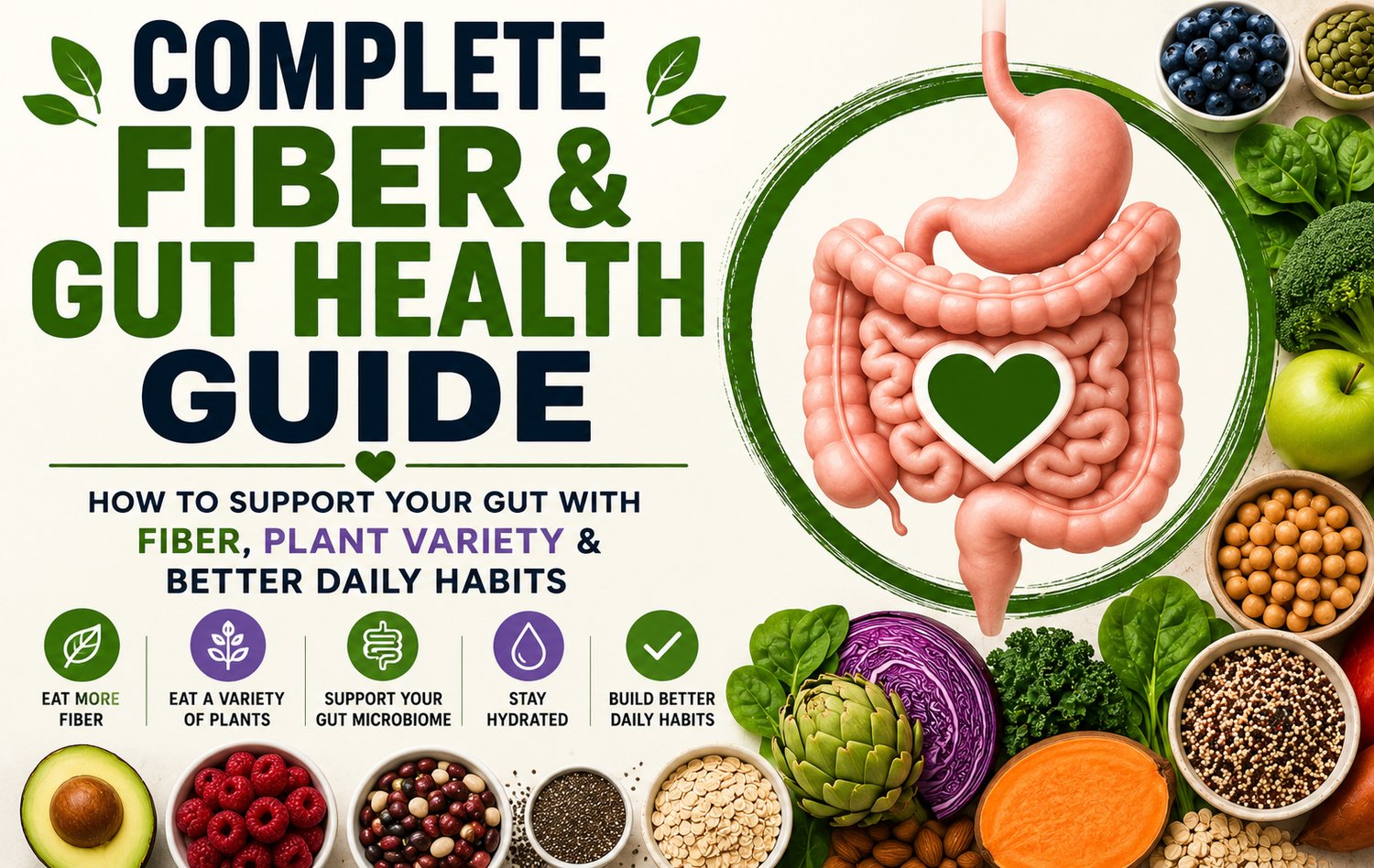
Complete Fiber & Gut Health Guide: How to Support Your Gut With Fiber, Plant Variety & Better Daily Habits
Complete Fiber & Gut Health Guide Hub
Gut health has become one of those topics where something fairly basic has somehow turned into:
microbiome tests + probiotic stacks + greens powders + detoxes + fermented shots + supplements you can't pronounce.
You don't need most of that to start.
The basic strategy is considerably less exciting:
Eat enough fiber.
Eat a variety of plant foods.
Drink enough fluid.
Move your body.
Pay attention to your bowel habits.
Make changes gradually enough that your digestive system can tolerate them.
That's the foundation.
Fiber deserves particular attention because it doesn't just influence stool and bowel regularity. Many fibers interact directly with intestinal microorganisms, which can ferment them and produce metabolites such as short-chain fatty acids. Research also shows that different fibers can affect the microbiota differently—and responses vary substantially between individuals.
That's why this guide exists.
We've spent this entire series breaking gut health into individual pieces.
Now we're putting them together.
Welcome to the HabitLogics Complete Fiber & Gut Health Guide.
Start Here: What Is Gut Health?
“Gut health” isn't a precise score.
You can't look at someone and say:
Congratulations. Your gut is 87% healthy.
In practical terms, we're talking about the normal functioning of your gastrointestinal system and the complex relationship between:
- Digestion
- Bowel function
- The intestinal environment
- The gut microbiota
- Diet
- Lifestyle
- Overall health
If you're completely new to the subject, start with:
What Is Gut Health? A Beginner’s Guide to Your Microbiome, Digestion & Everyday Habits
That article establishes the foundation for everything below.
What Is the Gut Microbiome?
Your digestive tract contains an enormous community of microorganisms.
Collectively, these include:
- Bacteria
- Viruses
- Fungi
- Other microorganisms
The term gut microbiota generally refers to the organisms themselves.
Gut microbiome is often used more broadly when discussing those organisms and their genetic material.
Researchers continue to study how these microbial communities interact with:
- Diet
- Metabolism
- Immune function
- Gastrointestinal health
Diet is one of the major factors influencing this microbial environment, and dietary fiber is particularly interesting because gut microbes can metabolize many fibers.
For the full explanation, read:
What Is the Gut Microbiome? How Your Gut Bacteria Affect Digestion & Health
You Don't Need to “Hack” Your Microbiome
This is worth establishing early.
The goal isn't:
create the perfect microbiome.
Science doesn't currently give us one universally “perfect” microbial composition to pursue.
Individual microbiomes vary.
And individual responses to fiber vary too. Recent research continues to show that the effect of fiber can depend on:
- Fiber type
- Amount
- Duration
- Individual microbial composition
- Health status
So don't turn gut health into another optimization contest.
Build healthy behaviors.
Then pay attention to how your digestive system responds.
The Gut-Health Foundation Is Surprisingly Ordinary
If you want to improve your everyday gut-health habits, start with:
Fiber
Eat enough consistently.
Plant Variety
Don't rely on the same three vegetables forever.
Fluids
Stay adequately hydrated.
Movement
Be physically active.
Sleep
Protect your normal sleep routine.
Bowel Habits
Pay attention to persistent changes.
Symptom Tracking
Track recurring digestive problems instead of guessing.
For a deeper breakdown, read:
How to Improve Gut Health Naturally: 10 Habits That Actually Matter
That's the lifestyle framework behind this entire pillar.
Why Fiber Matters for Gut Health
Fiber is a type of carbohydrate that isn't fully digested by human digestive enzymes.
Different fibers behave differently.
Some:
- Add stool bulk
- Hold water
- Form gels
- Are fermented by gut microbes
- Influence stool consistency
- Affect microbial metabolism
Certain fibers that reach the colon can be metabolized by intestinal microorganisms, producing compounds including:
- Acetate
- Propionate
- Butyrate
These are collectively called short-chain fatty acids, or SCFAs.
Fiber interventions have also been shown to affect specific bacterial populations, although changes in overall microbial diversity aren't nearly as predictable as some gut-health marketing implies.
For the full explanation:
Fiber for Gut Health: Why It Matters & What It Actually Does
How Much Fiber Do You Actually Need?
You don't need to maximize fiber.
You need enough.
Individual recommendations vary by:
- Age
- Sex
- Calorie intake
- Medical circumstances
And your current intake matters too.
Someone currently eating:
12 grams per day
probably shouldn't decide tomorrow morning:
35 GRAMS OR BUST.
A better strategy is:
measure → increase gradually → observe.
For specific intake targets and a practical way to estimate your needs, read:
How Much Fiber Do You Need Per Day? A Practical Guide for Men & Women
Soluble vs. Insoluble Fiber
You'll hear these terms constantly.
They're useful categories, although real foods often contain mixtures of fiber types.
Soluble Fiber
Some soluble fibers dissolve or interact with water and may form gels.
Sources can include:
- Oats
- Beans
- Fruit
- Psyllium
Insoluble Fiber
Insoluble fiber contributes structural bulk.
Sources can include:
- Whole grains
- Wheat bran
- Vegetables
- Nuts
The point isn't to meticulously calculate:
17 grams soluble + 12 grams insoluble.
Eat a variety of fiber-rich foods and you'll naturally consume different types.
For the deeper explanation:
30 Best High-Fiber Foods: Easy Foods to Help You Reach Your Fiber Goal
The Easiest Strategy: Add Before You Subtract
Gut-health advice often becomes restrictive.
Stop eating this.
Eliminate that.
Avoid everything on this list.
For most people trying to improve an ordinary diet, I'd start differently:
What can you add?
Add:
- Berries to breakfast
- Beans to lunch
- Vegetables to dinner
- Fruit to snacks
- Whole grains where they make sense
- Nuts or seeds in reasonable portions
That gives you something productive to do without turning food into a minefield.
Increase Fiber Gradually
This may be the most important practical advice in this entire guide.
Suppose you're eating:
10 grams of fiber per day.
You discover fiber is good for you.
Tomorrow you eat:
- Giant bowl of oatmeal
- Chia
- Raspberries
- Lentil soup
- Two apples
- Huge salad
- Beans
- Fiber bar
- Psyllium
Then by 8 p.m.:
“Fiber DESTROYED my stomach.”
Maybe.
Or maybe you quadrupled your intake in 12 hours.
Give your digestive system time to adjust.
For the complete strategy:
How to Increase Fiber Without Bloating, Gas or Digestive Discomfort
Spread Fiber Across the Day
Instead of:
Breakfast: 2g
Lunch: 4g
Dinner: 29g
try spreading fiber across meals.
For example:
Breakfast
Oatmeal + berries
Lunch
Whole-grain wrap + beans + vegetables
Snack
Apple + almonds
Dinner
Protein + potato + broccoli
Now fiber isn't arriving in one enormous digestive shipment.
Build a High-Fiber Breakfast
Breakfast is one of the easiest places to increase fiber.
Try:
- Oatmeal + berries
- Overnight oats + chia
- Whole-grain toast + fruit
- Yogurt + berries + seeds
- High-fiber cereal + banana
A few small changes can transform a breakfast that contains almost no fiber.
For more:
High-Fiber Breakfast Ideas: 20 Easy Ways to Start Your Day With More Fiber
Use Snacks Strategically
Snacks can either contribute almost nothing to your fiber intake...
or make reaching your daily target much easier.
Try:
- Apple
- Pear
- Berries
- Nuts
- Popcorn
- Vegetables + hummus
- Whole-grain crackers
- Roasted chickpeas
For the full list:
High-Fiber Snacks: 25 Easy Ideas to Help You Reach Your Daily Fiber Goal
Use a Simple High-Fiber Meal Formula
You don't need 400 high-fiber recipes.
Build meals from a repeatable structure:
Protein + fiber-rich carbohydrate + vegetables/fruit + optional fiber booster.
Example:
Chicken + brown rice + black beans + peppers
Or:
Salmon + potato + broccoli
Or:
Greek yogurt + oats + berries + chia
For the full framework:
How to Build a High-Fiber Meal: A Simple Formula for Breakfast, Lunch & Dinner
You Don't Need to Overhaul Your Diet
One reason healthy eating fails is that people change too much simultaneously.
Monday:
Normal diet.
Tuesday:
I AM NOW A GUT-HEALTH PERSON.
Suddenly every meal contains:
- Lentils
- Kale
- Fermented cabbage
- Chia
- Kefir
- Ancient grains
You don't need to eat like an entirely different human being.
Modify foods you already eat.
If dinner is:
tacos
add:
- Beans
- Peppers
- Onion
- Avocado
If breakfast is:
yogurt
add:
- Berries
- Oats
- Chia
For a complete practical plan:
High-Fiber Meal Plan: How to Eat More Fiber Without Overhauling Your Diet
Use the High-Fiber Meal Plan & Recipe System
If you want the planning already organized for you, the High-Fiber Meal Plan & Recipe System includes a structured 28-day approach with:
- Meal planning
- Recipes
- Grocery lists
- Fiber tracking
- Excel dashboard
The goal isn't to eat perfectly for 28 days.
It's to make high-fiber eating easier to repeat.
Plant Variety Is the Next Piece
Once fiber intake is improving, plant diversity becomes an interesting way to broaden the foods you're eating.
Different plants provide different combinations of:
- Fibers
- Resistant carbohydrates
- Polyphenols
- Vitamins
- Minerals
And different fibers can interact differently with gut microorganisms.
That's one reason eating:
30 grams of fiber from varied foods
is a different dietary pattern from getting most of it from one isolated supplement.
What About “30 Plants Per Week”?
You've probably seen this challenge:
Eat 30 different plants every week.
It's a useful behavioral target.
But 30 isn't a magical biological threshold where:
29 plants = bad gut
30 plants = microbiome unlocked.
Treat it as a diversity challenge.
Not a medical prescription.
For the evidence and context behind the idea:
30 Plants Per Week: Does Eating More Plant Variety Improve Gut Health?
What Counts as a Plant?
More than salad.
Think:
Fruits
Apples, berries, bananas, oranges.
Vegetables
Broccoli, carrots, peppers, onions.
Legumes
Beans, lentils, chickpeas.
Whole Grains
Oats, barley, whole wheat.
Nuts
Almonds, walnuts, pistachios.
Seeds
Chia, flax, pumpkin seeds.
Herbs and Spices
These can contribute additional plant variety too.
Suddenly 30 doesn't seem nearly as ridiculous.
Increase Plant Variety Without Making Meals Weird
You don't need:
17-plant superfood Buddha bowls.
Try:
Oatmeal → add berries + chia.
Eggs → add peppers + onion.
Tacos → add beans + corn + avocado.
Yogurt → add fruit + nuts.
Sandwich → add greens + tomato.
Soup → add beans + vegetables.
For dozens of practical ideas:
Track Plant Variety if You Like Challenges
The 30 Plants Per Week Challenge turns plant diversity into something measurable.
That's the value of the number.
Not:
30 is medically perfect.
It's:
Did I eat a wider variety of plants this week than I normally do?
That can be a useful habit challenge.
What If Fiber Makes You Bloated?
This is where many people quit.
They increase fiber.
Then experience:
- Gas
- Fullness
- Bloating
- Abdominal discomfort
And conclude:
My body can't handle fiber.
Sometimes the issue isn't fiber itself.
It may be:
- Too much too quickly
- A specific fiber
- Large portions
- Particular fermentable carbohydrates
- Constipation
- Another digestive condition
Many fibers are fermented by gut microbes, and fermentation can produce gas alongside metabolites such as SCFAs.
So some change in gas production isn't particularly surprising.
For troubleshooting:
Fiber and Bloating: Why Fiber Can Make You Bloated & What to Do About It
Don't Immediately Eliminate Healthy Foods
This pattern happens constantly.
Beans cause bloating once.
No beans.
Bread causes bloating once.
No gluten.
Milk causes bloating once.
No dairy.
Apple causes bloating.
No fruit.
Three weeks later you've built a diet consisting of chicken, rice and anxiety.
Don't do that.
One digestive episode isn't enough information to identify a trigger.
Track patterns first.
Track Bloating Instead of Guessing
Record:
- What you ate
- Portion size
- Time
- Symptom onset
- Severity
- Bowel movements
- Fiber intake
- Relevant context
Then look for repeated associations.
That's much more useful than:
“I think onions hate me.”
For the full system:
Bloating After Eating: How to Track Foods, Symptoms & Possible Triggers
Use a Food & Symptom Tracker When Needed
The Bloating, Digestion & Food Trigger Tracker gives you a structured 30-day system for tracking:
- Meals
- Symptoms
- Bloating
- Digestion
- Bowel habits
- Possible triggers
- Patterns over time
You're not trying to diagnose yourself from a spreadsheet.
You're trying to replace:
guessing
with:
useful observations.
Fiber Can Help Constipation—But More Isn't Always Better
Fiber is commonly recommended for constipation.
And for many people, increasing fiber can help.
But constipation isn't always caused by insufficient fiber.
If you're already eating plenty and you're still constipated?
The answer isn't automatically:
MORE FIBER.
You also need to consider:
- Fluid intake
- Activity
- Medications
- Bowel habits
- Medical conditions
And different fiber supplements aren't interchangeable.
For the complete explanation:
Fiber for Constipation: How Fiber Helps, Best Foods & Why More Isn’t Always Better
Don't Forget Fluids
As fiber increases, adequate fluid intake becomes particularly important.
This doesn't mean:
carry a gallon jug everywhere and drink until your urine achieves enlightenment.
Just don't combine:
dramatically higher fiber
with:
barely drinking anything.
Especially if constipation is already an issue.
Movement Matters Too
Your gut doesn't exist separately from the rest of your body.
Regular physical activity supports overall health and can also be part of a constipation-management strategy.
That can be as simple as:
walking.
You don't need a special gut-health workout.
Prebiotics vs. Probiotics
These two terms get confused constantly.
Here's the simple version:
Probiotics
Live microorganisms intended to provide a health benefit when consumed in adequate amounts.
Prebiotics
Nondigestible substrates that selected microorganisms can use in ways that benefit the host.
NCCIH emphasizes that they're not the same thing and that different probiotics can produce different effects.
For the full breakdown:
Prebiotics vs. Probiotics: What’s the Difference & Which Does Your Gut Need?
Prebiotic Foods Are Probably Already in Your Diet
Examples can include foods containing fermentable fibers such as:
- Garlic
- Onion
- Beans
- Oats
- Whole grains
- Certain fruits and vegetables
You don't necessarily need:
PREBIOTIC SUPER POWDER.
You may simply need to eat more plants.
Probiotics Are More Complicated Than “Good Bacteria”
Specific probiotic microorganisms can have different effects.
Evidence supporting one strain for one purpose doesn't automatically prove:
all probiotics work for everything.
NCCIH notes that although probiotics have shown promise for several uses, researchers often still don't know which probiotics are most helpful, which doses are best or who is most likely to benefit.
That's why:
100 BILLION CFU
isn't automatically better than:
10 BILLION CFU.
Specific evidence matters more than the biggest number on the bottle.
Fermented Food Doesn't Automatically Mean Probiotic
Yogurt.
Kefir.
Sauerkraut.
Kimchi.
Kombucha.
These are fermented foods.
That doesn't automatically mean every product contains a specific probiotic strain proven to produce a particular health benefit.
Fermented foods can absolutely fit into a healthy diet.
Just don't assign them magical powers.
You Probably Don't Need a Giant Gut Supplement Stack
Before spending money on:
- Probiotics
- Prebiotics
- Synbiotics
- Digestive enzymes
- Greens powders
- Fiber powders
- Gut detoxes
- Microbiome cleanses
ask:
Am I consistently eating fruits, vegetables, beans and whole grains?
If the answer is:
not really
that's where I'd start.
The boring foundation usually deserves attention before the expensive extras.
What About Microbiome Tests?
Consumer microbiome tests are interesting.
But be careful about treating a stool analysis like:
your personalized gut-health report card.
Our understanding of what constitutes an optimal microbiome for an individual is still developing.
The science is much stronger for:
eat a nutritious, fiber-rich diet
than:
you need to increase bacterial species X by 14%.
Don't let interesting data create fake precision.
Gut Health Isn't About Having the Most Diverse Microbiome Possible
Another important nuance:
Microbial diversity gets talked about as though:
more diversity = automatically healthier.
That's too simplistic.
A meta-analysis of 64 fiber intervention studies involving more than 2,000 participants found increases in certain bacterial groups and butyrate following fiber interventions, but didn't find a significant increase in alpha diversity overall.
More recent reviews similarly emphasize that fiber's effects on microbial diversity are variable and remain an active area of research.
So don't chase a microbiome diversity score.
Eat well.
Short-Chain Fatty Acids: The Useful Microbial Middlemen
You'll hear these mentioned often.
When intestinal microbes ferment certain fibers, they can produce:
- Acetate
- Propionate
- Butyrate
These short-chain fatty acids can interact with intestinal cells and other physiological systems.
But you don't need to micromanage your:
daily butyrate optimization protocol.
Eat varied sources of fiber.
Your microbes handle the chemistry.
Build Your Gut-Health System Around Habits
This is where HabitLogics comes into the picture.
Knowing that fiber matters isn't difficult.
Actually eating enough fiber on:
Tuesday
Wednesday
Thursday
and then continuing for months?
That's the harder part.
So build systems.
Habit 1: Add One Fiber Source to Breakfast
Examples:
- Berries
- Oats
- Whole-grain toast
- Chia
- Fruit
Do that consistently first.
Habit 2: Add a Plant to Lunch
Sandwich?
Add vegetables.
Rice bowl?
Add beans.
Salad?
Add chickpeas.
You're not rebuilding lunch.
You're upgrading it.
Habit 3: Make One Snack Produce-Based
Instead of trying to redesign every snack:
Pick one.
Apple.
Pear.
Berries.
Carrots + hummus.
Simple.
Habit 4: Add Beans a Few Times Per Week
Beans are one of the easiest ways to increase:
- Fiber
- Plant variety
- Plant protein
Start with smaller servings if you're not used to them.
Habit 5: Rotate Plants
Instead of:
broccoli every night
try:
Monday → broccoli.
Tuesday → carrots.
Wednesday → green beans.
Thursday → peppers.
Friday → Brussels sprouts.
No exotic produce required.
Habit 6: Track Before You Optimize
Before deciding:
I need probiotics
or:
gluten is the problem
or:
fiber doesn't work for me
collect some information.
Track:
- Fiber
- Meals
- Symptoms
- Bowel habits
- Plant variety
Patterns are more useful than assumptions.
Start With the FREE 7-Day Fiber & Gut Health Kickstart
If this guide feels like:
Okay, great. Where do I actually start Monday morning?
use the FREE 7-Day Fiber & Gut Health Kickstart.
It's designed to turn the concepts in this pillar into a simple first week.
Use it to start paying attention to:
- Fiber
- Plant variety
- Daily gut-health habits
without overhauling your entire diet.
Use the Gut Health & Microbiome Tracker for a Longer Experiment
Once you've established a baseline, the Gut Health & Microbiome Tracker | 30-Day Planner + Excel Dashboard gives you a longer framework for tracking:
- Gut-health habits
- Food patterns
- Symptoms
- Progress
- Consistency
The purpose isn't to diagnose your microbiome.
It's to track the behaviors you can actually control.
Track Fiber if That's Your Main Goal
If your biggest issue is simply:
I don't know whether I'm getting enough fiber
use the High-Fiber Meal Builder & 30-Day Fiber Tracker.
Track for a few weeks.
You'll quickly discover whether you're:
consistently getting enough
or:
occasionally having one enormous fiber day surrounded by low-fiber days.
That's actionable information.
A Simple Four-Week Gut-Health Plan
If you want to put this entire guide into practice without changing everything simultaneously:
Week 1 — Measure
Track your normal:
- Fiber intake
- Plant variety
- Bowel habits
- Digestive symptoms
Don't intentionally overhaul anything yet.
Week 2 — Increase Fiber Gradually
Add:
one or two dependable fiber sources each day.
Examples:
- Oats
- Fruit
- Beans
- Vegetables
Keep it manageable.
Week 3 — Increase Plant Variety
Keep your fiber habits.
Now rotate:
- Fruits
- Vegetables
- Beans
- Whole grains
- Nuts
- Seeds
Try some new plants.
Week 4 — Evaluate
Ask:
- Am I getting enough fiber?
- Is intake consistent?
- Am I more bloated?
- Less bloated?
- Are bowel movements comfortable?
- Which foods do I tolerate well?
- Which habits were easiest?
- Which changes actually stuck?
Then keep the useful behaviors.
Drop the unnecessary complexity.
What Gut Health Should Actually Feel Like
Your goal isn't:
perfect digestion every second of every day.
Humans:
- Pass gas
- Get temporarily bloated
- Have occasional bowel changes
- React differently to large meals
That's normal.
The more useful goal is:
generally comfortable digestion and predictable bowel function without persistent symptoms interfering with your life.
If something consistently isn't right?
Investigate it.
When Gut Symptoms Deserve Medical Attention
Dietary changes aren't a substitute for medical evaluation.
Talk with a healthcare professional when digestive symptoms are:
- Persistent
- Severe
- Progressively worsening
- Significantly affecting your daily life
Symptoms such as:
- Blood in stool
- Unexplained weight loss
- Persistent vomiting
- Significant abdominal pain
- Major or persistent changes in bowel habits
shouldn't be treated as a DIY fiber experiment.
And probiotics shouldn't be used to delay appropriate medical care; NCCIH explicitly recommends discussing health problems and probiotic use with a healthcare professional when appropriate.
Frequently Asked Questions
What is the best thing you can do for gut health?
There isn't one magic food.
A strong foundation includes:
- Adequate fiber
- Varied plant foods
- Adequate fluids
- Regular physical activity
- Healthy overall dietary patterns
- Attention to persistent digestive symptoms
Dietary fiber is especially relevant because many fibers interact with the gut microbiota and influence microbial metabolism.
How much fiber do I need?
Fiber needs vary based on factors including age and sex.
Instead of immediately chasing the highest possible intake, determine your approximate target, measure your current intake and increase gradually when necessary.
See:
How Much Fiber Do You Need Per Day? A Practical Guide for Men & Women
Is fiber good for the gut microbiome?
Yes, many dietary fibers interact with intestinal microorganisms and can influence their activity and composition.
However, different fibers produce different effects, and individual responses vary.
What are the best foods for gut health?
Instead of looking for one “best” food, build a varied diet containing:
- Fruits
- Vegetables
- Beans
- Whole grains
- Nuts
- Seeds
These provide different fibers and other nutrients.
Do I need to eat 30 plants every week?
No.
Thirty plants is a useful diversity challenge, not a biological requirement.
The broader principle is:
eat a variety of plant foods.
Why does fiber make me bloated?
Some fibers are fermented by gut microorganisms, which can increase gas production.
Bloating may also occur when fiber intake increases too rapidly or when someone eats large amounts of particular fermentable foods.
Increase gradually and track patterns.
Can fiber help constipation?
Yes, fiber can help many people with constipation.
But constipation has multiple possible causes, and continually increasing fiber isn't appropriate for every situation.
Read:
Fiber for Constipation: How Fiber Helps, Best Foods & Why More Isn’t Always Better
Do I need probiotics for gut health?
Not necessarily.
Different probiotics can have different effects, and evidence supporting one strain for one condition doesn't automatically apply to other probiotics. NCCIH notes that many questions remain about which probiotics are most useful, appropriate doses and who benefits most.
Are prebiotics better than probiotics?
They're different.
Prebiotics provide substrates that selected microorganisms can use.
Probiotics provide live microorganisms intended to produce health benefits.
One isn't universally “better.”
Should I take a fiber supplement?
A supplement can be useful when it's difficult to get enough fiber through food or when a specific fiber is being used for a particular purpose.
But food provides much more than isolated fiber.
Start by examining your overall diet.
How quickly should I increase fiber?
Gradually.
If you're currently eating very little fiber, don't attempt to double or triple your intake overnight.
Give your digestive system time to adapt.
The Complete HabitLogics Fiber & Gut Health Roadmap
If you're working through the pillar from beginning to end, here's the full path:
FOUNDATION
↓
↓
How to Improve Gut Health Naturally
FIBER
↓
↓
↓
↓
How to Increase Fiber Without Bloating
PUT IT INTO PRACTICE
↓
↓
↓
How to Build a High-Fiber Meal
↓
PLANT DIVERSITY
↓
↓
DIGESTIVE TROUBLESHOOTING
↓
↓
↓
MICROBIOME BASICS
↓
That's the entire cluster.
Key Takeaways
- Gut health doesn't require an elaborate supplement routine.
- Your gut contains a complex microbial ecosystem influenced by diet and many other factors.
- Dietary fiber interacts with gut microorganisms and can influence microbial metabolism.
- Different fibers can produce different effects, and responses vary between individuals.
- Eat a variety of fiber sources rather than relying entirely on one food or supplement.
- Fruits, vegetables, legumes, whole grains, nuts and seeds are practical fiber sources.
- Increase fiber gradually.
- Spread fiber across the day.
- Plant diversity is a useful goal, but 30 plants isn't a magical threshold.
- More fiber isn't always better.
- Bloating doesn't automatically mean fiber is bad for you.
- Track recurring symptoms before unnecessarily eliminating foods.
- Constipation isn't always caused by insufficient fiber.
- Prebiotics and probiotics are different.
- Different probiotics can have different effects; more strains or CFUs don't automatically mean better.
- You don't need a “perfect” microbiome.
- Build habits you can maintain.
- Persistent or concerning digestive symptoms deserve medical evaluation.
Final Thoughts
Gut health doesn't need to become another full-time job.
You don't need to wake up wondering:
Did I optimize my microbiome today?
Start much simpler.
Eat more:
plants.
Get enough:
fiber.
Try more:
variety.
Drink enough:
fluid.
Move your:
body.
And pay attention to what happens.
If you're currently eating 10 grams of fiber?
Don't obsess about probiotics.
Work on fiber.
If you're eating five plants per week?
Don't worry about microbiome testing.
Add some variety.
If increasing fiber makes you miserable?
Don't blindly keep increasing it.
Slow down and investigate.
If you're constantly bloated?
Track the pattern.
If constipation persists despite adequate fiber?
Stop assuming another bowl of bran will fix everything.
And if your digestion generally feels good?
You don't need to manufacture a gut-health problem just because the wellness industry has something to sell you.
The best gut-health strategy is probably going to look disappointingly ordinary:
good food + enough fiber + variety + movement + consistency.
And that's exactly the point.
Start Your Gut-Health Plan Free
Not sure where to begin?
Start with the FREE 7-Day Fiber & Gut Health Kickstart.
Use the next seven days to:
- Track your current fiber intake
- Increase plant variety
- Pay attention to digestion
- Build a few repeatable gut-health habits
Then, if you want to keep going, use the Gut Health & Microbiome Tracker, High-Fiber Meal Builder & 30-Day Fiber Tracker, 30 Plants Per Week Challenge, or Bloating, Digestion & Food Trigger Tracker depending on what you're actually trying to improve.
Don't try to optimize everything at once.
Pick one behavior.
Track it.
Build it.
Then add the next one.
That's how this becomes a lifestyle instead of another health kick you abandon in two weeks.
Educational Disclaimer
This guide is intended for educational purposes only and isn't individualized medical or nutrition advice. Digestive symptoms can have many causes, and dietary fiber, probiotics, prebiotics or other dietary changes aren't appropriate for every medical situation. Persistent, severe, progressive or otherwise concerning gastrointestinal symptoms should be evaluated by a qualified healthcare professional.