

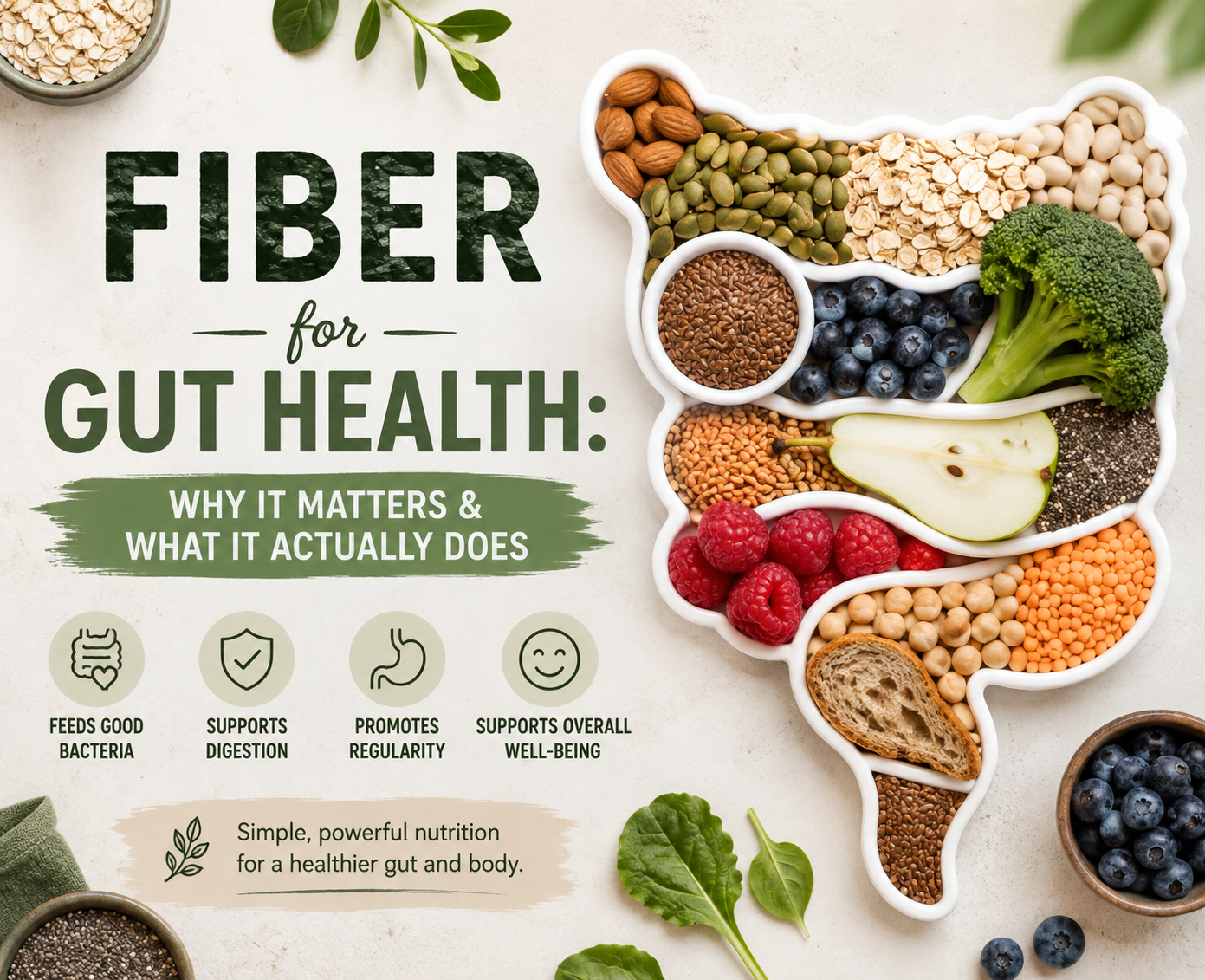
Fiber for Gut Health: Why It Matters & What It Actually Does
Complete Fiber & Gut Health Guide Hub
Fiber has an image problem.
Most people hear the word and think:
Constipation.
Or bran cereal.
Or somebody's grandmother putting fiber powder in a glass of water.
But dietary fiber does considerably more than help you go to the bathroom.
Depending on the type of fiber, it can influence:
- Stool consistency and bowel regularity
- Digestion
- Fullness
- Blood glucose
- Cholesterol
- The gut microbiome
- Production of microbial metabolites such as short-chain fatty acids
The FDA's current Daily Value for dietary fiber is 28 grams per day on a 2,000-calorie diet, and the Nutrition Facts label treats fiber as a nutrient Americans are encouraged to consume more of.
But there's an important catch:
Fiber isn't one thing.
The fiber in oats isn't biologically identical to the fiber in wheat bran.
Beans contain several types.
Fruit contains different combinations.
Some fibers dissolve in water.
Some don't.
Some are readily fermented by gut microbes.
Others primarily affect stool bulk and intestinal movement.
And individual responses can vary.
So the goal isn't:
Eat the biggest fiber number possible.
It's:
Get enough fiber from a variety of foods you tolerate well.
If you're new to the HabitLogics gut-health series, start with What Is Gut Health? A Beginner’s Guide to Your Microbiome, Digestion & Everyday Habits, then read What Is the Gut Microbiome? How Your Gut Bacteria Affect Digestion & Health.
And if you want the practical lifestyle foundation before diving deeper into fiber, read How to Improve Gut Health Naturally: 10 Habits That Actually Matter.
Now let's look at what fiber actually does.
What Is Dietary Fiber?
Fiber is a type of carbohydrate found primarily in plant foods.
Unlike digestible carbohydrates that are broken down into smaller sugars and absorbed, dietary fiber resists digestion to varying degrees as it moves through the gastrointestinal tract.
Major food sources include:
- Beans
- Lentils
- Peas
- Whole grains
- Vegetables
- Fruit
- Nuts
- Seeds
Those foods don't all contain the same fiber.
In fact, most whole plant foods contain mixtures of different fiber types.
That's one reason dietary variety is useful.
Fiber Isn't Just “Roughage”
Historically, people thought of fiber mostly as material that added bulk to stool.
That's still one important role.
But modern research shows that some dietary fibers interact much more directly with the gut microbiome.
Certain fibers can be fermented by intestinal microorganisms.
That fermentation can produce metabolites, including short-chain fatty acids, that interact with the cells and systems of the human body.
So fiber can function through multiple pathways.
Some effects occur because fiber changes the physical properties of food and stool.
Others occur because microorganisms metabolize it.
That's why simply saying:
“Fiber makes you poop.”
is technically true but wildly incomplete.
What Happens to Fiber After You Eat It?
Let's follow a simplified path.
You eat a bowl containing:
- Oats
- Berries
- Chia seeds
Your digestive system breaks down many of the carbohydrates, fats, and proteins.
But some of the fiber resists digestion.
As it moves through the gastrointestinal tract, different fibers may:
- Absorb water
- Form gels
- Add bulk
- Affect how quickly nutrients are absorbed
- Eventually reach the large intestine
Once there, fermentable fibers can become food for certain intestinal microbes.
Those microbes metabolize the material.
And that can produce compounds such as:
- Acetate
- Propionate
- Butyrate
These are major short-chain fatty acids produced by microbial fermentation.
What Are Short-Chain Fatty Acids?
Short-chain fatty acids—often abbreviated SCFAs—are microbial metabolites produced largely through the fermentation of dietary substrates such as fiber.
The major SCFAs include:
- Acetate
- Propionate
- Butyrate
These molecules are extensively studied because they interact with several aspects of human physiology.
Butyrate is especially interesting because cells lining the colon can use it as an energy source.
Research also suggests SCFAs participate in metabolic and immune signaling, although their biology is complex and researchers continue to investigate exactly how these effects translate into human health outcomes.
The practical takeaway is simpler:
Some fiber becomes raw material for microbial metabolism.
That's one major connection between fiber and the gut microbiome.
Not All Fiber Is Fermented the Same Way
This is important.
If all fiber behaved identically, you could simply:
take 28 grams of one fiber powder
and call your diet complete.
But fiber characteristics vary.
Different fibers differ in:
- Solubility
- Fermentability
- Viscosity
- Chemical structure
Systematic reviews in healthy adults show that different fiber interventions can produce different effects on gut microbial composition and short-chain fatty acid production.
That's why a varied diet makes sense.
You don't need to memorize fiber chemistry.
Just avoid relying on one single source for everything.
Soluble Fiber
Soluble fiber generally interacts with water and may form a gel-like material.
Foods containing soluble fiber include things such as:
- Oats
- Barley
- Beans
- Some fruits
- Psyllium
Certain soluble fibers can help slow nutrient absorption and may contribute to improvements in cholesterol or blood-glucose control depending on the specific fiber.
Many soluble fibers are also fermentable.
But:
soluble
and
fermentable
are not exactly the same thing.
Fiber terminology gets messy quickly.
For everyday eating, you don't need to classify every apple molecule.
Eat different fiber-rich foods.
Insoluble Fiber
Insoluble fiber doesn't dissolve in water in the same way.
It can help:
- Add bulk to stool
- Support movement of material through the digestive tract
Common sources include:
- Wheat bran
- Whole grains
- Vegetables
- Nuts
- Seeds
Again, whole foods usually contain mixtures rather than one perfectly isolated type.
Both soluble and insoluble fibers can contribute to a healthy dietary pattern.
Fiber and Bowel Regularity
This is fiber's most famous job.
And yes, it matters.
Adequate fiber can help prevent and treat constipation in many people, which is why NIDDK specifically recommends getting enough fiber as part of constipation management.
Fiber can influence stool in several ways.
Depending on the type, it can:
- Increase stool bulk
- Retain water
- Alter stool consistency
- Influence transit
But here's an important nuance:
Constipation is not always caused by low fiber.
NIDDK lists many possible contributors, including:
- Inadequate fluid intake
- Low physical activity
- Certain medications
- Diabetes
- Hypothyroidism
- Neurological disorders
- Other gastrointestinal problems
So:
Constipated = eat unlimited fiber
is not universally good advice.
Increasing Fiber Too Quickly Can Backfire
Imagine your usual intake is:
10 grams per day.
You decide gut health matters.
Tomorrow you eat:
- Oatmeal
- Chia seeds
- Two apples
- Lentil soup
- Chickpeas
- Broccoli
- Psyllium
Now you're at 40 grams.
Your intestines may have some opinions.
A rapid increase in fermentable material can contribute to:
- Gas
- Bloating
- Fullness
- Changes in bowel habits
NIDDK recommends adding fiber gradually so your body has time to adjust.
This may be one of the most important practical fiber rules:
Increase gradually.
Fiber Can Cause Gas Because Your Microbes Are Doing Something With It
Gas isn't always evidence that a food is bad for you.
When microbes ferment carbohydrates in the colon, gas can be produced as part of that process.
So when you suddenly increase:
- Beans
- Lentils
- Certain vegetables
- Fiber supplements
you may notice more gas.
That doesn't mean you must suffer indefinitely.
It means you may need to adjust:
- Amount
- Frequency
- Fiber type
- Speed of increase
Tolerance matters.
Don't Confuse Temporary Adjustment With a Food Intolerance
You eat beans twice.
You're gassy.
You conclude:
“I can't digest beans.”
Maybe.
But maybe you went from almost no legumes to two cups at dinner.
Those are different scenarios.
A better experiment might be:
Start with:
¼–½ cup.
Eat it several times per week.
See what happens.
Gradually increase.
Food tolerance is often dose-dependent.
And your digestive response today may not always be identical to your response after your diet has changed for several weeks.
Fiber Helps Shape the Gut Microbiome
Diet is one of the major environmental influences on gut microbial communities.
Fiber is especially interesting because certain microorganisms depend heavily on the carbohydrates that reach the colon.
Reviews of human research find that dietary fiber can alter microbiome composition and microbial metabolite production, although effects vary considerably by fiber type and between individuals.
This is where gut-health marketing often jumps too far.
The evidence supports:
Fiber influences the microbiome.
That does not automatically mean:
More fiber creates the perfect microbiome.
There is no single universally established microbial composition everyone should achieve.
Fiber Feeds Different Microbes Differently
Imagine a grocery store.
One person buys:
- Bread
Another:
- Vegetables
Another:
- Meat
Different people use different resources.
Gut microbes are similar in the sense that different organisms can specialize in metabolizing different substrates.
One fiber may encourage activity from one group of microorganisms.
Another fiber may affect a different group.
That's one reason fiber variety can matter.
The gut microbiome is an ecosystem.
Not one pet bacterium you're trying to feed.
This Is Why Eating Different Plants Makes Sense
Consider the difference between:
Diet A
Fiber comes almost entirely from bran cereal.
Diet B
Fiber comes from:
- Oats
- Lentils
- Berries
- Whole grains
- Apples
- Nuts
- Seeds
- Vegetables
- Beans
Both diets may theoretically reach the same fiber number.
But Diet B provides:
- More fiber types
- More phytochemicals
- More vitamins and minerals
- Greater plant diversity
That's one reason a food-based approach usually makes sense as the foundation.
Fiber supplements can fill gaps.
They don't need to replace the diet.
Fiber and Fullness
Protein gets most of the attention for satiety.
Fiber matters too.
Fiber-rich foods often require more chewing, add volume, and may slow digestion depending on the food and fiber type.
This can help meals feel more satisfying.
That doesn't mean fiber automatically causes weight loss.
But it can make a calorie-controlled eating pattern easier to sustain.
This is particularly useful when fiber-rich foods replace lower-fiber foods rather than simply being added on top of everything else.
An Apple and Apple Juice Are Not the Same Thing
Both come from apples.
Nutritionally, they behave differently.
A whole apple contains:
- Fiber
- Water
- Intact food structure
Apple juice has much of the fiber removed.
The whole fruit generally takes longer to eat and provides more physical volume.
This illustrates a bigger point:
Food structure matters.
You aren't only consuming isolated nutrients.
Fiber and Blood Sugar
Certain fibers can influence the rate at which carbohydrates are digested and absorbed.
Viscous soluble fibers are particularly interesting because they can slow movement and nutrient absorption in the gastrointestinal tract.
That can help moderate post-meal blood-glucose responses.
Fiber-rich eating patterns also tend to emphasize foods such as:
- Whole grains
- Legumes
- Vegetables
- Fruit
rather than relying heavily on refined carbohydrates.
Again, the effect depends on the actual food and fiber.
“Fiber” isn't one universal intervention.
Fiber and Cholesterol
Certain soluble fibers can help reduce LDL cholesterol.
This is one reason foods such as:
- Oats
- Barley
- Beans
are frequently associated with heart-healthy eating patterns.
Mayo Clinic notes that soluble fiber can help lower cholesterol and glucose levels.
This is a nice example of why gut health shouldn't be isolated from the rest of health.
A fiber-rich diet may simultaneously support:
- Digestion
- Microbial fermentation
- Cardiovascular health
- Metabolic health
You don't need separate foods for every organ.
Fiber Doesn't Cancel Out the Rest of Your Diet
Here's an easy mistake.
You hit 30 grams of fiber.
Great.
But if the rest of your diet is poorly structured, fiber does not create immunity from:
- Excess calories
- Very high saturated fat
- Inadequate protein
- Poor micronutrient intake
Fiber is one important component of diet quality.
Not the entire diet.
How Much Fiber Do You Need?
The FDA Daily Value is currently 28 grams per day based on a 2,000-calorie diet.
That's a useful benchmark when reading food labels.
For example, the FDA considers:
- 5% Daily Value or less per serving low
- 20% Daily Value or more per serving high
At a 28-gram Daily Value:
3 grams
≈ 11% DV
6 grams
≈ 21% DV
So a food containing 6 grams of fiber per serving is making a meaningful contribution.
Individual needs can vary, however, and certain digestive or medical conditions may require individualized guidance.
You Don't Need to Hit Exactly 28 Grams Every Single Day
Fiber is not a pass/fail test.
Maybe Monday is:
24 grams.
Tuesday:
Wednesday:
That's fine.
Look at your overall dietary pattern.
The point of a target is to help guide your choices.
Not give you anxiety because dinner left you at 27.2 grams.
Start by Measuring Your Current Intake
Before changing your diet dramatically, track a few normal days.
You might discover you're eating:
8–12 grams
Very low.
15–20 grams
Closer, but there's room.
25–30 grams
You're already in a strong range.
40+ grams
You may not need to chase more.
Your next step depends on your baseline.
The FREE 7-Day Fiber & Gut Health Kickstart includes a fiber tracker specifically so you can establish that baseline before trying to optimize anything.
Best Food Sources of Fiber
You have a lot of choices.
Legumes
- Lentils
- Black beans
- Chickpeas
- Kidney beans
- Split peas
Legumes are particularly useful because they also provide protein and micronutrients.
Whole Grains
- Oats
- Barley
- Whole wheat
- Brown rice
- Quinoa
Compare labels because fiber content can vary substantially between products.
Fruit
- Raspberries
- Pears
- Apples
- Oranges
- Bananas
Whole fruit generally provides more fiber than juice.
Vegetables
- Broccoli
- Brussels sprouts
- Carrots
- Peas
- Potatoes
- Sweet potatoes
Yes, potatoes count.
Your microbiome has not banned them.
Nuts and Seeds
- Chia
- Flax
- Almonds
- Pistachios
- Peanuts
- Walnuts
These can add fiber efficiently, but portions matter because nuts and seeds are also calorie-dense.
Mayo Clinic identifies fruits, vegetables, grains, beans, peas and lentils among useful food sources for meeting daily fiber goals.
You Don't Need “Gut Health Foods”
Look at that list again.
Beans.
Oats.
Apples.
Potatoes.
Nuts.
Nothing needs:
GUT HEALTH SUPERFOOD
printed on the package.
Some of the best fiber foods are inexpensive foods people have eaten for generations.
That's good news.
A high-fiber diet does not have to be a premium wellness product.
A High-Fiber Breakfast
Example:
Oatmeal
Fiber from oats.
Berries
More fiber plus plant variety.
Chia seeds
Additional fiber.
Greek yogurt
Protein.
Now you've built:
Protein + fiber + fruit + whole grain
in one meal.
That's much more useful than trying to compensate with fiber powder at 10 p.m.
A High-Fiber Lunch
Try:
- Whole-grain wrap
- Chicken or tofu
- Black beans
- Vegetables
- Avocado
Or:
- Lentil soup
- Whole-grain bread
- Fruit
The goal isn't making meals enormous.
It's making fiber a normal component.
A High-Fiber Dinner
Try:
- Salmon
- Potato
- Broccoli
- Side of lentils
Or:
- Chicken
- Brown rice
- Black beans
- Peppers
- Corn
- Salsa
You don't need to eat salads forever.
Fiber comes in many forms.
Fiber Supplements Can Be Useful
Let's not swing too far toward:
Food good. Supplements bad.
Fiber supplements have legitimate uses.
Examples include products based on:
- Psyllium
- Wheat dextrin
- Inulin
- Other isolated fibers
A supplement can be useful when:
- You struggle to reach your target through food.
- A clinician recommends a specific fiber.
- You want a consistent supplemental source.
But different fiber supplements behave differently.
So don't assume all powders are interchangeable.
Psyllium Is Not the Same as Inulin
This is a good example.
Psyllium is highly viscous and can help with stool consistency and cholesterol.
Inulin is highly fermentable and often marketed for prebiotic effects.
Those are different properties.
Someone may tolerate psyllium very well and experience substantial gas with a large dose of inulin.
That doesn't mean:
Fiber supplements don't work.
It means:
Which fiber?
matters.
Fiber Powder Doesn't Replace Plant Variety
Suppose you consume:
28 grams of supplemental fiber
and essentially no:
- Fruit
- Vegetables
- Whole grains
- Legumes
You've hit a fiber number.
You haven't recreated the nutritional profile of a varied diet.
Whole plant foods also provide:
- Vitamins
- Minerals
- Polyphenols
- Different fiber types
- Other bioactive compounds
Supplements can fill gaps.
Food builds the foundation.
What About Prebiotic Fiber?
Certain fibers can function as prebiotics, meaning they are selectively used by microorganisms in a way that confers a health benefit.
This is why you'll see ingredients such as:
- Inulin
- Fructooligosaccharides
- Galactooligosaccharides
marketed in gut-health products.
Prebiotic fiber can be useful.
But:
fiber
and
prebiotic
aren't interchangeable terms.
Not every fiber is classified as a prebiotic.
We'll unpack that distinction later in the series when we cover prebiotics and probiotics.
What If Fiber Makes You Bloated?
Don't immediately abandon fiber.
First look at:
- How quickly you increased it
- Which foods you added
- Portion sizes
- Your total intake
- Whether constipation is already present
If you went from:
little fiber → enormous fiber intake
reduce the jump.
Build gradually.
If one specific food repeatedly causes substantial symptoms even in smaller amounts, track it.
The Bloating, Digestion & Food Trigger Tracker can help organize:
- Meals
- Fiber intake
- Timing
- Bloating
- Gas
- Bowel habits
- Other symptoms
The goal isn't diagnosing yourself.
It's identifying reproducible patterns.
What If Fiber Makes Constipation Worse?
This can happen in certain circumstances.
For example, adding large amounts of fiber without adequate fluid—or adding fiber to a situation where another medical cause is driving constipation—may not solve the problem.
NIDDK notes that constipation has numerous potential causes beyond low fiber, including dehydration, inadequate activity, medications, metabolic problems, and neurological disorders.
If constipation is:
- Persistent
- Severe
- New and unexplained
don't keep escalating fiber indefinitely.
Get the underlying problem evaluated.
Fiber and IBS
People with irritable bowel syndrome may need more individualized fiber guidance.
Some fibers may be better tolerated than others.
Highly fermentable carbohydrates can worsen symptoms in some people.
This is why:
Everyone with gut problems needs more fiber
is too broad.
Fiber is important.
Individual digestive conditions still matter.
If you have diagnosed IBS or another GI condition, follow guidance appropriate to that condition rather than generic wellness advice.
Fiber and Inflammatory Bowel Disease
Crohn's disease and ulcerative colitis are medical conditions requiring individualized care.
People with inflammatory bowel disease may receive different dietary guidance depending on:
- Disease location
- Symptoms
- Whether disease is active
- Complications
This is not the place to experiment with an extreme fiber challenge because somebody said fiber is good for the microbiome.
Medical conditions change the equation.
Fiber and Diverticular Disease
Fiber has long been discussed in relation to diverticular disease.
Current dietary recommendations often emphasize overall dietary quality and fiber, but management can depend on the person's condition and whether acute symptoms are present.
Again:
General gut-health advice is not a substitute for individualized medical treatment.
Don't Let Fiber Become Another Restrictive Food Rule
There's an ironic way to make gut-health eating unhealthy.
You start saying:
This only has 2 grams.
This isn't high fiber.
I can't eat white rice.
I can't eat low-fiber food.
That's unnecessary.
Your total diet matters.
You can eat:
- White rice
- Sourdough
- Yogurt
- Eggs
- Fish
even though those foods aren't major fiber sources.
Just make sure other foods in the diet provide fiber.
Every ingredient does not need to perform every nutritional job.
Combine Fiber With Protein
This is one of the easiest ways to build satisfying meals.
Examples:
Greek yogurt + berries + chia
Protein + fiber.
Eggs + whole-grain toast + fruit
Protein + fiber.
Chicken + beans + vegetables
Protein + fiber.
Lentils + Greek yogurt sauce
Plant protein + fiber.
If you already use the HabitLogics high-protein content, this is where the two nutritional strategies fit together nicely:
Protein helps build the meal. Fiber helps round it out.
How to Increase Fiber Without Overhauling Your Diet
You don't need a completely new menu.
Make small swaps.
Instead of:
Plain cereal
Try:
Higher-fiber cereal + berries.
Instead of:
White bread every time
Try:
Whole-grain bread sometimes.
Instead of:
Meat-only taco filling
Try:
Meat + black beans.
Instead of:
Chips every afternoon
Sometimes use:
Fruit + nuts.
Instead of:
Rice alone
Try:
Rice + beans + vegetables.
Tiny changes accumulate.
Add Before You Subtract
This is one of the best nutrition strategies for fiber.
Instead of asking:
“What should I eliminate?”
ask:
“What fiber-rich food can I add?”
Add berries.
Add beans.
Add vegetables.
Add oats.
Add seeds.
This often improves diet quality without creating an unnecessarily restrictive food plan.
A Practical Fiber Progression
If your current intake is low, try this.
Week 1
Add one fruit daily.
Week 2
Add one whole-grain serving.
Week 3
Add beans or lentils 3 times.
Week 4
Increase vegetables.
Week 5
Add nuts or seeds.
Then reassess.
You may be surprised how quickly fiber rises without needing to calculate every gram forever.
Track Fiber for 30 Days if Consistency Is the Problem
Some people know exactly what they're supposed to eat.
The problem is actually doing it.
That's where tracking becomes useful.
The High-Fiber Meal Builder & 30-Day Fiber Tracker is built specifically around:
- Daily fiber goals
- Meal planning
- Building fiber-rich meals
- Tracking progress over time
It gives you a structured way to turn:
“I should probably eat more fiber.”
into:
“Here's what I'm actually doing each day.”
Want a Simpler Starting Point?
Use the FREE 7-Day Fiber & Gut Health Kickstart.
Start by tracking what you normally eat.
Then make a few small changes.
You don't need to transform your diet in one week.
You're building a baseline.
Frequently Asked Questions
Why is fiber good for gut health?
Fiber supports several aspects of digestive health.
Certain fibers add stool bulk or influence stool consistency, while others can be fermented by gut microorganisms and converted into metabolites such as short-chain fatty acids.
Different fibers can produce different effects.
Does fiber feed gut bacteria?
Some types do.
Certain fermentable fibers reach the large intestine, where gut microorganisms can metabolize them. This can influence microbial composition and produce compounds such as acetate, propionate, and butyrate.
How much fiber should you eat per day?
The FDA Daily Value is 28 grams per day based on a 2,000-calorie diet.
Individual needs can vary based on calorie intake, medical conditions, and tolerance.
Can too much fiber be bad?
A very rapid or excessive increase can cause:
- Bloating
- Gas
- Fullness
- Changes in bowel habits
especially when someone is accustomed to a low-fiber diet.
NIDDK recommends adding fiber gradually so your body can adjust.
What is the best fiber for gut bacteria?
There isn't one universally best fiber.
Different fibers have different chemical and fermentability characteristics and may produce different microbial responses. Human research shows considerable variation depending on fiber type and the individual consuming it.
A varied food-based fiber intake is a sensible foundation.
Is soluble or insoluble fiber better?
Neither is universally better.
They perform somewhat different functions, and most whole plant foods contain a mixture of fiber types.
Eating a variety of fiber-rich foods makes the distinction much less important for everyday meal planning.
Is fiber powder as good as food?
Fiber supplements can be useful, but whole foods also provide:
- Vitamins
- Minerals
- Other fiber types
- Polyphenols
- Additional nutrients
Use supplements as a tool rather than assuming they make plant foods unnecessary.
Can fiber help constipation?
Adequate dietary fiber can help prevent and treat constipation for many people, which is why NIDDK recommends getting enough fiber and increasing it gradually.
Persistent constipation may have other causes and should not automatically be treated with ever-increasing amounts of fiber.
Key Takeaways
- Fiber is more than “roughage.”
- Dietary fiber includes many different compounds with different physical and biological effects.
- Some fibers help influence stool bulk and bowel regularity.
- Other fibers can be fermented by gut microorganisms.
- Microbial fiber fermentation can produce short-chain fatty acids such as acetate, propionate, and butyrate.
- Different fiber types can produce different microbiome and metabolic responses.
- The FDA Daily Value for dietary fiber is 28 grams per day on a 2,000-calorie diet.
- Whole grains, legumes, fruit, vegetables, nuts, and seeds are useful fiber sources.
- Fiber can support bowel regularity, fullness, blood-glucose management, and cholesterol depending on the type and overall diet.
- Increasing fiber too quickly can cause bloating and gas.
- NIDDK recommends adding fiber gradually to allow your digestive system to adapt.
- Fiber supplements can be useful but do not replace the nutritional variety of whole foods.
- More fiber is not automatically better; adequacy, variety, and tolerance matter.
Final Thoughts
Fiber is probably one of the least glamorous nutritional tools available.
That's part of what makes it so useful.
It doesn't need a complicated protocol.
It doesn't require a proprietary supplement.
And it doesn't need to become another wellness obsession.
Eat beans.
Eat whole grains.
Eat fruit.
Eat vegetables.
Eat nuts and seeds.
Mix them up.
Increase gradually.
Pay attention to how your digestive system responds.
And stop treating fiber as something you only think about when you're constipated.
Fiber connects:
Food → digestion → bowel function → gut microbes → microbial metabolites → broader health.
That's why it's going to sit at the center of this entire HabitLogics gut-health pillar.
Continue the Fiber & Gut Health Series
Already published:
- What Is Gut Health? A Beginner’s Guide to Your Microbiome, Digestion & Everyday Habits
- What Is the Gut Microbiome? How Your Gut Bacteria Affect Digestion & Health
- How to Improve Gut Health Naturally: 10 Habits That Actually Matter
Coming next in the series:
How Much Fiber Do You Need Per Day? A Practical Guide for Men & Women
Then we'll move into:
Soluble vs. Insoluble Fiber
Best High-Fiber Foods
How to Increase Fiber Without Bloating
Useful HabitLogics resources:
- FREE 7-Day Fiber & Gut Health Kickstart
- High-Fiber Meal Builder & 30-Day Fiber Tracker
- Gut Health & Microbiome Tracker | 30-Day Planner + Excel Dashboard
Educational Disclaimer
This article is intended for educational purposes only and should not be considered medical or individualized nutrition advice. Fiber needs and tolerance vary, particularly in people with gastrointestinal disorders or other medical conditions. Persistent constipation, diarrhea, abdominal pain, bleeding, unexplained weight loss, or other concerning digestive symptoms should be evaluated by a qualified healthcare professional.