

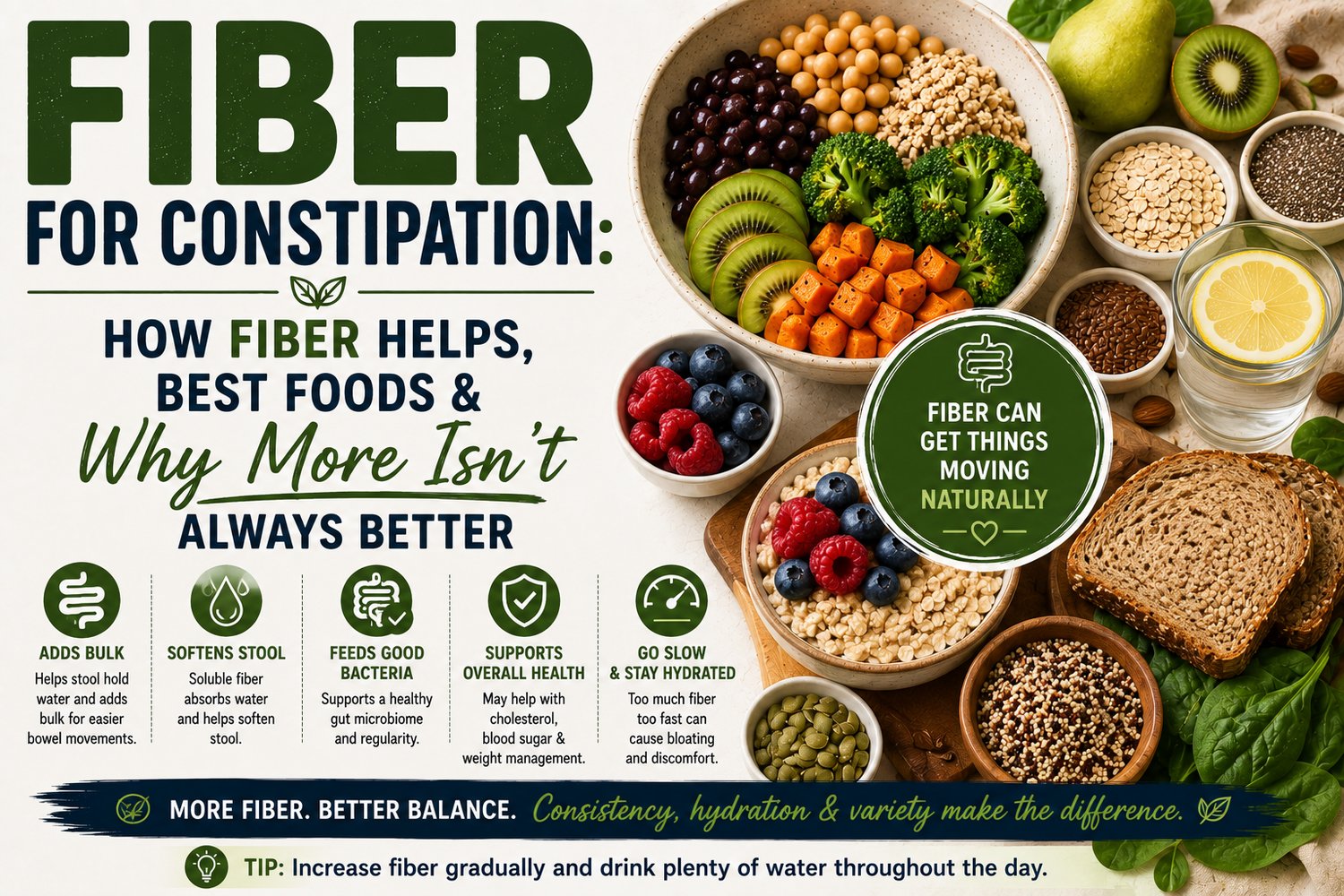
Fiber for Constipation: How Fiber Helps, Best Foods & Why More Isn’t Always Better
Complete Fiber & Gut Health Guide Hub
Constipated?
The standard advice is usually:
Eat more fiber.
And sometimes, that's exactly what you need.
But not always.
Constipation can have many causes, and simply piling more fiber onto the problem isn't guaranteed to fix it.
NIDDK defines constipation as having symptoms such as:
- Fewer than three bowel movements per week
- Hard, dry or lumpy stools
- Difficulty or pain passing stool
- Feeling like stool hasn't completely passed
Low fiber intake can contribute to constipation, but so can:
- Inadequate fluids
- Low physical activity
- Certain medications
- Diabetes
- Hypothyroidism
- Neurologic conditions
- Other gastrointestinal problems
So the useful question isn't simply:
“Do I need more fiber?”
It's:
“Is low fiber likely contributing to my constipation, and what type and amount can I actually tolerate?”
If you've been dealing with bloating alongside constipation, also read Bloating After Eating: How to Track Foods, Symptoms & Possible Triggers.
Now let's sort out what fiber can—and can't—do.
How Fiber Can Help Constipation
Fiber can influence stool in several ways.
Depending on the type, it can:
- Increase stool bulk
- Help stool retain water
- Improve stool consistency
- Support movement through the digestive tract
NIDDK recommends eating more high-fiber foods as one of the basic dietary strategies for relieving constipation.
But fiber isn't one single substance.
Different fibers behave differently.
That's why:
“Just eat fiber”
is less useful than:
“Choose an appropriate fiber source and increase it gradually.”
Soluble and Insoluble Fiber Work Differently
A simple way to think about the two major categories:
Soluble Fiber
Interacts with water and may form a gel.
Examples include fibers found in:
- Oats
- Beans
- Fruit
- Psyllium
Insoluble Fiber
Adds structural bulk.
Common sources include:
- Whole grains
- Wheat bran
- Vegetables
- Nuts
Both can contribute to bowel function.
But they don't necessarily produce the same effect in every person.
Psyllium Is One of the Best-Studied Fiber Supplements
If we're talking specifically about supplemental fiber for chronic constipation, psyllium deserves attention.
The joint American Gastroenterological Association/American College of Gastroenterology guideline suggests fiber supplementation for adults with chronic idiopathic constipation, particularly when dietary fiber intake is low. Among the fiber supplements evaluated, psyllium had the clearest evidence of benefit, while evidence for bran and inulin was much more limited.
A systematic review of randomized trials also found that fiber supplementation improved chronic constipation, with psyllium showing particularly favorable results.
That doesn't mean everyone with constipation needs psyllium.
It means if you're considering a fiber supplement, the type matters.
Psyllium Works Differently From Many Fermentable Fibers
Psyllium is:
- Soluble
- Gel-forming
- Viscous
It absorbs water and can help normalize stool consistency.
That's useful because the goal isn't simply:
make stool bigger.
You want stool that's:
- Soft enough to pass comfortably
- Formed enough to move normally
This is part of why psyllium has become one of the most commonly recommended fiber supplements for constipation.
More Fiber Isn't Always Better
This is where constipation advice often gets oversimplified.
Suppose you're constipated and currently eating:
25–30 grams of fiber per day.
Adding another:
20 grams
doesn't automatically solve the problem.
In some people, increasing fiber aggressively can worsen:
- Bloating
- Gas
- Fullness
- Abdominal discomfort
The AGA/ACG guideline specifically notes that flatulence is a commonly observed side effect of fiber supplementation.
So your goal isn't:
maximum fiber.
It's:
enough fiber, from a type you tolerate, alongside adequate fluid and appropriate overall management.
First: Find Out How Much Fiber You're Already Eating
Before adding a supplement, track your normal intake for a few days.
You might discover:
10–12 grams per day
Low.
More fiber may be a reasonable first step.
20–25 grams
Closer to a useful range.
You may benefit from a modest increase.
30+ grams
You're already eating plenty.
The problem may not be simple fiber deficiency.
NIDDK states that adults generally need about 22–34 grams of fiber per day, depending on age and sex.
That's a much better starting point than automatically taking a large supplement.
Don't Double Your Fiber Overnight
If you're eating:
12 grams
don't immediately jump to:
35 grams.
That can produce:
- Gas
- Bloating
- Cramping
especially if you add large amounts of:
- Beans
- Bran
- Chia
- Fiber supplements
NIDDK recommends adding fiber gradually rather than making a sudden large increase.
Your digestive system needs time to adjust.
Fiber and Water Work Together
This matters a lot.
NIDDK recommends drinking plenty of water and other liquids when increasing dietary fiber or using a fiber supplement because fluids can help make stools softer and easier to pass.
The AGA/ACG constipation guideline similarly recommends adequate hydration when fiber supplements are used.
That doesn't mean:
fiber requires a gallon of water.
It means:
don't dramatically increase fiber while barely drinking anything.
More Water Isn't Always the Whole Solution Either
If you're adequately hydrated, drinking enormous additional amounts of water isn't guaranteed to cure constipation.
Fluid intake matters most when:
- You're dehydrated
- You're increasing fiber
- Your stool is hard and dry
But constipation can still persist despite adequate water and fiber.
That's when it's time to look beyond:
“eat bran and drink water.”
Best High-Fiber Foods for Constipation
You don't need a special constipation diet.
Start with ordinary fiber-rich foods.
NIDDK recommends fiber sources including:
- Whole grains
- Legumes
- Fruits
- Vegetables
- Nuts
Let's make that practical.
Oats
Oatmeal is an easy way to add fiber without dramatically increasing meal size.
Try:
- Oatmeal + berries
- Overnight oats
- Oats + chia
- Oats + ground flax
If you're currently low in fiber, don't pile every fiber booster into one bowl immediately.
Start simple.
Beans and Lentils
Legumes can add a lot of fiber quickly.
Examples:
- Black beans
- Chickpeas
- Kidney beans
- Lentils
They're useful because they also provide plant protein.
But if beans make you extremely bloated?
Start with smaller portions.
A food doesn't need to be eaten in a huge amount to help.
Berries
Berries can be an easy fiber addition.
Use:
- Raspberries
- Blackberries
- Blueberries
with:
- Oatmeal
- Yogurt
- Cereal
Fruit often requires less preparation than adding another cooked vegetable.
That's useful when you're trying to build a sustainable routine.
Apples and Pears
Whole apples and pears can contribute meaningful fiber, especially with the edible skin.
They're also easy:
Wash.
Eat.
Done.
You don't need a constipation-specific snack product.
Vegetables
Useful options include:
- Broccoli
- Carrots
- Green peas
- Leafy greens
NIDDK specifically includes vegetables such as carrots, broccoli, green peas and collard greens among good fiber sources.
If large raw portions make you bloated, cooked vegetables still count.
Whole Grains
Try:
- Whole-grain bread
- Oatmeal
- Whole-grain pasta
- Barley
- Brown rice
Replacing some refined grains with higher-fiber options can increase intake without completely changing the meal.
Nuts and Seeds
Useful additions include:
- Almonds
- Chia
- Flax
They're easy to add to:
- Oatmeal
- Yogurt
- Snacks
But remember:
Nuts and seeds are calorie-dense.
Use them as fiber boosters, not unlimited snacks.
What About Prunes?
Prunes have a long reputation for helping constipation.
And there is actually evidence behind it.
A randomized trial found that dried plums improved stool frequency and consistency in people with mild-to-moderate constipation and performed better than psyllium in that study.
A systematic review later concluded that prunes appear promising for improving stool frequency and consistency, while also noting that the evidence base remained limited.
So yes:
Prunes can be a reasonable food-based option.
Just don't assume:
more prunes = better.
They can also cause:
- Gas
- Cramping
- Loose stool
in larger amounts.
Start With a Modest Amount of Prunes
Instead of eating half a bag because you're constipated:
Try a modest serving.
Then see what happens.
You're trying to improve stool consistency.
Not launch an intestinal emergency.
Kiwi Is Another Food Worth Considering
Kiwi is increasingly studied for bowel function because it provides:
- Fiber
- Water
- Other naturally occurring compounds
You don't need it specifically.
But if you like kiwi, it can be another fruit in your fiber rotation.
Variety helps you avoid relying on one food for everything.
Does Coffee Help Constipation?
Coffee can stimulate bowel activity in some people.
That doesn't make coffee a formal constipation treatment for everyone.
If your normal morning coffee reliably helps you have a bowel movement?
Fine.
You don't need to stop.
But drinking increasingly larger amounts isn't a substitute for addressing chronic constipation appropriately.
Does Exercise Help?
Physical activity is another piece of the picture.
NIDDK includes regular physical activity among lifestyle approaches that may help relieve or prevent constipation.
That doesn't mean you need an intense workout.
Walking counts.
If you're sedentary, try:
- Regular daily walking
- Short walks after meals
- More movement throughout the day
Your digestive tract is part of a moving body.
Don't Ignore the Urge to Go
Bowel habits matter too.
Repeatedly delaying a bowel movement can make stool harder and more difficult to pass.
If you regularly ignore the urge because you're:
- Busy
- At work
- Traveling
- Uncomfortable using public bathrooms
that pattern may contribute.
This is one of those unglamorous factors that matters more than another supplement.
Build a Regular Bathroom Routine
NIDDK notes that bowel training can sometimes help constipation, including trying to have a bowel movement at the same time each day.
For some people, the natural gastrocolic reflex after breakfast makes morning a good time to try.
Don't force it.
But giving yourself:
- Time
- Privacy
- A consistent routine
can help.
Don't Spend 20 Minutes Straining
Constipation isn't a strength-training session.
Prolonged straining isn't ideal.
If you're repeatedly spending long periods trying to force bowel movements, that's another sign the underlying constipation deserves attention.
Fiber may be part of the solution.
It may not be the whole solution.
What If Fiber Makes Constipation Worse?
This deserves special attention because people are often confused when it happens.
You follow the advice.
You add fiber.
And now you feel:
- More bloated
- More full
- Still constipated
Possible reasons include:
- You increased it too quickly
- You're not drinking enough
- You're eating a fiber type you don't tolerate well
- Constipation has another underlying cause
Don't respond by automatically adding even more fiber.
Step back and reassess.
If You're Already Eating Plenty of Fiber, Stop Chasing the Number
This is one of the most useful rules in the article.
If you're already consistently around:
25–35 grams per day
and you're constipated?
The answer may not be:
45 grams.
Look at:
- Fluids
- Activity
- Medications
- Bowel habits
- Underlying conditions
- Whether a different constipation treatment is appropriate
The AGA/ACG guideline notes that fiber supplementation is particularly relevant for people with low dietary fiber intake, which is an important distinction.
Some Medications Can Cause Constipation
Constipation isn't always dietary.
Medications that can contribute include certain:
- Pain medicines
- Iron supplements
- Anticholinergic medications
- Some blood pressure drugs
- Other medications
NIDDK identifies medication effects among common causes of constipation.
Do not stop a prescribed medication on your own.
If constipation began after starting or changing one, discuss it with the clinician or pharmacist involved.
Iron Supplements Are a Common Example
Iron can cause:
- Constipation
- Dark stool
- Digestive discomfort
If iron seems to be contributing, talk with your healthcare professional.
Don't simply stop taking it if it was prescribed for deficiency.
There may be other formulations or strategies available.
GLP-1 Medications Can Also Affect Bowel Habits
Medications that slow gastrointestinal motility can sometimes contribute to constipation.
If your constipation began after starting or increasing a medication, track the timing.
That's useful information for the clinician managing it.
Again:
Medication-related constipation isn't necessarily solved by indefinitely increasing fiber.
Constipation Can Have Medical Causes
NIDDK lists several conditions associated with constipation, including:
- Diabetes
- Hypothyroidism
- Celiac disease
- Neurologic conditions
- Inflammation
- Structural problems involving the colon or rectum
That's why persistent constipation deserves more attention than:
“Eat another bowl of bran.”
Chronic Constipation Is Different From an Occasional Bad Week
Travel.
Stress.
Diet change.
Dehydration.
Routine changes.
These can produce temporary constipation.
But if you're repeatedly dealing with constipation for weeks or months?
That's a different situation.
It may meet criteria for chronic constipation and deserve professional evaluation.
What If Fiber Isn't Enough?
This is important:
There are effective constipation treatments beyond dietary fiber.
The AGA/ACG guideline strongly recommends polyethylene glycol (PEG) for chronic idiopathic constipation based on moderate-certainty evidence and provides recommendations for several other over-the-counter and prescription options.
That doesn't mean you should immediately self-treat with multiple laxatives.
It means:
fiber is not the only legitimate treatment.
If lifestyle strategies aren't working, talk with a healthcare professional.
Fiber Is Not a Test of Willpower
Some people keep escalating fiber because they think:
“I should be able to fix this naturally.”
There is no prize for refusing appropriate treatment.
If you need:
- An osmotic laxative
- Another medication
- Evaluation for an underlying condition
that's not failure.
Constipation is a medical problem when it becomes persistent or significant.
Treat it like one.
A Simple Food-First Constipation Plan
If your constipation is mild, recent and you don't have concerning symptoms, a basic approach might look like this:
Step 1: Measure Your Fiber
Track several normal days.
Step 2: Increase Gradually if You're Low
Add:
- Fruit
- Oats
- Beans
- Vegetables
- Whole grains
Step 3: Drink Adequate Fluids
Especially as fiber increases.
Step 4: Move Daily
Walking is fine.
Step 5: Give Yourself Bathroom Time
Don't constantly ignore the urge.
Step 6: Track the Response
Look at:
- Stool frequency
- Stool consistency
- Straining
- Bloating
If the plan isn't helping?
Don't keep escalating forever.
Example Day for More Fiber
Breakfast
Oatmeal + berries
Lunch
Chicken + rice + black beans + vegetables
Snack
Pear + almonds
Dinner
Salmon + potato + broccoli
This gives you fiber spread throughout the day rather than one enormous dose.
If you're currently low in fiber, you can build toward this gradually.
Another Constipation-Friendly Pattern
Breakfast
Whole-grain toast + eggs + fruit
Lunch
Lentil soup
Snack
Prunes + Greek yogurt
Dinner
Chicken + brown rice + cooked vegetables
Again:
Nothing exotic.
The goal is consistent dietary fiber.
Use the High-Fiber Meal Builder if Consistency Is the Problem
If you know you should eat more fiber but your intake varies wildly from day to day, the High-Fiber Meal Builder & 30-Day Fiber Tracker can help you:
- Set a daily fiber goal
- Build fiber-rich meals
- Track intake
- Monitor consistency
This is especially useful if your pattern looks like:
Monday: 8g
Tuesday: 32g
Wednesday: 12g
Thursday: 35g
Consistency is easier on your digestive system than random fiber extremes.
Track Bloating and Bowel Habits Together
If constipation comes with:
- Bloating
- Gas
- Abdominal discomfort
the Bloating, Digestion & Food Trigger Tracker can help you track:
- Meals
- Fiber
- Symptoms
- Bowel movements
- Possible triggers
That can help you see whether:
more fiber is helping
or:
more fiber is simply making you more uncomfortable.
Start With the Free Fiber & Gut Health Kickstart
If you're not sure where you stand yet, the FREE 7-Day Fiber & Gut Health Kickstart gives you a simple way to start tracking:
- Fiber
- Plant variety
- Gut-health habits
You don't need a complicated system on day one.
You need a baseline.
When Constipation Needs Medical Attention
Seek medical evaluation rather than continuing to self-treat if constipation is:
- Persistent
- Severe
- Suddenly different from your normal pattern
or accompanied by concerning symptoms.
NIDDK specifically notes that constipation can have many underlying causes and that doctors may need to evaluate persistent symptoms.
Symptoms such as:
- Blood in stool
- Significant abdominal pain
- Unexplained weight loss
- Persistent vomiting
- Major bowel-pattern changes
deserve more attention.
Do not treat red-flag symptoms by simply taking more fiber.
Severe Abdominal Swelling Plus Inability to Pass Stool or Gas Is Different
This is not ordinary constipation advice territory.
If you have:
- Severe abdominal pain
- Marked distention
- Vomiting
- Inability to pass stool or gas
seek urgent medical evaluation.
Don't add a large fiber supplement and wait.
Fiber can be inappropriate when obstruction or significant narrowing is present.
Frequently Asked Questions
Does fiber help constipation?
Yes, fiber can help many people with constipation, particularly when dietary fiber intake is low.
NIDDK recommends eating more high-fiber foods as a basic constipation strategy, and gastroenterology guidelines suggest fiber supplementation as an option for chronic idiopathic constipation.
How much fiber should I eat for constipation?
NIDDK states that adults generally need about 22–34 grams per day, depending on age and sex.
If you're currently eating much less, increase gradually rather than jumping directly to the top of the range.
What is the best fiber supplement for constipation?
Among the fiber supplements evaluated in the AGA/ACG guideline, psyllium had the clearest evidence of effectiveness. Evidence for bran and inulin was more limited.
Individual tolerance and medical conditions still matter.
Can too much fiber make constipation worse?
It can make symptoms such as bloating, gas and fullness worse, particularly if fiber is increased rapidly or fluid intake is inadequate.
And if constipation has another cause, simply increasing fiber may not solve it.
Are prunes good for constipation?
They can be.
A randomized trial found dried plums improved stool frequency and consistency in people with mild-to-moderate constipation, and a later systematic review found them promising while noting limitations in the evidence.
Should I drink more water when increasing fiber?
Adequate fluids are recommended when you increase dietary fiber or use fiber supplements.
NIDDK and the AGA/ACG guideline both emphasize hydration alongside fiber.
Why am I still constipated even though I eat a lot of fiber?
Possible reasons include:
- Inadequate fluids
- Low physical activity
- Medication effects
- Metabolic or hormonal conditions
- Neurologic conditions
- Other gastrointestinal problems
NIDDK lists many causes of constipation beyond low fiber intake.
Should I keep increasing fiber until I have a bowel movement?
No.
If you're already consuming adequate fiber and constipation persists, endlessly increasing fiber isn't a good strategy.
Other treatments or medical evaluation may be appropriate.
Key Takeaways
- Constipation can involve infrequent bowel movements, hard or difficult-to-pass stool, or incomplete evacuation.
- Fiber can help many people with constipation.
- Adults generally need about 22–34 grams of fiber per day, depending on age and sex.
- Good fiber sources include whole grains, legumes, fruits, vegetables and nuts.
- Increase fiber gradually if your current intake is low.
- Adequate fluids are important when increasing fiber or using a fiber supplement.
- Psyllium has the strongest evidence among commonly evaluated fiber supplements for chronic idiopathic constipation.
- Fiber supplements can cause flatulence and bloating.
- Prunes may help stool frequency and consistency.
- More fiber isn't automatically better.
- If you're already eating adequate fiber, look beyond fiber quantity.
- Physical activity and bowel habits can matter too.
- Medications and medical conditions can contribute to constipation.
- Effective constipation treatments exist beyond fiber, including PEG and other medications when appropriate.
- Persistent or concerning constipation deserves medical evaluation.
Final Thoughts
Fiber deserves its reputation as an important constipation tool.
But it isn't magic.
If you're eating very little fiber?
Increasing it gradually may help a lot.
If you're already eating plenty?
Another 15 grams may simply make you:
constipated and bloated.
Look at the whole picture.
Fiber.
Fluids.
Movement.
Medications.
Bowel habits.
Symptoms.
And whether the constipation is temporary or persistent.
Use foods such as:
- Oats
- Beans
- Lentils
- Fruit
- Vegetables
- Whole grains
- Nuts
to build a consistent fiber intake.
If you need supplemental fiber, psyllium is one of the better-supported options.
But if constipation keeps happening despite sensible changes?
Stop trying to win through sheer fiber volume.
Get the underlying problem evaluated and use appropriate treatment.
The goal isn't:
eat the most fiber possible.
It's:
have comfortable, regular bowel function.
Those are not always the same thing.
Continue the Fiber & Gut Health Series
Recently published:
- Bloating After Eating: How to Track Foods, Symptoms & Possible Triggers
- Fiber and Bloating: Why Fiber Can Make You Bloated & What to Do About It
- How to Increase Fiber Without Bloating, Gas or Digestive Discomfort
Next in the series:
Prebiotics vs. Probiotics: What’s the Difference & Which Does Your Gut Need?
After that, we'll finish with the:
Complete Fiber & Gut Health Guide — HUB
Educational Disclaimer
This article is intended for educational purposes only and should not be considered individualized medical advice. Constipation can have many causes, and fiber is not appropriate for every gastrointestinal condition. Persistent, severe, sudden or otherwise concerning constipation should be evaluated by a qualified healthcare professional.