

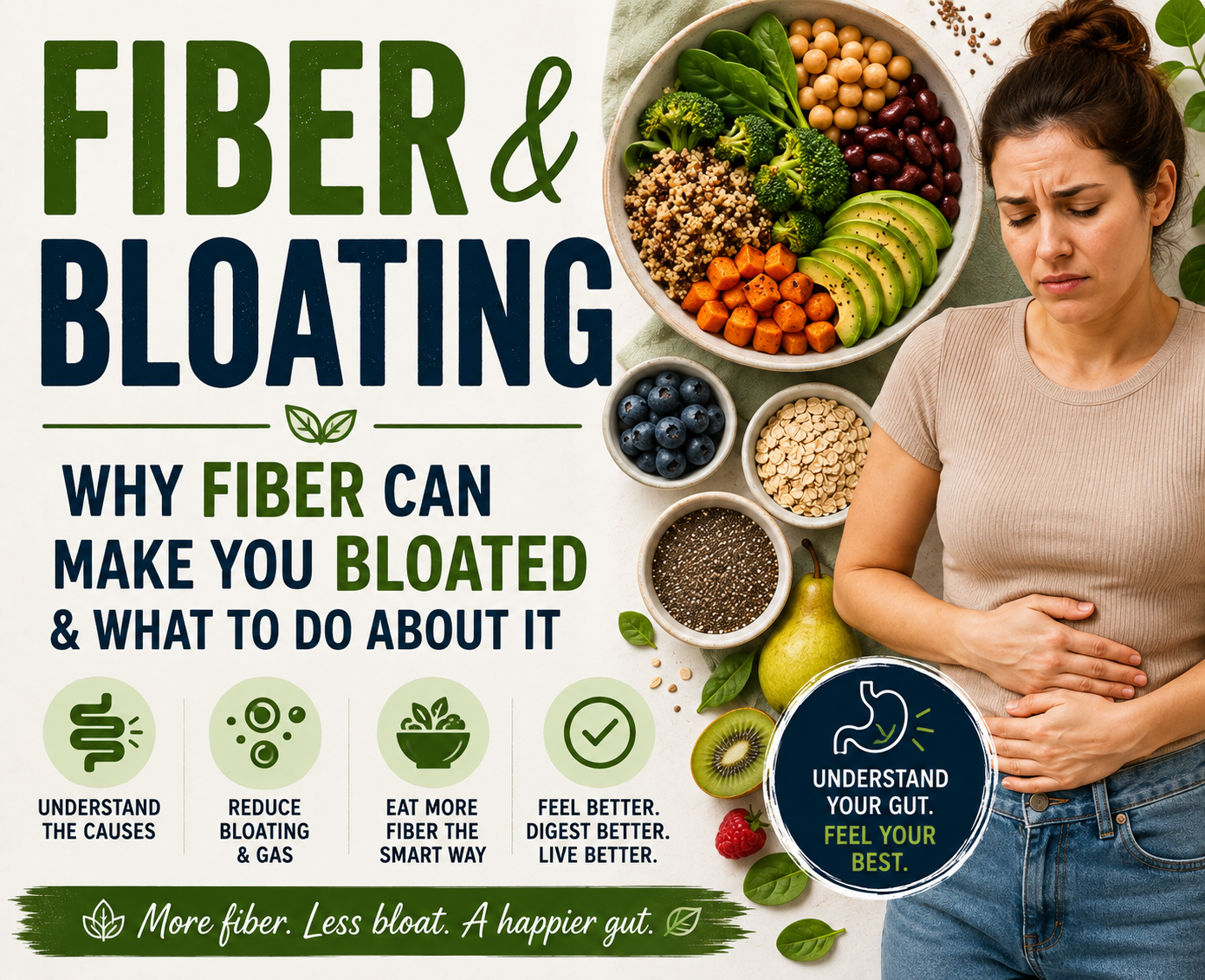
Fiber and Bloating: Why Fiber Can Make You Bloated & What to Do About It
Complete Fiber & Gut Health Guide Hub
Fiber is good for you.
Fiber can also make you feel terrible if you increase it too quickly.
Both can be true.
This is one of the most confusing parts of trying to improve your gut health.
You hear that you should eat more:
- Beans
- Lentils
- Whole grains
- Fruit
- Vegetables
- Nuts
- Seeds
So you do.
Then suddenly you're:
- Bloated
- Gassy
- Crampy
- Feeling unusually full
and wondering whether your new healthy diet is actually making your gut worse.
Sometimes, the answer is simply:
You increased fiber too fast.
NIDDK specifically notes that too much fiber at once can cause gas, and that gradually increasing fiber may help reduce gas and bloating. Mayo Clinic gives similar guidance, warning that adding too much fiber too quickly can lead to gas, bloating and cramping.
But fiber isn't the only possible cause of bloating.
And not all fiber affects everyone the same way.
So let's separate:
normal adjustment
from:
something worth paying more attention to.
If you just finished the plant-diversity section of this series, you may also want to read How to Eat More Plant Variety: Simple Ways to Add More Fruits, Vegetables, Beans, Grains, Nuts & Seeds.
First: What Is Bloating?
Bloating is the sensation that your abdomen feels:
- Full
- Tight
- Swollen
- Distended
Sometimes you actually have visible abdominal distention.
Sometimes you simply feel bloated.
Gas can be part of the picture, but they're not identical.
NIDDK lists common gas-related symptoms as belching, bloating, distention and passing gas, and notes that some gas symptoms are normal, especially during or after meals.
The problem is when symptoms:
- Happen frequently
- Become painful
- Interfere with daily life
- Keep getting worse
That's different from occasionally feeling full after eating a large meal.
Why Can Fiber Cause Bloating?
One major reason is fermentation.
Human digestive enzymes don't completely break down all dietary fiber.
Some fiber reaches the large intestine.
There, gut microorganisms can metabolize certain fibers.
That process can produce:
- Gas
- Short-chain fatty acids
- Other microbial metabolites
Gas is therefore not automatically evidence that something is wrong.
It's partly a consequence of intestinal microbes doing what intestinal microbes do.
The problem is that a sudden increase in fermentable material can create more gas than you're accustomed to.
Fiber Isn't One Thing
This is important.
Different fibers vary in:
- Solubility
- Viscosity
- Fermentability
- Chemical structure
Oregon State University's Linus Pauling Institute notes that fiber types differ in these characteristics, which helps explain their different physiological effects.
So when someone says:
“Fiber makes me bloated.”
the next question should be:
Which fiber?
Because:
- Psyllium
- Inulin
- Wheat bran
- Beans
- Oats
- Chia
can behave very differently.
Highly Fermentable Fiber May Produce More Gas
Some fibers are rapidly fermented by intestinal microbes.
That can increase gas production.
Examples of highly fermentable fibers or carbohydrates can include:
- Inulin
- Chicory-root fiber
- Certain fibers in legumes
- Certain fibers in fruits and vegetables
This doesn't make those foods bad.
It just means your digestive system may respond differently to them.
A food can be nutritious and still cause gas in a particular person.
The Dose Matters
This may be the most important point.
You might tolerate:
¼ cup of beans
perfectly well.
But:
1½ cups
might leave you bloated.
Same food.
Different dose.
That's why food tolerance shouldn't always be treated as:
yes/no.
Often it's:
how much?
The Speed of Increase Matters Too
Let's say your normal fiber intake is:
12 grams per day.
Then you decide to get serious about gut health.
Tomorrow you eat:
- Oatmeal
- Berries
- Chia
- Lentils
- Broccoli
- Beans
- Whole-grain bread
- A high-fiber bar
Now you're at:
35 grams.
Your digestive system has gone from:
12 → 35
in one day.
That is a major change.
Mayo Clinic recommends increasing fiber gradually over a few weeks rather than making a large jump all at once.
If your bloating began immediately after a huge increase?
The simplest explanation may be the correct one.
Normal Adjustment vs. Persistent Intolerance
There's a difference between:
Normal Adjustment
You add more fiber.
You notice slightly more gas for several days.
Symptoms improve as intake stabilizes.
and:
Persistent Problem
A particular food repeatedly causes:
- Severe bloating
- Cramping
- Diarrhea
- Significant discomfort
even after your diet has adjusted.
The first situation may respond to:
slower increases.
The second deserves closer attention.
Start With Your Baseline
Before trying to fix bloating, figure out where you started.
Track your usual fiber intake for several days.
Maybe you're averaging:
10 grams.
Maybe:
18 grams.
Maybe you're already eating:
30 grams.
If you were already eating plenty of fiber and suddenly developed persistent bloating?
The problem may not simply be:
“You need to adapt to fiber.”
Context matters.
If You Recently Increased Fiber, Pull Back Slightly
You don't necessarily need to go back to a very low-fiber diet.
Instead:
Reduce the most aggressive recent additions.
Maybe you added:
- Huge bean portions
- Bran cereal
- Chia
- Fiber bars
- A fiber supplement
all at once.
Scale back.
Then reintroduce gradually.
Mayo Clinic notes that high-fiber foods can be major gas producers for some people and suggests slowly adding fiber back after a temporary reduction when gas is problematic.
Don't Eliminate Fiber Completely
This is the opposite mistake.
You get bloated.
You decide:
Fiber is bad for me.
Then you eliminate:
- Fruit
- Vegetables
- Beans
- Whole grains
That's usually too extreme.
Fiber has established benefits.
The goal is not:
zero fiber.
It's:
the right amount, from foods you tolerate, increased at a pace your digestive system can handle.
Beans Are a Common Culprit
Beans are one of the best fiber foods available.
They're also famous for gas.
Both statements are true.
Beans contain fermentable carbohydrates that intestinal microbes can metabolize.
If you're new to them, try:
Start
¼ cup.
Then:
⅓ cup.
Then:
½ cup.
You don't need to begin with an enormous bean bowl.
Rinse Canned Beans
If you're using canned beans:
- Drain them
- Rinse them
This removes some of the material present in the canning liquid.
It won't magically eliminate all gas.
But it's a simple preparation step that many people find useful.
And canned beans remain incredibly practical.
Lentils Can Be Easier for Some People
Some people find certain lentils easier to tolerate than large servings of beans.
Others don't.
Again:
Individual response matters.
Try small portions.
Compare:
- Lentils
- Chickpeas
- Black beans
- Kidney beans
You may discover that one works better than another.
Chia Seeds Can Add Too Much Fiber Too Quickly
Chia is extremely fiber-dense.
That's useful.
It also means:
a few tablespoons can change your daily intake a lot.
If you go from:
No chia
to:
4 tablespoons daily
you're making a substantial change.
Start smaller.
One tablespoon may be plenty initially.
Bran Cereal Can Be Very Aggressive
Bran cereals can contain a lot of fiber per serving.
If you're used to a low-fiber breakfast, suddenly eating a large bowl can produce:
- Gas
- Bloating
- Cramping
Try:
- Smaller serving
- Mixing with another cereal
- Increasing gradually
You don't need breakfast to provide half your daily fiber goal.
Fiber Supplements Can Cause Bloating Too
People sometimes assume:
food fiber causes bloating, so I'll use a supplement instead.
That can backfire.
Different fiber supplements behave differently.
And some can produce substantial gas.
Inulin-based products, for example, can be highly fermentable.
Psyllium behaves differently because it's viscous and gel-forming.
This is why choosing a fiber supplement should involve more than looking for the largest number of grams.
High-Fiber Bars Can Be Sneaky
A packaged bar might contain:
12–15 grams of fiber.
That's a lot.
And the fiber may come largely from:
- Chicory root
- Inulin
- Soluble corn fiber
Now imagine eating that bar while also dramatically increasing whole-food fiber.
Your total intake may be much higher than you realize.
If bloating suddenly appears, look at packaged foods too.
Sugar Alcohols Can Make the Situation Worse
Some high-fiber or low-carb bars contain sugar alcohols.
Examples include:
- Sorbitol
- Mannitol
- Xylitol
- Maltitol
These can contribute to gas and digestive discomfort in some people.
So the problem may not be:
fiber alone.
It may be:
fiber + sugar alcohols + large dose.
Read the ingredient list.
Carbonation Can Add to the Bloating
If you're increasing fiber and also drinking:
- Soda
- Sparkling water
- Carbonated energy drinks
you may be adding more swallowed or dissolved gas to the situation.
This doesn't mean you have to eliminate carbonation forever.
But if you're troubleshooting bloating, it's another variable worth noticing.
Eating Quickly Can Make You Feel More Bloated
The faster you eat, the more likely you are to swallow air.
NIDDK and Mayo Clinic both recognize swallowed air as a contributor to gas symptoms.
So before blaming:
- Oats
- Broccoli
- Your microbiome
try slowing down.
Seriously.
Sometimes the simplest explanation gets overlooked.
Large Meals Can Make Bloating Worse
A meal can be nutritious and still be enormous.
Suppose you eat:
- Huge salad
- Beans
- Whole grain
- Fruit
- Seeds
That's a lot of:
- Food volume
- Fiber
- Fermentable carbohydrate
in one sitting.
Try distributing those foods across the day.
Your total intake can stay high while individual meals become more manageable.
Spread Fiber Across Meals
Instead of:
Breakfast
2 grams
Lunch
3 grams
Dinner
22 grams
try:
Breakfast
6 grams
Lunch
7 grams
Snack
4 grams
Dinner
9 grams
Same total.
Much less concentrated.
This is one of the simplest ways to reduce the likelihood of discomfort.
Raw Vegetables May Feel Harder to Tolerate
Some people tolerate:
cooked vegetables
better than:
huge raw salads.
Cooking softens plant structure.
So if raw:
- Broccoli
- Cabbage
- Carrots
- Kale
cause problems, try them cooked.
You don't lose your gut-health membership because you roasted the vegetables.
Soup Can Be Easier Than a Giant Salad
If you're trying to eat more plants but raw volume bothers you, soup can work beautifully.
For example:
- Lentils
- Carrots
- Spinach
- Barley
- Tomato
all cooked together.
You're still getting:
- Fiber
- Variety
but in a softer form.
Constipation Can Make Bloating Worse
This is an important connection.
If stool is moving slowly through the colon, fermentation and gas can become more noticeable.
So if you're:
- Increasing fiber
- Feeling bloated
- Constipated
don't assume the solution is simply:
more and more fiber.
NIDDK recommends fiber and adequate fluids as part of constipation management, but constipation can have many causes.
If increasing fiber makes constipation worse or doesn't help?
Pay attention.
Hydration Matters
As fiber increases, fluid intake becomes more important.
NIDDK recommends adequate water and other liquids to help fiber work better and soften stool.
That doesn't mean:
drink two gallons to cure bloating.
It means:
Don't combine:
high fiber + chronically low fluid intake.
More Water Doesn't Fix Excessive Fermentation
Hydration helps bowel function.
It does not erase all gas production.
So if you're bloated because you suddenly ate:
- Beans
- Inulin bars
- Chia
- Lentils
drinking enormous amounts of water isn't necessarily going to solve the issue.
Fix the actual variables.
Walking Can Help the Bigger Picture
Physical activity is part of healthy bowel function.
You don't need to exercise specifically to “move gas through your microbiome.”
But walking is a simple way to increase activity.
Try:
- 10 minutes after meals
- A longer walk later in the day
Movement can be part of a broader digestive-health routine.
Is Bloating a Sign You Have “Bad Gut Bacteria”?
Not necessarily.
This claim gets thrown around constantly.
Bloating can occur because of:
- Fermentation
- Constipation
- Food intolerance
- Large meals
- Swallowed air
- IBS
- Other gastrointestinal conditions
You cannot diagnose:
dysbiosis
from:
“beans make me gassy.”
That's far too simplistic.
Is Gas a Sign Your Microbiome Is “Working”?
Also too simplistic.
Some gas production is normal during fermentation.
But:
more gas = healthier microbiome
is not a useful rule either.
The goal isn't to maximize gas.
The goal is to eat a nutritious diet you tolerate well.
What About IBS?
IBS changes the picture.
Bloating is a common IBS symptom, along with abdominal pain and changes in bowel movements.
NIDDK notes that fiber can be helpful for some people with IBS, particularly soluble fiber, but that too much fiber at once can increase gas.
So if you have IBS:
“just eat more fiber”
may be overly simplistic.
Fiber type, dose and symptom pattern matter.
Soluble Fiber May Be Better Tolerated in IBS
NIDDK specifically notes that soluble fiber appears more helpful for IBS symptoms than insoluble fiber.
That doesn't mean every person with IBS should start supplementing aggressively.
It means different fiber types may affect symptoms differently.
Examples of soluble-fiber sources include:
- Oats
- Psyllium
- Certain fruits
- Beans
Individual tolerance still varies.
Insoluble Fiber Can Bother Some People
Coarse insoluble fiber—such as large amounts of bran—may worsen:
- Gas
- Cramping
- Discomfort
for some people with sensitive digestive systems.
That's another reason:
fiber grams alone
don't tell the entire story.
What About FODMAPs?
FODMAPs are certain short-chain carbohydrates that can be poorly absorbed and rapidly fermented.
They can increase:
- Gas
- Bloating
- Abdominal discomfort
in people who are sensitive to them, particularly those with IBS.
Some high-fiber foods are also high in FODMAPs.
That does not make them unhealthy.
It means the individual's digestive tolerance matters.
Don't Start a Low-FODMAP Diet Based on One Bad Day
A low-FODMAP diet can be useful in selected people with IBS.
It is also restrictive.
If your bloating began because you:
tripled your fiber intake in 24 hours
you probably don't need to immediately eliminate dozens of foods.
Fix the obvious first.
Increase fiber more gradually.
Track What Actually Causes Symptoms
Instead of saying:
“Fiber makes me bloated.”
track:
- Food
- Fiber amount
- Portion
- Time eaten
- Symptoms
- Bowel movements
- Other ingredients
You may discover:
Beans are fine under ½ cup.
or:
One specific fiber bar causes the problem.
or:
Bloating is much worse when I'm constipated.
That's much more useful.
Use the Bloating, Digestion & Food Trigger Tracker
If you're struggling to identify the pattern, the Bloating, Digestion & Food Trigger Tracker is designed specifically for this kind of problem.
You can track:
- Meals
- Fiber
- Bloating
- Gas
- Bowel habits
- Possible triggers
- Timing
- Trends
The goal is not to diagnose yourself with:
- IBS
- Celiac disease
- Food intolerance
- SIBO
from a spreadsheet.
The goal is to organize the information.
Change One Variable at a Time
This is the best troubleshooting rule.
If you're bloated, don't simultaneously:
- Remove gluten
- Remove dairy
- Stop beans
- Stop fruit
- Stop vegetables
- Stop whole grains
Now you've changed everything.
You learn nothing.
Instead:
Change one major variable.
Observe.
Then decide what to do next.
Use a Fiber Reduction Test Carefully
If your intake recently increased dramatically, reduce it modestly.
Not:
zero fiber.
Try returning closer to the level you were tolerating.
Once symptoms settle, add fiber back more slowly.
This is a much more useful experiment than eliminating every plant food.
Add Fiber Back in Small Steps
For example:
Week 1
Return to your comfortable baseline.
Week 2
Add one fruit serving.
Week 3
Add a small bean serving several times.
Week 4
Add another whole grain or vegetable.
Adjust based on symptoms.
There is no prize for speed.
Use Smaller Servings More Often
Instead of:
1 cup beans at dinner
try:
¼ cup at lunch + ¼ cup at dinner.
Same general idea.
Less concentrated.
This can be easier for some people to tolerate.
Don't Stack Every Fermentable Food Into One Meal
This is a common problem.
You build the world's healthiest bowl:
- Beans
- Lentils
- Broccoli
- Onion
- Garlic
- Avocado
- Whole grain
Great nutrition.
Potentially a lot of fermentable carbohydrate in one sitting.
Spread variety across the week instead of trying to impress your microbiome at one lunch.
Plant Variety Still Matters—Just Build It Gradually
The previous article encouraged you to increase plant diversity.
That advice still stands.
But if you're currently low in fiber, you don't need to jump from:
10 plants/week
to:
30 plants/week
at the same time you double your fiber intake.
Increase one variable at a time.
Your digestive system doesn't care about our publishing schedule.
A Lower-Bloat High-Fiber Day
Here's one example.
Breakfast
Oatmeal + blueberries
Lunch
Chicken + rice + cooked carrots + small amount of black beans
Snack
Pear + Greek yogurt
Dinner
Salmon + potato + cooked broccoli
This still provides:
- Whole grain
- Fruit
- Legume
- Vegetables
- Potato
but without stacking enormous fiber doses into one meal.
Another Example
Breakfast
Eggs + whole-grain toast + banana
Lunch
Turkey sandwich + cooked vegetable soup
Snack
Small serving of almonds + fruit
Dinner
Chicken + rice + lentils + cooked zucchini
Again:
Fiber is present throughout the day.
Not concentrated in one massive bowl.
When Bloating Is Probably Not Just Fiber Adjustment
Seek medical evaluation if bloating is:
- Severe
- Persistent
- Progressive
- Associated with significant pain
- Associated with vomiting
- Associated with blood in stool
- Associated with unexplained weight loss
- Accompanied by major changes in bowel habits
- Regularly interfering with your life
NIDDK notes that digestive diseases can produce overlapping symptoms, and persistent symptoms should not simply be assumed to be normal gas.
Sudden Severe Symptoms Deserve More Urgent Attention
Severe abdominal pain plus:
- Vomiting
- Significant swelling
- Inability to pass stool or gas
- Other signs of obstruction
can represent something very different from ordinary dietary bloating.
Do not try to solve severe symptoms with more fiber.
Get medical care.
Don't Use Bloating as a Reason to Self-Diagnose Celiac Disease
Bloating can occur in celiac disease.
It can also occur in:
- IBS
- Constipation
- Food intolerance
- Normal fermentation
So:
bloating after bread
doesn't prove:
gluten problem.
If symptoms suggest celiac disease, proper testing matters.
Starting a gluten-free diet before testing can complicate diagnosis.
Don't Self-Diagnose “SIBO” From TikTok Symptoms Either
Bloating.
Gas.
Fatigue.
Those symptoms are not specific.
Many conditions can cause them.
If you're concerned about a medical digestive disorder, talk with a healthcare professional.
Gut-health content should help you organize sensible habits.
Not convince you that every common symptom represents a complicated diagnosis.
Stop Blaming Every Symptom on Your Microbiome
This is probably worth saying directly.
Your gut microbiome is important.
But bloating can be caused by many ordinary things.
Sometimes it's:
- Big meal
- Constipation
- Fast eating
- Carbonation
- Too much fiber too quickly
That's far more likely to be useful than assuming your microbiome needs rebuilding.
A Simple Bloating Troubleshooting Checklist
If fiber seems to be causing bloating, ask:
1. Did I increase fiber suddenly?
If yes, slow down.
2. Did I add a high-fiber supplement or bar?
Check the dose and ingredients.
3. Did I dramatically increase beans or lentils?
Reduce the portion.
4. Am I eating huge raw-vegetable meals?
Try cooked vegetables.
5. Am I constipated?
Address the broader bowel pattern.
6. Am I drinking adequate fluids?
Hydration matters.
7. Are sugar alcohols involved?
Check packaged foods.
8. Does one specific food consistently cause symptoms?
Track it.
9. Are symptoms severe or persistent?
Get medical guidance.
That's a much better process than:
“Fiber is bad.”
Frequently Asked Questions
Can fiber cause bloating?
Yes.
Fiber can increase gas and bloating, particularly when intake rises quickly or when large amounts of fermentable fiber are eaten at once. NIDDK and Mayo Clinic both recommend increasing fiber gradually to reduce these symptoms.
Why does fiber make me gassy?
Certain fibers reach the large intestine, where gut microorganisms ferment them.
Gas can be produced during this process.
The amount depends on:
- Fiber type
- Dose
- Individual gut response
Does your body adjust to more fiber?
Often, yes.
Gradually increasing fiber over several weeks can allow the digestive system and gut microbial environment more time to adapt. Mayo Clinic specifically recommends a gradual increase for this reason.
How quickly should I increase fiber?
There is no single schedule for everyone.
NIDDK notes that in people with IBS, adding fiber by about 2–3 grams per day may help reduce gas and bloating.
If you're very sensitive, slower may be better.
Can too much fiber make you bloated?
Yes.
NIDDK notes that some people experience more gas symptoms when they consume too much fiber.
The issue may be total amount, fiber type, or how quickly intake increased.
Should I stop eating fiber if I'm bloated?
Not automatically.
First consider:
- Portion size
- Speed of increase
- Specific fiber type
- Constipation
- Hydration
- Other ingredients
A temporary modest reduction followed by a slower increase may be more appropriate than eliminating fiber completely.
Do beans cause bloating?
They can.
Beans contain fermentable carbohydrates and fiber that gut bacteria can metabolize.
Smaller portions and gradual increases may improve tolerance.
Can fiber supplements cause bloating?
Yes.
Different supplements contain different fiber types, and some are more fermentable than others.
Start with smaller amounts and increase gradually if appropriate.
Is bloating always caused by food?
No.
Bloating can also occur with:
- IBS
- Constipation
- Other digestive conditions
- Swallowed air
- Large meals
Persistent bloating deserves more careful evaluation.
Key Takeaways
- Fiber can cause gas and bloating, particularly when intake increases rapidly.
- NIDDK recommends increasing fiber gradually because too much at once can increase gas.
- Mayo Clinic similarly warns that rapid fiber increases can cause bloating and cramping.
- Fiber types differ in solubility, viscosity and fermentability.
- Highly fermentable fibers may cause more gas in some people.
- Portion size matters.
- Beans and lentils may be easier to tolerate in smaller servings.
- Chia, bran cereal and fiber supplements can increase total fiber quickly.
- High-fiber bars may contain added fibers and sugar alcohols that contribute to symptoms.
- Spreading fiber across the day can be easier than consuming large amounts in one meal.
- Cooked vegetables may be better tolerated than huge raw-vegetable servings for some people.
- Constipation can worsen bloating.
- Adequate fluids help fiber support bowel function.
- IBS can involve bloating, gas and altered bowel habits, and fiber strategies may need to be individualized.
- Persistent, severe or progressive bloating deserves medical evaluation.
- The goal isn't maximum fiber. It's an adequate intake from foods you tolerate well.
Final Thoughts
Fiber is supposed to improve your diet.
Not make you miserable.
If you're bloated after increasing fiber, don't immediately conclude:
“My body can't handle fiber.”
Look at what actually changed.
Did you:
Triple your intake?
Start eating huge bean portions?
Add chia, bran and a fiber bar at the same time?
Start eating enormous raw salads?
Those are fixable problems.
Reduce the dose.
Spread fiber across the day.
Cook foods when that helps.
Drink enough.
Add new foods gradually.
Track what consistently causes symptoms.
And remember:
A little gas after increasing fiber is not the same thing as severe, persistent digestive symptoms.
Your goal is not to force your body to tolerate the highest fiber intake possible.
It's to find a fiber-rich eating pattern that supports your health and feels sustainable enough to actually live with.
Continue the Fiber & Gut Health Series
Recently published:
- How to Eat More Plant Variety: Simple Ways to Add More Fruits, Vegetables, Beans, Grains, Nuts & Seeds
- 30 Plants Per Week: Does Eating More Plant Variety Improve Gut Health?
- How to Increase Fiber Without Bloating, Gas or Digestive Discomfort
Next in the series:
Bloating After Eating: How to Track Foods, Symptoms & Possible Triggers
Then we'll move into:
Fiber and Constipation: How Much Helps, What Foods to Eat & Why More Isn’t Always Better
Educational Disclaimer
This article is intended for educational purposes only and should not be considered individualized medical or nutrition advice. Bloating can have many causes, including gastrointestinal conditions that require medical evaluation. Persistent, severe, progressive or otherwise concerning digestive symptoms should be discussed with a qualified healthcare professional.