

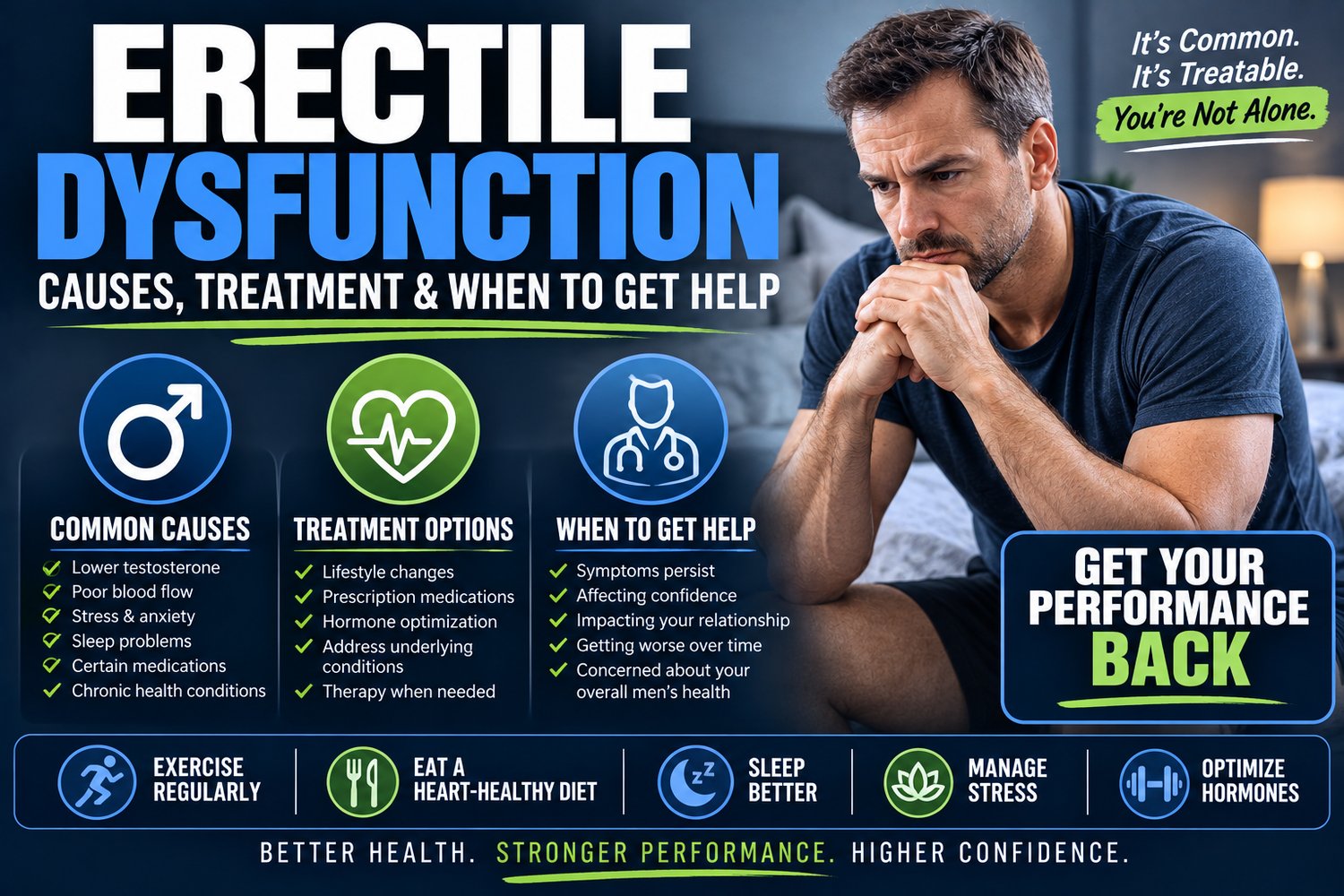
Erectile Dysfunction: Causes, Treatment & When to Get Help
Erectile dysfunction, or ED, means having persistent difficulty getting or maintaining an erection firm enough for satisfactory sexual activity. It can result from problems involving blood flow, nerves, hormones, medications, diabetes, cardiovascular disease, psychological factors, or a combination of several issues.
ED is common.
It is often treatable.
And most importantly:
Erectile dysfunction isn't always just a sexual problem.
Persistent changes in erections can sometimes provide useful information about your broader health—particularly cardiovascular and metabolic health.
Possible contributors include:
- Cardiovascular disease
- High blood pressure
- Diabetes
- Obesity
- Smoking
- Medications
- Nerve disorders
- Pelvic surgery
- Psychological stress or anxiety
- Low testosterone or other hormonal problems
- Sleep disorders
- Alcohol or recreational drug use
That means persistent ED deserves more than:
“I guess I'm getting older.”
This guide explains common causes of erectile dysfunction, how ED is evaluated, treatment options including sildenafil and tadalafil, the connection between ED and heart health, and when it's time to seek medical help.
What Is Erectile Dysfunction?
Erectile dysfunction means consistently or repeatedly having difficulty:
- Getting an erection
- Keeping an erection long enough for sexual activity
- Achieving an erection firm enough for satisfactory sex
An occasional erection problem isn't necessarily ED.
Most men will experience temporary difficulties at some point.
You might be:
- Exhausted
- Stressed
- Distracted
- Anxious
- Drinking alcohol
- Not especially aroused
- Recovering from illness
One unsuccessful sexual encounter doesn't establish a medical disorder.
The pattern becomes more meaningful when erection problems are:
- Persistent
- Recurrent
- Becoming more frequent
- Affecting sexual activity
- Affecting confidence or relationships
Patterns matter much more than one bad night.
How Does an Erection Work?
An erection requires several systems to work together.
That includes:
- Brain signaling
- Nerves
- Blood vessels
- Hormones
- Erectile tissue
- Psychological arousal
Sexual stimulation triggers nerve signals that cause blood vessels supplying the penis to relax.
Blood flow into the erectile tissue increases.
At the same time, mechanisms within the penis help trap that blood long enough to maintain rigidity.
If something disrupts:
- Blood flow
- Nerve signaling
- Hormonal function
- Psychological arousal
- Penile structure
erections may become less reliable.
That's why ED has so many possible causes.
ED Is Not an Inevitable Part of Aging
Erectile dysfunction becomes more common as men get older.
But aging itself doesn't automatically cause ED.
Older men are more likely to develop conditions that can interfere with erectile function, including:
- Cardiovascular disease
- Diabetes
- High blood pressure
- Obesity
- Neurological disease
- Medication use
So age can increase the likelihood of experiencing ED without making erectile dysfunction an unavoidable part of getting older.
Persistent changes deserve evaluation whether you're 35, 45, 55, or 75.
Common Causes of Erectile Dysfunction
ED often has more than one contributor.
A man might simultaneously have:
- High blood pressure
- Obesity
- Diabetes
- Poor sleep
- Medication effects
- Performance anxiety
That makes finding the cause more useful than simply labeling the symptom.
1. Cardiovascular and Blood-Vessel Disease
An erection is fundamentally dependent on healthy blood flow.
That makes vascular health extremely important.
Conditions such as:
- Atherosclerosis
- Coronary artery disease
- Peripheral vascular disease
- Other blood-vessel disorders
can reduce the ability of arteries to deliver adequate blood flow.
The penile arteries are relatively small, which means vascular dysfunction may sometimes become apparent through erection changes before more obvious cardiovascular symptoms develop.
That doesn't mean:
ED = heart disease.
It means persistent unexplained ED can be a reason to look more closely at cardiovascular health.
Can ED Be an Early Warning Sign of Heart Disease?
Sometimes.
The connection between erectile dysfunction and cardiovascular disease is important enough that newer cardiovascular and sexual-medicine recommendations increasingly treat ED as a potential marker of underlying cardiovascular risk.
The same processes that affect coronary arteries can affect penile blood vessels.
That can include:
- Atherosclerosis
- Endothelial dysfunction
- High blood pressure
- Diabetes
- Smoking
- Abnormal cholesterol
- Obesity
So if ED appears without an obvious explanation—particularly in a man with other cardiovascular risk factors—it may justify a broader risk assessment.
Useful areas to review can include:
- Blood pressure
- Cholesterol
- Blood glucose or A1C
- Smoking
- Weight and waist circumference
- Physical activity
- Family history
- Other cardiovascular symptoms
Treat the erection.
But don't automatically ignore the arteries behind it.
2. High Blood Pressure
High blood pressure can damage blood vessels over time.
That includes vessels involved in erectile function.
Some medications used to treat hypertension may also contribute to sexual side effects in certain men.
That creates a frustrating situation:
The condition can contribute to ED.
And occasionally the treatment can contribute too.
Do not stop blood-pressure medication because you think it's causing erectile dysfunction.
Talk with the healthcare professional prescribing it.
Medication choice or dosing may sometimes be adjusted safely.
Uncontrolled high blood pressure is considerably more dangerous than the sexual side effect you're trying to solve.
3. Diabetes
Diabetes is an important cause of erectile dysfunction.
Chronically elevated blood glucose can damage:
- Blood vessels
- Nerves
Both are critical to normal erections.
Diabetes is also frequently associated with:
- Obesity
- High blood pressure
- Cardiovascular disease
- Abnormal cholesterol
- Other metabolic problems
All of those can contribute further.
ED in a man with diabetes may therefore have multiple overlapping causes.
Improving diabetes management matters for far more than sexual function.
4. Obesity and Metabolic Health
Obesity can contribute to ED through several pathways.
It is associated with:
- Cardiovascular disease
- Diabetes
- Insulin resistance
- Inflammation
- Sleep apnea
- Reduced physical activity
- Hormonal changes
That doesn't mean body weight determines sexual function by itself.
But metabolic health and vascular health influence the systems required for erections.
If excess abdominal fat is one of your concerns, read Why Belly Fat Gets Harder to Lose After 30.
5. Low Testosterone
Testosterone matters.
But testosterone marketing often makes its role in ED sound much simpler than it is.
Low testosterone can contribute to:
- Reduced libido
- Fewer spontaneous erections
- Erectile difficulties
But erections also require healthy:
- Blood flow
- Nerve function
- Psychological arousal
- Penile tissue
A man can have normal testosterone and substantial ED because the primary issue is vascular, neurological, psychological, medication-related, or metabolic.
And a man with low testosterone may still be able to achieve erections.
That's why:
ED does not automatically mean low testosterone.
When Should Testosterone Be Checked for ED?
Testosterone evaluation may make more sense when erectile dysfunction occurs alongside symptoms such as:
- Persistently low libido
- Fewer spontaneous or morning erections
- Other sexual-function changes
- Loss of muscle mass
- Other signs compatible with testosterone deficiency
If testosterone is part of the concern, read:
For testing resources, visit the HabitLogics Men's Bloodwork Hub.
The Everlywell Testosterone Test provides one at-home testing option.
Remember:
One ED symptom doesn't diagnose low T, and one testosterone result doesn't diagnose hypogonadism.
6. Medications
Many commonly used medications can affect erectile function in some men.
Potential contributors can include certain:
- Antidepressants
- Blood-pressure medications
- Sedatives
- Hormonal medications
- Cancer treatments
- Pain medications
- Other prescription drugs
If erectile problems began soon after:
- Starting a medication
- Increasing a dose
- Switching drugs
tell your healthcare professional.
Do not stop a needed prescription on your own.
Sometimes an alternative medication, dose, or treatment strategy is possible.
7. Smoking
Smoking damages blood vessels.
That matters because healthy erections depend on healthy circulation.
Smoking also increases cardiovascular disease risk, which further connects it with erectile dysfunction.
If you smoke and have ED, quitting isn't a trendy sexual-health hack.
It's one of the strongest things you can do for your long-term vascular and overall health.
8. Alcohol
Alcohol can affect erections differently depending on the amount and pattern of use.
A small amount may reduce inhibition for some people.
Too much can interfere with:
- Arousal
- Nerve signaling
- Erectile function
- Coordination
- Sexual performance
Chronic heavy alcohol use can also damage broader physical and mental health.
If your erections are consistently worse after drinking heavily, the cause may not require a complicated hormone explanation.
9. Stress and Performance Anxiety
Psychological factors can cause or worsen erectile dysfunction.
Potential contributors include:
- Performance anxiety
- Stress
- Depression
- Relationship conflict
- Fear of sexual failure
- Low confidence
- Negative body image
ED can also create its own feedback loop.
An erection problem happens once.
You worry about it happening again.
During the next sexual encounter, you're monitoring your erection instead of experiencing arousal.
Anxiety increases.
Another erection problem occurs.
Now the fear feels confirmed.
That cycle can become powerful even when no serious physical problem started it.
Counseling, psychotherapy, or sex therapy may help when emotional or relationship factors are playing a significant role.
What Can Morning Erections Tell You?
Morning and spontaneous erections can provide useful context.
They aren't a perfect diagnostic test.
But patterns can help.
If you regularly have:
- Morning erections
- Normal erections during masturbation
but have difficulty mainly during partnered sexual activity, situational or psychological contributors may deserve greater attention.
If erections are consistently impaired:
- During partnered sex
- During masturbation
- In the morning
a physical contributor may become more likely.
Neither pattern proves the cause.
But the information can help guide an evaluation.
For a deeper look, read Morning Erections: What They Can Tell You About Your Health.
10. Poor Sleep and Sleep Apnea
Sleep problems can affect:
- Mood
- Energy
- Libido
- Cardiovascular health
- Metabolic health
- Hormone regulation
Obstructive sleep apnea deserves particular attention because it commonly overlaps with:
- Obesity
- High blood pressure
- Fatigue
- Metabolic disease
- Sexual dysfunction
If you're loudly snoring, gasping during sleep, experiencing witnessed breathing pauses, or waking exhausted despite enough time in bed, the sleep issue deserves evaluation.
Read Sleep for Men.
11. Nerve Damage and Neurological Conditions
Erections require intact nerve signaling.
Conditions or injuries that damage the nerves involved in erectile function can contribute to ED.
Examples can include:
- Diabetes
- Multiple sclerosis
- Spinal cord injuries
- Pelvic injuries
- Pelvic surgery
Prostate surgery is particularly relevant because nerves involved in erections can sometimes be damaged during treatment.
The appropriate ED treatment may differ when nerve injury is a major contributor.
12. Peyronie's Disease and Penile Changes
Peyronie's disease involves scar tissue within the penis.
It can cause:
- New penile curvature
- Pain
- Difficulty with intercourse
- Erectile problems
A noticeable new curve, painful erections, or a palpable penile abnormality deserves medical evaluation.
A urologist can assess whether Peyronie's disease or another structural problem is contributing.
How Is Erectile Dysfunction Diagnosed?
ED evaluation usually begins with conversation rather than a massive battery of tests.
A healthcare professional may review:
- Your medical history
- Sexual history
- Medications
- Mental health
- Relationship factors
- Cardiovascular risk factors
- Lifestyle
- Timing and pattern of erection problems
A physical examination may assess:
- Blood pressure
- Circulation
- Neurological function
- Signs of hormonal disorders
- Penile anatomy
- Testicular or reproductive findings when appropriate
Additional tests can be used if the cause remains unclear.
What Bloodwork May Be Used for ED?
Not every man with ED needs every possible blood test.
Testing should be based on the clinical picture.
Depending on age, symptoms, history, and risk factors, evaluation may include:
- Blood glucose
- A1C
- Lipid panel
- Testosterone when appropriate
- Thyroid testing
- Other relevant laboratory testing
The goal is to identify treatable underlying problems rather than simply prescribe an erection medication and ignore everything else.
The Men's Bloodwork Dashboard can help organize testosterone, glucose, lipids, metabolic markers, and other laboratory results over time.
Treat the Cause When Possible
A useful principle in ED treatment is:
Treat underlying causes where possible + treat the erection when needed.
For example:
Diabetes
Improve diabetes and cardiovascular-risk management.
High Blood Pressure
Control blood pressure and review medications if necessary.
Medication Side Effects
Discuss alternatives with the prescribing clinician.
Low Testosterone
Treat appropriately diagnosed hypogonadism when indicated.
Performance Anxiety
Counseling or sex therapy may help.
Smoking
Stopping smoking can benefit both erectile and cardiovascular health.
Even when ED medication works, addressing the underlying cause still matters.
Lifestyle Changes Can Improve Erectile Function
Lifestyle isn't a guaranteed cure for ED.
But many of the same behaviors that improve cardiovascular and metabolic health can improve erectile function in some men.
Useful areas include:
- Stop smoking
- Increase physical activity
- Maintain a healthier body weight
- Improve diet quality
- Limit excessive alcohol
- Manage diabetes and blood pressure
- Improve sleep
- Address stress and mental health
There is an unusually convenient overlap here:
What's good for your cardiovascular system is often good for your erections too.
Walking and Erectile Health
Walking isn't an ED medication.
But regular activity supports several systems relevant to erectile function:
- Cardiovascular fitness
- Blood pressure
- Blood glucose
- Weight management
- Metabolic health
- Stress management
If daily movement is low, Walking for Men's Health is a simple place to start.
Strength Training and Erectile Health
Resistance training can support:
- Body composition
- Insulin sensitivity
- Physical fitness
- Strength
- Cardiovascular-risk reduction
- Confidence
It doesn't function like sildenafil.
It doesn't need to.
The broader health benefits are useful on their own.
Use Strength Training for Men Over 30 if you're not already resistance training.
Erectile Dysfunction Treatment Options
ED treatment depends partly on the cause, medical history, other medications, personal preference, and how severe the problem is.
Options range from oral medication to counseling, devices, injectable medication, and surgery.
PDE5 Inhibitors: Common Oral ED Medications
The most familiar ED medications belong to a class known as phosphodiesterase type 5 inhibitors, or PDE5 inhibitors.
Common examples include:
- Sildenafil
- Tadalafil
- Vardenafil
- Avanafil
Sildenafil is the active ingredient associated with Viagra.
Tadalafil is associated with Cialis.
These medications improve the nitric-oxide signaling involved in penile blood flow.
They still generally require sexual stimulation.
Taking sildenafil doesn't normally produce an automatic erection independent of arousal.
Sildenafil
Sildenafil is commonly used before anticipated sexual activity.
Its effect lasts for several hours.
Timing, food, dose, other medications, health conditions, and individual response can influence how well it works.
Common potential side effects include:
- Headache
- Flushing
- Nasal congestion
- Indigestion
- Visual changes
A healthcare professional can help determine whether sildenafil is appropriate and how it should be taken.
Tadalafil
Tadalafil has a longer duration of action than sildenafil.
That longer window has led to the nickname:
“the weekend pill.”
Tadalafil may be prescribed:
- As needed
- As a lower-dose daily medication
Daily dosing can reduce the need to plan medication around individual sexual encounters.
Neither sildenafil nor tadalafil is universally “better.”
The best fit can depend on:
- How often you have sex
- Desired duration
- Side effects
- Cost
- Other medications
- Medical history
- Personal preference
ED Pills Don't Work for Everyone
PDE5 inhibitors work well for many men.
But response varies.
They may be less effective in some men with:
- Severe diabetes-related damage
- Significant vascular disease
- Nerve injury
- Previous prostate surgery
- Other complex causes of ED
Sometimes changes in:
- Dose
- Timing
- Medication choice
- How the medication is taken
improve results.
Other men need a different type of treatment.
Never Mix ED Pills With Nitrates
This is one of the most important safety rules in ED treatment.
PDE5 inhibitors such as sildenafil and tadalafil can cause a dangerous drop in blood pressure when combined with nitrate medications.
Examples include:
- Nitroglycerin
- Isosorbide mononitrate
- Isosorbide dinitrate
If you use nitrate medication for chest pain or heart disease, tell the clinician before taking any PDE5 inhibitor.
Do not experiment with this combination.
Mayo Clinic specifically warns against nitrate/PDE5-inhibitor combinations because of potentially dangerous hypotension.
Heart Disease and ED Medication
Having cardiovascular disease doesn't automatically mean you can never use ED medication.
But cardiovascular stability matters.
Sexual activity itself increases physical demand to some degree, and men with unstable cardiovascular disease, recent major cardiac events, or concerning symptoms may require additional evaluation before sexual activity or ED treatment.
If you develop:
- Chest pain with exertion
- Significant shortness of breath
- Fainting
- New cardiovascular symptoms
don't simply work around those symptoms with ED medication.
Get the cardiovascular problem evaluated.
What About Testosterone for ED?
TRT shouldn't be treated as the default erectile-dysfunction medication.
If you have:
ED + appropriately diagnosed testosterone deficiency
testosterone treatment may be one component of the overall plan.
But if testosterone is normal, simply raising testosterone doesn't automatically solve ED.
Read What Is TRT? Testosterone Replacement Therapy Explained for the benefits, risks, fertility implications, and monitoring involved.
If you've already completed appropriate evaluation and are researching treatment providers, you can also compare online TRT options.
HabitLogics may earn a commission if you purchase through links on our TRT provider page, at no additional cost to you.
Vacuum Erection Devices
A vacuum erection device uses negative pressure to pull blood into the penis.
A constriction ring can then help maintain the erection.
Potential advantages include:
- No systemic medication
- Can work when oral medication isn't appropriate or effective
- Reusable
Possible disadvantages include:
- Less spontaneity
- Bruising
- Discomfort
- A cool or numb sensation
- Mechanical feeling
For some men, vacuum devices provide a useful non-drug treatment option.
Penile Injections
Certain medications can be injected directly into penile erectile tissue.
That sounds intimidating to many men.
But intracavernosal injection therapy can be highly effective when oral medications don't work adequately.
These drugs directly increase penile blood flow.
Because improper dosing can create complications—including prolonged erections—patients need appropriate medical instruction.
This is not a DIY experiment.
Urethral Medication
Certain ED medications can be administered through the urethra.
This treatment is less commonly discussed than oral medication or injections but remains an option for some men.
A urologist can explain when this approach may make sense.
Penile Implants
For severe erectile dysfunction that doesn't respond adequately to less invasive treatments, penile implants can provide a surgical option.
Inflatable implants generally use internal cylinders and a pump to produce an erection when desired.
Implants are usually considered after other treatments have failed or aren't acceptable.
They're a much larger intervention than taking a pill.
But they can provide reliable erectile function for appropriately selected patients.
Counseling and Sex Therapy
Counseling deserves more respect than it often gets in conversations about ED.
If major contributors include:
- Performance anxiety
- Depression
- Relationship conflict
- Stress
- Sexual trauma
- Fear of failure
medication alone may not address the entire problem.
Psychotherapy, couples counseling, or sex therapy may help reduce anxiety, improve communication, and break the cycle between erectile difficulty and performance fear.
Using counseling doesn't mean:
“It's all in your head.”
The brain is one of the systems involved in sexual function.
Psychological and physical contributors can coexist.
Avoid Mystery “Male Enhancement” Supplements
ED has created a huge supplement market.
Products often promise to:
- Improve erections
- Raise testosterone
- Increase stamina
- Improve libido
- Increase penis size
sometimes all in the same bottle.
That's a red flag.
Sexual-enhancement supplements have repeatedly been the subject of FDA warnings because some products have contained undeclared pharmaceutical ingredients.
“Natural” doesn't mean:
- Proven effective
- Accurately labeled
- Interaction-free
- Safer than prescription medication
If a well-studied generic medication is medically appropriate, mystery capsules purchased online aren't automatically the safer route.
What About Online ED Treatment?
Telehealth can make legitimate ED treatment easier to access.
That's useful—especially for men who may otherwise avoid discussing sexual problems.
But convenience shouldn't eliminate appropriate clinical screening.
A responsible online provider should review:
- Your medications
- Nitrate use
- Cardiovascular history
- Other medical conditions
- Symptoms
- Treatment goals
- Potential interactions
Be cautious if a service appears willing to prescribe medication without adequately asking what else you're taking or what medical problems you have.
That's not convenience.
That's inadequate screening.
When Should You See a Healthcare Professional for ED?
Consider medical evaluation when:
- Erectile problems persist for several weeks or months
- ED is becoming more frequent
- Erections have changed significantly from your normal
- You have cardiovascular risk factors
- You have diabetes
- You have high blood pressure
- You smoke
- You have low libido or other hormonal symptoms
- You have penile pain or new curvature
- ED began after starting medication
- The problem is significantly affecting your mental health or relationship
Persistent erectile dysfunction deserves an explanation.
Not embarrassment.
When Is Erectile Dysfunction an Emergency?
ED itself usually isn't an emergency.
But certain related situations require urgent medical attention.
Chest Pain or Serious Cardiovascular Symptoms
Seek urgent care for symptoms such as:
- Chest pain
- Severe shortness of breath
- Fainting
- Symptoms suggesting a heart attack or other cardiovascular emergency
Priapism
An erection lasting four hours or longer requires urgent medical evaluation.
This condition is called priapism.
Prolonged erections can damage penile tissue if they're not treated promptly. NIDDK specifically advises immediate care for erections lasting more than four hours.
Sudden Vision or Hearing Changes After ED Medication
Rare but serious vision or hearing changes associated with oral ED medicines also warrant immediate medical attention.
If ED Medication Works, Still Pay Attention to Your Health
Suppose tadalafil works perfectly.
Great.
That solves an important symptom.
You should still care about:
- Blood pressure
- Cholesterol
- Blood glucose
- Weight
- Physical activity
- Smoking
- Sleep
- Cardiovascular fitness
Why?
Because medication can improve the erection without necessarily fixing the condition that contributed to ED.
If vascular health has declined, successful sildenafil doesn't reverse atherosclerosis.
Treat the symptom.
And address the system.
Track the Health Markers Behind ED
If erectile dysfunction motivates you to pay closer attention to your health, that's potentially useful.
Relevant markers can include:
- Blood pressure
- Weight
- Waist circumference
- Lipids
- Blood glucose
- A1C
- Testosterone when clinically appropriate
- Sleep
- Physical activity
The Men's Health & Performance Dashboard can help track fitness, body composition, energy, recovery, and broader health measures.
The Men's Bloodwork Dashboard is designed specifically for organizing laboratory trends.
For a free starting point, download the FREE Men's Hormone & Energy Starter Kit.
Frequently Asked Questions
What causes erectile dysfunction?
ED can result from cardiovascular disease, diabetes, high blood pressure, obesity, medications, smoking, neurological disease, hormonal problems, psychological factors, sleep disorders, penile conditions, or other health problems.
Several causes can overlap in the same person.
Is erectile dysfunction normal after 40?
ED becomes more common as men age, but it isn't simply an inevitable or normal consequence of getting older.
Persistent changes deserve evaluation.
Can ED be a sign of heart disease?
It can sometimes be associated with underlying vascular disease and may provide useful information about cardiovascular risk.
ED doesn't prove that you have heart disease, but persistent unexplained ED can be a reason to assess cardiovascular risk factors.
Does erectile dysfunction mean low testosterone?
No.
Low testosterone is one potential contributor, particularly when ED occurs with reduced libido or other symptoms of testosterone deficiency.
Many men with erectile dysfunction have normal testosterone.
Can stress cause erectile dysfunction?
Yes.
Stress, performance anxiety, depression, relationship problems, and other psychological factors can cause or worsen ED.
Physical and psychological causes can also occur together.
Can losing weight improve ED?
It may.
Weight reduction, regular physical activity, smoking cessation, healthy eating, and other cardiovascular-health improvements can improve erectile function in some men.
What is the best medication for erectile dysfunction?
There isn't one universally best ED medication.
Sildenafil and tadalafil are both widely used PDE5 inhibitors, but they have different durations and dosing options.
The best choice depends on medical history, other medications, desired duration, side effects, cost, and personal preference.
What's the difference between sildenafil and tadalafil?
Sildenafil is generally shorter-acting and is typically taken before anticipated sexual activity.
Tadalafil lasts considerably longer and can also be prescribed as a daily lower dose.
Both require medical consideration of interactions and contraindications.
Can I take sildenafil or tadalafil with nitroglycerin?
PDE5 inhibitors should not be combined with nitrate medications such as nitroglycerin because the combination can cause a dangerous drop in blood pressure.
Tell the prescribing clinician about all medications you take.
Does TRT treat erectile dysfunction?
TRT may help some men who have both erectile dysfunction and appropriately diagnosed testosterone deficiency.
It isn't the default ED treatment for men with normal testosterone.
Is erectile dysfunction reversible?
Sometimes.
If contributors such as smoking, obesity, medication effects, poorly controlled diabetes, stress, or other modifiable factors improve, erectile function may improve too.
Other causes may require ongoing medication, devices, injections, counseling, or surgical treatment.
When should I worry about erectile dysfunction?
Persistent or worsening ED deserves evaluation, especially when it occurs alongside:
- Cardiovascular risk factors
- Diabetes
- Penile pain or curvature
- Hormonal symptoms
- Medication changes
- Significant emotional or relationship distress
Key Takeaways
- Erectile dysfunction means persistent difficulty getting or maintaining an erection firm enough for satisfactory sexual activity.
- One occasional erection problem doesn't necessarily mean you have ED.
- ED becomes more common with age but isn't simply an inevitable consequence of aging.
- Cardiovascular disease, diabetes, obesity, high blood pressure, medications, neurological problems, psychological factors, sleep disorders, and hormonal problems can all contribute.
- Persistent ED can sometimes provide useful information about cardiovascular health.
- ED by itself doesn't diagnose low testosterone.
- Lifestyle improvements that support vascular and metabolic health can improve erectile function in some men.
- Sildenafil, tadalafil, and other PDE5 inhibitors are established oral treatments for many men with ED.
- PDE5 inhibitors should not be combined with nitrate medications because of the risk of dangerous low blood pressure.
- Vacuum devices, injections, urethral medication, counseling, and penile implants provide additional treatment options.
- An erection lasting four hours or longer requires urgent care.
- Treating the erection matters—but so does understanding what may be causing the problem.
Final Thoughts
Erectile dysfunction isn't a character flaw.
And it isn't something you need to quietly accept because you're getting older.
An erection depends on multiple systems working together:
Blood vessels.
Nerves.
Hormones.
Brain.
Penile tissue.
Overall health.
When erections change consistently, that can provide useful information.
Sometimes the solution is straightforward.
An ED medication works.
Sometimes the bigger issue is:
- Diabetes
- High blood pressure
- Cardiovascular disease
- Sleep apnea
- Medication effects
- Low testosterone
- Nerve injury
- Performance anxiety
The goal isn't only to get an erection tonight.
It's also to understand whether your body is telling you something worth paying attention to.
Treat the symptom.
But don't ignore the health behind it.
Continue the Men's Sexual Health & Testosterone Series
For related sexual-health content:
For the testosterone connection:
- Low Testosterone Symptoms
- What Causes Low Testosterone?
- How Testosterone Is Tested and Diagnosed
- What Is TRT? Testosterone Replacement Therapy Explained
For broader men's health:
- Complete Men's Wellness Guide
- Sleep for Men
- Walking for Men's Health
- Building Muscle After 40
- Why Belly Fat Gets Harder to Lose After 30
For testing and tracking:
- HabitLogics Men's Bloodwork Hub
- Everlywell Testosterone Test
- Men's Bloodwork Dashboard
- Men's Health & Performance Dashboard
- FREE Men's Hormone & Energy Starter Kit
If you've already completed appropriate evaluation and are researching testosterone treatment:
Affiliate Disclosure
Some links in this article are affiliate links. If you make a purchase through one of these links, HabitLogics may earn a commission at no additional cost to you. Recommendations are included only where they naturally fit the topic.
Educational Disclaimer
This article is intended for educational purposes only and should not be considered medical advice. Erectile dysfunction may be associated with cardiovascular disease, diabetes, medications, neurological conditions, hormonal disorders, psychological factors, or other medical conditions. Prescription ED medications can cause serious interactions, particularly with nitrate medications. Seek individualized advice from a qualified healthcare professional for persistent erectile dysfunction or before starting, stopping, or changing ED medication. Seek urgent medical attention for an erection lasting four hours or longer, chest pain or other emergency cardiovascular symptoms, or serious vision or hearing changes after using ED medication.