

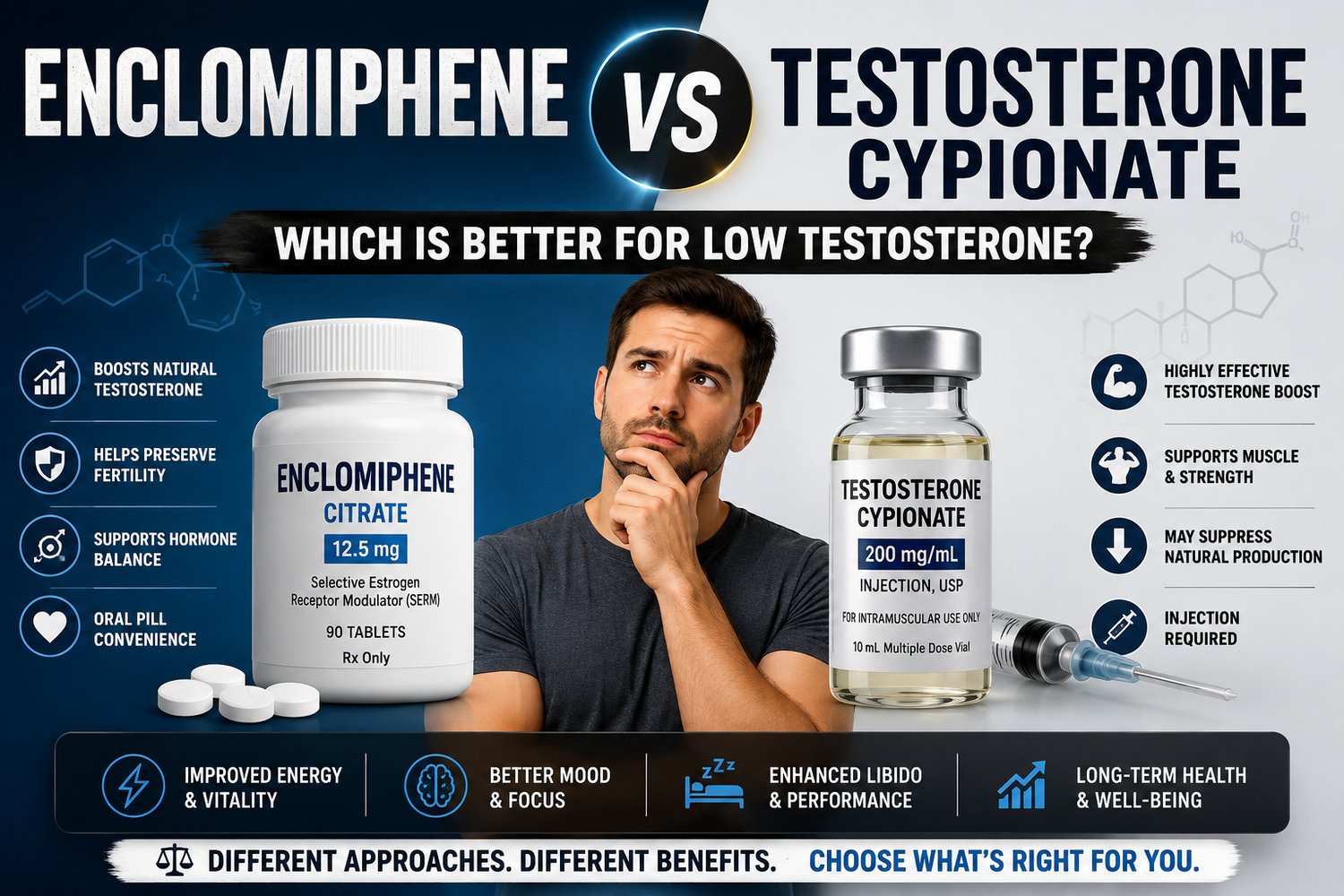
Enclomiphene vs Testosterone Cypionate: Which Is Better for Low Testosterone?
Men diagnosed with low testosterone increasingly encounter two very different treatment strategies:
Testosterone cypionate injections
and:
Enclomiphene
Both can raise testosterone.
But they do it in almost opposite ways.
Testosterone cypionate supplies testosterone from outside the body.
Enclomiphene stimulates the hormonal signaling that tells your testes to produce more testosterone themselves.
That difference affects:
- LH and FSH
- Sperm production
- Fertility
- Testicular function
- Which types of hypogonadism are likely to respond
- Monitoring
- Long-term treatment decisions
So asking:
“Which raises testosterone more?”
misses much of the point.
A better question is:
“Why is my testosterone low, and do I want to replace testosterone or stimulate my own production?”
For some men, injectable testosterone is the much more logical treatment.
For others—particularly men with certain forms of secondary or functional hypogonadism who want to preserve fertility—an approach that stimulates endogenous testosterone production may deserve discussion.
If you're still trying to understand whether you actually have testosterone deficiency, start with:
This comparison makes much more sense once the diagnosis and underlying cause are clear.
Enclomiphene vs Testosterone: The Quick Answer
Here's the simplest way to think about the difference.
Testosterone Cypionate
Replaces testosterone directly.
Injected testosterone raises circulating testosterone regardless of whether the testes are capable of producing enough on their own.
That makes testosterone replacement useful in both:
- Primary hypogonadism
- Certain forms of secondary hypogonadism
But external testosterone also suppresses the brain-to-testes signaling system.
LH and FSH generally fall.
Sperm production can fall dramatically as well.
Enclomiphene
Attempts to stimulate your own testosterone production.
Enclomiphene acts as a selective estrogen receptor modulator, or SERM.
By reducing estrogen's negative-feedback signaling at the hypothalamus and pituitary, it can increase:
- LH
- FSH
LH then tells the Leydig cells in the testes to produce more testosterone.
FSH contributes to sperm production.
That makes enclomiphene fundamentally different from TRT.
It depends on having a hormonal system that can still respond to increased stimulation.
The Biggest Difference: Replacement vs Restoration
This is really the heart of the comparison.
Imagine the reproductive hormone system as a communication chain:
Hypothalamus → Pituitary → LH/FSH → Testes → Testosterone + Sperm
Testosterone cypionate enters the system near the end.
You're supplying testosterone directly.
Enclomiphene works much farther upstream.
You're trying to increase the body's signal to the testes.
That means these treatments are not interchangeable solutions for every form of low testosterone.
How Testosterone Cypionate Works
Testosterone cypionate is an ester of testosterone formulated for injection.
Once administered, the ester is gradually released and converted into active testosterone.
The medication is FDA-approved as testosterone replacement for men with certain conditions associated with deficient or absent endogenous testosterone, including primary hypogonadism and hypogonadotropic hypogonadism.
In practical terms:
You inject testosterone → blood testosterone rises.
Your testes do not have to produce that testosterone.
That's one reason TRT can work even when testicular function itself is impaired.
What Happens to LH and FSH on Testosterone?
Your brain monitors circulating sex hormones through a feedback system.
When sufficient external testosterone is present, the hypothalamus and pituitary essentially receive the message:
“We have enough androgen.”
The pituitary then reduces LH and FSH signaling.
The current testosterone-cypionate label explicitly notes that exogenous androgens inhibit endogenous testosterone release through suppression of pituitary LH and can also suppress spermatogenesis through inhibition of FSH.
That's not an accidental side effect.
It's basic endocrine feedback.
What Is Enclomiphene?
Enclomiphene is one of the isomers contained within clomiphene citrate.
Clomiphene contains:
- Enclomiphene
- Zuclomiphene
Enclomiphene has attracted interest in men's health because of its ability to stimulate the hypothalamic-pituitary-gonadal axis.
Instead of supplying testosterone directly, it changes estrogen-feedback signaling at the hypothalamus and pituitary.
That can increase:
LH → more testicular testosterone production
and:
FSH → continued support of spermatogenesis
This makes enclomiphene particularly interesting in men with secondary or functional hypogonadism.
Is Enclomiphene FDA Approved?
No.
This distinction needs to be extremely clear.
There is currently no FDA-approved enclomiphene drug for male hypogonadism in the United States.
FDA stated during its review of enclomiphene for compounding that no FDA-approved drug contains enclomiphene.
Some men's-health and telehealth clinics offer compounded enclomiphene.
Compounded medications are not FDA-approved products, and FDA does not evaluate compounded products for safety, effectiveness, or quality before they reach patients in the same way it evaluates approved drugs.
That doesn't automatically mean compounded treatment is inappropriate.
It means patients should understand the regulatory difference.
FDA-approved testosterone cypionate and compounded enclomiphene are not equivalent regulatory products.
Is Enclomiphene the Same as Clomiphene?
No.
They're closely related, but not identical.
Clomiphene citrate contains two stereoisomers:
- Enclomiphene
- Zuclomiphene
Enclomiphene is the trans-isomer generally associated with the testosterone-stimulating effects that have attracted interest in male hypogonadism.
Clomiphene itself has long been used off-label in men for fertility and testosterone-related indications.
Enclomiphene attempts to isolate the component believed to provide much of the desired endocrine effect.
But the evidence base and regulatory history for the two treatments aren't identical.
Don't automatically treat:
clomiphene studies
and:
enclomiphene studies
as perfectly interchangeable.
What Does the Research on Enclomiphene Show?
The evidence is genuinely interesting.
In randomized trials of men with secondary hypogonadism, enclomiphene increased serum testosterone while also increasing or maintaining:
- LH
- FSH
- Sperm production
Testosterone gel increased testosterone too—but suppressed gonadotropins and reduced sperm concentration.
A 2025 systematic review and meta-analysis of randomized controlled trials examining clomiphene and enclomiphene found SERM therapy significantly increased:
- Total testosterone
- LH
- FSH
compared with placebo.
The analysis found no significant difference in total testosterone between SERM treatment and testosterone gel, although LH and FSH remained substantially higher with SERM therapy.
That's a very important result.
But it does not mean:
“Enclomiphene is proven to be better than TRT.”
The outcomes are different.
And the evidence base for standard testosterone replacement is considerably broader.
The Fertility Difference Is Huge
If future fertility matters, this may be the most important section of the article.
Exogenous testosterone can substantially suppress sperm production.
The American Urological Association states that exogenous testosterone should not be prescribed to men currently trying to conceive because it can interrupt spermatogenesis and produce severe oligospermia or even azoospermia.
The AUA/ASRM male-infertility guideline makes the distinction even clearer:
Men interested in current or future fertility should not receive exogenous testosterone as the default approach because suppressing LH and FSH can reduce or completely stop sperm production.
Enclomiphene Usually Preserves the Signals Needed for Sperm Production
This is where enclomiphene behaves very differently.
Randomized enclomiphene trials found that testosterone increased while:
- LH increased
- FSH increased
- Sperm counts were preserved
compared with testosterone therapy.
That makes an endogenous-stimulation strategy especially interesting for men who:
- Have low testosterone
- Have potentially responsive testes
- Want to preserve fertility
- Are planning children
- Don't want to suppress sperm production unnecessarily
But:
Preserving fertility is not the same as guaranteeing fertility.
Male fertility can be affected by many other factors.
Testosterone Doesn't Necessarily Make You Permanently Infertile
This myth deserves nuance too.
Testosterone therapy can suppress spermatogenesis significantly.
After stopping exogenous testosterone, many men eventually recover sperm production.
But recovery can take:
- Months
- Occasionally much longer
and may not be complete in every man.
The AUA/ASRM guideline notes that sperm recovery after testosterone cessation can be prolonged and, rarely, may take years; some men may remain subfertile and require fertility treatment.
So the right conversation is not:
“TRT makes you permanently infertile.”
It's:
“TRT can strongly suppress fertility, and recovery isn't immediate or perfectly predictable.”
Who Is More Likely to Respond to Enclomiphene?
Enclomiphene depends on the testes being capable of producing testosterone when given enough stimulation.
That's why it makes the most biological sense in secondary or functional hypogonadism.
In that situation:
- Testosterone is low
- LH may be low or inappropriately normal
- Testicular testosterone production may still be capable of increasing
Increase LH signaling and the testes may respond.
What Is Secondary Hypogonadism?
Secondary hypogonadism means the primary problem is higher in the signaling pathway.
The hypothalamus or pituitary isn't sending enough stimulation to the testes.
Possible contributors can include:
- Obesity
- Certain medications
- Hyperprolactinemia
- Pituitary disease
- Other functional or medical causes
The laboratory pattern often looks like:
Low testosterone + low or inappropriately normal LH
That's different from primary testicular failure.
Read What Causes Low Testosterone? for the full distinction.
Who May Not Respond Well to Enclomiphene?
A man with primary hypogonadism is a much less obvious candidate.
In primary hypogonadism, the problem lies mainly in the testes.
The pituitary may already be shouting:
“MAKE MORE TESTOSTERONE.”
LH may already be elevated.
If the testes cannot respond adequately, increasing that signal further may not solve the problem.
The AUA makes this same point for SERMs: men with elevated LH suggesting primary testicular dysfunction may have a limited testosterone response because increasing pituitary stimulation cannot repair impaired testicular function.
This is exactly why checking LH after confirming low testosterone can matter.
Primary vs Secondary Hypogonadism Changes the Treatment Conversation
Imagine two men.
Man A
Testosterone: low
LH: low-normal
Testicular function: potentially intact
Fertility: important
An endogenous-stimulation strategy may be worth discussing.
Man B
Testosterone: low
LH: already high
Testes: not responding adequately
Trying to stimulate the testes harder may accomplish little.
Direct testosterone replacement may make much more sense.
Same symptom:
Low testosterone.
Different physiology.
Different treatment.
Which Raises Testosterone More?
Both can raise testosterone substantially.
That's why comparing only the testosterone number isn't particularly useful.
In randomized studies, enclomiphene produced testosterone levels similar to topical testosterone treatment.
But the hormonal pattern underneath was completely different.
Testosterone Therapy
Testosterone ↑
LH ↓
FSH ↓
Sperm production may ↓
Enclomiphene
Testosterone ↑
LH ↑
FSH ↑
Sperm production generally preserved in the trials
That's the comparison that matters.
Which Is Better for Symptoms?
This is where the evidence becomes less satisfying.
We have good evidence that enclomiphene can raise testosterone.
We have evidence that it preserves gonadotropins and sperm production.
But:
A higher testosterone number isn't the only outcome that matters.
The AUA infertility guideline explicitly cautions that although SERMs can increase endogenous testosterone, their symptomatic benefits should not automatically be assumed to be equivalent to those of standard exogenous testosterone therapy.
That's an important limitation.
A man doesn't seek treatment because he wants to win a laboratory contest.
He usually wants improvement in things like:
- Libido
- Sexual symptoms
- Energy
- Other clinically relevant symptoms
More long-term head-to-head symptom data would be useful.
Testosterone Cypionate Has a Much Longer Clinical Track Record
Testosterone replacement has been used for decades.
That gives clinicians far more experience with:
- Dosing
- Monitoring
- Safety
- Symptom response
- Long-term management
- Different formulations
Testosterone cypionate is also an FDA-approved prescription drug for specified forms of male hypogonadism.
Enclomiphene simply doesn't have that same regulatory or long-term clinical foundation.
So:
“Enclomiphene preserves fertility”
shouldn't be turned into:
“Therefore enclomiphene is the superior testosterone treatment.”
Different strengths.
Different weaknesses.
Which Is More Predictable?
Generally:
Testosterone replacement.
Why?
Because you're directly supplying testosterone.
You don't depend as heavily on:
- Pituitary responsiveness
- Testicular responsiveness
- The cause of secondary suppression
With enclomiphene, you're asking the existing hormonal system to produce more testosterone.
That works only if the system retains enough capacity to respond.
Which Is Better if the Testes Can't Produce Enough Testosterone?
Usually testosterone replacement has the clearer biological rationale.
If the testes are unable to produce adequate testosterone because of:
- Testicular damage
- Certain genetic disorders
- Surgical removal
- Other primary testicular causes
more LH stimulation may not fix the underlying problem.
You're trying to turn up the thermostat on a furnace that can't produce enough heat.
Direct replacement bypasses that problem.
Which Is Better if Fertility Matters?
This is where enclomiphene or another fertility-preserving strategy may have the stronger argument.
If you're:
- Trying to conceive now
- Planning children soon
- Concerned about maintaining sperm production
starting exogenous testosterone without discussing fertility first is a poor idea.
The AUA strongly recommends against exogenous testosterone in men actively trying to conceive.
Potential fertility-preserving approaches may include clinician-supervised use of:
- SERMs
- hCG
- Aromatase inhibitors in selected circumstances
- Other fertility-directed treatment
depending on the underlying cause.
What About hCG?
Human chorionic gonadotropin, or hCG, acts similarly to LH.
It directly stimulates Leydig cells in the testes to produce testosterone.
That gives hCG another place in the fertility-preserving treatment conversation.
The AUA/ASRM guideline notes that clinicians may use:
- hCG
- SERMs
- Aromatase inhibitors
- Or combinations
in selected infertile men with low testosterone.
That's another reason “TRT vs enclomiphene” shouldn't be treated as the only two choices in existence.
Male reproductive endocrinology has more than two buttons.
Is Enclomiphene “Natural TRT”?
No.
This phrase is misleading.
Enclomiphene is a pharmaceutical medication that changes estrogen receptor signaling.
It may stimulate endogenous testosterone production.
That's different from being:
natural.
A better description is:
A non-testosterone pharmaceutical approach intended to stimulate endogenous testosterone production.
Less catchy.
Much more accurate.
Does Enclomiphene Shut Down Natural Testosterone Production?
Its mechanism is essentially the opposite.
Enclomiphene increases pituitary signaling, which can increase endogenous testosterone production.
Randomized studies observed increases in LH and FSH rather than the suppression seen with exogenous testosterone.
Again, that assumes the testes can respond.
Does Testosterone Cypionate Shut Down Natural Production?
Generally, yes while treatment is active.
External testosterone suppresses pituitary LH.
When LH falls, intratesticular testosterone production falls.
FSH suppression can also impair spermatogenesis.
The official testosterone-cypionate labeling describes this feedback suppression.
That's expected physiology.
What Happens to Testicular Size on TRT?
Because testicular stimulation decreases during exogenous testosterone therapy, some men experience:
- Reduced testicular volume
- Reduced sperm production
The degree varies.
This is another reason fertility and reproductive goals belong in the treatment conversation before therapy begins rather than after.
What Happens to Testicular Size on Enclomiphene?
Because LH and FSH stimulation are maintained or increased, enclomiphene does not create the same expected gonadotropin suppression as exogenous testosterone.
That makes testicular function one of the theoretical and practical advantages of the approach.
But long-term outcomes remain less comprehensively characterized than those of standard TRT.
Enclomiphene Is Oral
For some men, this is a major appeal.
No:
- Needles
- Syringes
- Injection technique
- Injection-site discomfort
That may improve adherence for men who dislike injections.
But convenience isn't the same thing as clinical superiority.
A pill that doesn't fit your type of hypogonadism is not better treatment because it's easier to swallow.
Testosterone Cypionate Requires Injections
Testosterone cypionate is generally administered by injection.
That involves:
- Medication handling
- Syringes and needles
- Injection technique
- Proper disposal
- Ongoing dosing schedule
Some men barely care.
Others hate needles.
Treatment preferences matter because hypogonadism management may continue for years.
What About Testosterone Gels?
Not every man using exogenous testosterone uses cypionate.
Other forms include:
- Gels
- Patches
- Other injections
- Nasal formulations
- Pellets
- Other products
Much of the enclomiphene clinical research actually compared enclomiphene with testosterone gel, not injectable testosterone cypionate.
That's an important evidence limitation.
We can compare the physiology of enclomiphene and exogenous testosterone confidently.
But readers should not assume every head-to-head trial specifically tested enclomiphene against testosterone cypionate injections.
What Are the Main Testosterone Cypionate Risks?
Testosterone therapy requires monitoring because potential issues can include:
- Elevated hematocrit
- Acne
- Fluid retention
- Gynecomastia
- Reduced sperm production
- Testicular suppression
- Injection-site reactions
- Blood-pressure concerns
- Other individualized risks
The current testosterone-cypionate labeling specifically calls for periodic hemoglobin and hematocrit monitoring to detect polycythemia.
Read What Is TRT? for the broader safety discussion.
What Are the Main Enclomiphene Risks?
This is an area where the evidence base is less mature.
Potential concerns with SERM therapy can include:
- Headache
- Mood changes
- Visual symptoms
- Changes in estradiol
- Other medication-related adverse effects
Because enclomiphene lacks FDA approval for male hypogonadism and long-term outcome data are more limited, its risk profile isn't characterized as comprehensively as standard testosterone therapy.
That doesn't mean:
“Enclomiphene is dangerous.”
It means:
“Less long-term evidence exists.”
Those are different statements.
What Happens to Estradiol?
This matters with both approaches.
Some testosterone is converted into estradiol through aromatase.
So when testosterone rises, estradiol may rise too.
That can happen whether testosterone increased because you:
- Injected testosterone
- Stimulated your testes to produce more
An elevated estradiol result by itself doesn't automatically mean treatment needs an aromatase inhibitor.
Symptoms, level, treatment context, and clinician judgment matter.
Do not automatically treat every estradiol number.
Does Enclomiphene Cause High Estrogen?
It can increase estradiol because it increases endogenous testosterone production and some testosterone is aromatized.
That isn't necessarily a treatment failure.
Estradiol has important physiological roles in men.
The goal isn't:
“Get testosterone high and estrogen as close to zero as possible.”
That is not normal male physiology.
What Bloodwork Matters Before Choosing?
Before arguing about:
enclomiphene vs injections
first establish whether low testosterone has actually been diagnosed correctly.
Useful evaluation may include:
- Repeat morning total testosterone
- LH
- FSH
- Free testosterone or SHBG when appropriate
- Prolactin when indicated
- Other testing based on the suspected cause
Read How Testosterone Is Tested and Diagnosed.
For the broader laboratory picture, see Blood Work for Men.
And visit the Men's Bloodwork Hub for testing resources.
LH May Be Especially Important Here
If you're choosing between:
stimulate production
and:
replace testosterone
LH provides useful information.
Low Testosterone + Low/Normal LH
May suggest secondary hypogonadism.
Endogenous stimulation may deserve consideration depending on the cause.
Low Testosterone + High LH
Suggests the pituitary is already trying to stimulate the testes.
The testes may not be responding adequately.
A SERM may have much less ability to increase testosterone in that situation.
The AUA specifically notes this distinction when discussing SERM treatment.
You Still Need to Determine Why Testosterone Is Low
This is worth repeating.
Secondary hypogonadism isn't one disease.
Possible causes include:
- Obesity
- Sleep disorders
- Certain medications
- Pituitary disorders
- Hyperprolactinemia
- Significant illness
- Other factors
Some contributors may be reversible.
Others require specific medical treatment.
Taking enclomiphene because:
“LH is low”
without understanding why LH is low can skip an important part of the evaluation.
Read What Causes Low Testosterone?.
Could Weight Loss Restore Testosterone Without Either Medication?
Sometimes.
Obesity-related functional hypogonadism can improve with substantial weight loss in some men.
That doesn't mean every overweight man can reverse hypogonadism through lifestyle.
But if a reversible contributor exists, treating it may improve the underlying physiology.
That's very different from permanent primary testicular failure.
Read How to Support Testosterone Naturally.
Could Sleep Apnea Be Part of the Problem?
Absolutely.
Sleep apnea can overlap with:
- Obesity
- Fatigue
- Low libido
- Reduced energy
- Lower testosterone
A man can arrive at a TRT clinic convinced:
“My testosterone is making me exhausted.”
when untreated sleep apnea is contributing substantially.
If you:
- Snore loudly
- Gasp during sleep
- Have witnessed breathing pauses
- Wake exhausted
investigate the sleep issue.
Read Sleep for Men.
Which Treatment Is Better for Muscle?
If both treatments raise testosterone into an appropriate physiological range, you'd expect testosterone-dependent tissues to respond to androgen exposure.
But we should be careful here.
The strongest long-term data for changes in:
- Lean mass
- Body composition
- Bone
- Other androgen-responsive outcomes
exist for standard testosterone therapy.
Enclomiphene trials have focused heavily on:
- Testosterone
- LH
- FSH
- Sperm counts
So I would not claim enclomiphene and testosterone cypionate are proven equivalent for muscle or body-composition outcomes simply because both can normalize total testosterone.
Lab equivalence does not automatically equal clinical-outcome equivalence.
Which Is Better for Libido?
Same caution.
Low testosterone can contribute to low libido.
Correcting testosterone deficiency may improve sexual symptoms.
But current evidence does not justify assuming:
Enclomiphene testosterone of 600 = testosterone-cypionate testosterone of 600 = identical symptom response in every man.
Symptoms should actually be followed.
Not inferred from the number.
Which Is Better for Energy?
Neither medication is an energy drug.
If testosterone deficiency genuinely contributes to fatigue, correcting the deficiency may help.
But persistent fatigue can also come from:
- Sleep apnea
- Poor sleep
- Depression
- Anemia
- Thyroid disease
- Medication effects
- Chronic illness
- Inadequate nutrition
If your testosterone improves and you're still exhausted:
Don't simply keep escalating hormone treatment.
Look for the other cause.
Which Is Better for Long-Term Treatment?
There is no universal winner.
Testosterone Cypionate Has Advantages
- FDA-approved for specified forms of hypogonadism
- Long clinical track record
- Predictable testosterone replacement
- Works even when endogenous production is impaired
- Extensive monitoring experience
Enclomiphene Has Advantages
- Oral
- Stimulates endogenous testosterone
- Maintains LH and FSH
- Has preserved sperm production in clinical trials
- Particularly interesting in secondary/functional hypogonadism
Enclomiphene Has Limitations
- Not FDA-approved for male hypogonadism
- Frequently supplied as a compounded medication
- Smaller evidence base
- Less long-term safety/outcome data
- Depends on functional testicular response
Testosterone Has Limitations
- Suppresses endogenous LH/FSH
- Can suppress spermatogenesis
- Can reduce testicular function while treatment is active
- Requires ongoing monitoring
- Injection burden if using cypionate
That's the actual comparison.
Enclomiphene vs Testosterone Cypionate: Side-by-Side
Mechanism
Enclomiphene: Stimulates endogenous hormone signaling.
Testosterone cypionate: Supplies exogenous testosterone.
Testosterone
Enclomiphene: Can raise endogenous testosterone.
Cypionate: Directly raises testosterone.
LH
Enclomiphene: Usually rises.
Cypionate: Usually suppressed.
FSH
Enclomiphene: Usually maintained or increased.
Cypionate: Usually suppressed.
Sperm Production
Enclomiphene: Preserved in randomized trials.
Cypionate: Can decline substantially.
Fertility
Enclomiphene: Potentially much more fertility-friendly in appropriately selected men.
Cypionate: Poor choice when actively trying to conceive.
Primary Testicular Failure
Enclomiphene: Often limited because the testes may not respond.
Cypionate: Can directly replace deficient testosterone.
Administration
Enclomiphene: Oral.
Cypionate: Injection.
FDA Approval for Male Hypogonadism
Enclomiphene: No.
Cypionate: Yes, for specified hypogonadal conditions.
Evidence Base
Enclomiphene: Promising but smaller.
Cypionate/TRT: Much broader and longer established.
So Which Is Better?
It depends on the problem.
Enclomiphene May Make More Sense When:
- Secondary or functional hypogonadism is present
- Testes appear capable of responding
- LH is low or inappropriately normal
- Fertility matters
- Preserving sperm production is a priority
- An oral treatment is preferred
- The patient understands its non-FDA-approved status
Testosterone Cypionate May Make More Sense When:
- Primary hypogonadism is present
- Testicular production cannot adequately respond
- Fertility isn't currently a priority
- Direct replacement is medically appropriate
- Predictable replacement is preferred
- Long-established treatment is important to the patient
Neither list replaces individualized medical evaluation.
What If You're Done Having Children?
Then fertility preservation may matter much less to you.
That shifts one of enclomiphene's biggest advantages.
Now the decision may place more weight on:
- Symptom response
- Cause of hypogonadism
- Predictability
- Convenience
- Side effects
- Cost
- Long-term evidence
For a man with no fertility concerns and genuine hypogonadism, standard testosterone replacement can be a very reasonable treatment.
What If You Might Want Children Later?
Don't ignore that because:
“That's five years away.”
Exogenous testosterone can suppress sperm production substantially.
Recovery after stopping can take months and occasionally much longer.
Discuss fertility before treatment starts.
Options might include:
- Choosing a fertility-preserving treatment strategy
- Semen analysis
- Sperm banking in selected circumstances
- Fertility consultation
depending on your goals.
It's easier to plan ahead than solve the problem afterward.
What If You're Already on TRT and Want Fertility?
Don't stop testosterone abruptly based on an internet article.
Men who want to restore fertility after exogenous testosterone use may require individualized treatment involving a reproductive urologist or endocrinologist.
Strategies can involve:
- Stopping exogenous testosterone
- hCG
- SERMs
- FSH-based treatment
- Other approaches
depending on the situation.
The recovery timeline varies.
Get a fertility-specific plan.
Enclomiphene Is Not Automatically Better Just Because It Preserves Fertility
This is an easy trap.
Preserving:
- LH
- FSH
- Sperm production
is valuable.
But that doesn't automatically make enclomiphene the superior treatment for every man with low testosterone.
If your testes cannot respond effectively:
It may not solve the problem.
If symptom response is inadequate:
A beautiful testosterone result isn't enough.
If you're receiving compounded treatment:
The regulatory and quality considerations are different.
Treatment should fit the diagnosis.
Testosterone Is Not Automatically Better Because It's “Real TRT”
The opposite mistake happens too.
Some men's-health discussions treat anything other than testosterone injections as:
Not real treatment.
That's not useful either.
For selected men—especially those with secondary hypogonadism and fertility goals—stimulating endogenous testosterone can be a rational medical strategy.
The question isn't:
Which camp are you in?
It's:
Which physiology are you treating?
What Should You Ask a TRT or Men's Health Provider?
If you're comparing treatment programs, ask:
How Was My Low Testosterone Confirmed?
One random test isn't enough.
What Do My LH and FSH Suggest?
This helps distinguish primary from secondary causes.
Why Are You Recommending This Treatment?
There should be an answer beyond:
“Your testosterone is below our target.”
How Will This Affect Fertility?
Especially if children are possible in the future.
Is Enclomiphene Compounded?
If yes, understand what that means.
What Monitoring Will I Need?
Treatment isn't:
Prescription → disappear forever.
What Happens if Symptoms Don't Improve?
A treatment plan should follow clinical response, not only testosterone numbers.
Comparing Online Testosterone Treatment?
If you've already completed appropriate testing and are researching treatment services, HabitLogics maintains a comparison of online TRT options, pricing structures, lab requirements, and treatment features.
Some providers may offer testosterone cypionate, enclomiphene, or other hormone-related treatments.
Availability and appropriateness vary by provider, state, diagnosis, and clinician review.
HabitLogics may earn a commission if you purchase through links on our TRT provider page, at no additional cost to you.
Don't Pick a Provider Based Only on Which Drug You Want
This matters.
Don't decide:
“I want enclomiphene.”
and then search for someone willing to prescribe it.
Likewise:
“I want injections.”
The correct order is:
Symptoms → testing → confirm deficiency → determine cause → discuss fertility → choose treatment.
Not:
Choose drug → find clinic → construct diagnosis around it.
Cost Can Differ Considerably
The financial comparison isn't only:
pill vs vial.
Depending on the provider, cost may include:
- Medication
- Labs
- Consultation
- Follow-up
- Injection supplies
- Shipping
- Membership fees
- Additional medications
That's why we're also building a dedicated guide to:
How Much Does TRT Cost?
The advertised monthly number isn't always the total treatment cost.
Monitoring Isn't Identical
Different treatments create different monitoring priorities.
Testosterone Cypionate
Monitoring may include:
- Testosterone
- Hemoglobin
- Hematocrit
- Blood pressure
- Symptoms
- PSA when appropriate
- Other individualized markers
The official testosterone-cypionate label specifically calls for periodic hemoglobin and hematocrit testing.
Enclomiphene
Depending on the situation, monitoring may include:
- Testosterone
- LH
- FSH
- Estradiol when clinically relevant
- Symptoms
- Fertility parameters when fertility is a goal
- Other individualized markers
This will be covered in more detail in the upcoming dedicated TRT Labs guide.
Frequently Asked Questions
Is Enclomiphene Better Than Testosterone?
Not universally.
Enclomiphene may be especially attractive for selected men with secondary hypogonadism who want to preserve fertility.
Testosterone replacement may be more appropriate when endogenous testosterone production cannot adequately respond or when standard replacement offers a more predictable treatment strategy.
Does Enclomiphene Increase Testosterone?
Yes.
Randomized trials and a 2025 meta-analysis found that enclomiphene/SERM therapy significantly increases total testosterone in men with functional or secondary hypogonadism.
Does Enclomiphene Preserve Fertility?
Clinical trials found that enclomiphene maintained sperm counts while increasing testosterone, LH, and FSH.
That makes it substantially different from exogenous testosterone.
It does not guarantee fertility in every man.
Does Testosterone Cypionate Cause Infertility?
It can strongly suppress sperm production.
AUA guidance states that exogenous testosterone should not be used by men actively trying to conceive.
Suppression may be reversible after stopping, but recovery can take months or longer and isn't perfectly predictable.
Is Enclomiphene FDA Approved?
No.
FDA has stated that no FDA-approved drug contains enclomiphene.
Products currently offered through some clinics are compounded rather than FDA-approved enclomiphene drugs.
Is Testosterone Cypionate FDA Approved?
Yes.
Testosterone cypionate is an FDA-approved prescription testosterone product indicated for replacement therapy in specified conditions involving deficient or absent endogenous testosterone.
Does Enclomiphene Shut Down LH and FSH?
No.
Its intended mechanism increases pituitary signaling, and clinical trials found increases in LH and FSH.
That's one of its major differences from exogenous testosterone.
Does TRT Shut Down LH and FSH?
Exogenous testosterone suppresses hypothalamic-pituitary signaling.
That commonly reduces LH and FSH and can reduce endogenous testosterone production and spermatogenesis.
Can Enclomiphene Work for Primary Hypogonadism?
It may be much less effective when the testes themselves cannot adequately respond.
The AUA notes that men with high LH suggesting testicular dysfunction may have limited response to SERM therapy.
Can Enclomiphene Replace TRT?
For some selected men, it may provide an alternative strategy.
It should not be viewed as a universal replacement for testosterone therapy.
The cause of testosterone deficiency and fertility goals matter enormously.
Is Enclomiphene Safer Than TRT?
We don't have enough evidence to make that blanket claim.
Enclomiphene avoids several consequences of exogenous testosterone—most notably gonadotropin and sperm suppression—but its long-term safety evidence is less extensive, and enclomiphene is not FDA-approved for male hypogonadism.
Key Takeaways
- Enclomiphene and testosterone cypionate can both raise testosterone, but they work very differently.
- Testosterone cypionate directly replaces testosterone.
- Enclomiphene stimulates endogenous testosterone production by increasing pituitary LH and FSH signaling.
- Exogenous testosterone generally suppresses LH and FSH.
- Testosterone therapy can substantially suppress sperm production and should not be used by men actively trying to conceive.
- Enclomiphene preserved sperm counts in randomized clinical trials while increasing testosterone, LH, and FSH.
- Enclomiphene makes the most biological sense when testicular function remains responsive, particularly in certain forms of secondary or functional hypogonadism.
- Men with primary testicular failure may have limited response to SERM stimulation.
- Testosterone cypionate has a longer clinical track record and FDA approval for specified forms of hypogonadism.
- Enclomiphene is not FDA-approved for male hypogonadism in the United States.
- Compounded enclomiphene products are not FDA-approved.
- Fertility goals should be discussed before starting testosterone treatment.
- A testosterone number alone should not determine the treatment.
- The correct sequence is diagnosis → cause → fertility goals → treatment.
Final Thoughts
Enclomiphene versus testosterone cypionate isn't really:
pill vs injection.
It's:
stimulate vs replace.
That's the distinction that matters.
If your testes can still produce adequate testosterone when properly stimulated—and preserving fertility matters—an endogenous-stimulation strategy may deserve serious consideration.
If your testes cannot produce enough testosterone even with adequate signaling, directly replacing testosterone makes considerably more biological sense.
And if fertility isn't important, that changes the tradeoff again.
Don't choose treatment because:
one clinic markets enclomiphene as “natural TRT.”
Don't choose injections because:
that's what everybody online calls real TRT.
Find out:
Why is testosterone low?
What do LH and FSH show?
Does fertility matter?
Can the testes respond?
What outcomes are you actually trying to improve?
Then choose the treatment that matches the physiology.
That's the useful comparison.
Continue the Testosterone & TRT Series
Understand the diagnosis first:
Understand TRT:
- What Is TRT? Testosterone Replacement Therapy Explained
- How to Support Testosterone Naturally
- Testosterone Myths
For bloodwork:
If you've completed appropriate evaluation and are comparing treatment services:
Coming next in the TRT expansion: How Much Does TRT Cost? Medication, Labs, Visits & Hidden Expenses.
Affiliate Disclosure
Some links in this article may be affiliate links. If you purchase through one of these links, HabitLogics may earn a commission at no additional cost to you. Affiliate relationships do not determine whether a treatment is medically appropriate.
Educational Disclaimer
This article is intended for educational purposes only and should not be considered medical advice. Testosterone deficiency requires appropriate clinical diagnosis, and treatment depends on the underlying cause, symptoms, fertility goals, medical history, laboratory results, and individual risks. Enclomiphene is not FDA-approved for male hypogonadism in the United States, and compounded medications are not FDA-approved. Exogenous testosterone can suppress sperm production and fertility. Do not start, stop, or change testosterone, enclomiphene, fertility medication, or other hormone treatment without guidance from a qualified healthcare professional.