

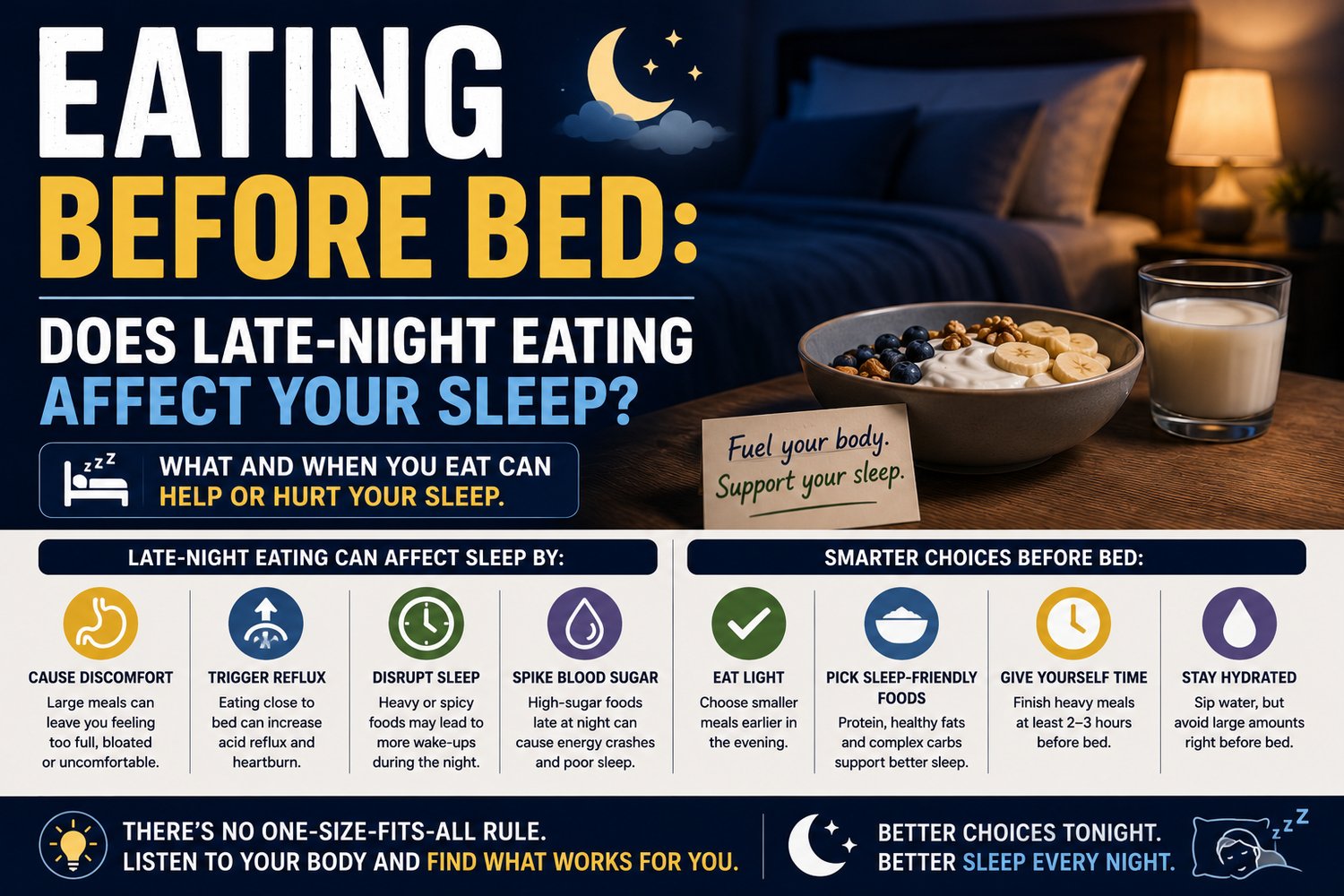
Eating Before Bed: Does Late-Night Eating Affect Your Sleep?
The Complete Sleep & Recovery Guide
You've probably heard some version of this rule:
Never eat before bed.
Or:
Stop eating after 7 p.m.
Or:
Eating late ruins your sleep.
Like a lot of nutrition advice, there's a useful idea buried inside a rule that became much more absolute than the evidence really supports.
Eating a large, heavy meal close to bedtime can make sleep harder for some people, especially if it causes discomfort or worsens acid reflux. NHLBI recommends avoiding heavy or large meals within a few hours of bedtime, while noting that a light snack is generally okay.
But that doesn't mean every calorie consumed after 7 p.m. suddenly becomes a sleep problem.
The more useful questions are:
How much are you eating?
How close to bed are you eating it?
Are you actually hungry?
Does eating late cause reflux or discomfort?
Does late-night eating keep you awake—or does going to bed hungry do that instead?
Let's separate useful sleep advice from another arbitrary food rule.
Does Eating Before Bed Affect Sleep?
It can.
But the relationship is more complicated than:
late food = bad sleep.
Research has found associations between later meal timing and poorer sleep quality in some populations. A 2024 study, for example, found that later meal timing and more frequent eating occasions were associated with poorer self-reported sleep quality.
Another study found that eating closer to bedtime was associated with more nighttime awakenings, although the authors emphasized that the research was preliminary and observational.
That's important.
An association doesn't prove that late eating directly caused the sleep problem.
People who eat late may also:
Stay awake later.
Have different work schedules.
Use more caffeine.
Drink alcohol.
Have irregular sleep schedules.
Experience more stress.
So we shouldn't turn observational findings into:
Eating at 9:03 p.m. biologically destroys sleep.
The practical evidence is much simpler:
Large late meals can be uncomfortable and may interfere with sleep, while lighter food closer to bed may be perfectly reasonable for many people.
Meal Size Matters
There's a big difference between:
a banana and yogurt
and
a cheeseburger, fries, wings and half a pizza.
Yet both could technically be described as:
eating before bed.
That's why meal size matters.
NHLBI specifically recommends avoiding heavy or large meals within a few hours of bedtime.
A big meal can leave you:
Overly full.
Bloated.
Uncomfortable.
Hot.
Dealing with reflux.
Trying to lie down while your digestive system is dealing with a major workload.
That's not necessarily the ideal setup for sleep.
How Long Before Bed Should You Stop Eating?
There is no universal food cutoff that applies to everyone.
For general sleep habits, NHLBI advises avoiding heavy meals within a few hours of bedtime.
For people with nighttime acid reflux or GERD, the advice becomes more specific: NIDDK says that eating meals at least three hours before lying down or going to bed may improve nighttime symptoms.
So a reasonable practical framework is:
Large meal: preferably several hours before bed.
Small snack: may be fine closer to bedtime if you're hungry.
Nighttime reflux: consider a three-hour meal-to-bed gap and discuss persistent symptoms with a healthcare professional.
That's much more useful than:
NO FOOD AFTER 7.
Because bedtime matters.
Someone asleep at:
9 p.m.
and someone asleep at:
1 a.m.
obviously shouldn't be given the exact same clock-based rule.
Is Eating After 8 p.m. Bad?
Not automatically.
The clock doesn't turn food dangerous at 8:01.
If you go to bed at midnight, eating dinner at 8 p.m. leaves several hours before sleep.
That's very different from finishing a huge meal at 11:45 and immediately lying down.
What matters more is:
Timing relative to sleep
rather than:
an arbitrary clock time.
Your schedule matters.
What Happens If You Eat a Big Meal Right Before Bed?
Several things may make sleep less comfortable.
You may experience:
- Fullness
- Bloating
- Reflux
- Heartburn
- Increased thirst
- More bathroom trips depending on what you consumed
- Physical discomfort when lying down
Some research also suggests meal timing may influence sleep architecture.
A controlled crossover study comparing dinner five hours before bedtime with dinner one hour before bedtime found differences in sleep-stage distribution, though the relationship between eating time and sleep remains incompletely understood.
That's a good example of where nuance matters.
There is enough evidence to take late heavy meals seriously.
There isn't enough to conclude that every late meal destroys sleep.
Acid Reflux Changes the Conversation
If you experience nighttime reflux, meal timing becomes more important.
When you lie down soon after eating, stomach contents may be more likely to move upward into the esophagus in people prone to reflux.
NIDDK specifically recommends that people with GERD symptoms at night or while lying down consider eating meals at least three hours before bed.
That means if your sleep is repeatedly interrupted by:
Heartburn.
Burning in your chest.
Sour taste.
Regurgitation.
Throat irritation.
then your evening meal timing deserves attention.
And if those symptoms happen regularly, don't just keep experimenting with sleep habits indefinitely.
Talk with a healthcare professional.
Can Going to Bed Hungry Hurt Sleep Too?
Absolutely.
This is the part that gets lost when people hear:
Never eat before bed.
Going to bed genuinely hungry can also make it harder to settle down.
If you're lying there thinking:
I am starving.
every 30 seconds, that's not particularly sleep-friendly either.
NHLBI explicitly notes that a light snack is okay before bedtime.
So the goal isn't:
Empty stomach at all costs.
The goal is:
Comfort.
Not painfully full.
Not distractingly hungry.
Somewhere in the middle.
What Makes a Good Bedtime Snack?
You don't need a magical "sleep food."
If you're genuinely hungry, keep it small and easy.
Examples might include:
- Yogurt
- A banana
- Fruit with a small amount of nut butter
- A small bowl of oatmeal
- A piece of toast
- Cottage cheese
- A small glass of milk if you tolerate it
- A modest portion of cereal
- A few crackers with cheese
The goal is not:
Engineer the perfect tryptophan-to-magnesium sleep snack.
It's:
Take the edge off hunger without eating another full dinner.
Simple wins.
Do Certain Foods Make You Sleep Better?
Food-and-sleep content gets very enthusiastic about this.
You'll see claims about:
Kiwi.
Tart cherries.
Almonds.
Turkey.
Bananas.
Milk.
Pistachios.
Certain foods contain nutrients related to biological processes involved in sleep.
But that does not mean eating one specific food acts like a sleeping pill.
There is some research on individual foods and sleep outcomes, but the evidence isn't strong enough to tell everyone:
Eat this before bed and you'll sleep better.
Think of food as part of your overall routine—not medication.
What About Carbohydrates Before Bed?
Carbohydrates are another area where online advice becomes strangely absolute.
One camp says:
Never eat carbs at night.
Another says:
Carbs before bed improve sleep.
The real answer depends on your overall diet, portion size, timing and individual response.
You don't need to manipulate nighttime carbohydrate intake purely for sleep unless you've identified an actual reason.
If a normal balanced dinner works well for you:
Keep eating it.
What About Protein Before Bed?
Protein before bed has been studied particularly in the context of muscle protein synthesis and exercise recovery.
For someone training regularly, a modest protein-containing snack may fit their nutrition plan.
That does not automatically mean it improves sleep.
And it doesn't automatically ruin sleep either.
The relevant questions remain:
Is the portion comfortable?
Does it cause reflux?
Does it fit your overall nutrition needs?
Later in this pillar we'll connect sleep more directly to muscle recovery.
For now, don't create a sleep problem where there isn't one.
Fatty Meals Can Feel Heavier
High-fat meals can be slower to leave the stomach and may feel especially heavy for some people when consumed close to bed.
That's another reason a large:
Burger.
Pizza.
Fried-food meal.
or very rich dinner
can feel noticeably different from a small snack.
That doesn't mean dietary fat itself is bad for sleep.
Again:
Amount + timing + individual tolerance.
Spicy Food and Sleep
Spicy food isn't universally bad at night.
But if spicy meals reliably trigger:
Heartburn.
Reflux.
Stomach discomfort.
then eating them shortly before lying down may be a bad strategy for you.
NIDDK advises people with GERD to identify and reduce foods or drinks that worsen their individual symptoms rather than assuming every trigger affects everyone identically.
That's the kind of nutrition advice I like.
Track your actual response.
What About Chocolate?
Chocolate can contain caffeine.
Dark chocolate typically contains more than milk chocolate.
The amount is usually much lower than coffee, but if you're highly caffeine-sensitive and eating a large amount late at night, it's something to keep in mind.
Our guide to Caffeine and Sleep: How Long Does Caffeine Last & When Should You Stop Drinking It? explains why dose and timing matter more than rigid rules.
You probably don't need to fear one chocolate square.
Context matters.
Alcohol With Dinner Is a Separate Issue
Sometimes the apparent:
late dinner problem
is partly an:
alcohol problem.
Alcohol can make you feel sleepy initially while contributing to more disrupted sleep later.
So if your typical late meal includes several drinks, don't automatically blame the food.
Track both variables.
This is another reason changing one thing at a time is useful.
Drinking Too Much Right Before Bed Can Be a Problem Too
Food isn't the only thing going into your body at night.
If you drink enormous amounts of fluid immediately before bed, you may create another issue:
bathroom trips.
NHLBI recommends limiting fluids close to bedtime when nighttime urination is disrupting sleep.
This doesn't mean intentionally dehydrating yourself.
Hydrate normally throughout the day.
Then you don't need to make up your entire fluid intake at 10 p.m.
Late-Night Eating and Night Wakings
One observational study found that eating or drinking within an hour of bedtime was associated with increased odds of waking during the night.
Again:
That doesn't prove eating caused every awakening.
But it's enough to make meal timing worth investigating if nighttime awakenings are already a problem.
If you routinely:
Eat at 10:30.
Go to bed at 11.
Wake repeatedly.
try shifting the meal earlier.
Then compare.
Cheap experiment.
Useful information.
Late Eating and Sleep Quality
A 2024 observational study found later meal timing was associated with poorer sleep-quality scores.
Another study of patients undergoing sleep evaluation found late meal timing was associated with worse sleep-pattern measures, although some differences were of limited clinical significance.
But not every study finds the same relationship. Another 2024 study in university students did not find an independent association between meal timing and sleep quality, while later sleep timing itself was associated with poorer sleep.
That's worth emphasizing.
The science does not justify saying:
Late eating always causes bad sleep.
It does justify saying:
Meal timing may matter, particularly when food is consumed very close to sleep or creates discomfort.
Your Chronotype Can Complicate the Picture
People naturally differ somewhat in when they prefer to sleep and be active.
Someone with a later schedule may naturally eat later too.
That makes observational research tricky.
Did late eating cause late sleep?
Did late sleep cause late eating?
Did another lifestyle factor cause both?
Sometimes the answer isn't obvious.
That's why personal experimentation matters.
Is Late-Night Eating Bad for Weight Loss?
This is related—but separate—from sleep.
Late eating has been associated with several weight-related and metabolic outcomes in observational research.
But it's easy to oversimplify that into:
Food after 8 becomes fat.
That's not how energy balance works.
Late-night eating may become relevant because it can:
Add calories.
Occur when you're less hungry and more habitual.
Involve highly palatable snack foods.
Be tied to irregular schedules.
Overlap with sleep deprivation.
For some people, the issue isn't the clock.
It's what late-night eating does to their overall pattern.
Sleep Loss Can Also Affect Eating
The relationship goes both ways.
Late eating may interact with sleep.
Poor sleep can also influence hunger, appetite and food choices.
That creates a possible loop:
Poor sleep
↓
Low daytime energy
↓
Irregular eating
↓
More evening hunger
↓
Late-night eating
↓
Potentially worse sleep or shorter sleep
↓
Repeat
This doesn't happen to everyone.
But if it sounds familiar, tracking both sleep and eating can be very useful.
That's exactly why the Sleep + Weight Loss System includes sleep, hunger and night-eating tracking together rather than pretending these behaviors exist independently.
Night Eating vs. Normal Evening Hunger
Not every bedtime snack is a problem.
There's a huge difference between:
I'm genuinely hungry, so I'm having yogurt.
and
I eat half a bag of chips every night while watching TV even though I'm not physically hungry.
One is a simple response to hunger.
The other may be a habit worth examining.
Ask:
Am I hungry?
Am I bored?
Am I stressed?
Is this automatic?
Did I barely eat during the day?
You don't need to judge yourself.
You need to identify the pattern.
If You're Starving Every Night, Look at Your Day
Nighttime hunger can sometimes reflect what happened earlier.
Maybe you:
Skipped breakfast.
Barely ate lunch.
Had a tiny dinner.
Trained hard.
Didn't eat enough protein or fiber.
Then by 10 p.m.:
Your body would like to file a complaint.
Instead of repeatedly trying to resist hunger at night, fix the daytime eating pattern.
This is one reason sleep, nutrition and behavior shouldn't be treated as completely separate systems.
Don't Invent a Food Cutoff You Can't Maintain
Suppose somebody tells you:
Never eat after 7 p.m.
But:
You get home from work at 7:30.
That's not practical advice.
A better system might be:
Eat a reasonable dinner at 8.
Avoid turning it into an enormous meal.
Go to bed at 11.
That's completely different from eating a huge dinner immediately before lying down.
Rules need to survive real life.
A Practical Dinner-to-Bedtime Window
If your schedule allows it, finishing a larger dinner a few hours before bedtime is a sensible target.
For example:
Dinner: 7 p.m.
Bedtime: 10:30 p.m.
Perfectly reasonable.
If you're hungry again at 9:45:
Have a small snack.
You do not need to sit there suffering because the internet told you digestion closes at 8.
What If You Must Eat Late?
Sometimes life doesn't cooperate.
You work late.
You train in the evening.
Your shift ends at 10.
You have kids.
You travel.
If you need to eat near bedtime:
Try making the meal:
smaller
less greasy
less likely to trigger reflux
and
comfortable for you
rather than skipping food entirely and going to bed starving.
Health advice should adapt to your schedule.
What If You Exercise Late?
If you train late and need food afterward, don't panic about eating.
Recovery nutrition still matters.
A smaller meal or snack may be more comfortable than an enormous post-workout feast right before sleep.
The best option depends on:
Your training.
Your nutrition needs.
Your bedtime.
Your tolerance.
There's no universal rule.
Should You Eat Before Bed If You're Trying to Build Muscle?
You may have nutrition reasons for doing so.
Pre-sleep protein has been studied in physically active populations, particularly for overnight muscle protein synthesis.
But that's a performance-nutrition question more than a basic sleep question.
If a modest protein snack fits your nutrition plan and does not interfere with sleep:
Fine.
Sleep itself is also essential for recovery.
Later in this pillar we'll cover sleep and muscle recovery directly.
Should You Eat Before Bed If You're Trying to Lose Weight?
You don't need a universal bedtime eating ban.
Weight loss depends on a much larger pattern than the timing of one snack.
But late-night eating can become important if it regularly adds substantial calories or happens in response to fatigue, stress or habit rather than hunger.
That's where tracking can reveal something useful.
If you're trying to understand the relationship between your sleep, hunger and nighttime eating, the Sleep + Weight Loss System was designed specifically around those patterns.
Try the "Move Dinner Earlier" Experiment
If you're currently struggling with sleep and eating close to bedtime, test it.
For one week:
Move your larger evening meal 30–90 minutes earlier if practical.
Don't dramatically change the meal itself.
Then track:
- Bedtime
- Fullness at bedtime
- Reflux
- Nighttime awakenings
- Difficulty falling asleep
- Morning energy
If sleep improves:
Great.
If nothing changes:
Meal timing may not be your main issue.
Try the "Smaller Late Meal" Experiment
If moving dinner earlier isn't realistic:
Reduce the size.
For example:
Instead of:
Huge dinner at 10 p.m.
try:
normal meal earlier if possible + smaller late snack
or
smaller late dinner
Then evaluate how comfortable you feel lying down.
Again:
Test.
Don't guess.
Track Food Timing Alongside Your Sleep
For a week, write down:
Dinner time
Bedtime
Late snacks
Alcohol
Caffeine
Reflux or discomfort
Nighttime awakenings
Morning energy
Now you're looking at actual patterns instead of rules.
The FREE 7-Day Sleep Reset | Sleep & Recovery Starter Kit gives you a simple framework for establishing your broader sleep baseline.
For longer-term sleep and behavior tracking, the Sleep Recovery Planner | Sleep Tracker and Energy Journal can help you follow sleep, energy, caffeine and evening routines over time.
Eating Before Bed Is One Part of Sleep Hygiene
Meal timing matters.
But don't let it distract from larger issues.
If you're:
Sleeping five hours.
Using caffeine late.
Scrolling until midnight.
Drinking heavily.
Keeping the bedroom hot.
Waking at random times.
then moving dinner from 8 p.m. to 7 p.m. probably isn't going to fix everything.
Our Sleep Hygiene: What It Is, What Actually Works & What’s Overrated guide covers the full system.
Fix the biggest problem first.
Pair Meal Timing With Your Bedtime Routine
Your eating pattern should fit naturally into your evening rather than compete with it.
Our How to Build a Better Bedtime Routine for Sleep explains how to create a predictable transition into sleep.
A simple evening might look like:
6:30 p.m. — Dinner
↓
7:00–9:00 — Normal evening
↓
9:30 — Wind down
↓
10:00 — Small snack if genuinely hungry
↓
10:30 — Bed
That's a system.
Not a food curfew.
Don't Let Screen Time Create Late-Night Eating Too
There's another connection worth watching.
Screen use can create both:
later bedtime
and
more opportunities to snack.
If you're awake watching television or scrolling for another two hours, you've created two additional hours in which eating can happen.
Our previous article, Screen Time and Sleep: Does Your Phone Really Keep You Awake?, explains why time displacement may be one of the biggest practical problems with screens.
Sometimes the solution to late-night eating is partly:
Stop extending the night.
When Late Eating Deserves Medical Attention
Meal timing is a lifestyle variable.
Persistent symptoms are different.
Talk with a healthcare professional if you frequently experience:
- Significant nighttime heartburn
- Regurgitation
- Difficulty swallowing
- Persistent abdominal pain
- Repeated vomiting
- Unexplained weight loss
- Sleep repeatedly disrupted by reflux or gastrointestinal symptoms
GERD and other gastrointestinal conditions deserve proper evaluation.
Don't simply keep moving dinner earlier forever while ignoring persistent symptoms.
Frequently Asked Questions
Is it bad to eat before bed?
Not necessarily.
Large or heavy meals close to bedtime may interfere with sleep or cause discomfort, while NHLBI notes that a light snack before bed is generally okay.
How long before bed should I stop eating?
For large meals, leaving a few hours before bedtime is a practical approach.
If you have nighttime GERD symptoms, NIDDK recommends eating meals at least three hours before lying down or going to bed.
Is eating after 8 p.m. bad?
Not automatically.
Timing relative to your bedtime matters more than an arbitrary clock time.
Eating at 8 p.m. before a midnight bedtime is very different from eating at 11:45 p.m. and immediately lying down.
Can eating late cause poor sleep?
Some observational studies have associated later meal timing with poorer sleep quality and more nighttime awakenings.
However, the relationship is not fully established and may be influenced by other lifestyle factors.
Can eating before bed cause acid reflux?
For people with GERD, lying down soon after eating can worsen nighttime symptoms. NIDDK recommends a roughly three-hour meal-to-bed interval for people with nighttime reflux.
Is a bedtime snack okay?
Yes.
NHLBI specifically notes that a light snack before bedtime can be okay.
If you're hungry, a small snack may be more comfortable than trying to sleep while starving.
What should I eat before bed if I'm hungry?
Keep it modest and comfortable.
Examples could include yogurt, fruit, toast, oatmeal, cereal, cottage cheese or another small snack that agrees with you.
You don't need a special "sleep food."
Does eating before bed reduce deep sleep?
The relationship between meal timing and sleep stages is still being studied. A controlled study found that late dinner altered some aspects of sleep-stage distribution, but the overall science is not strong enough to claim that all bedtime eating reduces deep sleep.
Is it better to go to bed hungry?
Not necessarily.
If hunger itself keeps you awake, a small snack can be reasonable.
Should I stop eating late to lose weight?
A strict nighttime food cutoff isn't required for weight loss.
But if late-night eating consistently adds substantial calories or happens habitually rather than from hunger, changing the pattern may help with overall intake.
Key Takeaways
Eating before bed isn't automatically bad.
The biggest issues are usually:
Meal size
Timing
Comfort
and
individual response.
A practical approach looks like this:
Avoid enormous meals immediately before bed.
Leave a few hours after larger dinners when practical.
If you have nighttime reflux, consider a roughly three-hour gap before lying down.
If you're genuinely hungry, a small snack is fine.
Track whether late eating actually affects your sleep.
And don't create arbitrary rules.
You don't need:
No food after 7.
You need:
A nighttime eating pattern that doesn't leave you uncomfortably full, painfully hungry or dealing with reflux when you're trying to sleep.
That's a much more useful goal.
Track Your Evening Pattern for One Week
If you're not sure whether late eating is affecting your sleep, don't guess.
For seven days, track:
Dinner time
Bedtime
Late-night snacks
Hunger
Reflux or discomfort
Nighttime awakenings
and
morning energy.
The FREE 7-Day Sleep Reset | Sleep & Recovery Starter Kit gives you a simple way to establish your broader sleep baseline.
And if your bigger concern is the connection between sleep, hunger and nighttime eating, the Sleep + Weight Loss System lets you track those patterns together.
Previously in the Sleep & Recovery series:
What Is Sleep Quality? How to Know If You’re Actually Sleeping Well
How Much Sleep Do You Need? A Practical Guide by Age & Lifestyle
Sleep Stages Explained: REM, Deep Sleep & What Happens While You Sleep
Deep Sleep vs. REM Sleep: What’s the Difference & How Much Do You Need?
How to Sleep Better Naturally: 12 Habits That Actually Matter
Sleep Hygiene: What It Is, What Actually Works & What’s Overrated
How to Build a Better Bedtime Routine for Sleep
Morning Habits for Better Sleep: Why Your Daytime Routine Matters at Night
The Best Bedroom Environment for Sleep: Temperature, Light, Noise & Comfort
Caffeine and Sleep: How Long Does Caffeine Last & When Should You Stop Drinking It?
Screen Time and Sleep: Does Your Phone Really Keep You Awake?
Next in the Sleep & Recovery series:
Exercise and Sleep: Can Working Out Help You Sleep Better?
Medical Disclaimer: This article is for educational and informational purposes only and is not intended as medical advice, diagnosis or treatment. If you experience persistent nighttime reflux, significant digestive symptoms, chronic sleep problems or other concerning symptoms, speak with a qualified healthcare professional.