

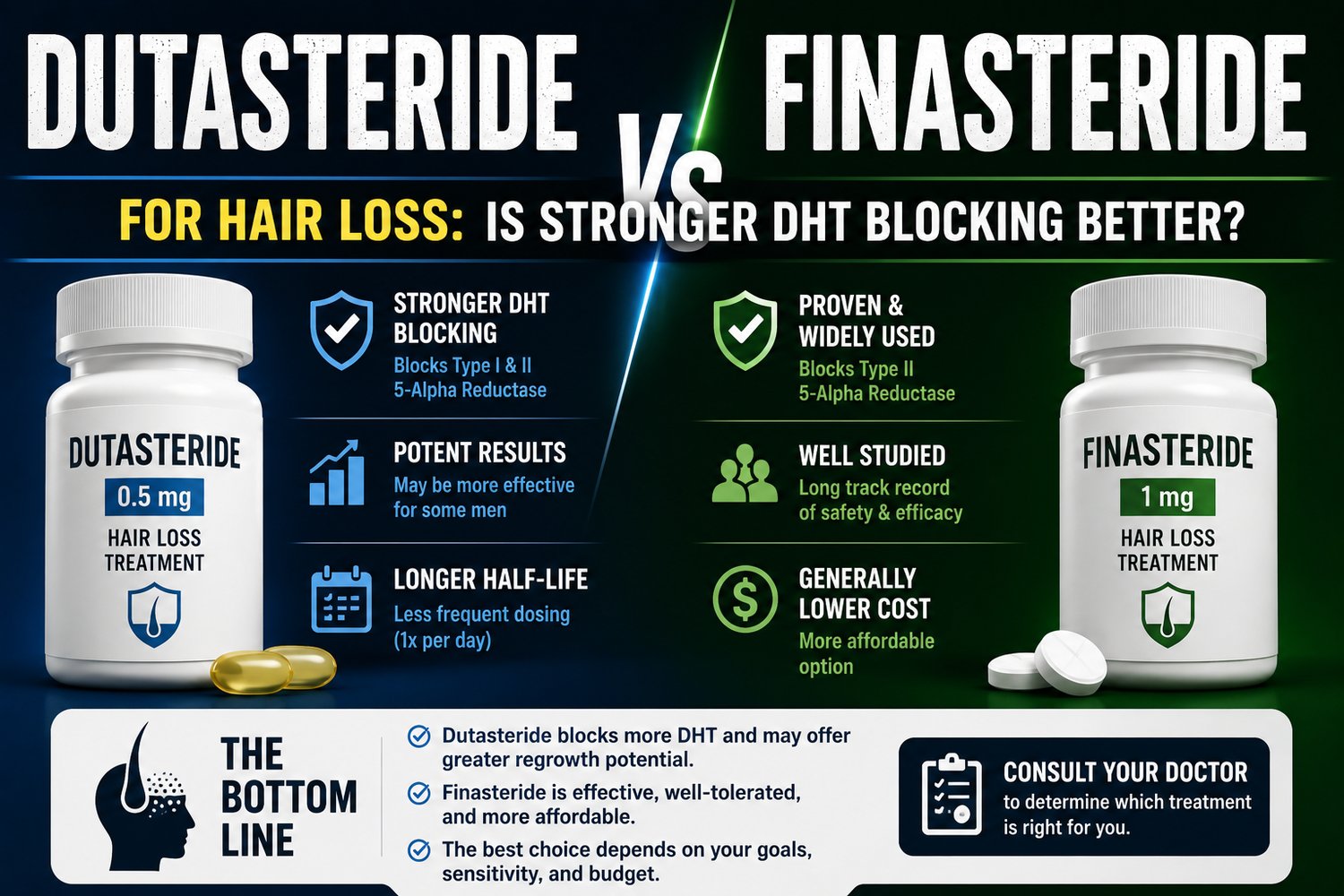
Dutasteride vs Finasteride for Hair Loss: Is Stronger DHT Blocking Better?
Finasteride is one of the most established medications for male pattern hair loss.
Dutasteride is the more aggressive cousin.
Both medications reduce:
Dihydrotestosterone, or DHT.
Both belong to a drug class called:
5-alpha-reductase inhibitors.
And both can slow the progressive follicle miniaturization that drives male pattern baldness.
But dutasteride blocks more forms of the enzyme that produces DHT.
That means:
Stronger DHT suppression.
And current comparative research suggests that stronger suppression can translate into greater average hair-growth effects.
A 2019 meta-analysis of randomized trials found dutasteride produced significantly greater improvements in hair count and photographic assessments than finasteride over 24 weeks. A newer 2024 systematic review likewise found dutasteride 0.5 mg more effective than finasteride 1 mg for increasing hair counts in the studies reviewed. And a 2025 network meta-analysis ranked oral dutasteride 0.5 mg/day as the most effective monotherapy among the conventional male-pattern-hair-loss treatments it evaluated.
So is dutasteride simply better?
Not necessarily.
Because there's another major difference:
Finasteride 1 mg is FDA-approved for male pattern hair loss in men.
Dutasteride is FDA-approved in the United States for benign prostatic hyperplasia—not hair loss. Hair-loss treatment with dutasteride is off-label.
That changes the decision.
The real question becomes:
Do the potentially greater hair benefits of stronger DHT suppression justify using an off-label medication with less long-term hair-loss-specific regulatory experience?
For some men, maybe.
For others, standard finasteride remains the more logical starting point.
If you're still learning why DHT matters, start with:
For the broader first-line medication decision:
Dutasteride vs Finasteride: The Quick Answer
Finasteride
Usually makes the strongest first-line argument if you want:
- An FDA-approved oral treatment for male pattern hair loss
- Decades of hair-loss use
- Standardized 1 mg dosing
- Strong evidence for slowing progression
- Less extensive DHT suppression than dutasteride
Dutasteride
May deserve discussion when:
- Male pattern hair loss continues despite finasteride
- Hair preservation is a very high priority
- Stronger DHT suppression is desired
- A clinician considers off-label treatment appropriate
- You understand that U.S. hair-loss use is not FDA-approved
Current evidence suggests dutasteride may produce greater average hair growth.
But:
Stronger pharmacology does not automatically mean better first-line treatment for every man.
What Is Finasteride?
Finasteride is an oral prescription medication that inhibits:
5-alpha reductase.
That enzyme converts testosterone into DHT.
DHT is one of the primary signals contributing to follicle miniaturization in genetically susceptible scalp hair.
Finasteride 1 mg is FDA-approved for treatment of male pattern hair loss in men. Current prescribing information recommends one 1 mg tablet daily and notes that at least several months of continued use are generally needed before benefit becomes apparent.
Finasteride mainly inhibits:
Type II 5-alpha reductase.
That matters when we compare it with dutasteride.
What Is Dutasteride?
Dutasteride is also a 5-alpha-reductase inhibitor.
But it inhibits:
Type I
and:
Type II
5-alpha reductase.
That produces more extensive suppression of DHT than finasteride.
The current FDA-approved indication for oral dutasteride in the United States is treatment of symptomatic:
Benign prostatic hyperplasia, or BPH.
It is not FDA-approved for male pattern hair loss in the United States.
When clinicians prescribe dutasteride for androgenetic alopecia, they're using an FDA-approved medication for an:
off-label indication.
Why Does Blocking Two Enzymes Matter?
There are multiple forms of the 5-alpha-reductase enzyme.
Finasteride primarily inhibits:
Type II.
Dutasteride inhibits:
Type I + Type II.
Both enzyme forms contribute to androgen metabolism, and both are present in hair-related tissues.
So the basic pharmacologic argument is:
Finasteride reduces DHT substantially.
Dutasteride reduces it even more extensively.
That's why dutasteride has attracted so much attention for difficult or progressive male pattern hair loss.
Does Dutasteride Block More DHT Than Finasteride?
Yes.
That's one of the clearest differences between the medications.
Dutasteride produces broader suppression of DHT because it inhibits both major 5-alpha-reductase isoenzymes.
Finasteride's systemic DHT reduction is less extensive.
That doesn't make finasteride weak.
It means dutasteride takes the same treatment strategy:
reduce DHT
and pushes it further.
Does More DHT Blocking Grow More Hair?
On average, comparative studies suggest:
It can.
A randomized study of 90 men compared:
- Dutasteride 0.5 mg daily
- Finasteride 1 mg daily
for 24 weeks.
Dutasteride produced a significantly greater increase in total hair count and greater reversal of follicle miniaturization.
The 2019 meta-analysis combining randomized trials likewise favored dutasteride for:
- Total hair count
- Vertex photographs
- Frontal photographs
- Patient assessments.
And the newer systematic review published in 2024 again found higher-dose dutasteride more effective than finasteride in the studies it examined.
So:
Yes, there is evidence that dutasteride can outperform finasteride for hair growth.
Does That Mean Everyone Should Start With Dutasteride?
No.
This is where online hair-loss communities tend to skip a few steps.
You could argue:
Dutasteride blocks more DHT.
Dutasteride often grows more hair.
Therefore:
Everyone should use dutasteride.
But treatment decisions involve more than maximum efficacy.
They also involve:
- FDA approval
- Long-term experience
- Side effects
- Fertility concerns
- Drug half-life
- Patient preference
- Severity of hair loss
- Whether a less intensive treatment already works
Finasteride is highly effective for many men.
If finasteride keeps your hair stable and you tolerate it well:
There may be no compelling reason to escalate.
Finasteride Has the Regulatory Advantage
This is one of finasteride's biggest strengths.
Finasteride 1 mg has an FDA-approved indication specifically for:
male pattern hair loss in men.
That means the FDA-approved product framework includes:
- Standardized dosing
- Hair-loss-specific labeling
- Safety information
- Manufacturing standards
- Clinical evidence submitted for that indication
Dutasteride doesn't have that U.S. hair-loss approval.
Dutasteride Hair-Loss Use Is Off-Label
Dutasteride itself is FDA-approved.
Just not for hair loss.
Current labeling lists treatment of symptomatic BPH in men with an enlarged prostate.
Using dutasteride for androgenetic alopecia therefore means:
An approved drug is being prescribed for a non-approved indication.
Off-label prescribing is common in medicine.
It does not mean:
experimental nonsense.
But it means the hair-loss indication hasn't gone through the same FDA approval pathway as oral finasteride 1 mg.
How Much Stronger Is Dutasteride?
The answer depends on what you mean by:
stronger.
Pharmacologically:
Dutasteride suppresses DHT more comprehensively.
Clinically:
Comparative studies show larger average improvements in some hair-growth outcomes.
But this does not mean:
Every man gets dramatically more hair.
Individual response still varies based on:
- Genetics
- Stage of hair loss
- Duration of treatment
- Follicle viability
- Adherence
- Other treatments being used
Stronger average results don't guarantee a dramatic personal difference.
Dutasteride May Be More Useful When Finasteride Isn't Enough
This is probably its most intuitive role.
Imagine a man who:
- Clearly has androgenetic alopecia
- Has used finasteride consistently
- Tolerates DHT suppression
- Continues losing meaningful hair
Now the question becomes:
Would more extensive 5-alpha-reductase inhibition help?
That's where dutasteride becomes especially interesting.
Instead of abandoning the DHT strategy entirely, a clinician might consider:
more complete DHT suppression.
But Make Sure Finasteride Actually Failed
Before declaring:
“Finasteride doesn't work.”
ask:
- Did you take it consistently?
- Did you use it long enough?
- Are comparison photos actually worse?
- Are you judging treatment by regrowth instead of stabilization?
- Is the diagnosis truly androgenetic alopecia?
A man whose hair looks almost identical after three years of treatment may think:
“Finasteride did nothing.”
If untreated hair loss would have progressed significantly during those years:
stability may be the success.
Preservation Matters More Than Regrowth
Both medications are especially valuable for:
keeping follicles from continuing to miniaturize.
Men understandably want:
More hair.
But preventing:
less hair
is often the more realistic long-term goal.
If you're already maintaining your density well on finasteride, chasing additional DHT suppression solely because dutasteride ranks higher in studies may provide less practical benefit than you expect.
Which Is Better for Hair Count?
Current evidence generally favors:
Dutasteride.
The 2019 meta-analysis found a statistically significant advantage in total hair count over finasteride.
A 2025 network meta-analysis likewise ranked oral dutasteride 0.5 mg/day highest among the conventional monotherapies analyzed for male pattern hair loss.
That's one of the strongest arguments for dutasteride.
Which Is Better for the Crown?
Both can help with androgen-sensitive crown thinning.
Comparative meta-analysis found photographic assessments of the vertex favored dutasteride.
That's useful.
But don't turn it into:
“Dutasteride will completely refill every bald crown.”
Once follicles have been severely miniaturized or inactive for years, medication becomes less capable of dramatic restoration.
Which Is Better for the Hairline?
The same general hierarchy may apply:
Stronger DHT suppression can help preserve vulnerable follicles.
The 2019 meta-analysis found frontal photographic assessments also favored dutasteride.
But frontal recession remains challenging.
Neither medication should be expected to restore a teenage hairline from an area that has been bald for years.
Earlier intervention gives you more follicles to preserve.
How Long Does Finasteride Take to Work?
Current finasteride labeling says daily use for:
three months or more
is generally needed before benefit is observed.
In real-world hair-loss treatment, fuller assessment typically takes longer.
Think:
6–12 months
rather than:
six weeks.
Hair biology moves slowly.
How Long Does Dutasteride Take to Work?
Same general principle.
Clinical trials commonly evaluate meaningful outcomes over several months.
A man changing to dutasteride should not judge the drug after:
one month.
Take standardized photographs.
Compare over time.
Finasteride and Dutasteride Have Long-Term Commitment in Common
Neither drug permanently rewrites your genetics.
They suppress DHT while you use them.
If treatment is stopped:
the underlying androgenetic alopecia process can resume.
This is long-term management.
Not:
Take pills for one year and graduate from baldness.
Which Has More Sexual Side Effects?
This is less clear than many people assume.
You might expect:
More DHT suppression = dramatically more sexual side effects.
Comparative trial evidence hasn't consistently shown a major difference.
The 2019 dutasteride-versus-finasteride meta-analysis found no statistically significant difference between the two drugs in:
- Altered libido
- Erectile dysfunction
- Ejaculatory disorders.
A separate systematic review of randomized placebo-controlled trials found 5-alpha-reductase inhibitors as a class increased sexual-dysfunction risk, while direct evidence for dutasteride was more limited.
So the fair conclusion is:
Both can cause sexual adverse effects.
Current evidence does not prove that dutasteride necessarily causes dramatically more sexual dysfunction than finasteride.
Finasteride Sexual Side Effects
Current finasteride 1 mg labeling lists common adverse reactions including:
- Decreased libido
- Erectile dysfunction
- Ejaculation disorder.
Many men take finasteride without these symptoms.
But the risk is real enough to understand before treatment.
Dutasteride Sexual Side Effects
Dutasteride also carries potential sexual adverse effects.
Because it suppresses DHT more extensively, some men may be uncomfortable escalating from finasteride even if average comparative trial rates appear similar.
That's a legitimate preference.
Hair is cosmetic.
Your tolerance for medication risk matters.
Dutasteride Has a Much Longer Half-Life
This is a major practical difference.
Dutasteride remains in the body much longer than finasteride.
That's useful for maintaining stable enzyme inhibition.
But it also means:
If you experience an adverse effect and stop the medication, the drug doesn't disappear quickly.
This is one reason some men are more comfortable beginning with finasteride.
A longer-acting drug creates less flexibility if you decide:
“I don't like how this is affecting me.”
Why Half-Life Matters
Imagine two medications.
Medication A clears relatively quickly.
Medication B remains in the body for weeks.
If both work:
No problem.
If you dislike an adverse effect:
Medication A gives you a quicker path toward reducing drug exposure.
Medication B takes longer.
That doesn't make dutasteride unsafe.
It changes the practical risk calculation.
Which Is Better for Someone Nervous About Side Effects?
Usually I'd argue:
Finasteride makes more sense as the initial discussion.
Why?
- FDA-approved for male pattern hair loss
- Less extensive DHT suppression
- Longer history for this indication
- Easier to step away from pharmacologically
If finasteride isn't adequate and you're tolerating it:
Then escalating to dutasteride becomes easier to justify.
Which Is Better for Someone Losing Hair Aggressively?
This is where dutasteride becomes more attractive.
If you're experiencing:
- Rapid progression
- Strong family history
- Significant miniaturization
- Inadequate response to finasteride
a clinician may reasonably consider stronger DHT suppression.
Current efficacy research provides a legitimate rationale for that discussion.
What About Intermittent Dutasteride?
Interesting newer research has looked at this.
A 2025 randomized pilot study compared:
- Dutasteride 0.5 mg twice weekly
- Dutasteride 0.5 mg three times weekly
- Finasteride 1 mg daily
for 24 weeks.
All three groups improved.
Three-times-weekly dutasteride produced greater hair-density and diameter improvement than twice-weekly dutasteride, but it did not significantly outperform daily finasteride in total hair count in this small trial. Sexual adverse events were similar among groups.
That's interesting.
It is not enough evidence to tell readers to invent their own intermittent dutasteride schedule.
Don't Create Your Own Dutasteride Schedule
This deserves to be explicit.
The internet is full of:
once weekly
twice weekly
three times weekly
daily
dutasteride protocols.
The medication's long half-life makes alternate schedules biologically plausible.
But hair-loss use is already off-label in the U.S.
Don't turn:
off-label clinician prescribing
into:
DIY pharmacology experiment.
If dutasteride is prescribed, use the regimen your clinician selects.
Dutasteride vs Finasteride and Fertility
Both medications alter androgen metabolism rather than suppressing LH and FSH the way exogenous testosterone does.
But 5-alpha-reductase inhibitors can still affect:
- Semen parameters
- Ejaculatory function
- Sexual function
in some men.
If you're:
- Trying to conceive
- Already dealing with infertility
- Concerned about semen quality
bring that up before using either medication.
Don't treat fertility as unrelated just because the prescription is for hair.
Neither Drug Is Testosterone Replacement Therapy
This should be obvious, but the hormonal overlap can cause confusion.
Finasteride and dutasteride:
reduce conversion of testosterone into DHT.
TRT:
supplies testosterone.
They're completely different treatment strategies.
And a man can use testosterone therapy while also taking a 5-alpha-reductase inhibitor in selected circumstances.
For the broader testosterone side:
What About Hair Loss While on TRT?
Testosterone can be converted into DHT.
For genetically susceptible men, increased androgen exposure may accelerate male pattern hair loss.
That doesn't mean everyone on TRT needs:
finasteride
or:
dutasteride.
Treat hair loss based on:
- Actual progression
- Risk tolerance
- Treatment goals
not automatically because testosterone is being prescribed.
Can Dutasteride Completely Block Hair Loss?
No.
Even extremely strong DHT suppression doesn't guarantee:
perfect lifelong hair.
Male pattern baldness involves:
- Genetics
- Follicle sensitivity
- Time
- Other biological factors
DHT is central.
It isn't the entire universe.
You can respond well and still experience gradual progression.
What About Minoxidil?
Finasteride and dutasteride attack the DHT side of male pattern baldness.
Minoxidil addresses hair growth through a different mechanism.
That makes combination treatment biologically reasonable.
5-Alpha-Reductase Inhibitor
Reduce androgen-driven miniaturization.
Minoxidil
Support follicle activity and growth.
For the broader decision:
And if you're choosing how to use minoxidil:
Oral Minoxidil vs Topical Minoxidil →
What About Topical Finasteride?
If your concern is:
systemic exposure to finasteride
there is another option entirely.
Compounded topical finasteride attempts to target the scalp while reducing systemic drug exposure.
But it is not risk-free and is not FDA-approved in topical form in the United States.
For the full comparison:
Topical Finasteride vs Oral Finasteride →
Is There Topical Dutasteride?
Yes.
Compounded topical dutasteride formulations are also offered by some hair-loss services.
Strut currently offers a compounded topical dutasteride hair-loss formula containing possible ingredients such as:
- Dutasteride
- Minoxidil
- Tretinoin
- Fluocinolone
- Biotin
and currently lists it starting at $69/month. Strut explicitly identifies the product as compounded and its hair-loss use as off-label.
Topical dutasteride is even less standardized than oral dutasteride hair-loss treatment.
Don't assume:
topical = no systemic absorption
or:
compounded = FDA-approved.
Strut Also Offers Oral Dutasteride
Strut currently lists compounded oral dutasteride capsules for hair loss at:
$39/month
for a 30-day auto-renewing supply.
Its current treatment information explicitly identifies dutasteride hair-loss use as:
off-label
and the product as:
compounded and not FDA-approved.
Because you gave me the general Strut men's hair-loss affiliate landing page—not a dedicated dutasteride affiliate deep link—the clean affiliate route here is:
Explore Strut Men's Hair Loss Options →
HabitLogics may earn a commission if you purchase through this link, at no additional cost to you.
Why Strut Makes Sense in This Article
This isn't a:
“Dutasteride is better, buy dutasteride”
CTA.
Strut is useful here because it currently offers several different hair-loss strategies under one service, including:
- Finasteride options
- Dutasteride options
- Minoxidil
- Combination treatments
That makes the landing page relevant to a reader who has reached:
“I understand the difference; now I want to discuss treatment options with a clinician.”
That's where the commercial link belongs.
Don't Skip Finasteride Just Because Dutasteride Ranks Higher
Imagine:
Finasteride works.
Your hair stabilizes.
No meaningful adverse effects.
Then you read:
“Dutasteride is more effective.”
Do you need to switch?
Not necessarily.
You're treating:
your hair loss
not competing for the strongest DHT suppression score.
Escalation should solve a problem.
When Switching to Dutasteride May Be More Rational
A discussion becomes more reasonable when:
- Finasteride has been used consistently
- Enough time has passed to assess it
- Hair loss continues objectively
- Diagnosis is clear
- Stronger treatment matters to you
- Risks have been discussed
That's very different from:
“I started finasteride eight weeks ago and my temples aren't full yet.”
Don't Judge Treatment by Shedding Alone
Hair shedding fluctuates.
A period of increased shedding doesn't automatically mean:
The medication stopped working.
Track:
- Hairline
- Crown
- Overall density
- Standardized photographs
over months.
Not shower-drain anxiety.
Take Baseline Photos
Before switching drugs:
Photograph:
- Front
- Left temple
- Right temple
- Top
- Crown
Use consistent:
- Lighting
- Hair length
- Camera distance
- Hair condition
Otherwise you'll have no objective way to know whether dutasteride actually improved anything.
Which Is Cheaper?
Generic finasteride is often inexpensive.
Dutasteride itself can also be inexpensive as a generic medication when prescribed for an FDA-approved indication, but cash-pay hair-loss pricing varies because:
- Hair-loss use is off-label
- Telehealth fees may be involved
- Compounding may be involved
- Combination formulas cost more
Don't evaluate only the pill price.
Hair-loss treatment is usually long-term.
Cost Over 10 Years Matters
Suppose one treatment costs:
$15/month
and another costs:
$50/month.
The difference over ten years is:
$4,200.
That doesn't mean choose the cheapest treatment.
It means:
Long-term affordability belongs in the decision.
The best medication doesn't preserve your hair if you stop buying it.
Dutasteride vs Finasteride: Side-by-Side
Drug Class
Finasteride: 5-alpha-reductase inhibitor.
Dutasteride: 5-alpha-reductase inhibitor.
Enzymes Blocked
Finasteride: Primarily type II.
Dutasteride: Type I + type II.
DHT Suppression
Finasteride: Strong.
Dutasteride: More extensive.
FDA Approval for Male Pattern Hair Loss
Finasteride 1 mg: Yes.
Dutasteride: No; U.S. hair-loss use is off-label.
Hair-Growth Evidence
Finasteride: Strong and long established.
Dutasteride: Comparative studies suggest greater average efficacy.
Sexual Side Effects
Finasteride: Possible.
Dutasteride: Possible.
Comparative trials haven't consistently demonstrated a significant difference in sexual adverse-event rates.
Drug Persistence
Finasteride: Shorter-lasting.
Dutasteride: Much longer-lasting.
Best Fit
Finasteride: Strong default first-line DHT-blocking treatment.
Dutasteride: More aggressive off-label option when stronger DHT suppression is desired or finasteride response is inadequate.
Which Would I Start With?
For a man newly diagnosed with ordinary male pattern baldness who wants an oral DHT-blocking medication:
Finasteride makes the cleaner starting argument.
Why?
- FDA-approved specifically for male pattern hair loss
- Excellent evidence
- Long history
- Standardized dosing
- Less extensive pharmacologic commitment
If finasteride is:
- Well tolerated
- Used consistently
- Given adequate time
but hair loss continues significantly?
Then I'd want to discuss:
dutasteride
with a dermatologist or other qualified clinician.
That's not because dutasteride is some secret advanced hair hack.
It's because comparative evidence suggests stronger 5-alpha-reductase inhibition can produce stronger average hair outcomes.
Who Might Prefer Finasteride?
Finasteride may make more sense if you:
- Are starting treatment
- Want an FDA-approved hair-loss medication
- Want strong DHT reduction without maximizing suppression
- Prefer the longer hair-loss-specific track record
- Want a medication that clears faster if stopped
- Are doing well on it already
Who Might Discuss Dutasteride?
Dutasteride may become more attractive if you:
- Have clearly progressive androgenetic alopecia
- Have not achieved adequate stabilization with finasteride
- Want stronger DHT suppression
- Accept off-label treatment
- Understand its longer persistence
- Have reviewed sexual, fertility and other risks with a clinician
Who Should Probably Not Escalate Just Because the Internet Said To?
The guy who:
- Started finasteride last month
- Has no objective progression data
- Is already stable
- Is terrified of stronger medication
- Doesn't actually know whether he has male pattern baldness
More pharmacology doesn't fix uncertainty.
Frequently Asked Questions
Is Dutasteride Better Than Finasteride for Hair Loss?
Comparative research generally suggests dutasteride produces greater average improvements in hair count and photographic assessment.
A 2019 meta-analysis and newer reviews favor dutasteride for efficacy.
That does not automatically make dutasteride the best first treatment for every man.
Why Is Dutasteride Stronger Than Finasteride?
Dutasteride inhibits both type I and type II 5-alpha-reductase.
Finasteride mainly inhibits type II.
That allows dutasteride to suppress DHT more extensively.
Is Dutasteride FDA Approved for Hair Loss?
No.
Current U.S. dutasteride labeling is for benign prostatic hyperplasia.
Hair-loss use is off-label.
Is Finasteride FDA Approved for Hair Loss?
Yes.
Finasteride 1 mg is FDA-approved for male pattern hair loss in men.
Does Dutasteride Cause More Sexual Side Effects?
Not clearly based on available comparative trials.
The 2019 meta-analysis found no statistically significant difference between dutasteride and finasteride in altered libido, erectile dysfunction or ejaculation disorders.
Both drugs can cause sexual adverse effects.
Should You Switch From Finasteride to Dutasteride?
Not automatically.
A switch may be worth discussing when:
- Finasteride has been used consistently
- Enough time has passed
- Hair loss continues objectively
- Stronger treatment is desired
If finasteride is already keeping your hair stable, escalation may offer limited practical benefit.
Can You Take Dutasteride Only a Few Times per Week?
Intermittent regimens have been studied.
A small 2025 randomized trial found twice- and three-times-weekly dutasteride improved hair growth, with three-times-weekly treatment performing better than twice-weekly on several outcomes.
That does not mean you should design your own dosing schedule.
Hair-loss use is off-label and should be clinician-directed.
Does Dutasteride Work Better on the Hairline?
Comparative evidence has shown stronger frontal photographic outcomes with dutasteride than finasteride on average.
Neither drug should be expected to fully reconstruct a long-lost hairline.
Does Dutasteride Work Better on the Crown?
Comparative studies also favor dutasteride on vertex/crown assessments.
Earlier thinning generally provides more salvageable follicles than longstanding complete baldness.
Can You Use Dutasteride With Minoxidil?
Clinicians may combine DHT suppression with minoxidil because the drugs work through different mechanisms.
A 2025 study also examined low-dose oral minoxidil with finasteride or dutasteride combination therapy.
Combination treatment should be individualized.
Does Strut Offer Dutasteride for Hair Loss?
Yes.
Strut currently offers compounded oral and topical dutasteride hair-loss treatments. Its topical formula starts at $69/month, while its current compounded oral dutasteride listing shows $39/month. Both are identified as off-label hair-loss treatments, and the compounded products are not FDA-approved.
Explore Strut Men's Hair Loss Options →
Key Takeaways
- Finasteride and dutasteride both reduce DHT by inhibiting 5-alpha reductase.
- Finasteride mainly inhibits type II 5-alpha reductase.
- Dutasteride inhibits type I and type II and therefore produces stronger DHT suppression.
- Comparative trials and meta-analyses generally show greater average hair-growth efficacy with dutasteride.
- Finasteride 1 mg is FDA-approved for male pattern hair loss in men.
- Dutasteride is FDA-approved for BPH, while U.S. hair-loss treatment is off-label.
- Stronger DHT suppression does not automatically make dutasteride the best first-line choice.
- Finasteride remains a strong starting treatment for many men.
- Dutasteride may be especially useful when hair loss continues despite adequate finasteride treatment.
- Both medications can cause sexual adverse effects.
- Comparative trials have not consistently shown a significantly greater rate of sexual dysfunction with dutasteride.
- Dutasteride remains in the body much longer, which matters if side effects occur.
- Neither medication permanently cures male pattern baldness.
- Long-term treatment is generally necessary to maintain benefit.
- More DHT suppression should solve a real treatment problem—not simply satisfy a desire to use the strongest drug.
Final Thoughts
Dutasteride versus finasteride is one of the rare hair-loss comparisons where:
the stronger drug often really does produce stronger average hair results.
Dutasteride suppresses more DHT.
And clinical studies generally show better hair-count and photographic outcomes.
But that's not the end of the decision.
Finasteride has something dutasteride doesn't:
FDA approval specifically for male pattern hair loss.
It also has decades of use for that indication and less extensive DHT suppression.
So I wouldn't think about this as:
Finasteride = beginner treatment.
Dutasteride = better treatment.
I'd think:
Finasteride = established first-line DHT strategy.
Dutasteride = stronger off-label DHT strategy when there's a reason to escalate.
If finasteride works?
Great.
You don't win extra hair-loss points for blocking the maximum possible amount of DHT.
If finasteride isn't enough?
Then dutasteride becomes a very legitimate conversation.
The goal isn't:
strongest medication.
It's:
enough treatment to preserve the hair you care about at a risk level you're comfortable living with for years.
Continue the Men's Hair Loss Series
Understand Hair Loss
Compare Treatments
- Minoxidil vs Finasteride
- Oral Minoxidil vs Topical Minoxidil
- Topical Finasteride vs Oral Finasteride
- Best Hair Loss Treatments for Men
Explore Strut
Strut Men's Hair Loss Options →
For the broader men's-health pillar:
Complete Men's Wellness Guide →
Affiliate Disclosure
HabitLogics participates in affiliate programs with some providers linked from this article. If you use one of these links and purchase treatment, HabitLogics may earn a commission at no additional cost to you. Affiliate relationships do not determine whether a medication is medically appropriate.
Educational Disclaimer
This article is intended for educational purposes only and should not be considered medical advice. Finasteride and dutasteride are prescription medications that can cause adverse effects and may affect sexual or reproductive function. Finasteride 1 mg is FDA-approved for male pattern hair loss in men, while dutasteride use for hair loss in the United States is off-label. Compounded dutasteride products are not FDA-approved. Do not start, stop, switch, combine or alter the dosing frequency of finasteride or dutasteride without guidance from a qualified healthcare professional.