

Deep Sleep vs. REM Sleep: What’s the Difference & How Much Do You Need?
The Complete Sleep & Recovery Guide
You wake up.
Grab your phone.
Open your sleep app.
And there it is:
Deep sleep: 58 minutes.
REM sleep: 1 hour 34 minutes.
Now the questions begin.
Is 58 minutes of deep sleep terrible?
Do I need more REM?
Which one matters more?
How do I increase deep sleep?
Did I somehow sleep incorrectly?
Welcome to one of the stranger side effects of modern sleep technology: millions of people now have detailed-looking sleep data every morning without necessarily knowing what those numbers mean.
The first thing to understand is this:
Deep sleep and REM sleep are not competing versions of good sleep.
They're different parts of a normal sleep cycle.
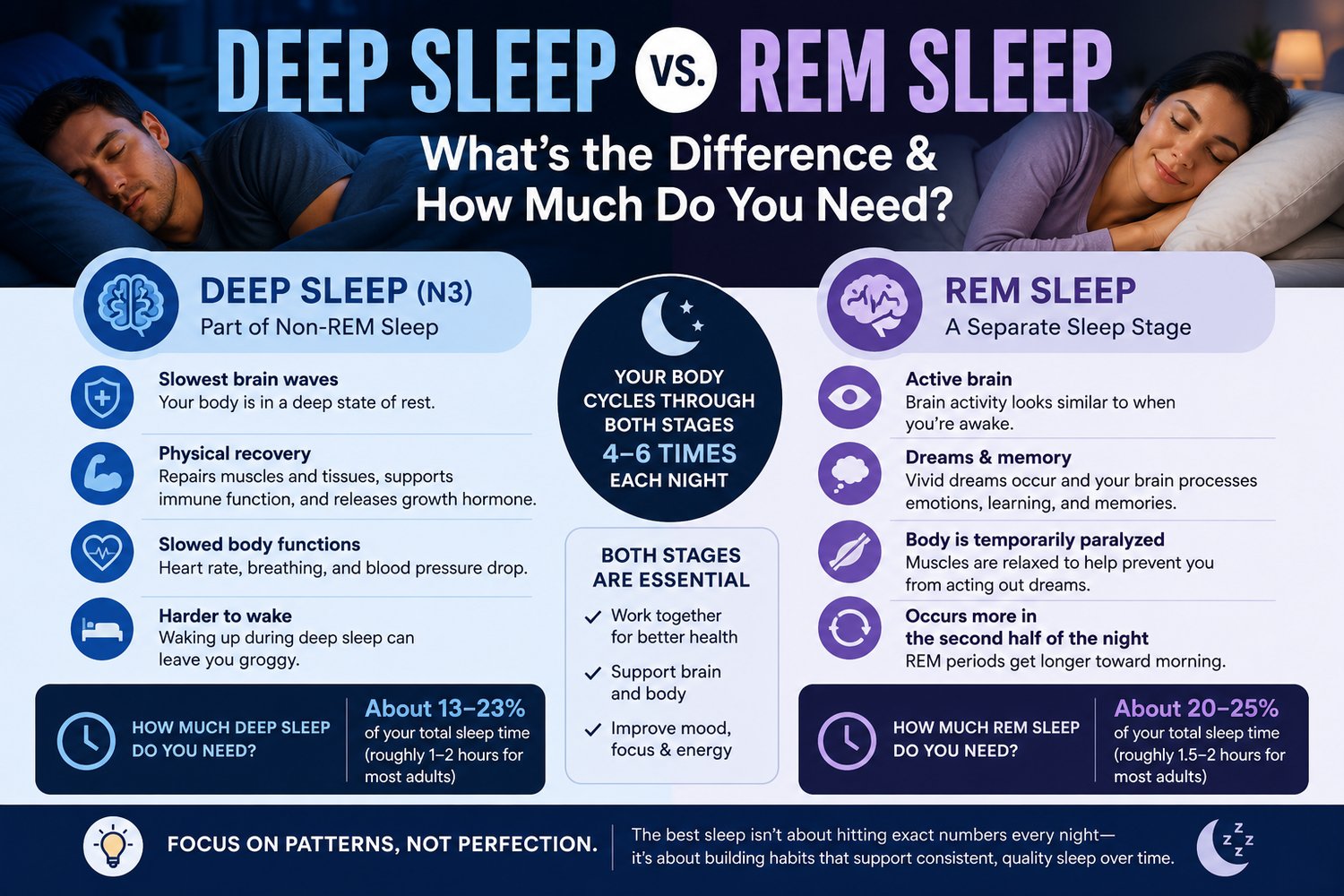
Deep sleep is the deepest stage of non-REM sleep, while REM is a separate sleep phase characterized by more active brain activity, rapid eye movements and vivid dreaming. During a typical night, your body cycles through non-REM and REM sleep roughly four to six times.
And despite what your watch may make it feel like, your job isn't to manually optimize every minute.
Let's make sense of what these stages actually do.
What Is Deep Sleep?
Deep sleep is Stage N3 of non-REM sleep.
It's also commonly called slow-wave sleep because of the characteristic slow brain-wave activity seen during this stage.
During deep sleep:
- Brain waves become slower
- Heart rate and breathing slow
- Muscles are relaxed
- You're more difficult to awaken
- Your body is in a particularly restorative phase of sleep
Deep sleep occurs more heavily during the first part of the night.
If someone wakes you from deep sleep, you may feel particularly groggy and disoriented.
That's one reason being ripped out of a deep afternoon nap can leave you sitting on the edge of the couch wondering what country you're in.
Deep sleep is normal.
It's important.
But it's only one part of healthy sleep.
What Is REM Sleep?
REM stands for rapid eye movement.
During REM sleep, brain activity becomes more similar to waking brain activity, your eyes move rapidly behind your eyelids, and your arm and leg muscles normally become temporarily inactive.
REM is also the sleep phase most strongly associated with vivid dreaming, although dreaming can occur during non-REM sleep too.
REM sleep usually first appears around 90 minutes after falling asleep.
Unlike deep sleep, which is concentrated more heavily earlier in the night, REM periods generally become longer during the second half of the night.
That's an important distinction we'll come back to.
Deep Sleep vs. REM Sleep: What's the Main Difference?
The easiest way to understand the difference is to look at where each fits within normal sleep architecture.
Deep sleep is Stage N3 of non-REM sleep.
REM sleep is a separate sleep phase.
Deep sleep tends to involve slower brain activity and is particularly associated with physical restoration.
REM involves considerably more active brain activity and is strongly associated with dreaming and processes involving memory.
But avoid the oversimplified internet version:
Deep sleep = body repair
REM sleep = brain repair
There's some truth behind why people describe them that way, but human sleep isn't divided into two perfectly separate maintenance departments.
Memory consolidation, for example, appears to involve both non-REM and REM sleep rather than one stage working alone.
The better way to think about it is:
Deep sleep and REM sleep perform different but overlapping roles within the larger sleep process.
You need both.
Where Deep Sleep and REM Fit Into Your Sleep Cycle
To understand why comparing the two can be misleading, it helps to zoom out.
As we explained in Sleep Stages Explained: REM, Deep Sleep & What Happens While You Sleep, sleep moves through several stages:
N1 → N2 → N3 deep sleep → REM → repeat
A sleep cycle typically lasts about 80 to 100 minutes, and most people complete around four to six cycles each night.
But those cycles aren't identical.
Early in the night, you generally spend more time in deep sleep.
Later in the night, you generally spend more time in REM sleep.
So your sleep architecture might look conceptually like this:
Early night: more deep sleep
↓
Middle of night: mixture of stages
↓
Late night: longer REM periods
Your body changes the composition of sleep as the night progresses.
That's one reason simply asking:
"Which stage is better?"
doesn't really make sense.
It's like asking whether breakfast or dinner is more important.
They're different parts of the system.
What Happens During Deep Sleep?
Deep sleep is often described as the most physically restorative stage of sleep.
During Stage N3, your heartbeat and breathing reach some of their lowest levels during sleep, muscles remain relaxed and brain activity becomes dominated by slow waves.
Deep sleep is also associated with processes involving physical restoration and recovery.
This is particularly relevant if you:
- Strength train
- Exercise regularly
- Have a physically demanding job
- Are trying to build or preserve muscle
- Are recovering from strenuous activity
That doesn't mean getting an extra 20 minutes of deep sleep automatically produces more muscle.
Sleep doesn't work like adding protein powder to a shake.
But adequate, high-quality sleep is an important part of overall physical recovery.
Later in this Sleep & Recovery pillar, we'll look specifically at sleep and muscle recovery, including how insufficient sleep may interact with training, performance and recovery.
What Happens During REM Sleep?
REM looks very different.
Your brain becomes much more active.
Your eyes move rapidly.
Your breathing can become faster and less regular.
Heart rate and blood pressure rise closer toward waking levels.
Meanwhile, the muscles in your arms and legs normally become temporarily inactive, which helps keep you from physically acting out your dreams.
REM is associated with:
- Dreaming
- Learning
- Memory processing
- Emotional processing
- Brain development
Again, those functions aren't exclusive to REM.
Sleep stages work together.
But REM is clearly much more than simply "the part where weird dreams happen."
Is Deep Sleep More Important Than REM?
No useful scientific ranking says:
1. Deep sleep
2. REM
3. Everything else
Healthy sleep requires the complete sleep architecture.
Even Stage N2—the "light sleep" that people sometimes complain about when looking at their wearables—is a major normal component of sleep.
In fact, NINDS notes that people typically spend more of their repeated sleep cycles in Stage N2 than in the other sleep stages.
That's not wasted sleep.
Your goal shouldn't be:
Minimize light sleep and maximize deep sleep.
Your goal should be:
Get sufficient, reasonably continuous sleep so your body can move naturally through all of its sleep stages.
That's much more achievable.
How Much Deep Sleep Do You Need?
Here's where the answer becomes less satisfying than most sleep apps would have you believe.
There isn't one universally prescribed number of minutes of deep sleep that every adult must achieve every night.
Deep sleep varies significantly with factors including:
- Age
- Individual biology
- Sleep duration
- Previous sleep loss
- Sleep quality
- Health
- Medications and substances
- Sleep disorders
Age is especially important.
The amount of slow-wave sleep peaks earlier in life and generally decreases as we get older. NHLBI notes that it declines sharply after puberty and continues declining throughout adulthood.
So if you're 50 and comparing your deep-sleep percentage with your 18-year-old son's, that's not particularly useful.
You're not operating with identical sleep architecture.
What Percentage of Sleep Should Be Deep Sleep?
You'll frequently see precise ranges online.
Something like:
"Adults should get exactly X–Y% deep sleep."
Be careful with those numbers.
Population averages can be useful for researchers and clinicians, but they shouldn't automatically become personal nightly targets.
There are two big reasons.
First, deep sleep naturally varies with age and individual physiology.
Second, if the number comes from your smartwatch or ring, you're looking at an estimate rather than a direct clinical measurement of your brain waves.
That makes chasing an exact percentage questionable.
If you wake feeling good and function well throughout the day, don't automatically decide you have a deep-sleep problem because your wearable displayed a number below something you found on Google.
How Much REM Sleep Do You Need?
The same principle applies to REM.
There isn't a single nightly number you need to personally force your body to achieve.
REM duration varies throughout life and from night to night.
Your body also doesn't distribute REM evenly.
REM periods generally become longer later in the night.
That has an important practical implication:
Consistently cutting your sleep short may disproportionately eliminate some of the REM-rich portion toward the end of your night.
Imagine you normally need around eight hours but routinely wake after six.
You're not simply shaving an identical slice off every sleep stage.
You're eliminating the final portion of a night in which REM periods tend to be longer.
That's another reason getting enough total sleep matters.
Can You Get Too Much REM or Deep Sleep?
Seeing an unusually high percentage on one night's tracker isn't necessarily meaningful.
Sleep architecture naturally varies.
One night might contain more deep sleep.
Another might contain more REM.
Previous sleep loss can also influence subsequent sleep.
Instead of interpreting every fluctuation as a health problem, look at the larger picture:
Are you sleeping enough?
Is your sleep reasonably continuous?
Do you feel refreshed?
Are you alert during the day?
Are there persistent symptoms suggesting something isn't right?
Those questions usually matter more than whether your deep-sleep percentage changed from 16% to 19% on Tuesday.
Why You Usually Get More Deep Sleep Earlier in the Night
Deep sleep isn't evenly distributed across eight hours.
Stage N3 occurs in longer periods during the first half of the night.
This means the first few sleep cycles generally contain more slow-wave sleep.
As the night progresses, deep sleep decreases.
That's normal.
It doesn't mean your sleep becomes less useful later.
The composition is simply changing.
And as deep sleep becomes less prominent, REM generally becomes more prominent.
Your body is essentially changing gears throughout the night.
Why You Usually Get More REM Later in the Night
REM first appears roughly 90 minutes after sleep begins and generally occurs in increasingly longer periods during the second half of the night.
That's why you may be more likely to remember vivid dreams when you wake in the morning.
You may have awakened directly from a longer REM period.
It also helps explain why sleeping enough isn't simply about accumulating a minimum number of hours.
Your body needs enough opportunity to move through the full progression of sleep cycles.
If you're unsure how much total sleep you need, read How Much Sleep Do You Need? A Practical Guide by Age & Lifestyle.
For most adults, consistently giving yourself adequate sleep opportunity is far more important than attempting to manually manipulate your REM percentage.
Can You Increase Deep Sleep?
This is probably the question that brought half of you here.
And unfortunately, there's no legitimate:
DEEP SLEEP HACK — ADD 47 MINUTES TONIGHT
button.
You can't consciously tell your brain:
Skip N2. Let's get straight to the good stuff.
What you can do is improve the conditions that support healthy sleep overall.
That means focusing on fundamentals such as:
- Getting enough total sleep
- Keeping a reasonably consistent sleep schedule
- Exercising regularly
- Managing caffeine timing
- Limiting behaviors that disrupt sleep
- Creating a dark, quiet and comfortable bedroom
- Building a repeatable wind-down routine
- Addressing persistent sleep problems
Those aren't flashy.
But sleep biology doesn't care whether advice makes a good TikTok.
Throughout this pillar, we'll explore each of these areas individually.
Can You Increase REM Sleep?
Again, the best strategy isn't to directly chase REM.
Give yourself adequate sleep opportunity.
Because REM periods generally lengthen toward morning, consistently allowing enough time for a full night's sleep helps preserve that later REM-rich portion of the night.
Trying to "hack REM" while sleeping five hours a night is missing the larger problem.
Start with:
Enough total sleep.
Then:
Better sleep quality.
Then:
Consistency.
Those are things you can actually influence.
Alcohol and Sleep Stages
Alcohol deserves special attention because people frequently use it to help themselves fall asleep.
Alcohol can make you feel sleepy.
But feeling sedated isn't the same thing as getting ideal sleep.
Alcohol can alter normal sleep architecture and contribute to disrupted sleep later in the night.
So someone might say:
I sleep great after a couple drinks. I'm out immediately.
But falling asleep quickly doesn't tell you everything about the quality or structure of the sleep that follows.
If you're tracking sleep patterns, alcohol consumption is worth noting alongside your sleep and next-day energy.
The goal isn't moral judgment.
It's figuring out what actually happens.
What About Caffeine?
Caffeine can also influence sleep by making it harder to fall asleep or interfering with sleep when consumed too late for your individual sensitivity.
Rather than trying to determine whether caffeine specifically stole 14 minutes of deep sleep according to your watch, start with the more useful question:
Does later caffeine consistently correspond with worse sleep for me?
That's something you can track.
We'll devote an entire article later in this series to caffeine and sleep, including how long caffeine lasts and how to choose a realistic cutoff time.
How Accurate Are Smartwatches at Measuring Deep and REM Sleep?
This is extremely important.
Your wearable does not generally measure sleep stages the same way a clinical sleep study does.
Clinical sleep staging uses polysomnography, which includes measurements such as brain activity, eye movements and muscle activity. NHLBI notes that sleep studies use sensors recording brain activity and eye movements to classify sleep stages.
Consumer wearables typically rely on combinations of signals such as movement, heart rate and other physiological data, then use algorithms to estimate your sleep.
The American Academy of Sleep Medicine notes that many consumer devices provide sleep staging despite limited validation outside laboratory settings, and accuracy can vary between devices, manufacturers and even software versions.
That doesn't make your tracker useless.
It changes how you should interpret it.
Use Your Sleep Tracker for Trends, Not Diagnosis
Wearables can be useful for noticing patterns.
Maybe your device consistently suggests shorter sleep on weekdays.
Maybe bedtime shifts dramatically on weekends.
Maybe you see more nighttime awakenings after drinking alcohol.
Maybe your total sleep gradually improves after establishing a better schedule.
Useful.
But the AASM has cautioned that consumer sleep technology should not substitute for appropriate medical evaluation or be used by itself to diagnose or treat sleep disorders.
So:
"My watch says my deep sleep was low last night."
is information.
"My watch proves I have a sleep disorder."
is a very different claim.
Don't confuse the two.
Don't Let Sleep Tracking Make Your Sleep Worse
There's a funny trap here.
You decide to improve your sleep.
So you buy a tracker.
Now every morning you receive a grade.
84 — Good
Excellent.
91 — Excellent
You're basically an Olympic sleeper.
Then:
63 — Fair
Oh no.
What happened?
Why was REM low?
Why did deep sleep drop?
Was the bedroom too warm?
Did dinner ruin everything?
Should you take magnesium?
Do you need a new mattress?
Why were you awake at 3:12 a.m.?
Suddenly you're spending more mental energy worrying about sleep than you ever did before owning the tracker.
That's not progress.
Use data when it helps you identify actionable patterns.
Ignore it when it becomes noise.
Better Things to Track Than REM Percentages
For most people, these variables are more actionable:
Bedtime
When did you actually attempt to sleep?
Wake Time
When did you get up?
Total Sleep Opportunity
Did you give yourself enough time to sleep?
Difficulty Falling Asleep
Was it easy, moderate or difficult?
Nighttime Awakenings
Were they frequent or prolonged?
Morning Energy
How refreshed did you feel?
Daytime Energy
Were you reasonably alert or constantly fighting sleepiness?
Caffeine Timing
When was your last caffeinated drink?
Exercise
Did you move or train that day?
Evening Routine
What did the final hour or two before bed look like?
Those are behaviors and outcomes you can actually work with.
If you want a simple starting point, the FREE 7-Day Sleep Reset | Sleep & Recovery Starter Kit helps you establish a seven-day baseline and identify which habits may be worth changing.
What If Your Deep Sleep Is Always Low?
First:
Low according to what?
If the answer is your consumer wearable, remember that the device is estimating sleep stages.
Don't diagnose yourself from a dashboard.
Instead, look at your overall sleep and daytime functioning.
If you're:
- Getting adequate sleep
- Waking reasonably refreshed
- Functioning well during the day
- Not experiencing concerning symptoms
then a wearable's estimated deep-sleep number may not deserve much attention.
On the other hand, if you're consistently exhausted, sleeping poorly, waking repeatedly or experiencing significant daytime sleepiness, that's worth investigating regardless of what your deep-sleep percentage says.
What If Your REM Sleep Is Always Low?
Same answer.
Don't treat an estimated REM number as a diagnosis.
Look at:
Total sleep duration
Sleep quality
Schedule consistency
Daytime functioning
Persistent symptoms
Because REM becomes more prominent later in the night, also ask whether you're simply cutting your sleep short.
Someone who needs eight hours but routinely gives themselves six may be eliminating a substantial portion of their later-night sleep.
The first intervention may not be a supplement.
It may be:
Go to bed earlier.
Not glamorous.
Potentially very effective.
When Sleep Problems Deserve Medical Attention
Sleep trackers are not substitutes for medical evaluation.
If you regularly experience symptoms such as:
- Significant daytime sleepiness
- Persistent insomnia
- Loud snoring
- Gasping or choking during sleep
- Repeated unexplained awakenings
- Unusual behaviors during sleep
- Difficulty functioning despite adequate sleep opportunity
talk with a qualified healthcare professional.
An actual sleep evaluation can provide information your smartwatch simply cannot.
This is particularly important if sleepiness affects driving or operating machinery.
Don't try to out-track a potentially serious sleep problem.
Track the Things You Can Actually Change
There's nothing wrong with being interested in REM and deep sleep.
Understanding sleep stages can help you appreciate why sleep is much more complex than simply being unconscious for eight hours.
But your daily behavior should focus on what you can control.
That's where longer-term tracking can help.
The Sleep Recovery Planner | Sleep Tracker and Energy Journal lets you track sleep, energy, caffeine and evening routines using a fillable PDF and Excel dashboard.
Instead of trying to manually increase one sleep stage, you can ask:
What behaviors repeatedly correspond with better sleep?
That's a question you can actually do something about.
Deep Sleep, REM and Physical Recovery
Understanding the distinction between these sleep stages also becomes important when we talk about exercise and recovery.
Deep sleep is strongly associated with physical restoration, while REM and non-REM sleep both participate in important neurological processes.
But good recovery doesn't come from maximizing one stage.
It comes from supporting the entire system:
Training
Nutrition
Enough sleep
Good sleep quality
Recovery time
Later in this pillar, we'll connect these ideas directly to muscle recovery, strength and performance.
And if you're trying to manage weight as well, sleep becomes part of an even larger behavioral picture involving hunger, energy and eating patterns.
The Sleep + Weight Loss System is designed specifically to track sleep alongside hunger and night-eating patterns rather than looking at sleep in isolation.
Frequently Asked Questions
Is deep sleep better than REM sleep?
No.
They're different components of healthy sleep.
Deep sleep is Stage N3 of non-REM sleep and tends to be concentrated earlier in the night. REM is a separate phase that becomes more prominent later in the night. Both are normal parts of healthy sleep architecture.
What is the difference between deep sleep and REM sleep?
Deep sleep involves slow-wave brain activity and is the deepest stage of non-REM sleep.
REM involves rapid eye movements, relatively active brain activity, vivid dreaming and temporary reduction in arm and leg muscle activity.
Which sleep stage is most restorative?
Deep sleep is often described as particularly restorative physically, but healthy sleep requires all of the sleep stages.
Trying to identify one "best" stage oversimplifies how sleep works.
How much deep sleep should I get?
There isn't one universally prescribed number of deep-sleep minutes that every adult must achieve each night.
Deep sleep varies substantially with age and other individual factors, and consumer wearables only estimate sleep stages.
How much REM sleep should I get?
REM duration varies by individual and across the night.
Rather than chasing an exact REM target, prioritize adequate total sleep and overall sleep quality.
Why am I getting very little deep sleep?
Possible explanations range from normal variation and age-related changes to inaccurate wearable estimates or disrupted sleep.
If you're concerned because you also experience persistent fatigue, excessive sleepiness or other symptoms, talk with a healthcare professional rather than relying solely on your tracker.
Does deep sleep decrease with age?
Generally, yes.
Slow-wave sleep peaks earlier in life and declines substantially as people age.
Does REM happen more toward morning?
Yes.
REM periods generally become longer later in the night, while deep sleep tends to be concentrated earlier.
Can a smartwatch accurately tell me my REM and deep sleep?
Consumer wearables can provide estimates and may be useful for observing trends, but their sleep-stage accuracy varies. AASM notes that many consumer devices offer sleep staging with limited validation outside laboratory settings.
Should I worry about one bad sleep score?
Probably not.
One night's sleep can vary for countless reasons.
Look for patterns across time rather than treating every night's score like a medical test.
Key Takeaways
Deep sleep and REM sleep are different, but you need both.
Deep sleep is Stage N3 of non-REM sleep.
It's characterized by slow brain-wave activity, reduced heart and breathing rates and greater difficulty waking.
It occurs more heavily during the first part of the night.
REM sleep is characterized by rapid eye movements, increased brain activity, dreaming and temporary muscle inactivity.
It becomes more prominent later in the night.
But here's the most important takeaway:
You don't need to manage your sleep stages manually.
Instead of asking:
How do I maximize deep sleep?
or
How do I get the perfect REM percentage?
start with:
Am I sleeping long enough?
Is my sleep reasonably continuous?
Do I wake refreshed?
Am I functioning well during the day?
Are my daily habits supporting sleep or interfering with it?
Those are much more useful questions.
Your body already knows how to cycle through sleep stages.
Your job is mostly to give it enough time and the right conditions to do so.
Build a Better Sleep Baseline
If your sleep tracker is giving you more questions than answers, simplify.
Start with the FREE 7-Day Sleep Reset | Sleep & Recovery Starter Kit and track the fundamentals for one week.
Look at your sleep duration, schedule, energy, caffeine and evening habits.
Then identify the highest-impact change.
Previously in the Sleep & Recovery series:
What Is Sleep Quality? How to Know If You’re Actually Sleeping Well
How Much Sleep Do You Need? A Practical Guide by Age & Lifestyle
Sleep Stages Explained: REM, Deep Sleep & What Happens While You Sleep
Next in the Sleep & Recovery series:
How to Sleep Better Naturally: 12 Habits That Actually Matter
Medical Disclaimer: This article is for educational and informational purposes only and is not intended as medical advice, diagnosis or treatment. Sleep architecture varies between individuals, and consumer sleep trackers are not substitutes for professional medical evaluation. If you experience persistent sleep problems, excessive daytime sleepiness, loud snoring, gasping during sleep or other concerning symptoms, speak with a qualified healthcare professional.