

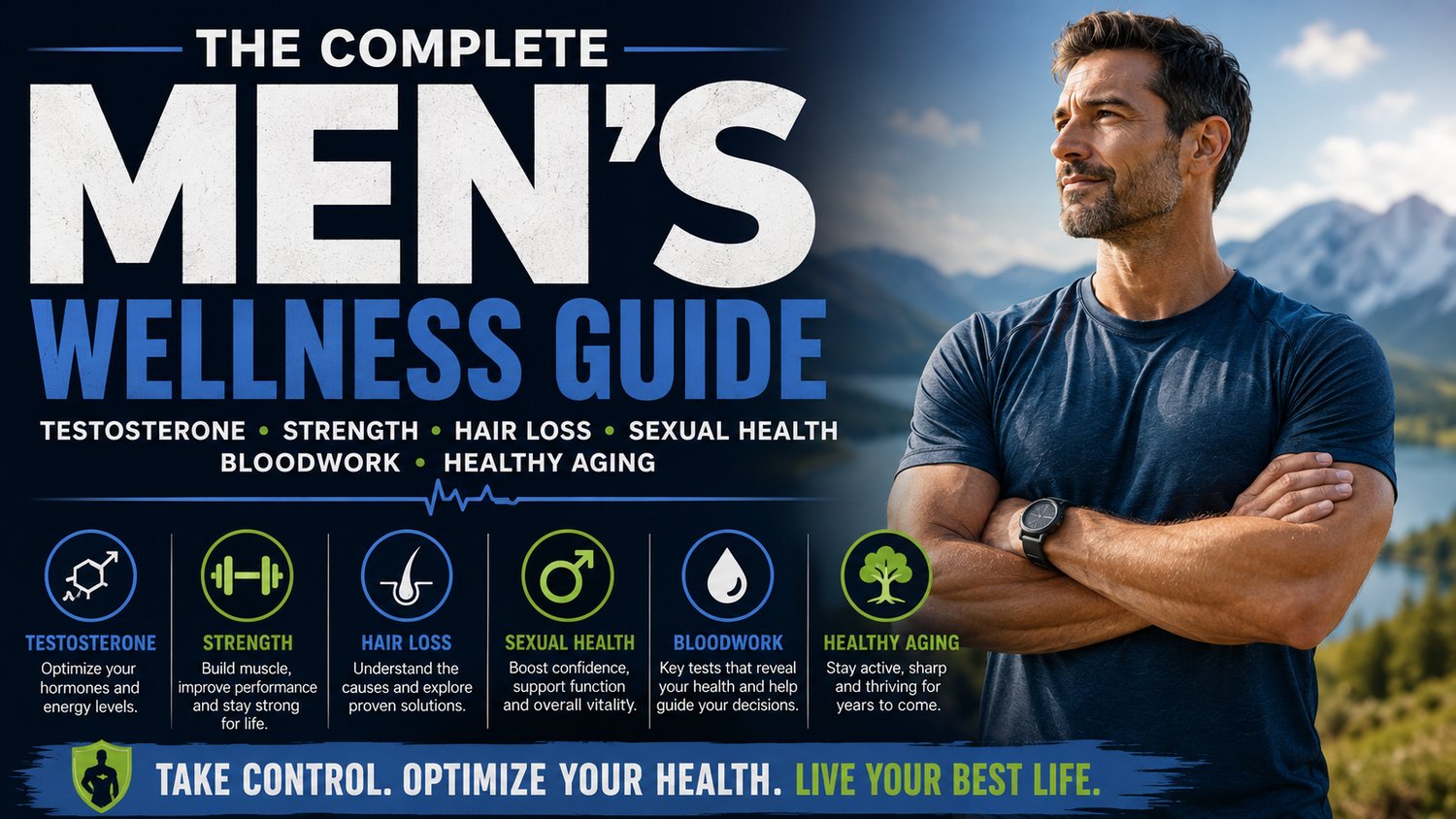
The Complete Men's Wellness Guide: Testosterone, Strength, Hair Loss, Sexual Health, Bloodwork & Healthy Aging
Men's wellness has become unnecessarily complicated.
Depending on what appears in your feed, you apparently need to:
Optimize testosterone.
Take six supplements.
Eliminate seed oils.
Cold plunge every morning.
Track 40 biomarkers.
Never eat soy.
Walk exactly 10,000 steps.
Lift heavy.
Do Zone 2.
Fix cortisol.
Prevent hair loss.
Get lean.
Sleep eight perfect hours.
And somehow accomplish all of it while working, raising a family, paying bills and having an actual life.
That's not a particularly useful health strategy.
Men's health gets much simpler when you stop treating every concern as an isolated problem.
Your:
- Sleep
- Strength
- Body composition
- Cardiovascular health
- Testosterone
- Sexual function
- Nutrition
- Bloodwork
- Hair
- Long-term health
are interconnected.
Poor sleep can affect energy, appetite, training and hormone health.
Excess abdominal fat can affect metabolic and cardiovascular health while also interacting with testosterone.
Erectile dysfunction can sometimes provide clues about vascular health.
Strength training helps preserve muscle and physical capacity as you age.
Bloodwork can identify risk factors long before you feel sick.
And healthy aging is really the accumulated result of how well you manage these systems over decades.
So this guide isn't about becoming a perfectly optimized man.
It's about knowing:
What actually matters.
What you can improve yourself.
What deserves medical attention.
And where to start.
If you want the introductory philosophy behind this pillar, begin with:
Then use this page as your roadmap.
The Men's Wellness Framework
A practical men's wellness plan can be organized into eight areas:
- Daily health habits
- Sleep and recovery
- Strength, movement and body composition
- Nutrition
- Testosterone and hormone health
- Hair loss and appearance
- Sexual and cardiovascular health
- Bloodwork, prevention and healthy aging
You don't need to fix all eight at once.
Trying to do that is a great way to fix none of them.
Start with the area causing the biggest problem.
Then build outward.
1. Build the Basics Before You Optimize Anything
Men's-health marketing often starts at the end.
Supplements.
Hormone optimization.
Peptides.
Wearables.
Advanced testing.
Special diets.
But if you're currently:
- Sleeping five hours
- Barely moving
- Never strength training
- Eating poorly
- Drinking excessively
- Ignoring high blood pressure
you don't have an optimization problem.
You have a foundation problem.
Start with:
Healthy Habits Every Man Should Build Before Buying Supplements →
The fundamental priorities are boring:
- Sleep enough
- Strength train
- Walk
- Eat adequate protein
- Maintain a reasonable body composition
- Don't smoke
- Limit excessive alcohol
- Manage blood pressure
- Get appropriate preventive care
They also happen to work.
2. Sleep Is Part of Your Health Plan
Sleep is often the first thing men sacrifice when life gets busy.
Work.
Kids.
Entertainment.
Phones.
Then caffeine gets used to compensate.
That can work for a while.
Eventually you may notice:
- Lower energy
- Worse workouts
- More hunger
- Reduced patience
- Poor concentration
- Worse recovery
- Changes in sexual function
Sleep also intersects with testosterone.
But don't reduce sleep to another testosterone hack.
Sleep matters because your brain and body require it whether testosterone changes or not.
Read:
Sleep for Men: Why Better Sleep Matters for Testosterone, Recovery & Health →
Don't Ignore Sleep Apnea
If you:
- Snore loudly
- Gasp during sleep
- Have witnessed breathing pauses
- Wake exhausted
- Experience severe daytime sleepiness
don't assume you're simply:
Getting older.
Obstructive sleep apnea can affect sleep quality, energy, blood pressure, cardiovascular health and sexual health.
Several of those symptoms can also overlap with testosterone deficiency.
Treat the actual problem.
Not just the fatigue.
3. Strength Is One of the Best Investments Men Can Make
Muscle is useful far beyond appearance.
It helps you:
- Lift
- Carry
- Work
- Move
- Maintain balance
- Stay physically capable
- Preserve independence as you age
That's why resistance training should generally become more important, not less, as you get older.
Start with:
Strength Training for Men Over 30 →
You don't need six gym days or two-hour workouts.
Two to four intelligently designed resistance-training sessions can accomplish a lot.
You Can Still Build Muscle After 40
Forty is not a muscle-building cliff.
You may need to pay more attention to:
- Recovery
- Previous injuries
- Sleep
- Exercise selection
- Training volume
- Protein intake
But the formula remains familiar:
Progressive resistance training + adequate protein + recovery + time.
Read:
The goal doesn't have to be bodybuilding.
Still strong at 60 is a pretty damn good goal.
Walking Complements Strength Training
You don't need to choose between:
Lifting
and:
Cardio.
Walking is one of the easiest ways to accumulate additional activity without creating much recovery demand.
It can support cardiovascular fitness, weight management, daily energy expenditure and general activity.
Read:
For the deeper walking pillar:
Why Belly Fat Gets Harder to Lose After 30 →
You also can't spot-reduce belly fat.
Train your core because it's useful.
Reduce excess abdominal fat through overall fat loss.
GLP-1 Treatment May Be Appropriate for Some Men
Obesity is a chronic medical condition.
For some men, prescription obesity treatment—including GLP-1–based medications—can appropriately become part of treatment.
Medication doesn't eliminate the importance of:
- Protein
- Strength training
- Walking
- Adequate nutrition
- Sleep
- Sustainable habits
If you're researching that route:
For meal ideas, inexpensive protein sources, recipes, timing and practical nutrition:
What Causes Low Testosterone?
There isn't one cause.
Possible contributors include:
- Testicular disorders
- Pituitary or hypothalamic disorders
- Obesity
- Sleep problems
- Certain medications
- Chronic illness
- Significant calorie restriction
- Other medical conditions
That means low testosterone is the beginning of the investigation, not necessarily the end.
Read:
What Causes Low Testosterone? →
Testosterone Testing Needs to Be Done Correctly
One random testosterone test doesn't establish hypogonadism.
Diagnosis generally requires compatible symptoms or signs alongside consistently low testosterone levels, confirmed with repeat testing.
For the full process:
How Testosterone Is Tested and Diagnosed →
For broader men's testing:
For independent testing resources:
What Is TRT? Testosterone Replacement Therapy Explained →
The useful position isn't:
TRT is miracle medicine.
Or:
TRT is poison.
It's:
TRT is medicine.
Testosterone Cypionate for TRT
If you start researching injectable TRT, testosterone cypionate appears almost immediately.
But treatment involves more than:
inject testosterone → feel awesome.
Questions include:
- Injection route
- Dosing interval
- Peaks and troughs
- Lab timing
- Hematocrit
- Fertility
- Side effects
- Long-term monitoring
Read:
Testosterone Cypionate for TRT →
Enclomiphene vs Testosterone Cypionate
Not every medication used in men's hormone treatment works like TRT.
Testosterone cypionate:
replaces testosterone from outside the body.
Enclomiphene:
attempts to stimulate endogenous testosterone production.
That creates important differences involving fertility, sperm production, testicular function and the underlying cause of low testosterone.
Read:
Enclomiphene vs Testosterone Cypionate →
What Does TRT Actually Cost?
A program advertised at:
$99/month
doesn't necessarily cost only $99/month.
Total expenses may include:
- Initial labs
- Confirmatory testing
- Follow-up bloodwork
- Provider visits
- Medication
- Syringes and supplies
- Shipping
- Membership fees
- Other treatment
Read:
TRT Labs Matter Before and During Treatment
TRT bloodwork serves different purposes at different stages.
Before treatment:
Is testosterone really low?
Then:
Why is it low?
During treatment:
Is therapy working safely?
Important testing can include total testosterone, free testosterone or SHBG when appropriate, LH, FSH, prolactin in selected cases, hemoglobin, hematocrit and PSA when appropriate.
Read:
What Labs Do You Need for TRT? →
Exploring Online TRT?
If you've already completed appropriate evaluation and are comparing treatment providers:
HabitLogics may earn a commission if you purchase through links on our TRT provider page, at no additional cost to you.
Can You Support Testosterone Naturally?
Sometimes lifestyle helps—especially when lifestyle contributes to the problem.
Focus on:
- Sleep
- Body composition
- Strength training
- Physical activity
- Adequate nutrition
- Correcting actual deficiencies
- Limiting excessive alcohol
- Recovery
Read:
How to Support Testosterone Naturally →
Lifestyle can improve health.
It cannot repair every medical cause of hypogonadism.
Ignore the Testosterone Myths
Common myths include:
- Every man over 40 needs TRT
- Soy destroys testosterone
- Cold showers dramatically boost testosterone
- One low result proves low T
- More testosterone is always better
- TRT automatically causes heart attacks
- Testosterone boosters are natural TRT
Read:
6. Hair Loss Is Connected to Hormones—But Not the Way Most Men Think
Going bald does not prove you have high testosterone.
Male pattern hair loss is primarily about:
- Genetics
- Androgen signaling
- DHT
- Follicle sensitivity
- Time
And not every form of hair loss is androgenetic alopecia.
Start here:
Male Pattern Baldness Explained
The most common form of male hair loss is androgenetic alopecia.
Genetically susceptible follicles gradually miniaturize under androgen influence, particularly DHT.
Typical areas include:
- Temples
- Frontal hairline
- Crown
Read:
Minoxidil vs Finasteride
These medications do different jobs.
Minoxidil
Primarily supports hair growth and follicle activity.
Finasteride
Reduces DHT production, targeting a major mechanism driving androgenetic alopecia.
Read:
Oral Minoxidil vs Topical Minoxidil
Topical minoxidil is the traditional OTC approach.
Low-dose oral minoxidil is increasingly used as an off-label prescription treatment for hair loss.
The tradeoff becomes roughly:
topical inconvenience + lower systemic exposure
versus:
oral convenience + greater systemic exposure.
Read:
Oral Minoxidil vs Topical Minoxidil →
Topical Finasteride vs Oral Finasteride
Topical finasteride attempts to deliver treatment directly to the scalp while reducing systemic exposure.
But:
lower systemic exposure does not mean zero systemic exposure.
For the full comparison:
Topical Finasteride vs Oral Finasteride →
Dutasteride vs Finasteride
Dutasteride takes DHT suppression further than finasteride.
Research suggests that can translate into greater average hair-growth effects.
But stronger DHT blocking isn't automatically better treatment for every man.
Finasteride is FDA-approved specifically for male pattern hair loss.
Dutasteride use for hair loss in the United States is off-label.
Read:
Which Hair-Loss Treatments Actually Work?
Beyond minoxidil and finasteride, men encounter:
- Dutasteride
- Laser devices
- PRP
- Microneedling
- Hair transplants
- Hair vitamins
- DHT shampoos
- Rosemary oil
- Hair fibers
- Scalp micropigmentation
- Hair systems
Some have legitimate roles.
Others have much weaker evidence than their marketing suggests.
Read:
Best Hair Loss Treatments for Men →
Exploring Online Hair-Loss Treatment?
For clinician-supervised telehealth options:
Explore Strut Men's Hair Loss Options →
For specific treatment routes:
Strut Finasteride Hair Loss Formula →
Strut Oral Minoxidil Tablets →
HabitLogics may earn a commission if you purchase through these links, at no additional cost to you.
7. Erectile Health Is Cardiovascular Health Too
Erectile dysfunction shouldn't automatically be treated as an isolated bedroom problem.
Erections depend on blood flow, nerve function, hormones and brain signaling.
Persistent ED can be influenced by:
- Cardiovascular disease
- Diabetes
- High blood pressure
- Obesity
- Medication
- Low testosterone
- Psychological factors
Read:
Erectile Dysfunction: Causes, Treatment & When to Get Help →
Morning Erections Can Provide Additional Clues
Men naturally experience erections during sleep.
A persistent change in spontaneous erections may provide additional context about erectile function, sleep, hormone health, blood flow and neurological function.
Read:
Morning Erections: What They Can Tell You About Your Health →
Look for meaningful changes in your normal pattern rather than obsessively tracking individual mornings.
8. Know Your Bloodwork
Testosterone shouldn't be the only laboratory value men care about.
It helps to understand:
- CBC
- Metabolic panel
- Cholesterol
- Glucose
- A1C
- Kidney-related markers
- Liver-related markers
- Age- and risk-based testing
Read:
You don't need 70 biomarkers every month.
You need the right information for your situation.
Track Trends, Not Just Isolated Results
One result is a snapshot.
Years of results become a story.
You can notice:
- LDL rising
- A1C creeping upward
- Hematocrit increasing on TRT
- Testosterone changing
- Weight increasing
- Waist expanding
before the situation becomes dramatic.
The:
The goal isn't simply reaching 80.
It's still being able to use your body and enjoy your life when you get there.
A Practical Men's Wellness Routine
Daily
- Eat protein-rich meals.
- Walk and move.
- Get some daylight.
- Maintain a reasonable sleep schedule.
- Take prescribed medication correctly.
- Avoid smoking.
Two to Four Times Per Week
Strength train.
Weekly
Pay attention to:
- Body weight
- Waist trend
- Exercise consistency
- Sleep
- Alcohol intake
- Energy
Periodically
Monitor:
- Blood pressure
- Appropriate bloodwork
- Preventive screening
When Symptoms Change
Investigate.
Don't automatically blame age, testosterone or stress.
Find out what's actually happening.
Where Should You Start?
If You're Exhausted
If You're Sedentary
Start with Walking for Men's Health →
If You're Weak or Losing Muscle
Start with Strength Training for Men Over 30 →
If You're Over 40 and Want to Add Muscle
Start with Building Muscle After 40 →
If Your Waist Is Growing
Start with Why Belly Fat Gets Harder to Lose After 30 →
If Your Diet Is Poor
If You're Worried About Testosterone
Start with Low Testosterone Symptoms →
If You've Been Diagnosed With Low Testosterone
If You're Comparing TRT Treatments
Start with Enclomiphene vs Testosterone Cypionate →
If You're Comparing TRT Providers
If You're Losing Hair
Start with Why Men Lose Their Hair →
If You're Comparing Hair-Loss Treatments
Start with Best Hair Loss Treatments for Men →
If Erections Have Changed
Start with Erectile Dysfunction →
If You Don't Know Your Health Numbers
Start with Blood Work for Men →
One problem.
One starting point.
Then build.
The Men's Wellness Priority Pyramid
Level 1 — Don't Ignore Major Risks
- Smoking
- Severe obesity
- High blood pressure
- Diabetes
- Untreated sleep apnea
- Significant diagnosed medical conditions
Level 2 — Build the Foundation
- Sleep
- Strength training
- Walking and aerobic activity
- Nutritious diet
- Protein
- Weight management
Level 3 — Measure What Matters
- Blood pressure
- Bloodwork
- Weight
- Waist
- Fitness
- Symptoms
Level 4 — Treat Specific Problems
- Testosterone deficiency
- Erectile dysfunction
- Hair loss
- Obesity
- Sleep disorders
- Other diagnosed conditions
Level 5 — Optimize
- Supplements
- Advanced biomarkers
- Specialized training strategies
- Experimental wellness trends
A lot of men's-health marketing tries to sell you Level 5 while Level 1 is on fire.
Don't do that.
Frequently Asked Questions
What Does Men's Wellness Include?
Men's wellness includes strength, physical activity, nutrition, sleep, cardiovascular health, metabolic health, hormone health, sexual function, preventive care, mental well-being and healthy aging.
It is much broader than testosterone or fitness alone.
What Are the Most Important Health Habits for Men?
A strong foundation includes regular resistance training, aerobic activity, walking, adequate sleep, nutritious eating, enough protein, healthy body composition, avoiding smoking and appropriate preventive care.
Healthy Habits Every Man Should Build Before Buying Supplements →
Should Every Man Get Testosterone Tested?
No.
Testing is most useful when symptoms or medical circumstances make testosterone deficiency plausible.
How Testosterone Is Tested and Diagnosed →
Does Every Man Eventually Need TRT?
No.
TRT is treatment for appropriately diagnosed testosterone deficiency.
Age alone doesn't automatically create an indication for testosterone.
Does TRT Affect Fertility?
It can.
Exogenous testosterone can suppress hormonal signaling required for normal sperm production.
Men with current or future fertility goals should discuss this before treatment.
Enclomiphene vs Testosterone Cypionate →
What Labs Matter on TRT?
Common testing may include testosterone, hemoglobin, hematocrit, PSA when appropriate and other testing based on the individual.
What Labs Do You Need for TRT? →
What's the Best Exercise for Men's Health?
There isn't one.
A complete plan combines resistance training, aerobic activity and regular daily movement.
Strength training plus walking is an excellent starting combination.
Is Finasteride or Minoxidil Better for Hair Loss?
They work differently.
Finasteride reduces DHT.
Minoxidil supports hair growth.
For some men, combination treatment makes sense.
Is Topical Finasteride Safer Than Oral Finasteride?
Topical finasteride may reduce systemic exposure, but it doesn't eliminate it.
Topical Finasteride vs Oral Finasteride →
What Health Numbers Should Men Know?
Useful numbers can include blood pressure, weight, waist circumference, cholesterol, glucose, A1C when appropriate and other routine laboratory markers.
Key Takeaways
- Men's wellness is a system, not a collection of isolated hacks.
- Sleep, strength, movement, nutrition, body composition, hormones, cardiovascular health, sexual function and preventive care interact.
- Build the health foundation before spending heavily on supplements and optimization.
- Resistance training helps preserve muscle and physical capacity as men age.
- Walking is one of the easiest ways to increase activity.
- Adequate protein supports muscle, weight management and healthy aging.
- Testosterone deficiency is real, but symptoms and proper testing matter.
- TRT is legitimate treatment for appropriate patients—not a universal men's-health requirement.
- TRT treatment involves more than choosing a testosterone medication; cost, labs, fertility and monitoring matter.
- Male pattern baldness is driven largely by genetics and androgen-sensitive follicles rather than simply “high testosterone.”
- Minoxidil, finasteride and dutasteride have different roles.
- Persistent erectile dysfunction can deserve broader cardiovascular and metabolic evaluation.
- Bloodwork becomes more useful when you track trends rather than isolated measurements.
- Healthy aging is ultimately about preserving strength, mobility, independence and quality of life.
Final Thoughts
Men's wellness doesn't require perfection.
It requires paying attention.
Sleep before you're exhausted.
Train before you're weak.
Walk before movement becomes difficult.
Manage your waist before metabolic problems become severe.
Know your blood pressure before hypertension damages something.
Investigate sexual changes rather than ignoring them.
Test testosterone when there's an actual reason.
Treat hair loss early if preserving your hair matters.
Get routine healthcare before you're sick.
And stop expecting one supplement, medication, diet or hormone to solve the entire system.
A healthy man isn't necessarily the guy with:
the highest testosterone.
Or:
the lowest body-fat percentage.
Or:
the most supplements.
It's the guy who maintains enough strength, cardiovascular health, metabolic health, mental capacity, mobility and independence to keep doing the things that matter to him.
That's the goal.
And you build it through boring, repeatable habits practiced for years.
Explore the Complete Men's Wellness Library
Start Here
Sleep, Exercise, Nutrition & Body Composition
Strength Training for Men Over 30 →
Why Belly Fat Gets Harder to Lose After 30 →
Testosterone & Low Testosterone
What Causes Low Testosterone? →
How Testosterone Is Tested and Diagnosed →
How to Support Testosterone Naturally →
TRT Treatment Guides
Testosterone Cypionate for TRT →
Enclomiphene vs Testosterone Cypionate →
What Labs Do You Need for TRT? →
Hair Loss
Oral Minoxidil vs Topical Minoxidil →
Topical Finasteride vs Oral Finasteride →
Best Hair Loss Treatments for Men →
Sexual Health
Testing & Healthy Aging
Free & Premium HabitLogics Resources
FREE Men's Hormone & Energy Starter Kit →
Men's Health & Performance Dashboard →
Testosterone Lifestyle Guide →
Men's Momentum System Bundle →
Related HabitLogics Pillars
Complete Walking for Weight Loss Guide →
Complete GLP-1 Success Guide →
Affiliate Disclosure
Some links in this guide are affiliate links. If you use one of these links and make a purchase, HabitLogics may earn a commission at no additional cost to you. Affiliate relationships do not determine whether a treatment, provider or product is medically appropriate.
Educational Disclaimer
This guide is intended for educational and informational purposes only and should not be considered medical advice. Men's health needs vary according to age, symptoms, medical history, medications, family history, fertility goals and individual risk. Testosterone therapy, prescription hair-loss medication, obesity treatment and other medical interventions require individualized assessment. Persistent symptoms, abnormal laboratory results, sexual dysfunction, suspected hormone disorders, significant or unusual hair loss or other health concerns should be evaluated by an appropriately qualified healthcare professional.