

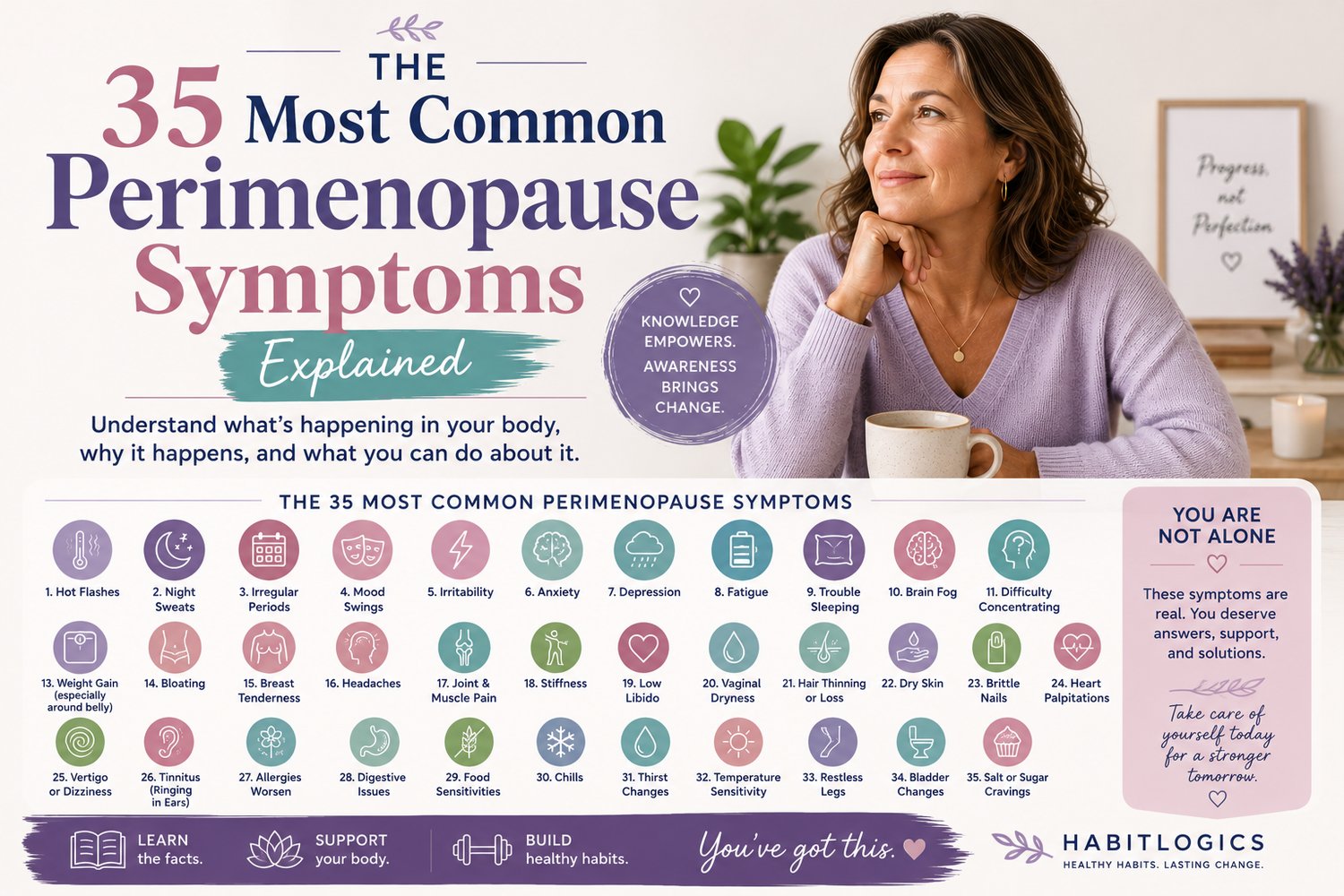
35 Perimenopause Symptoms: Common Signs, What’s Normal & When to Get Help
Perimenopause can be confusing because it rarely looks exactly the same from one person to another.
One woman may notice that her periods suddenly become unpredictable. Another may start waking up drenched in sweat. Someone else may first notice worsening sleep, irritability, vaginal dryness, or trouble concentrating.
And some women have relatively few symptoms at all.
That variability has helped create enormous online lists claiming that practically anything that happens during your 40s is a symptom of perimenopause.
That's where we need to be careful.
Hormonal changes during perimenopause can affect several systems throughout the body, but not every headache, dizzy spell, aching joint, or bad night's sleep is caused by perimenopause.
This guide covers 35 symptoms and changes that may occur during the menopause transition, while distinguishing the classic signs from symptoms that are less specific and may have many other explanations.
If you're just starting to figure out what's happening, begin with What Is Perimenopause? Signs, Symptoms & What to Expect and When Does Perimenopause Start? Age, Early Signs & What to Expect.
What Happens During Perimenopause?
Perimenopause is the transition leading up to menopause.
During this time, ovarian function becomes less predictable. Ovulation may occur during some cycles and not others, while estrogen and progesterone levels can fluctuate considerably.
Eventually, menstrual periods stop completely.
Menopause is officially reached after 12 consecutive months without a menstrual period, assuming there isn't another explanation for the absence of periods.
The transition commonly begins during the 40s, although timing varies.
Hormonal changes during this period can influence:
- Menstrual cycles
- Temperature regulation
- Sleep
- Mood
- Vaginal and urinary tissues
- Sexual function
- Bone health
- Body composition
But age, stress, medications, medical conditions, sleep, nutrition, and normal midlife changes can occur at the same time.
That overlap is why symptoms should be viewed as clues rather than proof.
The Most Recognizable Perimenopause Symptoms
Some symptoms are much more strongly associated with the menopause transition than others.
1. Irregular Periods
Changes in your menstrual cycle are one of the most characteristic signs of perimenopause.
Periods may become:
- Closer together
- Farther apart
- Shorter
- Longer
- Heavier
- Lighter
- Less predictable
You may also begin skipping periods.
These changes occur partly because ovulation becomes increasingly inconsistent.
Period changes can be expected during perimenopause, but that doesn't mean every type of abnormal bleeding should simply be blamed on hormones.
We'll cover important warning signs later in this guide.
2. Hot Flashes
Hot flashes are among the best-known symptoms of the menopause transition.
A hot flash can cause a sudden sensation of warmth, often involving the face, neck, or upper body. Some women also experience sweating, flushing, chills afterward, or a rapid heartbeat.
Episodes may be occasional or frequent and can range from mildly annoying to seriously disruptive.
For practical strategies, read Managing Hot Flashes During Perimenopause.
3. Night Sweats
Night sweats are essentially hot flashes that occur during sleep.
They may cause you to:
- Wake suddenly feeling overheated
- Sweat heavily
- Throw off blankets
- Change clothing or bedding
- Struggle to fall asleep again
Repeated night sweats can create a second problem: chronic sleep disruption.
4. Sleep Problems
Sleep can become more difficult during perimenopause even when night sweats aren't the only culprit.
You may notice:
- Trouble falling asleep
- Frequent awakenings
- Waking earlier than intended
- Difficulty returning to sleep
- Feeling unrefreshed in the morning
Hot flashes, stress, mood changes, medical conditions, caffeine, alcohol, sleep habits, and other factors can all contribute.
Read Sleep During Perimenopause: Why It Changes & How to Sleep Better for a deeper look.
If sleep and nighttime hot flashes are becoming difficult to keep track of, the Perimenopause Sleep & Hot Flash Planner provides printable and Excel tools for tracking sleep, night sweats, bedtime routines, and patterns over time.
5. Vaginal Dryness
Declining estrogen exposure can cause vaginal tissues to become thinner, drier, and less elastic.
That may lead to:
- Dryness
- Irritation
- Burning
- Discomfort
- Pain during sexual activity
These changes are part of a broader condition known as genitourinary syndrome of menopause (GSM).
Unlike some symptoms that improve after the menopause transition, untreated vaginal and urinary symptoms may persist.
Effective treatments are available, so this isn't something you simply have to tolerate.
6. Urinary Changes
Estrogen-related changes can also affect tissues around the urethra and bladder.
Some women experience:
- Urinary urgency
- More frequent urination
- Burning or irritation
- Recurrent urinary tract infections
These symptoms can have other causes—including an actual UTI—so new urinary symptoms deserve appropriate evaluation.
Menstrual and Reproductive Changes
7. Heavier Periods
Some periods may become considerably heavier during perimenopause.
Changes in ovulation can alter how the uterine lining develops and sheds.
However, heavy bleeding shouldn't automatically be dismissed as normal perimenopause.
Fibroids, polyps, adenomyosis, thyroid problems, medications, pregnancy-related conditions, and changes involving the uterine lining can also cause abnormal bleeding.
8. Lighter Periods
The opposite can happen too.
Some cycles may become noticeably lighter or shorter than what was previously normal for you.
A changing pattern is common as ovulation becomes less predictable.
9. Shorter or Longer Cycles
A period that once arrived like clockwork may start appearing earlier or later.
You might have several shorter cycles followed by a surprisingly long gap.
Tracking the actual dates can be far more useful than trying to reconstruct the pattern from memory months later.
10. Skipped Periods
Skipped periods become increasingly common as the transition progresses.
But here's an important distinction:
Perimenopause does not mean pregnancy is impossible.
Ovulation may still occur unpredictably until menopause has been reached.
If pregnancy is possible, don't automatically assume a missed period is caused by perimenopause.
For a clearer explanation of where one stage ends and the next begins, read Perimenopause vs. Menopause: What’s the Difference?.
Mood and Cognitive Symptoms
Hormones may be part of the picture, but they aren't the entire picture.
Poor sleep, hot flashes, work demands, caregiving responsibilities, relationship stress, existing mental health conditions, medications, and other midlife changes can overlap with the menopause transition.
11. Mood Changes
Some women notice that their mood feels less predictable during perimenopause.
Emotional reactions may feel stronger or occur more quickly than they used to.
That doesn't mean every bad mood is hormonal.
It does mean a noticeable change from your normal emotional pattern is worth paying attention to.
Read Mood Swings During Perimenopause: Why They Happen & What May Help.
12. Irritability
Reduced patience and increased irritability are commonly reported.
And sometimes the explanation isn't mysterious.
If you're waking up four times a night because you're overheating, exhausted the next day, and dealing with other uncomfortable symptoms, you're probably not going to feel unusually patient.
Hormones, sleep, stress, and physical symptoms can interact rather than operating independently.
13. Anxiety
Some women report new or worsening anxiety during the menopause transition.
That can include:
- Excessive worry
- Feeling tense or on edge
- Racing thoughts
- Difficulty relaxing
- Physical symptoms such as a racing heart
New or severe anxiety shouldn't simply be written off as hormones.
Treatment and professional support are available regardless of whether perimenopause is contributing.
14. Low Mood
Periods of sadness or feeling emotionally flat can occur.
Persistent depression is different.
If low mood is prolonged, interferes with daily functioning, causes loss of interest in things you normally enjoy, or becomes severe, seek professional help.
Perimenopause may influence mental health.
It does not make serious mental health symptoms something you should simply endure.
15. Brain Fog
"Brain fog" isn't a formal diagnosis, but it's a useful description of what many women experience during the menopause transition.
You may feel:
- More forgetful
- Easily distracted
- Mentally slower
- Less organized
- Unable to find a familiar word
- Overwhelmed by multitasking
Hormonal changes may contribute, while sleep disruption, stress, anxiety, medications, and other health conditions can also affect cognition.
Read Brain Fog During Perimenopause: Why It Happens & What May Help.
16. Difficulty Concentrating
Tasks that previously felt automatic may suddenly require more effort.
This can become particularly obvious during busy workdays or periods of poor sleep.
Reducing distractions, writing things down, and working in focused blocks can help compensate while you address underlying contributors.
17. Forgetfulness
Walking into a room and forgetting why you're there is frustrating.
So is losing your train of thought halfway through a sentence.
Mild memory complaints can occur during the menopause transition and aren't the same thing as dementia.
Memory problems that are severe, rapidly worsening, or significantly affecting daily functioning deserve medical evaluation.
Physical Changes That May Occur
18. Fatigue
Fatigue is common but extremely nonspecific.
Hormonal changes may play a role, but so can:
- Poor sleep
- Night sweats
- Iron-deficiency anemia
- Thyroid disorders
- Depression
- Sleep apnea
- Medication effects
- Nutritional deficiencies
- Other medical conditions
Persistent exhaustion deserves more investigation than, "Well, you're in your 40s now."
19. Weight and Body-Composition Changes
Many women notice their body changing around the menopause transition.
But the simplistic explanation that "perimenopause causes weight gain" misses a lot.
Aging, changes in muscle mass, activity, sleep, diet, medications, stress, and hormonal changes can all contribute. Menopause also appears to influence where fat tends to be stored.
Read Perimenopause Weight Gain: Why It Happens & What Actually Helps for the full discussion.
20. More Abdominal Fat
Body-fat distribution can shift toward the abdominal area during the menopause transition.
That's different from saying hormones magically create belly fat regardless of lifestyle.
Body composition is influenced by multiple factors, which is why preserving muscle, remaining active, getting adequate sleep, and maintaining useful nutrition habits matter.
21. Joint Aches and Stiffness
Musculoskeletal discomfort is frequently reported during midlife and the menopause transition.
But joint pain is another symptom with a very long list of possible causes.
Regular movement and appropriate resistance training can support mobility, strength, and physical function, but persistent swelling, severe pain, or significant loss of function deserves medical evaluation.
22. Headaches or Changes in Migraine
Hormonal fluctuations can influence migraine patterns in people who are susceptible to them.
Some women notice headaches becoming more frequent or less predictable during perimenopause.
A new severe headache, sudden "worst headache" pattern, or headache accompanied by neurological symptoms requires prompt medical attention.
23. Breast Tenderness
Hormonal fluctuations can cause temporary breast soreness or tenderness similar to what some women experience at other points in the menstrual cycle.
A new breast lump, nipple discharge, skin change, or persistent focal pain should be evaluated rather than assumed to be hormonal.
24. Heart Palpitations
Some women report sensations of:
- Racing
- Pounding
- Fluttering
- Skipped beats
Palpitations can occur during the menopause transition, including around hot flashes.
But they can also result from heart rhythm problems, thyroid disorders, anemia, medications, caffeine, anxiety, and other causes.
Don't automatically label new heart symptoms "perimenopause."
Seek medical attention for concerning palpitations, particularly when accompanied by chest pain, fainting, severe shortness of breath, or other significant symptoms.
25. Changes in Sexual Desire
Libido may decrease for some women, remain unchanged for others, or fluctuate.
Sexual desire is complicated.
Hormones may matter, but so can:
- Vaginal discomfort
- Poor sleep
- Stress
- Relationship factors
- Medications
- Mood
- Body image
- Other health conditions
If vaginal dryness or pain is making sex uncomfortable, treating the physical problem may make a meaningful difference.
Hair, Skin, Muscle, and Bone Changes
These changes deserve slightly different treatment because they're often discussed as "perimenopause symptoms" even though normal aging and other health factors can contribute substantially.
26. Dry Skin
Skin can become drier and change in texture with age and changing estrogen levels.
Moisturizers, sun protection, hydration, and appropriate skin care may help, while persistent or unusual skin problems may need dermatologic evaluation.
27. Hair Thinning
Some women notice increased shedding or gradual thinning around midlife.
Hormonal changes may contribute, but hair loss can also result from:
- Genetics
- Thyroid disorders
- Iron deficiency
- Significant weight loss
- Nutritional deficiencies
- Illness
- Medications
- Other types of alopecia
In other words: don't assume hair loss is inevitable just because you're approaching menopause.
28. Changes in Muscle Mass and Strength
Muscle mass and strength tend to decline with age unless you actively work to preserve them.
The menopause transition may add another layer to these changes, but resistance training and adequate nutrition remain powerful tools for maintaining function.
Read Strength Training During Perimenopause: Benefits, Workouts & How to Start.
Protein also matters for maintaining muscle. Protein During Perimenopause: How Much Do You Need? covers the practical side.
If you want a structured way to organize meals while tracking protein and fiber, the Perimenopause Nutrition & Meal Planner combines meal planning, food journaling, meal prep, and nutrition tracking in printable and Excel formats.
29. Bone Loss
Estrogen plays an important role in bone health.
Bone loss accelerates around the menopause transition and becomes an increasingly important long-term health consideration.
Strength training, weight-bearing activity, adequate nutrition, and appropriate calcium and vitamin D intake all matter, while individual screening and treatment decisions should be discussed with a healthcare professional.
This is less about something you can "feel" happening and more about protecting future health before a problem announces itself.
Other Symptoms Sometimes Reported During Perimenopause
This next group requires more caution.
These symptoms are sometimes reported during the menopause transition, but they're not specific enough to use as evidence that you're in perimenopause by themselves.
30. Dizziness or Lightheadedness
Some women report dizziness during midlife, but dizziness has many possible causes, including:
- Dehydration
- Blood-pressure changes
- Anemia
- Medication effects
- Inner-ear problems
- Blood-sugar changes
- Heart problems
- Neurological conditions
Repeated, severe, or unexplained dizziness should be evaluated.
31. Tingling or Unusual Skin Sensations
Pins-and-needles, crawling sensations, tingling, or altered skin sensitivity are sometimes included on menopause symptom lists.
These sensations can also have neurological, circulatory, metabolic, medication-related, or nutritional causes.
Persistent numbness or tingling deserves proper evaluation rather than an automatic hormone explanation.
32. Bloating
Some women report changes in bloating or digestive comfort during midlife.
But bloating is highly nonspecific.
Diet, constipation, gastrointestinal disorders, medications, stress, and many other factors can contribute.
Persistent or significant abdominal bloating—especially when accompanied by pain, changes in bowel habits, feeling full unusually quickly, or unexplained weight changes—should be discussed with a healthcare professional.
33. Dry Mouth or Oral Changes
Dry mouth, altered taste, or burning sensations in the mouth are sometimes reported around menopause.
They can also result from medications, dehydration, dental problems, nutritional deficiencies, diabetes, autoimmune disorders, and other conditions.
Persistent oral symptoms deserve evaluation.
34. Changes in Body Odor
Hot flashes and increased sweating can certainly change how you smell after a long day.
That's different from claiming that a change in body odor is a reliable diagnostic sign of perimenopause.
Changes in sweating, skin bacteria, medications, diet, and personal-care products can all affect odor.
35. Brittle Nails
Nail texture and strength can change with age.
Brittle nails also appear on many online perimenopause symptom lists, but they're not a useful standalone indicator of the menopause transition.
Frequent water exposure, nail products, nutritional issues, thyroid conditions, skin disorders, and normal aging can all affect nail strength.
Don't Diagnose Perimenopause From a Symptom Checklist
This deserves its own section because the internet has made perimenopause symptom counting unnecessarily confusing.
You do not need 10 symptoms, 20 symptoms, or 35 symptoms to "qualify" for perimenopause.
And experiencing 15 symptoms on this list doesn't prove that hormones caused them.
For otherwise healthy people around the typical age of the menopause transition, clinicians often identify perimenopause based on the overall picture:
- Age
- Menstrual-cycle changes
- Typical menopause-associated symptoms
- Medical history
- Other possible explanations
Routine hormone testing often isn't necessary in people over 45 with a typical presentation because hormone levels can fluctuate considerably during perimenopause.
Testing may be more relevant when symptoms occur at a younger age or when another medical condition needs to be investigated.
The important question isn't:
"How many perimenopause symptoms do I have?"
It's:
"Does the overall pattern fit perimenopause, and is there anything else that needs to be ruled out?"
Symptoms Often Feed Into One Another
One reason perimenopause can feel overwhelming is that symptoms don't necessarily occur independently.
For example:
Hot flashes → disrupted sleep → fatigue → less activity → worse mood → more difficulty coping with symptoms.
Or:
Vaginal dryness → painful sex → reduced sexual desire → relationship stress.
This is why improving one part of the picture can sometimes help several others.
Sleep, nutrition, movement, stress management, symptom-specific treatment, and medical care aren't competing strategies.
They can work together.
For broader lifestyle strategies, read Healthy Habits During Perimenopause: What Actually Matters.
Track Patterns Instead of Trying to Remember Everything
Perimenopause symptoms can change from week to week and month to month.
Memory is a terrible spreadsheet.
Tracking can help you record:
- Period dates and bleeding
- Hot flashes
- Night sweats
- Sleep quality
- Mood
- Energy
- Headaches
- Exercise
- Nutrition
- Medications
- Possible triggers
- Changes over time
The point isn't to obsess over every sensation.
It's to create a clearer picture.
That can make it easier to notice patterns and give your healthcare provider more useful information than, "I've felt weird for the last six months."
The Perimenopause Symptom Tracker includes printable and Excel tools for tracking hot flashes, mood, sleep, menstrual changes, symptoms, and possible patterns over time.
If you want one system covering symptoms, sleep, hot flashes, nutrition, and lifestyle planning, the Perimenopause Planner Bundle combines the broader set of Perimenopause planning tools.
Want an easy place to start? The FREE Perimenopause Starter Kit includes a symptom tracker, sleep and hot flash log, habit planner, and wellness guide in a 28-page PDF.
If you want more detailed tracking in both printable and spreadsheet formats, the Perimenopause Symptom Tracker provides a more comprehensive system for monitoring hot flashes, mood, sleep, menstrual changes, symptoms, and possible patterns over time.
When Should You Contact a Healthcare Provider?
Perimenopause is a normal biological transition.
That does not mean every symptom during perimenopause is normal.
Talk with a healthcare professional about symptoms that are new, persistent, severe, unusual for you, or interfering with your quality of life.
Bleeding changes deserve particular attention.
Contact your healthcare provider about:
- Very heavy bleeding
- Bleeding or spotting between periods
- Bleeding after sex
- Bleeding that lasts substantially longer than usual
- Significant pelvic pain
- Symptoms of anemia such as unusual weakness or shortness of breath
- Persistent or concerning heart palpitations
- Significant depression or anxiety
- Severe or unusual headaches
- Symptoms that substantially interfere with daily life
Any vaginal bleeding after menopause should be medically evaluated.
Remember: menopause means you've gone 12 consecutive months without a menstrual period. Bleeding after that point isn't simply another irregular perimenopause period.
What Can Actually Help Perimenopause Symptoms?
There isn't one universal perimenopause treatment because different symptoms require different approaches.
Lifestyle foundations can include:
- Regular physical activity
- Strength training
- Adequate protein
- Balanced nutrition
- Consistent sleep habits
- Stress management
- Limiting personal hot-flash triggers when identifiable
- Avoiding smoking
- Moderating alcohol when appropriate
For practical movement strategies, see Walking During Perimenopause: Benefits for Weight, Mood & Health.
For nutrition, read Best Diet for Perimenopause: What to Eat for Midlife Health.
Lifestyle changes can support health and may make some symptoms easier to manage.
But there's an equally important point:
You don't get bonus points for suffering through significant symptoms without treatment.
Medical options exist for hot flashes, vaginal symptoms, sleep disruption, and other menopause-related concerns.
Menopausal hormone therapy is one treatment option and can be highly effective for appropriate candidates, particularly for vasomotor symptoms such as hot flashes and night sweats. Hormonal and nonhormonal options are available, and the right choice depends on your symptoms, medical history, risk factors, preferences, and whether you still have a uterus.
Read Hormone Therapy During Perimenopause: Benefits, Risks & What to Know before assuming either that hormone therapy is a miracle solution or that it's automatically dangerous.
Neither extreme is useful.
Frequently Asked Questions
What are the most common symptoms of perimenopause?
Changes in menstrual cycles, hot flashes, night sweats, sleep problems, and vaginal or urinary changes are among the most characteristic symptoms.
Mood changes, cognitive complaints, sexual changes, headaches, and other symptoms may also occur.
Not everyone experiences the same combination or severity.
What is usually the first sign of perimenopause?
Menstrual-cycle changes are often one of the earliest clues.
Periods may become shorter, longer, heavier, lighter, closer together, farther apart, or occasionally skipped.
Some women notice hot flashes, sleep disruption, or other symptoms around the same time.
Read When Does Perimenopause Start? Age, Early Signs & What to Expect for more detail.
Can you have perimenopause without hot flashes?
Yes.
Hot flashes are common, but they aren't required for perimenopause.
Some women have few vasomotor symptoms and primarily notice menstrual changes or other symptoms.
Can you still have regular periods during perimenopause?
Especially early in the transition, cycles may remain fairly regular while other changes begin appearing.
Over time, menstrual patterns commonly become less predictable.
Do I need a hormone test to know if I'm in perimenopause?
Often, no.
In otherwise healthy people 45 and older with typical symptoms and menstrual changes, perimenopause can generally be identified clinically without routine hormone testing.
Hormone levels fluctuate during the transition, so a single result may provide little useful information.
Testing may be appropriate in younger people or when a healthcare provider is investigating another possible cause.
How long do perimenopause symptoms last?
There isn't one standard timeline.
Perimenopause itself can last several years, and individual symptoms can appear, disappear, worsen, or improve during that time.
Some symptoms may continue after menopause.
Can perimenopause cause weight gain?
Weight and body composition commonly change during midlife, but hormones aren't the only factor.
Aging, muscle loss, activity, sleep, nutrition, medications, stress, and hormonal changes can overlap.
That's why "balance your hormones and melt menopause belly fat" is a much better marketing slogan than medical explanation.
Read Perimenopause Weight Gain: Why It Happens & What Actually Helps for the more useful version.
Can healthy habits reduce perimenopause symptoms?
They can help support overall health and may improve certain symptoms, but healthy habits don't stop the menopause transition.
Walking, resistance training, adequate nutrition, sleep habits, and stress management remain valuable even when medical treatment is also needed.
It doesn't have to be lifestyle or treatment.
Key Takeaways
- Perimenopause can affect menstrual cycles, temperature regulation, sleep, mood, vaginal and urinary health, sexual function, cognition, and other aspects of well-being.
- Menstrual changes, hot flashes, night sweats, sleep problems, and vaginal or urinary changes are among the more characteristic symptoms.
- Not every symptom on a large online perimenopause checklist is strongly or specifically linked to hormonal changes.
- Symptoms such as fatigue, dizziness, headaches, bloating, palpitations, hair loss, and tingling can have many other causes.
- Perimenopause is usually assessed from the overall clinical picture rather than by counting symptoms.
- Routine hormone testing is often unnecessary in people over 45 with a typical presentation.
- Pregnancy can still occur during perimenopause.
- Abnormal bleeding should not automatically be blamed on hormones.
- Any bleeding after menopause requires medical evaluation.
- Lifestyle changes can support health, while medical treatments are available when symptoms become bothersome.
- Tracking symptoms and menstrual changes can make patterns easier to recognize and discuss with a healthcare provider.
Continue Learning
Build out the bigger picture with these HabitLogics guides:
- What Is Perimenopause? Signs, Symptoms & What to Expect
- When Does Perimenopause Start? Age, Early Signs & What to Expect
- Perimenopause vs. Menopause: What’s the Difference?
- Managing Hot Flashes During Perimenopause
- Sleep During Perimenopause
- Brain Fog During Perimenopause
- Mood Swings During Perimenopause
- Hormone Therapy During Perimenopause
Or return to the Complete Perimenopause Guide for the full HabitLogics perimenopause roadmap.
Educational Disclaimer
This article is intended for educational purposes only and is not medical advice, diagnosis, or treatment. Symptoms associated with perimenopause overlap with many other medical conditions. Consult a qualified healthcare professional about new, persistent, severe, or concerning symptoms and before making decisions about medical treatment.