

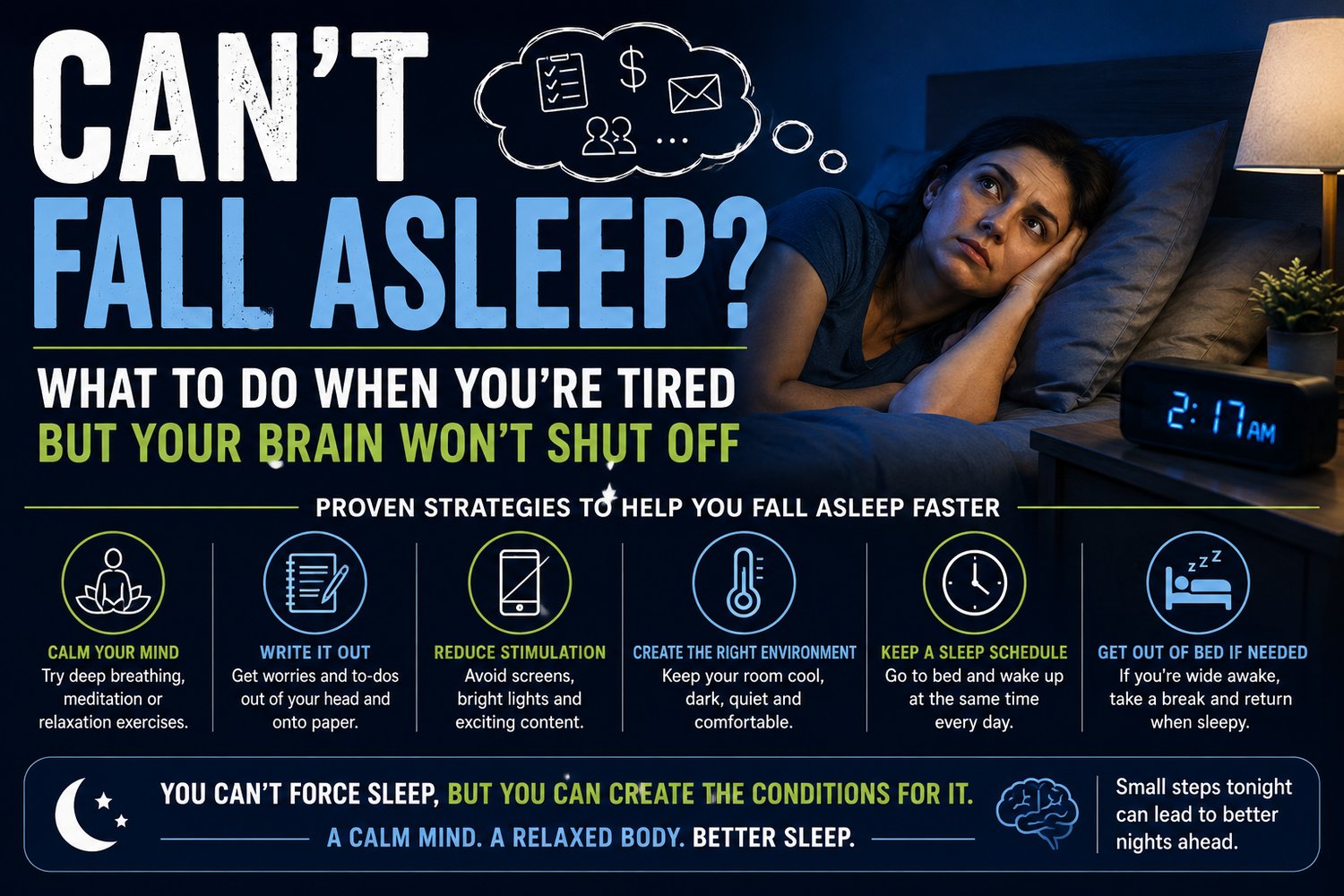
Can’t Fall Asleep? What to Do When You’re Tired but Your Brain Won’t Shut Off
The Complete Sleep & Recovery Guide
You’re tired.
You want to sleep.
You know you should sleep.
You get into bed.
And suddenly your brain decides this is the perfect time to review:
Tomorrow’s schedule
That weird thing you said three years ago
Money
Work
Whether you locked the door
A conversation you may never have
Every possible outcome of a problem you can’t solve at midnight
Meanwhile, your body is exhausted.
This is one of the most frustrating sleep problems because it feels like:
I am tired. Why can’t I just sleep?
The answer is usually that sleepiness and mental arousal are not the same thing.
You can be physically tired while your brain is still highly engaged.
Stress, habits, light, caffeine, screen use, sleep timing and insomnia can all contribute.
The good news is that there are several practical things you can try.
The bad news is:
“Try harder to sleep” is not one of them.
Why Can You Be Tired but Unable to Sleep?
Because falling asleep requires more than simply feeling exhausted.
Your body and brain are influenced by:
- Sleep pressure
- Circadian timing
- Stress
- Light exposure
- Stimulation
- Caffeine
- Your environment
- Learned bedtime habits
You can have plenty of sleep pressure while still being mentally alert.
For example:
You’ve been awake 16 hours.
You’re clearly tired.
But you just finished answering work emails, had caffeine late, spent 45 minutes scrolling and then started worrying about tomorrow.
Your sleep drive may be high.
Your brain is also getting a lot of:
Stay awake and pay attention
signals.
That creates the classic:
tired but wired
feeling.
Is It Normal to Have Trouble Falling Asleep Sometimes?
Yes.
An occasional bad night is normal.
You may struggle because of:
- Stress
- Travel
- Illness
- Noise
- A late meal
- Caffeine
- Alcohol
- An unusual schedule
- Something exciting happening tomorrow
- Something stressful happening tomorrow
One rough night doesn't mean you have insomnia.
The concern increases when the problem becomes:
Frequent
Persistent
and
disruptive to daytime functioning
NHLBI describes insomnia as difficulty falling asleep or staying asleep even when you have the time and appropriate environment to sleep. (nhlbi.nih.gov)
So context matters.
1. Stop Trying to Force Sleep
This is the first thing to understand.
Sleep is not a performance task.
You cannot lie there thinking:
Come on.
Sleep.
Now.
Why am I still awake?
and expect that pressure to help.
Usually it does the opposite.
Now you’re monitoring yourself.
Judging the night.
Calculating how much sleep remains.
Getting frustrated.
That raises arousal.
Sleep becomes even harder.
The goal is not:
Force sleep.
The goal is:
Reduce the things keeping you awake.
2. Stop Watching the Clock
Clock-watching can turn a normal delay into a crisis.
You check:
10:58 p.m.
Then:
11:17
Then:
11:42
Now you start calculating:
If I fall asleep right now, I can still get six hours and 18 minutes.
Then:
12:06
Now you’re angry.
The clock didn’t cause the original problem.
But it may be helping your brain stay engaged with it.
Turn the clock away.
Keep the phone out of reach.
You do not need minute-by-minute evidence that you’re still awake.
3. Get Out of Bed If You’re Clearly Awake and Frustrated
This can feel counterintuitive.
If you want to sleep:
Why leave the bed?
Because spending long periods awake and frustrated in bed can strengthen the association between:
bed = wakefulness
rather than
bed = sleep
Stimulus control is a core part of cognitive behavioral therapy for insomnia, or CBT-I.
A common approach is:
If you’re clearly awake and becoming frustrated, get up.
Go somewhere dim.
Do something quiet.
Return to bed when you feel sleepy again.
Possible options:
- Read something calm
- Sit quietly
- Listen to relaxing audio
- Do gentle breathing
- Fold laundry if it’s boring enough
Not:
Start work.
Watch intense TV.
Open social media.
Clean the entire house.
You want low stimulation.
4. Keep the Lights Low
Bright light is not particularly helpful when you’re trying to return to a sleepy state.
Your circadian system responds to light.
NHLBI recommends reducing bright artificial light before bedtime and using the final hour before sleep for quieter activities. (nhlbi.nih.gov)
So if you get out of bed:
Use a lamp.
Keep brightness low.
Avoid turning the kitchen into a surgical suite.
The goal is:
Awake enough to stop struggling in bed
but not
fully restart the day.
5. Put the Phone Away
This one is huge.
You’re awake.
You’re bored.
The phone is right there.
So you check:
One message.
Then email.
Then social media.
Then news.
Then a video.
Now you are no longer simply awake.
You are stimulated.
Our guide Screen Time and Sleep: Does Your Phone Really Keep You Awake? explains why the biggest issue is often not just blue light.
It’s:
time displacement
and
mental stimulation.
If you can’t sleep, your phone is rarely the best rescue plan.
6. Write Down What Your Brain Is Trying to Hold Onto
Racing thoughts often revolve around unfinished tasks.
Your brain is trying to keep them active because it thinks:
Do not forget this.
One useful strategy is to externalize them.
Write:
Tomorrow
- Call dentist
- Finish report
- Buy groceries
Done.
You don’t need a journal entry.
You need a storage location.
Now your brain doesn’t need to keep rehearsing the list.
7. Use a “Worry List” Instead of Worrying in Bed
If your thoughts are more emotional than practical, try separating them into:
Can act on tomorrow
and
Cannot solve tonight
Example:
Work deadline → make plan tomorrow
Money concern → review budget tomorrow
Conversation → decide whether to address tomorrow
Random future catastrophe → cannot solve at 12:14 a.m.
This won’t make every concern disappear.
But it creates a boundary.
You’re telling your brain:
This is real, but not actionable right now.
8. Use Slow Breathing If It Actually Helps You
Breathing exercises can reduce arousal for some people.
Keep it simple.
You do not need the perfect ratio.
Try:
Slow inhale
Longer slow exhale
Repeat.
The goal is relaxation.
Not hitting a technical breathing target.
If counting breaths makes you more annoyed:
Stop.
This is not a test.
9. Try Progressive Muscle Relaxation
Another option is to gradually relax different muscle groups.
For example:
Feet.
Calves.
Thighs.
Hands.
Arms.
Shoulders.
Jaw.
You can briefly tense each area and then release it.
This may help shift attention away from racing thoughts and toward physical relaxation.
Again:
Optional.
If it helps:
Use it.
If it makes you feel ridiculous and more awake:
Skip it.
10. Don’t Turn “Relaxation” Into Another Task
This is a common trap.
Now you’re lying there thinking:
Am I relaxed enough?
Is this breathing working?
Why am I still awake?
Congratulations.
Relaxation has become another performance metric.
You don’t need to achieve a perfect calm state.
You’re simply reducing stimulation.
That’s enough.
11. Look at Your Caffeine Timing
If your brain feels unusually alert at bedtime, caffeine deserves attention.
Especially if you regularly consume:
- Afternoon coffee
- Energy drinks
- Pre-workout
- Tea
- Caffeinated soda
Caffeine can remain active for hours.
Our guide Caffeine and Sleep: How Long Does Caffeine Last & When Should You Stop Drinking It? explains why dose and timing both matter.
If you’re struggling to fall asleep:
Try moving your last caffeine earlier.
Then track whether bedtime gets easier.
12. Alcohol Isn’t a Great Fix
Alcohol can make you feel sleepy.
That makes it tempting when you’re struggling to fall asleep.
But sedation and healthy sleep are not the same thing.
Alcohol can disrupt sleep later in the night even if it initially helps you fall asleep.
So using alcohol as a sleep strategy may trade:
trouble falling asleep
for
more fragmented sleep later.
Not a great bargain.
13. Stop Doing Work Right Before Bed
Work creates mental activation.
Especially if it involves:
Deadlines.
Email.
Problem-solving.
Conflict.
Planning.
Then you close the laptop and expect immediate sleep.
Your brain may still be in:
solve problems
mode.
Try creating a buffer between work and bed.
Even:
30 minutes
can help.
Our guide How to Build a Better Bedtime Routine for Sleep explains how to create that transition without turning bedtime into an elaborate ritual.
14. Don’t Start Difficult Conversations at Bedtime
Sometimes life requires serious conversations at night.
But if you have a choice:
Bedtime may not be the best moment to discuss:
Money.
Relationship conflict.
Family problems.
Work drama.
Major decisions.
Now both people are activated.
Then one of you says:
Good night.
That transition may be slightly ambitious.
If the conversation can wait until tomorrow:
Let it.
15. Watch the Late-Night Exercise Intensity
Exercise generally supports sleep.
But a very intense workout immediately before bed can leave some people feeling more alert.
That doesn’t mean evening exercise is bad.
It means:
Pay attention to your response.
Our guide Exercise and Sleep: Can Working Out Help You Sleep Better? covers why evening workouts are not automatically a problem.
If late workouts leave you wired:
Move them earlier.
If they don’t:
No need to change them.
16. Your Bedtime May Simply Be Too Early
This is easy to miss.
Suppose you aren’t sleepy until around 11 p.m.
But you decide:
I should go to bed at 9:30 because more sleep is healthy.
Now you’re lying there for 90 minutes wondering why you can’t sleep.
You may simply not have enough sleep pressure yet.
More time in bed is not always better.
A realistic bedtime should line up reasonably well with:
when you actually become sleepy
and
how much sleep you need before wake time.
17. Your Sleep Schedule May Be Too Inconsistent
If your bedtime changes dramatically:
10 p.m.
1 a.m.
11 p.m.
2 a.m.
9:30 p.m.
your body is constantly adjusting.
NHLBI recommends keeping bedtime and wake time reasonably consistent, including across weekends when possible. (nhlbi.nih.gov)
You don’t need precision.
You need a pattern.
18. Late Screen Time May Be Delaying Sleepiness
Sometimes the problem isn’t:
I’m tired but physically unable to sleep.
It’s:
I was tired, but then I spent an hour on my phone and became alert again.
Screens can:
Delay bedtime.
Provide light.
Create emotional stimulation.
Pull you into endless content.
If your nightly routine is:
tired at 10
scroll until 11:30
now strangely awake
the solution may be pretty obvious.
19. Your Bedroom May Be Too Stimulating
A bright, noisy, hot bedroom makes everything harder.
Ask:
Is the room dark?
Quiet?
Comfortable?
Cool enough?
If not, fix the obvious problem.
Our Best Bedroom Environment for Sleep guide covers this in detail.
Do not try meditation in a room that feels like a sauna while the TV is blasting.
Fix the room first.
20. Hunger Can Keep You Awake
If you go to bed genuinely hungry, that can be distracting.
You do not need to force yourself to sleep on an empty stomach.
NHLBI notes that a light snack can be reasonable before bed. (nhlbi.nih.gov)
A small snack may be more useful than lying there thinking about food.
Our guide Eating Before Bed: Does Late-Night Eating Affect Your Sleep? explains the difference between:
a small bedtime snack
and
a huge late meal.
They’re not the same thing.
21. Reflux or Discomfort Can Keep You Awake
Sometimes your brain isn’t the problem.
Your stomach is.
If you lie down and experience:
Heartburn.
Reflux.
Bloating.
Pain.
then sleep may become difficult.
In that case, changing meal timing or seeking medical evaluation for persistent symptoms may matter more than relaxation techniques.
22. Pain Can Prevent Sleep Onset
Back pain.
Neck pain.
Headaches.
Joint pain.
Injury.
All of these can make falling asleep difficult.
If pain is the main issue, don’t spend weeks trying to improve sleep hygiene while ignoring the physical problem.
Address the pain appropriately with a healthcare professional.
23. Anxiety Can Show Up Most Strongly at Night
This is common.
During the day:
Work.
Conversation.
Noise.
Tasks.
Movement.
Then bedtime arrives.
Everything becomes quiet.
Now your thoughts become much louder.
If anxiety is a persistent issue, especially if it affects more than sleep, treating the underlying anxiety may be much more effective than endlessly tweaking bedtime habits.
Sleep strategies can help.
They may not be the whole answer.
24. Bedtime Procrastination Can Look Like Insomnia
This is important.
Some people say:
I can’t fall asleep.
But what actually happens is:
They don’t attempt sleep until very late.
They scroll.
Watch TV.
Work.
Snack.
Then finally get in bed.
At that point, they may still be stimulated.
The real problem may be:
Delayed bedtime
rather than
true inability to sleep.
The fix is different.
You need a bedtime boundary.
Not necessarily a sleep treatment.
25. What If You’re Tired but Not Sleepy?
There’s another useful distinction.
You may feel:
Exhausted.
Drained.
Burned out.
Low energy.
But not actually sleepy.
That can happen.
Fatigue and sleepiness overlap, but they are not identical.
Our previous article, Why Am I Tired After 8 Hours of Sleep? Sleep Quantity vs. Sleep Quality, explains this distinction in more detail.
If you’re tired but not sleepy:
The issue may not simply be lack of sleep.
What About the “Military Method”?
You'll see methods promising:
Fall asleep in two minutes.
These usually involve combinations of:
Relaxing muscles.
Slowing breathing.
Clearing the mind.
Visualizing something calm.
These strategies can be useful as relaxation tools.
But avoid turning them into:
If I don’t fall asleep in 120 seconds, something is wrong.
That adds pressure.
Use relaxation to reduce arousal.
Not to race a stopwatch.
What About the 4-7-8 Breathing Method?
You can try it if you like.
But the exact numbers are less important than:
slow breathing
longer exhalation
and
reduced arousal.
If you find the pattern relaxing:
Great.
If you’re lying there thinking:
Wait, was that seven seconds or eight?
then it may not be your method.
Simple is fine.
What About Counting Sheep?
If it bores your brain enough:
Sure.
😂
The real principle is:
Use something repetitive and low-stimulation.
That could be:
Counting.
Imagery.
Breathing.
Quiet audio.
The specific method matters less than avoiding highly engaging thought.
What About Podcasts or Audiobooks?
They can work for some people.
Choose something:
Calm.
Familiar.
Low stakes.
Set a sleep timer.
Do not choose:
The most gripping mystery you've ever heard
and then wonder why you’re still awake two hours later.
The point is to reduce stimulation.
Should You Listen to White Noise?
If background noise helps mask environmental sounds:
Fine.
White noise is not required.
Some people prefer:
Fan.
Rain sounds.
Brown noise.
Silence.
Use what actually helps.
Don't overthink it.
Should You Take Melatonin?
Melatonin may be useful in some circumstances, particularly when circadian timing is part of the issue.
But it isn't simply a universal sleep pill.
NHLBI notes that melatonin supplements may help with some circadian-rhythm sleep disorders, but evidence for chronic insomnia is limited and safety can depend on dose, timing and individual circumstances. (nhlbi.nih.gov)
Don't immediately add supplements because you had three bad nights.
Start with the obvious behavior and schedule issues first.
If you're considering ongoing supplement use, discuss it with a healthcare professional.
What About Magnesium?
Magnesium has become one of the most heavily marketed sleep supplements.
Some people may need magnesium for nutritional reasons.
That does not automatically mean everyone who struggles to fall asleep is magnesium deficient.
The evidence for magnesium specifically as an insomnia treatment is limited and mixed.
So before adding supplements:
Check the basics.
Sleep schedule.
Caffeine.
Screens.
Stress.
Environment.
Persistent insomnia deserves proper treatment rather than supplement roulette.
When Does Trouble Falling Asleep Become Insomnia?
An occasional difficult night isn't insomnia.
Chronic insomnia involves persistent sleep difficulty despite adequate opportunity and circumstances for sleep and usually comes with daytime consequences.
NHLBI distinguishes short-term insomnia from chronic insomnia based partly on duration and frequency. (nhlbi.nih.gov)
If trouble falling asleep is happening:
Several nights per week.
For months.
And affecting daytime functioning.
it's time to think beyond generic sleep tips.
CBT-I Is More Than Sleep Hygiene
Cognitive behavioral therapy for insomnia is a structured treatment.
It can include:
- Stimulus control
- Sleep scheduling
- Cognitive strategies
- Relaxation
- Education
- Changing unhelpful beliefs around sleep
NHLBI describes CBT-I as typically the first treatment option for long-term insomnia. (nhlbi.nih.gov)
This matters because people with chronic insomnia are often repeatedly told:
No screens.
No coffee.
Take a bath.
They may already be doing all of that.
Chronic insomnia can require actual treatment.
A Simple “Can’t Sleep” Plan
If you find yourself awake tonight, try this:
Step 1
Do not check the clock repeatedly.
Step 2
Keep the phone away.
Step 3
Stay relaxed for a bit.
Step 4
If you're becoming frustrated and clearly awake, leave bed.
Step 5
Do something quiet in dim light.
Step 6
Return to bed when sleepy.
Step 7
Wake around your normal time tomorrow rather than completely shifting the schedule.
Simple.
Not perfect.
Useful.
What Not to Do
Try to avoid:
Clock-watching
Doomscrolling
Work
Bright lights
Huge snacks
Alcohol as a sleep aid
Taking random supplements because you’re frustrated
Sleeping until noon the next day if that completely disrupts your schedule
One bad night is bad enough.
Don't accidentally create the next one too.
Don't Panic About Tomorrow
This is easier said than done.
You’re lying there thinking:
Tomorrow is going to be terrible.
That thought creates more pressure.
Yes:
A poor night may make tomorrow harder.
But humans can function after imperfect sleep.
You've probably done it many times.
Your goal is not to convince yourself:
Sleep doesn't matter.
It does.
Your goal is:
Stop treating one bad night like an emergency.
That can reduce some of the mental pressure keeping you awake.
The Best Long-Term Strategy Is Usually Daytime Too
If trouble falling asleep happens regularly, look beyond bedtime.
Ask:
Am I waking at consistent times?
Am I getting daylight?
Am I moving during the day?
Am I napping too late?
Am I drinking caffeine late?
Am I going to bed before I’m actually sleepy?
Sleep is a 24-hour system.
Not a bedtime event.
Track What Happens Before Bad Nights
For one to two weeks, track:
- Bedtime
- Approximate time to fall asleep
- Wake time
- Caffeine timing
- Screen cutoff
- Exercise
- Alcohol
- Late meals
- Stress
- Morning energy
Then compare:
Easy-sleep nights
with
hard-sleep nights.
You may find a pattern.
The FREE 7-Day Sleep Reset | Sleep & Recovery Starter Kit is designed for exactly this kind of baseline tracking.
Longer-Term Tracking Can Help Separate Patterns From Random Nights
If the issue is ongoing, the Sleep Recovery Planner | Sleep Tracker and Energy Journal lets you track sleep, energy, caffeine and evening routines over time using a fillable PDF and Excel dashboard.
That can help you answer:
Is my sleep onset actually improving?
Do late caffeine days look worse?
Do screens matter?
Does consistency matter?
That's useful data.
When Should You Talk to a Healthcare Professional?
Consider getting help if trouble falling asleep is:
- Persistent
- Happening several nights per week
- Lasting for months
- Significantly affecting daytime functioning
- Causing substantial distress
- Associated with severe anxiety or other symptoms
Also seek evaluation if you have:
- Loud snoring
- Gasping
- Breathing pauses
- Significant daytime sleepiness
- Unusual nighttime movements
- Persistent pain
- Other symptoms suggesting a medical or sleep disorder
You don't need to fail every sleep hack before asking for help.
Frequently Asked Questions
Why am I tired but can’t fall asleep?
You can have strong sleep pressure while still experiencing mental or physiological arousal from stress, caffeine, light, screens, an inconsistent schedule or insomnia.
Being tired does not automatically mean your brain is ready to transition into sleep.
What should I do if I can’t fall asleep?
Avoid forcing sleep.
Keep lights low.
Stay off your phone.
If you become frustrated and clearly awake, leave bed temporarily and do something quiet until sleepiness returns.
How long should it take to fall asleep?
There is normal variation.
Occasionally taking longer is not necessarily a problem.
Persistent difficulty falling asleep despite adequate opportunity deserves more attention.
Should I stay in bed if I can’t sleep?
Not indefinitely.
Stimulus-control approaches used in CBT-I often recommend leaving bed when you're clearly awake and frustrated, then returning when sleepy.
Why does my brain get more active at night?
Nighttime is often the first quiet period of the day.
Stress, unfinished tasks and reduced external distractions can make thoughts feel more noticeable.
Can caffeine make my brain race at night?
Yes.
Caffeine can increase alertness and may remain active for several hours.
If this is a recurring problem, move caffeine earlier and compare your sleep.
Do phones make it harder to fall asleep?
They can.
Screens can provide light, mental stimulation and—most importantly—keep you awake longer than intended.
Can anxiety cause trouble falling asleep?
Yes.
Anxiety and stress can increase mental and physiological arousal and contribute to insomnia.
Does melatonin help if I can’t sleep?
Sometimes, depending on the reason for the sleep problem.
Melatonin is particularly relevant to circadian timing, but it is not a universal solution for insomnia.
When should I see a doctor for trouble sleeping?
If difficulty falling asleep is persistent, frequent or significantly affecting daytime life—or if you have symptoms of another sleep or medical disorder—talk with a healthcare professional.
Key Takeaways
Being tired but unable to fall asleep is frustrating.
But the solution usually isn't:
Try harder.
Instead:
Reduce stimulation.
Stop watching the clock.
Put away the phone.
Write down racing thoughts.
Use a quiet wind-down period.
Check caffeine timing.
Make sure bedtime isn't unrealistically early.
Keep your schedule reasonably consistent.
Leave bed temporarily if you're clearly awake and frustrated.
Then look for patterns.
If this happens occasionally:
You're human.
If it happens constantly:
It deserves more attention.
And if it has become chronic insomnia:
Stop treating it like a bedtime-discipline problem.
Evidence-based treatment exists.
Track What Happens Before Your Hardest Nights
For seven days, record:
when you try to sleep
how long you think it takes
caffeine
screen use
stress
exercise
and
morning energy.
The FREE 7-Day Sleep Reset | Sleep & Recovery Starter Kit gives you a simple place to start.
For ongoing tracking, the Sleep Recovery Planner | Sleep Tracker and Energy Journal can help you follow sleep and evening patterns over time.
Related Sleep & Recovery Guides
Why Am I Tired After 8 Hours of Sleep? Sleep Quantity vs. Sleep Quality
Sleep Hygiene: What It Is, What Actually Works & What’s Overrated
How to Build a Better Bedtime Routine for Sleep
Screen Time and Sleep: Does Your Phone Really Keep You Awake?
Next in the Sleep & Recovery series:
Why Do I Wake Up Too Early? Common Reasons & Better Sleep Strategies
Medical Disclaimer: This article is for educational and informational purposes only and is not intended as medical advice, diagnosis or treatment. Persistent insomnia, severe anxiety, excessive daytime sleepiness, loud snoring, gasping during sleep or other concerning symptoms should be discussed with a qualified healthcare professional.