

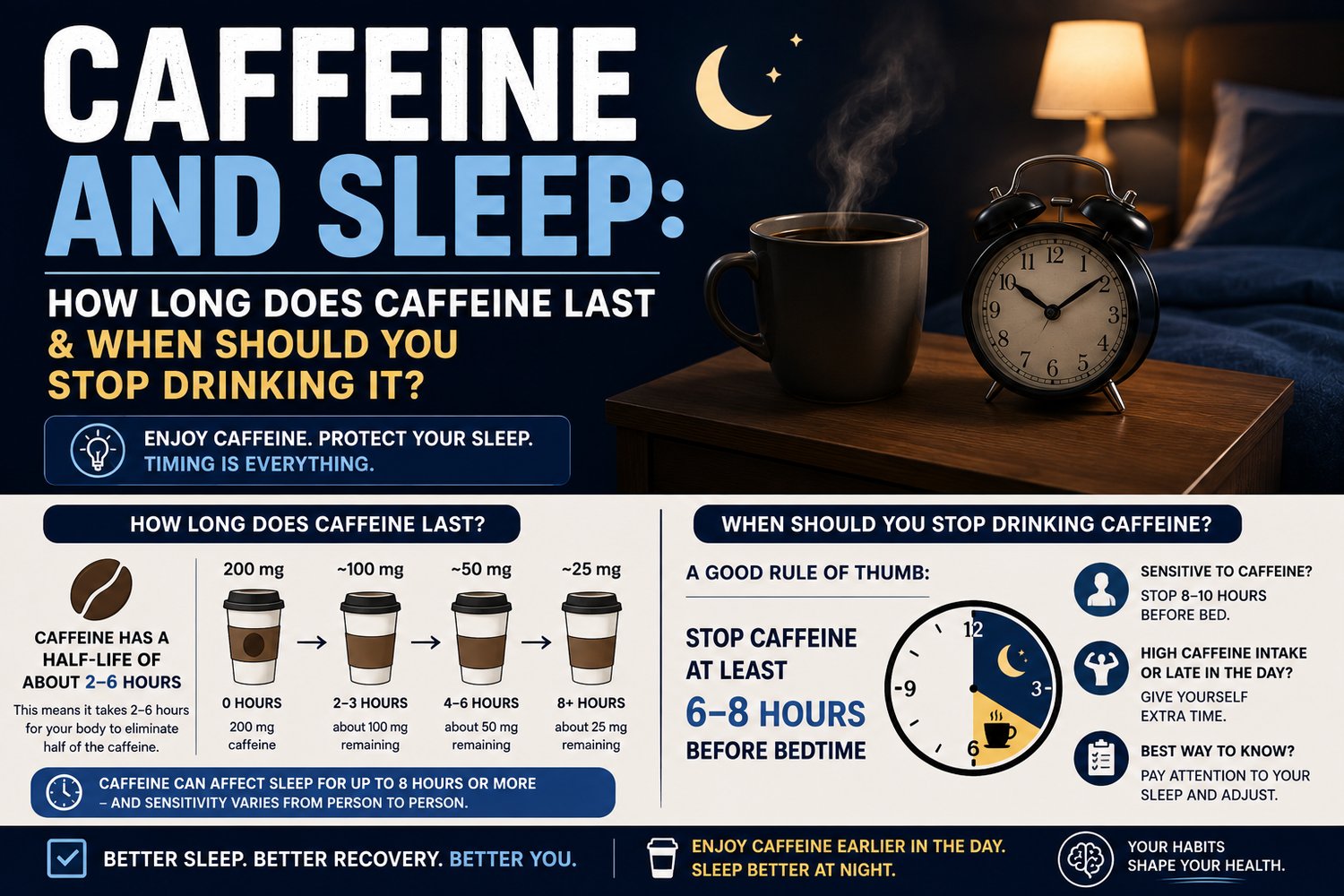
Caffeine and Sleep: How Long Does Caffeine Last & When Should You Stop Drinking It?
The Complete Sleep & Recovery Guide
Coffee gets blamed for a lot.
Sometimes fairly.
Sometimes not.
You can drink coffee every day and sleep perfectly well.
You can also drink coffee every day, struggle to fall asleep, wake tired, drink more coffee to compensate, then repeat the cycle.
The problem usually isn't:
Caffeine is bad.
The better question is:
Is the amount and timing of caffeine you're using interfering with your sleep?
Caffeine is a stimulant. NHLBI notes that it can interfere with sleep and that its effects may last up to eight hours.
But that doesn't mean everyone on Earth needs to stop drinking coffee exactly eight hours before bed.
Dose matters.
Timing matters.
Individual sensitivity matters.
And newer controlled research suggests the relationship may be more nuanced than the simple "no caffeine after noon" rule.
So instead of turning coffee into the enemy, let's figure out how to use it without accidentally sabotaging your sleep.
How Does Caffeine Affect Sleep?
Caffeine helps you feel more awake primarily because it interferes with the action of adenosine, a chemical involved in building sleep pressure across the day.
As you're awake longer, adenosine normally contributes to increasing sleepiness.
Caffeine blocks adenosine receptors.
The result:
You feel less sleepy.
That's why caffeine is useful.
It's also why caffeine can become a problem near bedtime.
Your body may be saying:
We're tired.
while caffeine is effectively saying:
Not so fast.
NHLBI describes caffeine as one of the factors that can create false wakefulness signals and interfere with the normal sleep-wake process.
How Long Does Caffeine Last?
This is where people usually want one simple number.
Unfortunately:
There isn't one.
The effects of caffeine can persist for several hours, and NHLBI advises that caffeine may interfere with sleep for up to eight hours.
Caffeine also has a biological half-life.
Half-life means the amount of time it takes your body to eliminate roughly half of the caffeine you've consumed.
In healthy adults, caffeine's half-life is often several hours, but it can vary substantially. FDA material has cited an average range of roughly 2–6 hours, with considerably longer values possible in some people.
That variation is one reason universal caffeine cutoff rules aren't perfect.
What Does Caffeine Half-Life Actually Mean?
Suppose you consume:
200 mg of caffeine at 2 p.m.
If your caffeine half-life were around five hours, a simplified example would look like:
2 p.m. — 200 mg
7 p.m. — about 100 mg remaining
Midnight — about 50 mg remaining
That's not an exact personal prediction.
Human metabolism is more complicated than that.
But it illustrates the key point:
Caffeine doesn't suddenly disappear a few hours after your coffee.
Some can remain in your system long after you stop consciously feeling "buzzed."
That's why saying:
Coffee doesn't affect me. I can fall asleep after drinking it.
doesn't necessarily prove it has no effect on your sleep.
Falling asleep is only one outcome.
Can Caffeine Affect Sleep Even If You Fall Asleep Normally?
Potentially, yes.
Researchers studying caffeine and sleep look at more than whether someone eventually falls asleep.
Outcomes can include:
- Total sleep time
- Time needed to fall asleep
- Sleep efficiency
- Nighttime awakenings
- Sleep architecture
- Deep sleep
A 2023 systematic review and meta-analysis found that caffeine consumption was associated on average with shorter total sleep time, lower sleep efficiency, longer time to fall asleep and somewhat less deep sleep across the included studies.
That doesn't mean every cup of coffee causes all of those effects in every person.
It means:
"I still fell asleep" isn't the only thing worth measuring.
Does Caffeine Reduce Deep Sleep?
Research suggests caffeine can affect sleep architecture.
The 2023 systematic review found that caffeine was associated with a modest increase in light sleep and a decrease in deep sleep across the analyzed studies.
But don't immediately turn this into:
Coffee destroys deep sleep.
Dose and timing matter.
Individual response matters.
And if your only evidence is that your smartwatch gave you 42 minutes of deep sleep yesterday, remember that consumer wearables estimate sleep stages rather than measuring them the same way clinical polysomnography does.
We covered this extensively in Deep Sleep vs. REM Sleep: What’s the Difference & How Much Do You Need?.
The more practical question is:
Does your caffeine pattern consistently correspond with worse sleep or worse daytime functioning?
When Should You Stop Drinking Caffeine Before Bed?
This is probably the main reason you're here.
A useful starting point is:
Move caffeine at least 6–8 hours away from bedtime if you're having sleep problems.
Why?
NHLBI states that caffeine's effects may last up to eight hours.
And a well-known controlled study found that a 400 mg dose of caffeine significantly disrupted sleep even when consumed six hours before bedtime.
But there's an important catch.
That was a fairly large caffeine dose.
Four hundred milligrams is very different from drinking a small cup of coffee.
Dose Matters More Than Most Cutoff Rules Admit
Newer research helps illustrate this nicely.
A 2024 controlled study examined 100 mg and 400 mg doses of caffeine taken at different times before bedtime.
The researchers found that 100 mg consumed four hours before bed did not significantly affect subsequent sleep in their study, while 400 mg disrupted aspects of sleep even when consumed much earlier—up to 12 hours before bed for some outcomes.
That's a big difference.
Compare:
Small coffee
with
Large energy drink + pre-workout + another coffee
Those shouldn't automatically receive identical advice.
A More Practical Caffeine Cutoff
Instead of one universal rule, think in ranges.
If you sleep around:
10 p.m.
a cautious caffeine cutoff might be:
2–4 p.m.
If you're highly caffeine-sensitive or using larger doses:
You may need to stop earlier.
If you drink small amounts and sleep well:
You may tolerate caffeine later.
The key word is:
tolerate.
Don't create a restriction just because someone on the internet says you need one.
But if you're struggling with sleep, caffeine is one of the easiest variables to test.
Start With an 8-Hour Experiment
Here's a simple approach.
For one week:
Stop caffeine eight hours before your target bedtime.
Example:
Bedtime = 10:30 p.m.
Caffeine cutoff = 2:30 p.m.
Then track:
- How quickly you fall asleep
- Nighttime awakenings
- Morning energy
- Daytime energy
- Whether you feel more naturally sleepy before bed
If nothing changes, you can experiment further.
If sleep noticeably improves:
You learned something useful.
That's far better than arguing online about whether the "correct" cutoff is noon.
Does Everyone Process Caffeine the Same Way?
No.
Caffeine response varies substantially between people.
Differences can be influenced by:
- Genetics
- Regular caffeine use
- Medications
- Pregnancy
- Liver function
- Smoking status
- Age
- Other individual factors
That means two people can consume the exact same amount at the exact same time and experience very different effects.
One person drinks coffee at dinner and sleeps.
Another drinks coffee at 1 p.m. and is staring at the ceiling at midnight.
Neither person's experience proves how caffeine affects everyone else.
Can You Be "Immune" to Caffeine?
People can develop some tolerance to certain effects of caffeine.
That may make the subjective stimulant effect feel weaker over time.
But feeling less "buzzed" isn't necessarily the same as caffeine having zero physiological effect.
This is another reason your subjective reaction isn't the only thing to consider.
Instead of asking:
Do I feel caffeine?
ask:
Does changing my caffeine timing change my sleep?
That's testable.
Does Coffee Have More Caffeine Than You Think?
Sometimes.
Caffeine content can vary enormously between products and serving sizes.
A "coffee" might mean:
A small home-brewed cup.
A large coffeehouse drink.
Cold brew.
Espresso.
Instant coffee.
And those don't necessarily contain the same amount.
The FDA notes that caffeine is found in coffee, tea, chocolate, energy drinks, supplements and certain medications, and that caffeine content can vary considerably between products.
So if you're trying to understand your caffeine intake, don't only count:
cups of coffee.
Think:
total caffeine.
Hidden Sources of Caffeine
Coffee is obvious.
Other sources may be less obvious.
These can include:
- Tea
- Energy drinks
- Pre-workout
- Soda
- Chocolate
- Caffeine pills
- Some headache medications
- Some supplements
- Certain flavored waters or gums
So you may say:
I stopped coffee at noon.
while consuming 250 mg of pre-workout at 5:30 p.m.
Your body counts that too.
How Much Caffeine Is Too Much?
The FDA says that for most healthy adults, 400 mg of caffeine per day is an amount not generally associated with negative effects.
But that's a general safety benchmark.
It is not a sleep guarantee.
Someone may stay under 400 mg per day and still experience sleep problems if the caffeine is consumed late or if they're particularly sensitive.
Likewise:
safe amount
and
ideal amount for your sleep
are not necessarily identical.
400 mg at 8 a.m. Is Different From 400 mg at 4 p.m.
Timing matters.
So does how you distribute caffeine.
Imagine two people.
Person A
Coffee at 7 a.m.
Coffee at 9 a.m.
No caffeine after lunch.
Person B
Coffee at 7 a.m.
Energy drink at noon.
Pre-workout at 5 p.m.
Diet soda at dinner.
They may consume similar daily totals.
But their nighttime exposure isn't remotely the same.
When you're troubleshooting sleep, timing can be just as informative as total intake.
Is Morning Coffee Bad for Sleep?
For most people, morning coffee is much less likely to create problems than late-day caffeine.
That's simply because your body has much more time to metabolize it before bedtime.
That doesn't mean huge doses in the morning can never matter.
The 2024 dose-and-timing study found that a 400 mg dose could affect subsequent nighttime sleep even when consumed 12 hours before bed.
So again:
Dose matters.
A normal morning coffee is one thing.
Four hundred milligrams at once is another.
Can You Drink Coffee After Lunch?
Maybe.
This depends on:
- Your bedtime
- Dose
- Caffeine sensitivity
- Whether you're having sleep problems
If you go to bed at midnight, a 1 p.m. coffee gives you a very different window than if you go to bed at 9 p.m.
If you're sleeping well, there's no urgent reason to invent a problem.
If you're struggling with sleep:
Try moving it earlier.
Observe what happens.
What About the "No Caffeine After Noon" Rule?
It's a decent simple rule.
It's not a biological law.
For someone sleeping around 10 p.m., noon creates about a ten-hour gap before bedtime.
That's conservative enough to reduce the chance that late caffeine is contributing.
But someone sleeping at 1 a.m. may not need exactly the same cutoff.
And someone highly sensitive to caffeine might benefit from even earlier timing.
Instead of treating noon as magical, use it as a convenient behavioral boundary if it works for you.
What About Caffeine Six Hours Before Bed?
Six hours is often mentioned because of a controlled 2013 study.
Participants received 400 mg of caffeine either at bedtime, three hours before bedtime or six hours before bedtime.
Caffeine significantly disrupted sleep even when taken six hours before bed.
That's useful evidence.
But remember the dose:
400 mg.
You shouldn't automatically interpret that study as proving that 40 mg of tea six hours before bed will ruin everyone's sleep.
Context matters.
Why Do Some Studies Seem to Contradict Each Other?
Because sleep and caffeine research doesn't always study the same thing.
Different studies may involve:
- Different doses
- Different populations
- Different caffeine sources
- Different timing
- Different sleep measurements
- Different habitual caffeine use
For example, an NHLBI-highlighted observational study of 785 people did not find a significant association between caffeine consumed within four hours of bedtime and the measured sleep outcomes in that cohort.
Meanwhile, controlled laboratory trials using large caffeine doses have found clear sleep disruption.
Those findings aren't necessarily incompatible.
They highlight why:
dose + timing + individual response
matter.
Can Caffeine Cause a Sleep-Caffeine Cycle?
Absolutely.
The cycle can look like:
Poor sleep
↓
More caffeine
↓
Caffeine later in day
↓
Harder time sleeping
↓
Wake tired
↓
More caffeine
Eventually, you may believe:
I need caffeine because I'm naturally exhausted.
When part of the exhaustion may be related to insufficient or disrupted sleep.
This doesn't mean caffeine created every problem.
But if you're using progressively more caffeine to compensate for chronic tiredness, it's worth examining the whole system.
Caffeine Doesn't Replace Sleep
This seems obvious, but it's easy to forget.
Caffeine can improve alertness temporarily.
It does not reproduce the biological functions of sleep.
You cannot routinely sleep five hours, consume enough caffeine to feel awake and conclude that your body no longer needs adequate sleep.
Our guide to How Much Sleep Do You Need? A Practical Guide by Age & Lifestyle covers why healthy adults generally need at least seven hours of sleep regularly.
Caffeine can help you feel less sleepy.
That's not the same thing as being fully recovered.
Should You Quit Caffeine Completely to Sleep Better?
Usually, that isn't the first step I'd take.
Unless you already want to stop caffeine, try adjusting timing first.
For example:
Current pattern:
7 a.m. coffee
11 a.m. coffee
3 p.m. coffee
6 p.m. energy drink
Experiment:
7 a.m. coffee
10 a.m. coffee
No caffeine after 2 p.m.
That's a much smaller lifestyle change.
If sleep improves, great.
If not, you can adjust further.
There's no prize for eliminating coffee if coffee wasn't actually causing your problem.
What If You Want to Reduce Caffeine?
If you're consuming a large amount of caffeine every day, abruptly stopping can cause withdrawal symptoms such as headaches, fatigue and irritability.
A gradual reduction may be easier.
For example:
Week 1:
Reduce one late-day caffeine source.
Week 2:
Make one coffee smaller.
Week 3:
Replace another drink with decaf.
The purpose isn't necessarily to reach zero.
It's to find the amount and timing that work for you.
Does Decaf Still Contain Caffeine?
Usually, yes—a small amount.
"Decaf" doesn't necessarily mean absolutely caffeine-free.
But the amount is typically far lower than regular coffee.
For many people who enjoy the ritual of an evening coffee, switching to decaf may be an easy compromise.
You keep:
coffee
without nearly as much:
stimulant.
What About Tea Before Bed?
Some tea contains caffeine.
Black tea and green tea generally contain caffeine.
Herbal teas often do not, although you should still check the product.
So:
tea
doesn't automatically mean:
caffeine-free.
If you enjoy tea at night and have trouble sleeping, check the label.
What About Energy Drinks?
Energy drinks can contain substantial caffeine.
Some products also come in large serving sizes or contain multiple stimulant ingredients.
If you're struggling to sleep and drinking an energy drink late in the afternoon or evening, that's an obvious place to experiment first.
Don't start by buying magnesium.
Move the energy drink.
😂
What About Pre-Workout?
Same issue.
Many pre-workout products contain significant caffeine.
If you train in the evening and use a high-stimulant pre-workout at 6 p.m., the workout itself may not be what's keeping you awake.
The caffeine might be contributing.
Options include:
- Training earlier
- Using less
- Using a stimulant-free pre-workout
- Skipping it during later workouts
Again:
Test the variable.
Track Caffeine Alongside Sleep
Caffeine is one of the easiest sleep variables to track.
For one week, record:
Time
and
approximate caffeine amount
alongside:
- Bedtime
- Difficulty falling asleep
- Nighttime awakenings
- Morning energy
- Daytime energy
Then look for patterns.
If you want a structured way to do that, the FREE 7-Day Sleep Reset | Sleep & Recovery Starter Kit helps you establish your baseline without turning your morning coffee into a moral issue.
You may discover that caffeine isn't the problem.
That's useful too.
How to Find Your Personal Caffeine Cutoff
Try this simple experiment.
Week 1: Track Normally
Don't change anything.
Record:
- Caffeine amount
- Caffeine timing
- Bedtime
- Sleep quality
- Morning energy
Week 2: Set an Earlier Cutoff
Move your last caffeine dose at least 6–8 hours before bedtime.
Keep everything else roughly similar.
Compare
Did you:
Fall asleep faster?
Wake less?
Feel more naturally sleepy at bedtime?
Wake more refreshed?
If yes:
Keep the earlier cutoff.
If no:
Look at other variables.
That's far more useful than blindly obeying someone else's coffee rule.
Caffeine and Your Bedtime Routine
Your caffeine strategy starts long before your bedtime routine.
But they should work together.
Our article How to Build a Better Bedtime Routine for Sleep focuses on reducing stimulation as bedtime approaches.
It's much easier to wind down at 10 p.m. when you haven't consumed a huge stimulant dose at 7 p.m.
Think of caffeine as one part of your full sleep system.
Caffeine and Morning Habits
Earlier caffeine use generally fits better with the daytime rhythm we discussed in Morning Habits for Better Sleep: Why Your Daytime Routine Matters at Night.
Morning:
light
movement
activity
caffeine if desired
Evening:
less stimulation
lower light
wind down
sleep
That's a cleaner signal than stimulating yourself throughout the entire day and then expecting your nervous system to flip off instantly.
Don't Fixate on Caffeine If Everything Else Is Worse
Caffeine gets a lot of attention because it's easy to blame.
But imagine this:
You drink one cup of coffee at 8 a.m.
Then:
Sleep five hours.
Stay in bed scrolling every night.
Drink alcohol before bed.
Wake at different times every day.
Keep the bedroom at 80 degrees.
It probably doesn't make sense to blame the morning coffee first.
Our Sleep Hygiene: What It Is, What Actually Works & What’s Overrated guide looks at the bigger picture.
Fix the biggest obvious problem.
What If You Stop Late Caffeine and Still Can't Sleep?
Then caffeine may not be the primary issue.
Possible contributors include:
- Inconsistent sleep timing
- Stress
- Alcohol
- Bedroom environment
- Chronic insomnia
- Sleep apnea
- Pain
- Medications
- Medical conditions
- Other sleep disorders
Don't keep moving your caffeine cutoff earlier and earlier indefinitely while ignoring persistent sleep problems.
If you're experiencing ongoing insomnia, excessive daytime sleepiness, loud snoring, gasping during sleep or other concerning symptoms, talk with a qualified healthcare professional.
Frequently Asked Questions
How long does caffeine last?
Caffeine can affect people for several hours. NHLBI notes that the effects may last up to eight hours.
Its half-life varies substantially between individuals.
What is the half-life of caffeine?
Caffeine's half-life in healthy adults is generally several hours. FDA material has cited a typical range of roughly 2–6 hours, although it may be longer in some individuals.
How many hours before bed should you stop drinking caffeine?
If you're struggling with sleep, 6–8 hours before bedtime is a reasonable starting experiment.
Higher caffeine doses may need an even larger gap. Controlled research has found that 400 mg can disrupt sleep even when consumed six hours before bed, while newer research found effects from a 400 mg dose even earlier for some sleep outcomes.
Is caffeine six hours before bed bad?
It can be, particularly at higher doses.
A controlled trial using 400 mg of caffeine found significant sleep disruption when caffeine was taken six hours before bedtime.
That doesn't mean every smaller dose affects everyone identically.
Can I drink coffee four hours before bed?
Maybe.
A recent controlled study found that 100 mg four hours before bed did not significantly affect subsequent sleep in that experiment, while a 400 mg dose clearly did.
Dose and individual sensitivity matter.
Is noon the best caffeine cutoff?
Not universally.
Noon is a simple conservative cutoff for many people, especially those with an earlier bedtime.
But your ideal cutoff depends on your sleep schedule, caffeine dose and sensitivity.
Can caffeine affect deep sleep?
Research suggests caffeine can modestly reduce deep sleep, particularly depending on dose and timing. A 2023 systematic review found a decrease in deep sleep across included caffeine studies.
Does caffeine affect REM sleep?
Caffeine can alter sleep architecture, although the effects depend on dose and timing. The practical goal should be improving overall sleep rather than chasing one specific sleep stage.
Can you sleep after caffeine?
Yes.
Being able to fall asleep after caffeine doesn't necessarily mean caffeine has no effect on your sleep duration, continuity or architecture.
Should I quit coffee if I sleep badly?
Not automatically.
Try moving caffeine earlier first.
Track whether your sleep changes.
If it doesn't, investigate other causes.
Key Takeaways
Caffeine is not automatically bad for sleep.
Late caffeine can be.
And high-dose caffeine can matter even when it's consumed surprisingly early.
Remember:
Caffeine is a stimulant.
Its effects can last for hours.
Dose matters.
Timing matters.
People differ in sensitivity.
Rather than obsessing over one universal cutoff, try this:
Track your current intake.
↓
Move caffeine 6–8 hours away from bedtime.
↓
Watch your sleep and energy for a week.
↓
Adjust if necessary.
If you're sleeping well:
Enjoy your coffee.
If you're struggling:
Caffeine is a cheap and easy variable to test.
You don't need to declare war on coffee.
You just need to make sure your 4 p.m. pick-me-up isn't creating tomorrow morning's exhaustion.
Test Your Caffeine Cutoff This Week
For one week, record when you consume caffeine and how you sleep that night.
The FREE 7-Day Sleep Reset | Sleep & Recovery Starter Kit gives you a simple way to track caffeine alongside your sleep, energy and daily habits.
If you want to follow those patterns over a longer period, the Sleep Recovery Planner | Sleep Tracker and Energy Journal includes dedicated caffeine, sleep and energy tracking in a fillable PDF and Excel dashboard.
Don't guess.
Run the experiment.
Previously in the Sleep & Recovery series:
What Is Sleep Quality? How to Know If You’re Actually Sleeping Well
How Much Sleep Do You Need? A Practical Guide by Age & Lifestyle
Sleep Stages Explained: REM, Deep Sleep & What Happens While You Sleep
Deep Sleep vs. REM Sleep: What’s the Difference & How Much Do You Need?
How to Sleep Better Naturally: 12 Habits That Actually Matter
Sleep Hygiene: What It Is, What Actually Works & What’s Overrated
How to Build a Better Bedtime Routine for Sleep
Morning Habits for Better Sleep: Why Your Daytime Routine Matters at Night
The Best Bedroom Environment for Sleep: Temperature, Light, Noise & Comfort
Next in the Sleep & Recovery series:
Screen Time and Sleep: Does Your Phone Really Keep You Awake?
Medical Disclaimer: This article is for educational and informational purposes only and is not intended as medical advice, diagnosis or treatment. Individual responses to caffeine vary, and certain medications, pregnancy and health conditions can affect caffeine metabolism or appropriate intake. Persistent insomnia, excessive daytime sleepiness or other concerning sleep symptoms should be discussed with a qualified healthcare professional.