

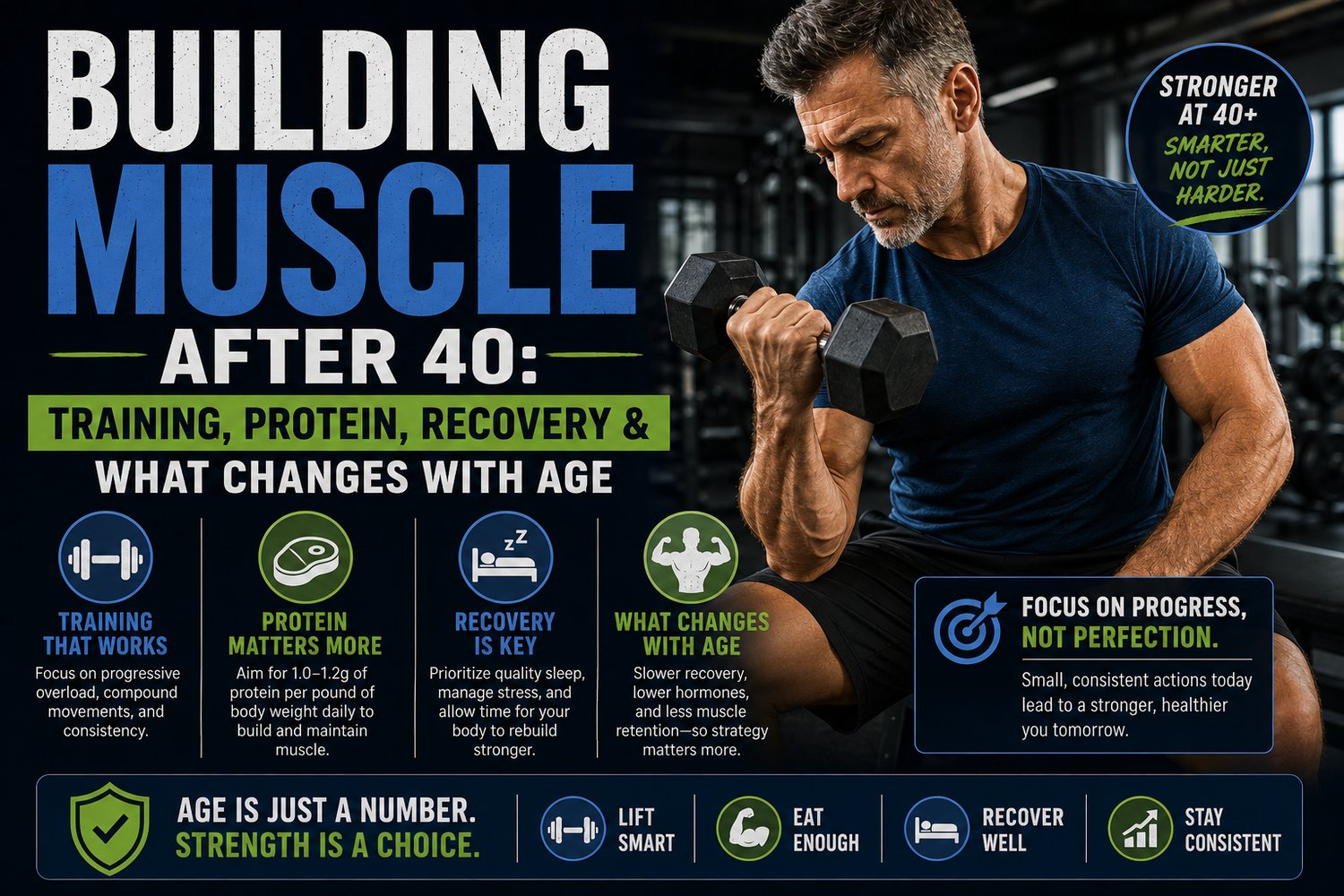
Building Muscle After 40: Training, Protein, Recovery & What Changes With Age
Turning 40 does not shut down your ability to build muscle.
You aren't suddenly fragile.
And you aren't destined to get smaller every year.
But you probably shouldn't assume that training exactly the way you did at 20 will remain the smartest approach forever.
Men can absolutely build muscle after 40.
Resistance training continues to improve muscle size, strength, power, and physical function across adulthood.
What changes with age is less the basic muscle-building formula and more the amount of attention you may need to give to:
- Recovery
- Sleep
- Joint tolerance
- Injury history
- Training volume
- Nutrition
- Overall health
The formula is still remarkably familiar:
Progressive resistance training + adequate protein + enough calories + recovery + time.
The goal isn't to find a special “over-40 workout.”
It's to build a training system that gives your muscles enough reason to adapt without creating so much fatigue or joint irritation that you can't sustain it.
If you need the general training foundation first, read Strength Training for Men Over 30.
For nutrition, start with Protein for Men.
Yes, You Can Build Muscle After 40
Let's remove this misconception immediately.
Older muscle still responds to resistance training.
Research supported by the National Institute on Aging shows that muscle mass and strength tend to peak around ages 30–35 and decline gradually afterward, with faster losses generally occurring later in life.
But physical activity—especially resistance training—can substantially slow those losses, and older adults can still increase strength through training.
So the useful question isn't:
“Am I too old to build muscle?”
It's:
“How can I keep training progressively for the next 10, 20, or 30 years?”
That's a much better problem to solve.
Muscle Becomes More Valuable With Age
At 22, muscle may mostly feel like an appearance goal.
At 42, it starts becoming something else too:
Physical reserve.
Muscle and strength help you:
- Carry heavy objects
- Lift children or grandchildren
- Work around the house
- Climb stairs
- Stay active
- Maintain balance
- Continue recreational activities
- Recover from periods of inactivity
- Preserve independence later in life
Age-related decline in muscle, strength, and physical function—often grouped under the term sarcopenia—can contribute to weakness, mobility limitations, falls, and loss of independence later in life.
You don't need to obsess about sarcopenia at 40.
You should recognize that building muscle now gives you more to preserve later.
What Actually Changes After 40?
The fundamentals don't suddenly change.
You still build muscle by applying resistance, recovering, and repeating the process.
But several practical factors may deserve more attention.
Change #1: Recovery Matters More
At 20, you may have gotten away with:
- Five hours of sleep
- Random meals
- High training volume
- Poor exercise selection
- Training sore joints anyway
- Going hard again tomorrow
You may even have called this:
“Dedication.”
By 40, that approach often stops being charming.
Recovery is influenced by:
- Sleep
- Work stress
- Family responsibilities
- Calorie intake
- Protein intake
- Training volume
- Injury history
- General health
You can still train hard.
But you need to respect the space between hard sessions.
Read Sleep for Men.
Change #2: Your Exercise Selection May Need to Get Smarter
There is no award for performing the most hardcore version of every exercise.
If barbell back squats work beautifully for you:
Great.
Keep them.
If they repeatedly irritate your back or knees, you have options:
- Leg press
- Hack squat
- Goblet squat
- Split squat
- Belt squat
The same principle applies everywhere.
You can build your chest using:
- Barbell bench press
- Dumbbells
- Machines
- Push-ups
You can build your back using:
- Rows
- Pulldowns
- Pull-ups
- Machines
Your muscles don't care whether the exercise wins internet masculinity points.
They respond to:
tension + effort + progression.
Machines Are Not the Easy Version
Many experienced lifters become more appreciative of machines as they age.
That's not because they've become weak.
Machines can allow you to train a target muscle very hard while reducing:
- Stabilization demands
- Technique complexity
- Fatigue from supporting muscles
Examples include:
- Chest press
- Leg press
- Hack squat
- Cable row
- Pulldown
- Hamstring curl
ACSM's 2026 position stand found no consistent advantage of machines versus free weights for the average healthy adult when the goal is simply improving resistance-training outcomes.
Use the tool that lets you train effectively and consistently.
Change #3: Training Volume Should Match Your Recovery
More training can stimulate more growth.
Until it doesn't.
ACSM's 2026 resistance-training guidance identifies roughly 10 weekly sets per muscle group as a useful hypertrophy-oriented target, while also emphasizing that programs should be individualized and that more complexity isn't automatically better.
You don't need to begin there.
A newer lifter may make excellent progress around:
6–10 challenging sets per major muscle group per week.
Then add more only if:
- Progress stalls
- Recovery remains good
- You actually need more stimulus
Don't automatically copy the 20-set chest routine of an advanced bodybuilder.
Training age matters.
You Don't Need Six Training Days
Many men overcomplicate this.
For general health, muscle-strengthening exercise on at least two days per week is recommended, and even older adults can benefit from gradual progressive strengthening.
For muscle growth, many men do extremely well with:
3 resistance-training days
or:
4 moderately sized sessions
each week.
The important question is:
Are you consistently training your major muscles hard enough to progress?
Not:
How many times did your gym bag leave the house?
A Three-Day Full-Body Routine Works Extremely Well
For a busy man over 40, full-body training is hard to beat.
Monday
- Squat or leg press
- Bench press
- Row
- Romanian deadlift
- Lateral raise
- Curl
Wednesday
- Split squat
- Overhead press
- Lat pulldown
- Hip thrust
- Triceps pressdown
- Core work
Friday
- Leg press or squat variation
- Incline dumbbell press
- Cable row
- Hamstring curl
- Shoulder work
- Arms
You train the major muscle groups several times per week.
You get recovery days between sessions.
And missing Tuesday because your kid has something going on doesn't destroy an elaborate six-day split.
Four Days Can Work Too
If you prefer shorter, more frequent sessions:
Monday — Upper
Chest, back, shoulders, arms
Tuesday — Lower
Quads, hamstrings, glutes, calves
Thursday — Upper
Repeat with different movements or rep ranges
Friday — Lower
Repeat
The split itself isn't magic.
It's just a way to distribute the work.
Progressive Overload Still Drives Progress
Your body needs a reason to adapt.
Progressive overload means gradually increasing the training demand.
That can include:
- More weight
- More repetitions
- More sets
- Better range of motion
- Better exercise control
- Improved technique
Example:
50-pound dumbbells × 8 reps
Eventually:
50 × 10
Then:
50 × 12
Then:
55 × 8
That's progression.
You don't need a secret midlife muscle protocol.
You Don't Need Maximal Weights
Heavy lifting is useful for maximizing strength.
Muscle growth can occur across a broader range of loads when the sets are sufficiently challenging.
ACSM's 2026 guidance specifically separates maximal-strength programming from hypertrophy programming rather than treating one loading strategy as universally superior.
For many recreational lifters, much of hypertrophy training can live comfortably around:
- 6–10 reps
- 8–12 reps
- 10–15 reps
Higher and lower ranges can work too.
Choose loads you can control.
You Don't Need to Train Every Set to Failure
Training hard matters.
Training until another repetition is physically impossible on every set usually doesn't.
ACSM's 2026 review found that momentary muscle failure wasn't consistently necessary to improve outcomes for the average healthy adult.
For many sets, finishing with roughly:
1–3 good reps left
works well.
That can be especially useful if:
- Recovery is limited
- You have a physical job
- You're training several muscle groups in one session
- Your joints dislike constant grinding
You need enough effort to stimulate growth.
Not enough fatigue to sabotage the rest of the week.
Technique Matters More Than Ego
Age doesn't automatically make resistance training dangerous.
Poor decisions can.
Control the weight.
Use a useful range of motion.
Progress gradually.
Choose movements that fit your anatomy and injury history.
If something causes persistent pain:
- Check technique
- Reduce the load
- Modify the range
- Choose another exercise
- Seek appropriate evaluation if needed
No exercise is mandatory.
Past Injuries Matter
By 40, many men have collected some history.
Old shoulder.
Knee problem.
Back that occasionally reminds you of something dumb you did in your 20s.
Don't ignore that.
But don't automatically stop training either.
Often you can modify:
- Grip
- Exercise
- Range of motion
- Load
- Training volume
Persistent or severe pain deserves evaluation.
Training around limitations is smarter than repeatedly testing whether the injury still hurts.
Warm Up for the Workout You're Actually Doing
You don't need a 35-minute mobility ceremony.
Try:
5 Minutes
Walk, cycle, or row.
Movement Preparation
Perform a few comfortable movements for the joints you're about to use.
Ramp-Up Sets
Gradually increase the load before your heavier working sets.
For example, if your working bench press is 185 pounds:
95 × 10
135 × 6
165 × 3
Then begin your working sets.
Warm up.
Then train.
Protein Is Part of the Muscle-Building Strategy
Resistance training creates the signal.
Protein provides amino acids used to build and repair muscle.
For many healthy active men, a practical range is approximately:
1.2–1.6 g/kg/day
with roughly:
1.6 g/kg/day
serving as a useful evidence-based muscle-building target for many resistance-trained adults.
For a 200-pound man:
200 lb ≈ 91 kg
91 × 1.6 ≈
146 grams per day
Very manageable.
Read Protein for Men for the full breakdown.
Spread Protein Across Several Meals
You don't need to eat every two hours.
But putting almost all your protein at dinner isn't particularly convenient either.
A simple structure:
Breakfast
30–40 grams
Lunch
30–40 grams
Dinner
40–50 grams
Snack or Shake
20–30 grams if needed
Daily total matters most.
Distribution simply makes the target easier to reach.
Protein Powder Is Optional
Protein powder is useful when:
- Breakfast is rushed
- Appetite is low
- You're traveling
- Food alone makes your target inconvenient
It's convenient nutrition.
Not anabolic magic.
For more food ideas, visit the Complete High-Protein Guide.
Calories Matter Too
If you're eating in a severe calorie deficit, maximizing muscle growth becomes harder.
Can you build muscle while losing fat?
Absolutely possible, especially if you're:
- New to lifting
- Returning after a long layoff
- Carrying substantial excess body fat
That's body recomposition.
But if you're already relatively lean and want to maximize muscle gain, a modest calorie surplus can make the process easier.
Don't “Bulk” Like You're 19
You probably don't need:
Eat everything → gain 30 pounds → spend six months dieting it off.
For most recreational lifters, slower muscle gain is easier to manage.
Think:
Small surplus + productive training + patience
not:
Become enormous and hope most of it is muscle.
Recomposition Can Be an Excellent Goal After 40
Body recomposition means:
losing fat while gaining or preserving muscle.
It's especially realistic if you're:
- New to resistance training
- Returning after a break
- Carrying excess body fat
Use:
- Progressive resistance training
- Adequate protein
- Moderate calorie control
- Walking
- Good sleep
If abdominal fat is the bigger concern, read Why Belly Fat Gets Harder to Lose After 30.
Sleep May Be Your Most Underrated Muscle-Building Tool
The gym receives the attention.
Recovery happens outside it.
Poor sleep can affect:
- Training performance
- Energy
- Motivation
- Appetite
- Recovery
If you're trying to build muscle while sleeping five hours per night, you're making the job harder.
Read Sleep for Men.
A protein shake cannot replace sleep.
Neither can pre-workout.
You Don't Need to Avoid Cardio
Cardio doesn't automatically kill your gains.
Adults benefit from both:
- Aerobic activity
- Resistance training
Walking, cycling, swimming, or running can coexist with muscle growth.
The problem is usually excessive total stress:
Huge endurance volume + hard lifting + too few calories + poor sleep
not:
I walked for 30 minutes.
Walking Pairs Extremely Well With Muscle Building
Walking provides:
- Daily movement
- Aerobic activity
- Active recovery
- Extra calorie expenditure
- Very little muscle damage
That's why it fits particularly well alongside hypertrophy training.
Read Walking for Men's Health.
Testosterone Matters—But Don't Use Age as a Diagnosis
Testosterone contributes to muscle physiology.
That does not mean:
“I'm 43, so I can't grow without TRT.”
When progress stalls, first look at:
- Training consistency
- Progressive overload
- Protein
- Calories
- Sleep
- Recovery
- Program hopping
If you also have persistent symptoms compatible with testosterone deficiency, that's a different question.
Read:
Don't diagnose yourself from a disappointing chest workout.
TRT Is Not a Standard Muscle-Building Step After 40
Testosterone replacement therapy is medical treatment for appropriately diagnosed hypogonadism.
It isn't the next phase of fitness after your 40th birthday.
Men with normal testosterone can continue building muscle through:
- Progressive training
- Adequate protein
- Appropriate calories
- Recovery
If true hypogonadism is present, medical treatment may be appropriate for medical reasons.
That's a different question from:
“Would more testosterone make me bigger?”
Read What Is TRT? Testosterone Replacement Therapy Explained.
If you've already completed appropriate evaluation and are researching treatment providers, you can compare online TRT options.
HabitLogics may earn a commission if you purchase through links on our TRT provider page, at no additional cost to you.
What About Creatine?
Creatine is one of the sports supplements that genuinely deserves consideration.
Creatine monohydrate has substantial evidence supporting improvements in:
- Strength
- High-intensity exercise performance
- Lean-mass gains when paired with resistance training
You don't need it.
But if you're already:
- Training consistently
- Eating enough protein
- Recovering reasonably well
creatine makes considerably more sense as a muscle-building supplement than most “testosterone boosters.”
Supplements come after the program.
Testosterone Boosters Are Not the Missing Variable
If you're:
- Sleeping poorly
- Training inconsistently
- Eating 80 grams of protein
- Never progressing your exercises
a testosterone-booster supplement isn't the obvious solution.
Read Healthy Habits Every Man Should Build Before Buying Supplements.
Fix the big stuff first.
Compound Exercises Are Useful—Not Sacred
Compound exercises train multiple muscle groups simultaneously.
Examples:
- Squats
- Presses
- Rows
- Deadlift variations
- Pulldowns
They're efficient.
Isolation exercises are useful too.
Examples:
- Lateral raises
- Biceps curls
- Triceps extensions
- Leg curls
- Calf raises
A good hypertrophy program can use both.
You do not receive bonus masculinity points for refusing to curl.
Appearance Is a Legitimate Goal
Healthy aging content sometimes goes too far in the other direction.
Every exercise becomes:
“functional longevity.”
Want bigger arms?
Train them.
Want broader shoulders?
Do lateral raises.
Want a bigger chest?
Train your chest.
Appearance is a perfectly legitimate reason to exercise.
The nice part is that the muscle you build for appearance also contributes to physical reserve later.
Everybody wins.
How Many Sets Should You Do?
There isn't one universal answer.
A useful starting point for many lifters is roughly:
6–10 challenging sets per major muscle group per week.
For someone specifically trying to maximize hypertrophy, ACSM's 2026 guidance identifies roughly 10 weekly sets per muscle group as a useful target.
Increase volume only if:
- Progress stalls
- Recovery remains good
- More work is actually needed
More isn't infinitely better.
Keep a Training Log
Write down:
- Exercise
- Weight
- Sets
- Repetitions
- Useful notes
Then ask:
Am I improving?
If six months pass and you're performing exactly the same workload, something probably needs to change.
Memory isn't a training program.
Don't Confuse Variety With Progress
New routine.
New exercise.
New split.
Every two weeks.
That feels productive.
It makes actual progression difficult to measure.
Keep your major exercises long enough to:
- Improve technique
- Add repetitions
- Add resistance
- Learn what works
Change exercises when there's a reason.
Not because social media became bored with your program.
A Practical Three-Day Muscle-Building Week
Monday — Full Body A
Squat — 3 × 6–10
Bench Press — 3 × 6–10
Cable Row — 3 × 8–12
Romanian Deadlift — 2 × 8–12
Lateral Raise — 2 × 12–15
Curl — 2 × 10–15
Wednesday — Full Body B
Leg Press — 3 × 8–12
Overhead Press — 3 × 6–10
Lat Pulldown — 3 × 8–12
Hamstring Curl — 3 × 10–15
Triceps Pressdown — 2 × 10–15
Core — 2–3 sets
Friday — Full Body C
Split Squat — 3 × 8–12
Incline Dumbbell Press — 3 × 8–12
Row Variation — 3 × 8–12
Hip Thrust — 3 × 8–12
Lateral Raise — 2 × 12–20
Curl or Triceps — 2 × 10–15
Progress gradually.
Walk on the other days.
Done.
What If You Only Have Two Days?
You can still build muscle.
Day 1
- Squat
- Bench
- Row
- Romanian deadlift
- Shoulder work
- Arms
Day 2
- Leg press or split squat
- Overhead press
- Pulldown
- Hamstring curl
- Chest accessory
- Arms
Training twice per week for two years beats training five times per week for three weeks.
What If You Haven't Lifted in 15 Years?
Start smaller.
Your first month doesn't need to maximize hypertrophy.
It needs to build:
- Technique
- Habit
- Tolerance
- Confidence
Try:
- Two full-body workouts weekly
- Manageable loads
- Controlled technique
- Gradual progression
NIA specifically encourages adults to build strengthening activity gradually and notes that strength training can help preserve function and independence as people age.
You have time.
What If You Have a Busy Family Schedule?
Use a program that fits it.
You don't need the schedule of a 22-year-old fitness influencer.
A two- or three-day plan can fit around:
- Work
- School events
- Kids' activities
- Family obligations
The 90 Day Dad Fitness Planner combines workout, nutrition, and habit tracking in one structured system.
For broader tracking, use the Men's Health & Performance Dashboard.
Track More Than Muscle Size
Progress can include:
- More weight lifted
- More repetitions
- Bigger arms
- Smaller waist
- Better posture
- Improved energy
- Easier physical tasks
- Better fitness
Don't let the scale determine whether training is working.
You can improve considerably without dramatic body-weight changes.
Muscle and Fat Loss Can Happen Together
Particularly if you're:
- New
- Returning
- Carrying excess body fat
you may become stronger while your waist gets smaller.
That's an excellent outcome.
If:
- Your waist drops
- Your strength rises
- You look better
- Your scale weight changes slowly
don't conclude that nothing is happening.
That's recomposition.
Don't Overreact to One Bad Workout
Some days you're weaker.
Possible reasons include:
- Poor sleep
- Work stress
- Nutrition
- Recovery
- Random variation
That doesn't automatically mean:
Your testosterone crashed.
And it doesn't mean:
The program stopped working.
Look at trends across several weeks.
One workout is data.
Not a verdict.
Recovery Doesn't Mean Doing Nothing
You don't need to remain motionless between workouts.
Active recovery can include:
- Walking
- Light cycling
- Mobility
- Normal daily activity
Just don't turn every recovery day into another hidden hard training session.
Know When to Back Off
A lighter training week may be useful if you're experiencing several weeks of:
- Declining performance
- Persistent soreness
- Worsening sleep
- Joint irritation
- Poor motivation
Reduce the volume or intensity temporarily.
Then rebuild.
Strategic recovery allows you to accumulate more productive training over years.
The Goal Is to Still Be Training at 60
This is the key difference between smart midlife training and ego lifting.
You're not trying to win Thursday.
You want to be training:
- Next year
- In five years
- At 50
- At 60
- Beyond
Sometimes choosing:
slightly less today
lets you do:
far more over decades.
Muscle comes from accumulated consistency.
Frequently Asked Questions
Can a 40-Year-Old Man Still Build Muscle?
Yes.
Resistance training remains capable of increasing muscle and strength throughout adulthood.
Age changes the context.
It does not eliminate adaptation.
Is It Harder to Build Muscle After 40?
It can become somewhat more challenging because:
- Recovery may change
- Injuries accumulate
- Sleep changes
- Hormonal and health factors vary
- Life gets busier
But those differences are highly individual.
A well-trained, well-rested 45-year-old may outperform a sedentary, sleep-deprived 25-year-old.
How Many Times a Week Should a Man Over 40 Lift?
For general health, muscle-strengthening work should be performed at least two days per week.
For hypertrophy, many men do well with:
3–4 weekly resistance-training sessions.
How Much Protein Should a Man Over 40 Eat to Build Muscle?
For many healthy active men:
1.2–1.6 g/kg/day
is a practical range.
Roughly:
1.6 g/kg/day
is a useful muscle-building target for many resistance-trained adults.
Do Men Over 40 Need TRT to Build Muscle?
No.
Men with normal testosterone can build muscle through:
- Progressive resistance training
- Adequate protein
- Sufficient calories
- Recovery
TRT is medical treatment for appropriately diagnosed testosterone deficiency.
Should Men Over 40 Lift Heavy?
They can.
Age alone isn't a reason to avoid heavier resistance.
Exercise selection, technique, health status, joint tolerance, injury history, and recovery should guide the program.
How Long Does It Take to Build Muscle After 40?
Think:
months and years
rather than weeks.
Strength often improves relatively quickly in newer lifters.
Visible muscle gain takes longer.
Long-term consistency matters far more than a 30-day transformation.
Is Creatine Good for Men Over 40?
Creatine monohydrate is one of the better-supported sports supplements for resistance training and can help improve strength and lean-mass gains when combined with training.
It isn't mandatory.
And it doesn't replace training, protein, or recovery.
Key Takeaways
- Men can absolutely build muscle after 40.
- Muscle and strength become more valuable as you age.
- Age-related anabolic resistance can occur, especially later in life, but it does not mean older muscle stops responding to resistance training.
- Resistance training remains effective across adulthood.
- Two to four weekly strength sessions are enough for many men.
- Progressive overload matters more than complicated programming.
- Training every set to failure isn't required.
- Machines, free weights, bands, and bodyweight resistance can all work.
- Roughly 6–10 challenging weekly sets per muscle group is a reasonable starting point for many lifters.
- Adequate protein supports muscle-building adaptations.
- Sleep and overall recovery matter.
- Cardio and walking can coexist with hypertrophy.
- TRT is not required simply because you're over 40.
- The long-term goal is staying strong enough to continue training as you age.
Final Thoughts
Forty isn't old.
But it's old enough to stop taking muscle for granted.
Maybe at 22 you wanted muscle because you wanted to look better without a shirt.
At 42, you can still want that.
But now that same muscle also helps you:
Stay strong.
Maintain your body composition.
Keep doing physical things you enjoy.
Remain capable as you age.
The formula remains simple.
Lift progressively.
Eat enough protein.
Sleep.
Recover.
Walk.
Don't constantly change programs.
And don't use your age as the explanation for problems that are really coming from inconsistency.
You don't need to train exactly like you're 20.
You need to train like you intend to still be strong when you're 60.
That's the better goal.
Continue the Men's Wellness Series
For muscle and body composition:
- Protein for Men
- Strength Training for Men Over 30
- Walking for Men's Health
- Why Belly Fat Gets Harder to Lose After 30
- Sleep for Men
For nutrition:
For testosterone:
- Low Testosterone Symptoms
- How Testosterone Is Tested and Diagnosed
- How to Support Testosterone Naturally
- What Is TRT?
For tracking:
- FREE Men's Hormone & Energy Starter Kit
- Men's Health & Performance Dashboard
- 90 Day Dad Fitness Planner
For the complete pillar:
Educational Disclaimer
This article is intended for educational purposes only and should not be considered medical or individualized exercise advice. Exercise needs vary according to health status, injuries, medications, fitness experience, and physical ability. Men with cardiovascular disease, significant joint problems, chronic medical conditions, or concerning exercise-related symptoms should discuss major changes in training with a qualified healthcare professional.