

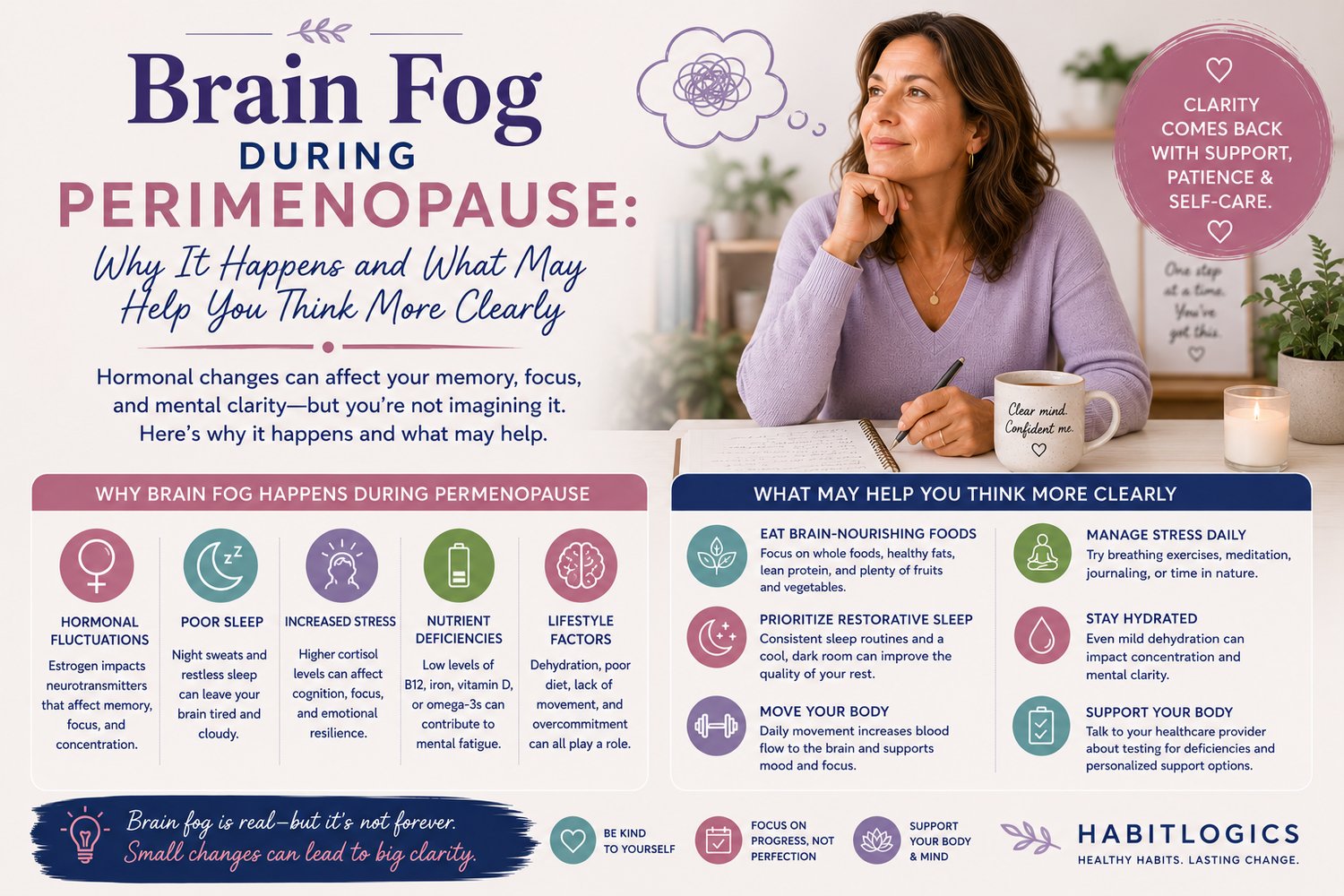
Brain Fog During Perimenopause: Memory Problems, Causes & What Actually Helps
Brain fog during perimenopause can make you forget a familiar word halfway through a sentence, lose your train of thought during a meeting, reread the same paragraph three times, or walk into a room with absolutely no idea why you went there.
For someone who normally feels mentally sharp, that can be unsettling.
And eventually the scary question may appear:
“Is something wrong with my memory?”
Cognitive complaints involving memory, concentration, attention, and word retrieval are common during the menopause transition.
But here's the most important distinction:
Typical perimenopause brain fog is not the same thing as dementia.
Most menopause-related cognitive changes are subtle. They can still be frustrating and disruptive, but they generally don't cause the progressive loss of independence and everyday functioning that defines dementia.
At the same time, not every memory problem during your 40s or 50s should automatically be blamed on hormones.
Poor sleep, depression, anxiety, medications, thyroid disorders, anemia, vitamin deficiencies, sleep apnea, alcohol, cardiovascular risk factors, and neurological conditions can all affect cognition.
So rather than assuming either “it's just perimenopause” or “I'm developing dementia,” let's look at what brain fog actually means, why it may happen, and what deserves further evaluation.
What Does Perimenopause Brain Fog Feel Like?
“Brain fog” isn't a medical diagnosis.
It's an informal description of several cognitive complaints that can appear during the menopause transition.
You might notice:
- Forgetting familiar words
- Losing your train of thought
- Difficulty concentrating
- Getting distracted more easily
- Forgetting appointments or tasks
- Difficulty remembering names
- Slower mental processing
- Trouble switching between tasks
- Feeling mentally overloaded
- Needing to reread information
- More difficulty organizing complex tasks
- Feeling less mentally sharp than usual
One woman may primarily notice word-finding problems.
Another may struggle with concentration.
Someone else may feel like her working memory suddenly has approximately three browser tabs available instead of thirty.
These experiences are real.
But “brain fog” covers several different cognitive processes, which is one reason there isn't one universal treatment.
Is Brain Fog Common During Perimenopause?
Yes.
Cognitive complaints are common during the menopause transition.
Women frequently report changes involving:
- Memory
- Attention
- Concentration
- Word retrieval
- Mental processing
Research has also found small measurable changes in certain cognitive domains during the menopause transition, particularly verbal memory.
That doesn't mean everyone experiences measurable cognitive decline.
And it doesn't mean the brain is rapidly deteriorating.
The changes seen during the typical menopause transition are generally much subtler than those associated with dementia.
Why Does Brain Fog Happen During Perimenopause?
There probably isn't one single cause.
Several processes can overlap.
Changing Hormone Patterns
Estrogen receptors are present throughout the brain, including regions involved in:
- Memory
- Attention
- Learning
- Mood
- Executive function
During perimenopause, estrogen doesn't simply decline smoothly.
Hormone patterns can fluctuate considerably.
Those changes may contribute to the cognitive differences some women notice during the transition.
But hormones don't operate in isolation.
Poor Sleep
Sleep may be one of the biggest contributors.
If you're repeatedly waking because of:
- Night sweats
- Insomnia
- Anxiety
- Sleep apnea
- Pain
- Other sleep disruption
your concentration and memory are probably going to suffer.
Hot Flashes and Night Sweats
Vasomotor symptoms may affect cognition indirectly by repeatedly disrupting sleep and increasing fatigue.
Severe hot flashes themselves have also been studied in relation to cognitive performance.
Mood and Anxiety
Depression and anxiety can both affect:
- Concentration
- Memory
- Motivation
- Mental processing
- Attention
Sometimes what feels like a memory disorder is partly a problem with attention.
If your brain never fully encoded the information because you were anxious, exhausted, or distracted, recalling it later becomes difficult.
Everyday Cognitive Load
Perimenopause often arrives during a stage of life when the brain is already juggling a lot.
Work.
Children.
Parents.
Appointments.
Finances.
Relationships.
Household management.
Health.
Trying to remember 47 things simultaneously would challenge anyone's working memory.
Hormonal changes may be one part of the picture without getting sole credit for the chaos.
Brain Fog vs. Dementia: What's the Difference?
This is usually the question underneath the question.
For example:
Brain fog might look like:
You temporarily can't remember a coworker's name, but it eventually comes back to you.
More concerning cognitive change might look like:
You repeatedly fail to recognize familiar people or cannot remember important information despite reminders.
Brain fog might mean you walk into a room and forget why.
More concerning impairment might involve repeatedly becoming lost in familiar places.
Brain fog may make work feel slower.
Dementia involves cognitive impairment significant enough to interfere with independent daily functioning.
Those distinctions aren't perfect diagnostic tests.
They're simply useful context.
Typical menopause-related cognitive complaints are generally milder than dementia.
Still, don't use an internet article to dismiss cognitive changes that are rapidly worsening or interfering substantially with everyday life.
Is Dementia Common During Perimenopause?
No.
Dementia in midlife is relatively uncommon.
That's reassuring when someone is experiencing the classic word-finding, distractibility, or mild forgetfulness commonly reported during the menopause transition.
But “uncommon” doesn't mean impossible.
And other neurological or medical conditions can also cause cognitive changes.
If symptoms are severe, progressive, unusual, or affecting independence, seek medical evaluation.
Why Word-Finding Problems Are So Noticeable
One of the most common complaints is:
“I know the word. Why can't I SAY the word?”
You may be describing an object and suddenly the name disappears.
Or you know someone's name perfectly well but can't retrieve it for several seconds.
Word retrieval relies on several cognitive processes working together.
Mild word-finding difficulty can occur during the menopause transition and with:
- Fatigue
- Stress
- Poor sleep
- Anxiety
- Normal aging
That occasional frustrating pause is different from progressively losing language ability or becoming unable to understand ordinary speech.
Rapidly worsening language problems deserve medical evaluation.
Why Poor Sleep Can Look Like Brain Fog
Sleep affects memory formation, attention, emotional regulation, and executive function.
After several nights of poor sleep, you may notice:
- Forgetfulness
- Slower reactions
- Poor concentration
- More mistakes
- Difficulty making decisions
- Irritability
- Mental fatigue
Now imagine repeating that cycle for months because night sweats keep waking you.
That's why sleep deserves to be investigated rather than treated as a footnote in a brain-fog article.
Read Sleep During Perimenopause: Why You Can’t Sleep & What Actually Helps.
If hot flashes are driving those awakenings, also read Hot Flashes During Perimenopause: Causes, Triggers & Treatments That Actually Help.
Don't Miss Sleep Apnea
Sleep apnea deserves special mention because it can create exactly the kind of symptoms someone might otherwise blame on menopause:
- Fatigue
- Poor concentration
- Memory problems
- Morning headaches
- Irritability
- Unrefreshing sleep
Possible clues include:
- Loud snoring
- Gasping during sleep
- Witnessed pauses in breathing
- Waking choking
- Significant daytime sleepiness
If that pattern sounds familiar, don't just add a memory supplement.
Talk with a healthcare professional about sleep evaluation.
Treating an actual sleep disorder is much more useful than trying to “biohack” around it.
Depression and Anxiety Can Affect Concentration Too
Mood symptoms can significantly affect cognitive performance.
Depression can make thinking feel slow.
Anxiety can keep your attention bouncing between worries.
Both can interfere with:
- Focus
- Working memory
- Motivation
- Decision-making
- Information processing
That doesn't mean brain fog is imaginary.
It means the brain isn't divided into completely separate hormone, sleep, cognition, and mood departments.
Everything interacts.
Read Mood Swings During Perimenopause: Causes, Anxiety, Depression & What Actually Helps.
What Else Can Cause Brain Fog?
There are plenty of possibilities besides perimenopause.
Depending on your symptoms and medical history, contributors can include:
- Thyroid disorders
- Iron-deficiency anemia
- Vitamin B12 deficiency
- Folate deficiency
- Sleep apnea
- Depression
- Anxiety
- Chronic sleep deprivation
- Medication side effects
- Alcohol or other substances
- Chronic pain
- Certain infections or illnesses
- Neurological conditions
This doesn't mean everyone with brain fog needs a giant laboratory workup.
It means persistent cognitive symptoms deserve context.
Especially if something about the pattern doesn't fit ordinary perimenopause.
Can Hot Flashes Affect Memory?
Possibly.
Hot flashes can disrupt sleep, which clearly affects cognitive performance.
More severe vasomotor symptoms may also overlap with other physiological changes being studied in relation to cognition.
But it's difficult to separate:
hormonal change
from
hot flashes
from
sleep disruption
from
stress and mood
because these factors frequently occur together.
What we can say confidently is that controlling bothersome hot flashes may improve quality of life and sleep.
That can make daytime thinking easier even if the hot-flash treatment isn't directly functioning as a “memory medication.”
Can Hormone Therapy Fix Brain Fog?
This needs a very careful answer.
Some women report feeling mentally clearer after starting hormone therapy.
That can be completely genuine.
If hormone therapy improves:
- Severe hot flashes
- Night sweats
- Sleep
- Mood
- Overall symptom burden
then concentration and mental clarity may improve too.
But:
Menopausal hormone therapy is not recommended solely to improve cognition or prevent dementia in women undergoing natural menopause.
Randomized clinical trials have not established hormone therapy as a reliable memory-enhancing treatment for naturally menopausal women.
So brain fog by itself isn't a reason to assume:
“I need estrogen for my brain.”
If you have bothersome vasomotor or other menopause symptoms and are otherwise an appropriate candidate for hormone therapy, cognitive changes can certainly be part of the bigger conversation.
Read Hormone Therapy for Perimenopause: Benefits, Risks, Types & Who It May Help.
Does Hormone Therapy Prevent Dementia?
No current menopause guidance recommends starting hormone therapy specifically to prevent dementia.
This is important because hormone and “longevity” clinics sometimes imply that estrogen replacement protects the brain and therefore everyone should take it indefinitely.
The research is considerably more complicated.
Age at menopause, cardiovascular health, lifetime hormone exposure, genetics, and many other factors may influence long-term brain health.
That does not translate into:
“Take menopausal hormone therapy to prevent Alzheimer's.”
Hormone therapy should be prescribed for evidence-based indications after an individualized benefit-risk discussion.
What Actually Helps Perimenopause Brain Fog?
There isn't one proven brain-fog pill.
The most useful approach is usually:
identify and treat contributors + support overall brain health + use practical tools to compensate when necessary.
That sounds less exciting than “take this supplement and eliminate brain fog.”
It's also more useful.
Treat Sleep Problems
If you're sleeping terribly, start there.
That may mean addressing:
- Night sweats
- Insomnia
- Sleep apnea
- Restless legs
- Alcohol
- Caffeine timing
- Anxiety
- Other sleep problems
Improving sleep can make a noticeable difference in concentration and mental energy.
For chronic insomnia, evidence-based treatment such as CBT-I deserves more attention than generic sleep-hygiene advice alone.
Treat Depression or Anxiety When They're Present
If depression or anxiety is affecting cognition, treating those conditions may improve concentration.
Treatment can include:
- Psychotherapy
- Medication
- Lifestyle support
- Treatment of overlapping menopause symptoms
- Other individualized strategies
Don't wait for menopause to “finish” if you're dealing with a treatable mental-health condition now.
Exercise for Brain Health—Not as a Miracle Brain-Fog Cure
Regular physical activity is one of the stronger lifestyle tools for long-term health.
It supports:
- Cardiovascular health
- Metabolic health
- Sleep
- Mood
- Physical function
- Brain health
Walking and strength training are practical starting points.
But don't oversell exercise.
A walk isn't guaranteed to make word-finding problems disappear tomorrow.
Think of physical activity as part of long-term health maintenance rather than an acute medication for brain fog.
Explore:
Walking During Perimenopause: Benefits for Weight, Mood & Health
and
Strength Training During Perimenopause: Benefits, Workouts & How to Start.
Protect Your Cardiovascular Health
Heart health and brain health are closely connected.
Long-term cognitive health is influenced by cardiovascular risk factors including:
- High blood pressure
- Diabetes
- High cholesterol
- Smoking
- Physical inactivity
That makes ordinary preventive healthcare surprisingly relevant to a discussion about your brain.
You don't need an exotic nootropic stack while ignoring untreated high blood pressure.
Boring health fundamentals remain annoyingly powerful.
Eat for Overall Brain and Cardiovascular Health
There isn't a specific perimenopause brain-fog diet.
A broadly nutritious eating pattern supports cardiovascular and brain health.
That generally means emphasizing foods such as:
- Vegetables
- Fruits
- Whole grains
- Beans and legumes
- Nuts and seeds
- Fish and other nutritious protein sources
- Unsaturated fats
- Fiber-rich foods
Patterns similar to Mediterranean-style eating are commonly associated with cardiovascular and cognitive-health benefits.
That doesn't mean olive oil cures perimenopause brain fog.
It means your brain is part of the same body you're trying to keep healthy for the next several decades.
For the larger nutrition picture, read Best Diet for Perimenopause: What to Eat for Midlife Health.
Protein Is Important—But It Isn't a Brain-Fog Treatment
Adequate protein matters during midlife, particularly for preserving muscle.
Protein also supplies amino acids the body uses for many essential processes.
But the leap from:
“protein is important”
to
“more protein fixes brain fog”
isn't supported.
Eat enough protein because it's part of a solid nutrition strategy.
Don't treat a protein shake as cognitive medication.
Read Protein During Perimenopause: How Much Do You Need?.
What About Omega-3s?
Fish and other foods containing omega-3 fatty acids can fit into a nutritious eating pattern.
But buying high-dose omega-3 supplements specifically to treat perimenopause brain fog is a different claim.
Evidence for supplements as a direct treatment for these cognitive complaints isn't strong enough to make them a standard brain-fog solution.
Food-first nutritional habits generally make more sense unless a healthcare professional recommends supplementation for a specific reason.
Do Brain Supplements or Nootropics Work?
Be skeptical.
Products marketed for menopause brain fog may contain things such as:
- Ginkgo
- Herbal blends
- Mushroom extracts
- B vitamins
- Omega-3s
- Stimulants
- Proprietary “focus” blends
The evidence usually doesn't come close to matching the marketing.
Supplements can also:
- Interact with medications
- Contain inconsistent doses
- Produce side effects
- Cost a surprising amount of money
If someone promises to “reverse menopause brain fog” with a proprietary supplement, ask for evidence on that exact product.
Not testimonials.
Not evidence that one ingredient performs some interesting biochemical function.
Evidence that the actual intervention meaningfully improves the problem.
Reduce Cognitive Overload
Now we move from trying to change the brain fog itself to making everyday life easier.
If your working memory feels overloaded, stop requiring it to hold everything.
Use:
- Calendar reminders
- Written task lists
- Notes
- Timers
- Recurring reminders
- Shopping lists
- Project-management tools
- A consistent place for important items
That's not “giving in” to brain fog.
It's good cognitive ergonomics.
We don't shame ourselves for using a calculator.
You don't have to prove your memory works by refusing to use a calendar either.
Stop Multitasking So Much
Multitasking is often just rapid task-switching wearing a productivity costume.
If concentration has become more difficult, reduce unnecessary switching.
Try:
- Closing unrelated browser tabs
- Silencing notifications
- Finishing one meaningful task before opening another
- Grouping similar tasks together
- Protecting focused work periods
Your brain may feel considerably less broken once you stop asking it to process an email, Slack message, spreadsheet, phone notification, podcast, and conversation simultaneously.
Give Important Information One Home
A surprisingly effective strategy is deciding where information lives.
Appointments go in the calendar.
Tasks go in one task list.
Shopping goes in one grocery list.
Important documents go in one predictable location.
When information is scattered between:
- Your memory
- Three notebooks
- Text messages
- Screenshots
- Sticky notes
- Email drafts
you've created a retrieval problem even for a perfectly functioning brain.
Organization can reduce the mental load brain fog makes harder.
Schedule Difficult Work When You're Sharpest
If your concentration is noticeably better at certain times, use that information.
Maybe mentally demanding work is easier in the morning.
Maybe afternoons are better after you've exercised.
Maybe the day following bad night sweats is simply not the day to schedule five complex meetings if you can avoid it.
You don't need to structure your entire life around brain fog.
But using your best cognitive window for your hardest tasks is practical.
Social and Mental Activity Still Matter
Staying mentally and socially engaged supports healthy aging.
That might mean:
- Reading
- Learning
- Working
- Hobbies
- Playing music
- Games
- Conversation
- Volunteering
- Spending time with other people
- Learning new skills
You don't need an expensive “brain-training” app.
A meaningful, engaged life gives your brain plenty to do.
Track Patterns Without Turning Your Life Into an Experiment
Brain fog often fluctuates.
A simple symptom record can help you notice whether worse days tend to follow:
- Poor sleep
- Night sweats
- High stress
- Alcohol
- Missed meals
- Mood symptoms
- Medication changes
- Certain points in your menstrual cycle
Track enough to learn something.
You do not need to grade your memory every hour.
The FREE Perimenopause Starter Kit includes basic symptom tracking if you want an easy place to begin.
For more detailed tracking, the Perimenopause Symptom Tracker includes printable and Excel tools for monitoring brain fog alongside sleep, mood, menstrual changes, hot flashes, and other symptoms over time.
When Should Brain Fog Be Medically Evaluated?
Occasional forgetfulness is one thing.
Rapidly progressive cognitive change is another.
Talk with a healthcare professional if you notice:
- Memory problems getting substantially worse
- Difficulty managing finances or medications
- Becoming lost in familiar places
- Repeatedly forgetting important information
- Difficulty performing familiar tasks
- Significant personality or behavioral changes
- Persistent confusion
- Major language problems
- Cognitive changes interfering with work or independence
- Symptoms that concern people close to you
Other neurological warning signs—such as sudden weakness, facial drooping, severe headache, major speech difficulty, or sudden confusion—require urgent medical evaluation.
And remember:
The choice isn't simply between perimenopause and dementia.
Many treatable conditions can cause cognitive symptoms.
What Might a Healthcare Professional Check?
The evaluation depends on your age, symptoms, medical history, medications, and how severe the changes are.
A clinician may consider issues such as:
- Sleep
- Mood
- Medications
- Alcohol use
- Thyroid function
- Anemia
- Nutritional deficiencies
- Cardiovascular health
- Neurological symptoms
More testing isn't automatically better.
The point is to look for plausible contributors rather than ordering every available laboratory test because you forgot a noun yesterday.
Common Brain-Fog Myths
“Brain Fog Means I'm Developing Dementia”
Usually not.
Mild memory and concentration complaints are common during the menopause transition and are generally different from progressive dementia.
Severe or worsening symptoms still deserve evaluation.
“It's Just Hormones, So Nothing Can Help”
Also wrong.
Even when perimenopause is contributing, treating sleep problems, depression, anxiety, hot flashes, or another medical condition can improve how your brain functions day to day.
“Hormone Therapy Will Protect My Brain”
Hormone therapy should not be started solely to improve cognition or prevent dementia after natural menopause.
It may improve other symptoms that indirectly affect mental clarity.
That's a different claim.
“I Need a Brain Supplement”
Probably not.
There isn't a standard supplement proven to eliminate perimenopause brain fog.
Be skeptical of expensive products promising dramatic cognitive improvement.
“Using Reminders Means My Memory Is Getting Worse”
No.
External reminders are tools.
Highly organized people use calendars, notes, task lists, and alarms whether they're in perimenopause or not.
Save your memory for something more interesting.
Frequently Asked Questions
Is brain fog common during perimenopause?
Yes.
Difficulty concentrating, forgetfulness, distractibility, word-finding problems, and other mild cognitive complaints are commonly reported during the menopause transition.
What causes brain fog during perimenopause?
There probably isn't one cause.
Changing hormone patterns may contribute, while poor sleep, hot flashes, mood symptoms, stress, medications, medical conditions, and ordinary cognitive overload can overlap.
Does perimenopause brain fog mean dementia?
Usually not.
Typical menopause-related cognitive changes tend to be mild and aren't the same as the progressive loss of function seen with dementia.
Severe or worsening cognitive symptoms should still be evaluated.
Why can't I remember words during perimenopause?
Word-finding difficulty is commonly reported during the menopause transition.
Fatigue, poor sleep, stress, anxiety, and hormonal changes may all contribute.
Rapidly worsening language problems aren't something to simply blame on perimenopause.
Does brain fog go away after menopause?
Symptoms and cognitive performance can change as women move through the menopause transition, but there isn't one guaranteed timeline for every person.
Persistent cognitive problems should be evaluated rather than assuming they will automatically disappear after the final menstrual period.
Does hormone therapy help brain fog?
Hormone therapy is not recommended solely to improve cognition in women undergoing natural menopause.
Some women may feel mentally clearer when treatment improves hot flashes, sleep, mood, and overall symptom burden.
Does HRT prevent Alzheimer's disease?
Hormone therapy isn't recommended specifically to prevent dementia or Alzheimer's disease.
Long-term dementia risk is influenced by many factors.
Can better sleep improve brain fog?
Yes, when sleep disruption is contributing to the cognitive problem.
Poor sleep can substantially affect memory, attention, decision-making, and mental processing.
Does exercise help brain fog?
Physical activity supports overall brain, cardiovascular, sleep, and mental health.
It's a worthwhile part of healthy aging but shouldn't be marketed as a guaranteed treatment for perimenopause brain fog.
What supplements help perimenopause brain fog?
No over-the-counter supplement has established itself as a standard, reliably effective treatment for perimenopause brain fog.
Discuss supplements with a healthcare professional if you're considering them, particularly if you take medications.
Key Takeaways
- Brain fog during perimenopause can involve forgetfulness, concentration problems, distractibility, word-finding difficulty, and mental fatigue.
- Cognitive complaints are common during the menopause transition.
- Measurable cognitive changes tend to be subtle, with verbal memory among the areas most consistently studied.
- Typical perimenopause brain fog is not the same as dementia.
- Poor sleep, night sweats, depression, anxiety, stress, medications, and other health conditions can contribute.
- Treating an underlying sleep, mood, or medical problem may improve mental clarity.
- Hormone therapy isn't recommended solely to improve cognition or prevent dementia after natural menopause.
- Regular physical activity, cardiovascular health, nutritious eating, social engagement, and other healthy-aging habits support long-term brain health.
- Supplements marketed specifically for menopause brain fog generally have much weaker evidence than their marketing suggests.
- Calendars, reminders, task lists, and reduced multitasking are practical tools—not signs of failure.
- Severe, rapidly worsening, or function-limiting cognitive changes deserve medical evaluation.
Continue Learning
If brain fog is occurring alongside other perimenopause symptoms, continue with:
- Mood Swings During Perimenopause: Causes, Anxiety, Depression & What Actually Helps
- Sleep During Perimenopause: Why You Can’t Sleep & What Actually Helps
- Hot Flashes During Perimenopause: Causes, Triggers & Treatments That Actually Help
- Hormone Therapy for Perimenopause: Benefits, Risks, Types & Who It May Help
- 35 Perimenopause Symptoms: Common Signs, What’s Normal & When to Get Help
Or return to the Complete Perimenopause Guide for the full HabitLogics perimenopause roadmap.
Educational Disclaimer
This article is intended for educational purposes only and is not medical advice, diagnosis, or treatment. Memory and concentration problems can have many causes, including sleep disorders, depression, anxiety, thyroid disease, anemia, nutritional deficiencies, medication effects, substance use, cardiovascular disease, and neurological conditions. Consult a qualified healthcare professional about persistent, worsening, severe, or function-limiting cognitive changes.