

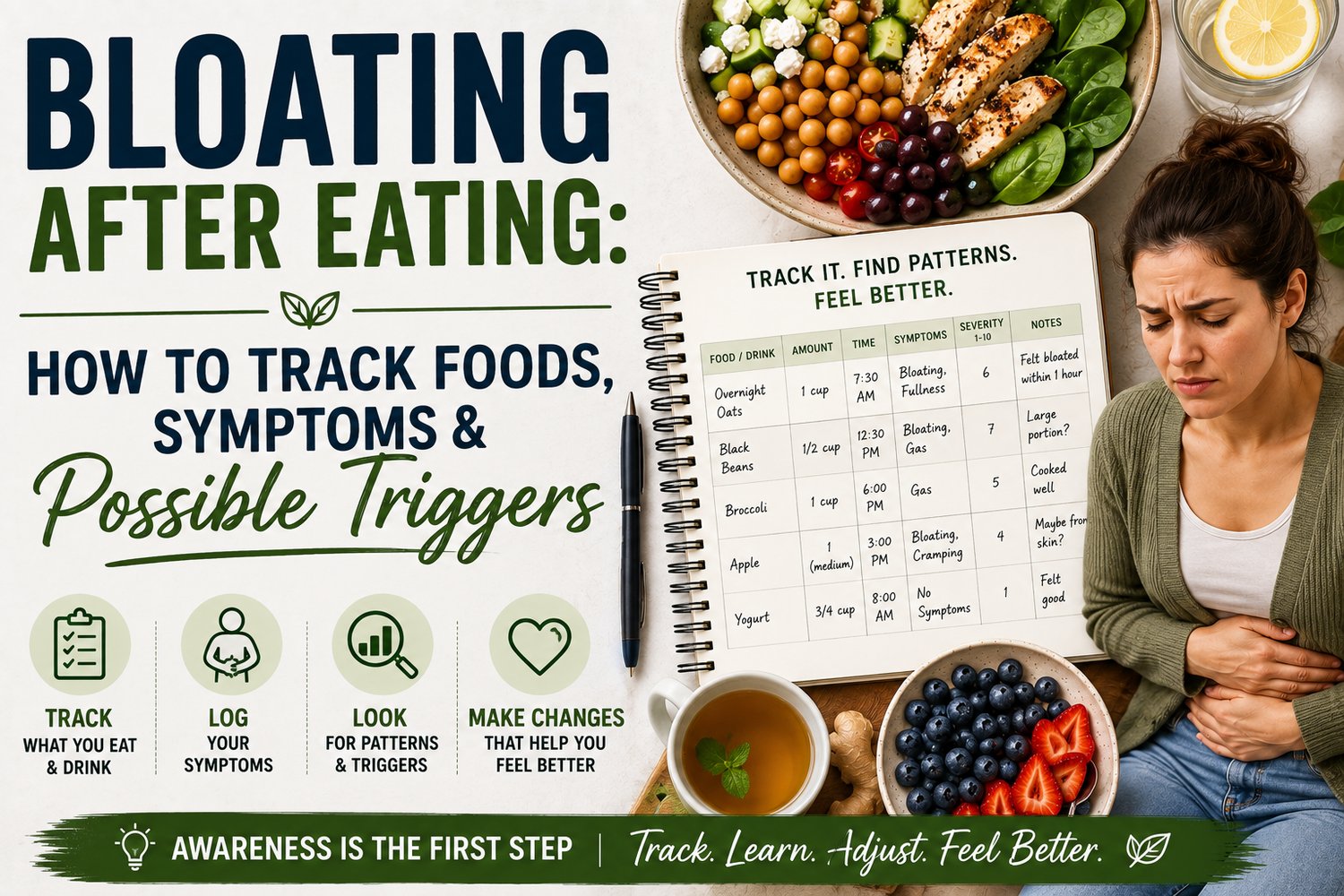
Bloating After Eating: How to Track Foods, Symptoms & Possible Triggers
Complete Fiber & Gut Health Guide Hub
You eat dinner.
An hour later your stomach feels enormous.
So naturally, you start investigating.
Was it:
The bread?
The dairy?
The beans?
The broccoli?
The artificial sweetener?
The fiber?
Gluten?
Your microbiome?
And within 20 minutes of searching online, you've somehow diagnosed yourself with six gastrointestinal disorders and decided you're never eating an onion again.
There's a better way to approach this.
Bloating after eating is common, and occasional bloating doesn't automatically mean something is wrong. NIDDK defines bloating as a feeling of fullness or swelling in the abdomen and notes that only about half of people who report bloating also have measurable abdominal distention.
More importantly:
Many different things can cause similar symptoms.
That means one episode of bloating usually isn't enough information to identify the culprit.
Instead of immediately eliminating foods, the better first question is:
Is there a repeatable pattern?
That's what we're going to figure out.
If your bloating started after dramatically increasing fiber, start with Fiber and Bloating: Why Fiber Can Make You Bloated & What to Do About It.
This article goes broader.
We're going to build a simple system for tracking:
food → portion → timing → symptoms → bowel habits → patterns.
First: Some Bloating After Eating Can Be Normal
Your abdomen isn't supposed to remain exactly the same size from:
6:00 a.m.
to:
10:00 p.m.
You eat food.
You drink fluids.
Your digestive tract processes meals.
Intestinal bacteria ferment some carbohydrates.
Gas is produced.
NIDDK explains that gas normally enters the digestive tract in two primary ways:
- Swallowing air
- Bacteria in the large intestine breaking down carbohydrates that weren't fully digested earlier in the digestive tract
So:
“My stomach feels somewhat fuller after dinner”
is very different from:
“I have painful bloating after nearly every meal.”
Frequency and severity matter.
Bloating and Distention Aren't Exactly the Same Thing
These terms are often used interchangeably.
Technically:
Bloating
The sensation of abdominal fullness or swelling.
Distention
A measurable or visible increase in abdominal size.
NIDDK notes that only about half of people who experience bloating also have distention.
That's useful because it tells us something important:
How bloated you feel isn't determined entirely by how much gas is physically present.
Digestive sensation can be complicated.
Why Do I Get Bloated After Eating?
There isn't one answer.
Possible contributors include:
- Large meals
- Rapid eating
- Swallowed air
- Carbonated drinks
- Certain carbohydrates
- High-fiber foods
- Large increases in fiber
- Beans and legumes
- Sugar alcohols
- Lactose intolerance
- Fructose intolerance
- Constipation
- IBS
- Other digestive conditions
NIDDK notes that conditions including IBS, functional abdominal bloating, constipation, carbohydrate intolerances, celiac disease and other gastrointestinal disorders can contribute to gas symptoms.
That's why:
“What food causes bloating?”
isn't a very useful question.
A better one is:
“What consistently causes bloating for me, under what circumstances, and at what amount?”
The Same Food Can Affect Different People Differently
Your friend eats:
a giant bowl of lentil chili
and feels fantastic.
You eat half a bowl and spend the evening reconsidering your life choices.
That doesn't mean:
lentils are unhealthy.
It means digestive tolerance varies.
The same applies to:
- Dairy
- Beans
- Whole grains
- Certain fruits
- Certain vegetables
That's why generic lists of:
“10 FOODS DESTROYING YOUR GUT”
aren't particularly useful.
Individual patterns matter more.
Portion Size Matters More Than Most People Realize
This is one of the first things I would track.
You might tolerate:
¼ cup black beans
without a problem.
You might tolerate:
½ cup
with mild gas.
But:
1½ cups
may produce significant bloating.
If your food diary simply says:
“beans”
you've missed important information.
Write:
Black beans — approximately ¾ cup.
Much better.
Meal Size Matters Too
Imagine dinner includes:
- Large burrito
- Beans
- Rice
- Avocado
- Salsa
- Chips
- Carbonated drink
You feel bloated afterward.
Was it:
gluten?
Maybe.
But it was also:
a very large meal.
You need to distinguish:
food-specific reactions
from:
I ate a ton of food.
This sounds obvious.
It's surprisingly easy to overlook.
Eating Speed Can Matter
Eating quickly can increase swallowed air.
NIDDK recommends eating slowly and, when possible, sitting down to eat rather than eating on the run as strategies that may help reduce gas symptoms.
So track this too.
Was the meal:
Relaxed — 25 minutes
or:
Inhaled in the car — 6 minutes?
That's useful context.
Carbonated Drinks Can Contribute
If dinner includes:
- Soda
- Sparkling water
- Carbonated energy drink
don't ignore the beverage.
NIDDK recommends limiting fizzy drinks when trying to reduce gas symptoms because swallowed air contributes to intestinal gas.
This doesn't mean carbonation is automatically your problem.
It means:
track the drink too.
Sugar Alcohols Are Easy to Miss
Look at packaged:
- Protein bars
- Low-carb snacks
- Sugar-free candy
- Gum
- Desserts
You may see ingredients such as:
- Sorbitol
- Mannitol
- Xylitol
- Maltitol
- Erythritol
NIDDK lists sweeteners ending in “-ol” among ingredients that can contribute to gas symptoms in some people.
So your:
“healthy protein bar”
may deserve more scrutiny than the apple you blamed.
High-Fiber Foods Can Increase Gas
Fiber itself can contribute to gas because some types reach the colon and are fermented by intestinal bacteria.
NIDDK notes that some people experience more gas symptoms when they consume too much fiber.
That doesn't mean:
fiber = bad.
Ask instead:
- How much did I eat?
- How quickly did I increase it?
- What type of food supplied it?
- Did I stack several high-fiber foods together?
Those questions are much more useful.
Beans and Lentils Are Common Triggers
Legumes include:
- Beans
- Peas
- Lentils
They're excellent sources of fiber and plant protein.
They're also among the foods NIDDK lists as possible contributors to excess gas in some people.
Again:
Dose matters.
Try tracking:
¼ cup
versus:
½ cup
versus:
1 cup.
You may have a perfectly manageable tolerance threshold.
Certain Vegetables Can Produce More Gas
Cruciferous vegetables are common examples:
- Broccoli
- Cauliflower
- Kale
- Collard greens
NIDDK lists cruciferous vegetables among foods that may contribute to gas symptoms in some people.
But please don't turn this into:
“Broccoli causes bloating, therefore broccoli is bad.”
It doesn't work that way.
You may tolerate broccoli perfectly well.
Or:
½ cup may be fine.
A giant raw bowl may not be.
Track the actual response.
Fruit Can Be a Trigger for Some People
Certain fruits contain carbohydrates that can cause digestive symptoms in susceptible people.
NIDDK specifically lists fruits such as:
- Apples
- Pears
- Peaches
among foods that may increase gas symptoms in some people.
That doesn't mean fruit is unhealthy.
It means if you consistently notice:
apple → bloating
but:
orange → fine
that's useful information.
Dairy Can Be the Problem
Lactose intolerance can cause:
- Bloating
- Gas
- Diarrhea
- Abdominal discomfort
after consuming lactose-containing foods.
If symptoms consistently follow:
- Milk
- Ice cream
- Certain dairy products
that's worth tracking.
But don't diagnose lactose intolerance because you felt bloated after pizza once.
Pizza introduces about 14 variables at the same time.
Wheat Doesn't Automatically Mean Gluten
This distinction matters.
Someone eats wheat bread.
They feel bloated.
They conclude:
gluten intolerance.
But wheat contains more than gluten.
Some wheat products also contain fermentable carbohydrates that can trigger symptoms in people with IBS.
NIDDK includes wheat and rye products among foods containing FODMAP carbohydrates.
So symptoms after wheat do not automatically identify gluten as the culprit.
Don't Go Gluten-Free Before Celiac Testing
This is important.
If you have symptoms that make you concerned about celiac disease, talk with a healthcare professional before eliminating gluten.
NIDDK specifically states that doctors don't recommend beginning a gluten-free diet before diagnostic testing because removing gluten can affect the test results.
That's one reason random elimination diets can backfire.
You can make proper diagnosis harder.
Constipation Can Cause Bloating
Sometimes you're staring at yesterday's dinner when the real problem is:
you're constipated.
Constipation is among the conditions NIDDK lists as a potential contributor to gas and bloating symptoms.
That's why your symptom tracker should include:
bowel movements.
Otherwise you may blame individual foods for a broader motility problem.
IBS Can Cause Bloating After Eating
IBS can involve:
- Abdominal pain
- Bloating
- Gas
- Diarrhea
- Constipation
- Changes in bowel habits
And people with IBS can be particularly sensitive to certain fermentable carbohydrates.
NIDDK notes that dietary strategies for IBS may include increasing fiber gradually or trying a low-FODMAP approach under appropriate guidance.
But:
bloating does not automatically mean IBS.
Diagnosis requires more than one symptom.
FODMAPs: What Are They?
FODMAP stands for:
Fermentable Oligosaccharides, Disaccharides, Monosaccharides and Polyols.
They're short-chain carbohydrates that can be difficult for some people to digest or absorb.
Examples can occur in:
- Certain fruits
- Certain vegetables
- Beans
- Wheat and rye products
- Dairy products containing lactose
- Honey
- Some sweeteners
NIDDK notes that healthcare professionals may recommend a temporary low-FODMAP diet for some people with IBS, followed by gradual reintroduction of foods.
The important word there is:
temporary.
Don't Turn Low-FODMAP Into a Forever Diet
The purpose isn't:
eliminate every fermentable plant food permanently.
A structured low-FODMAP approach typically involves:
- Temporary restriction
- Reintroduction
- Identifying individual tolerance
- Expanding the diet as much as possible
If you suspect IBS or significant FODMAP sensitivity, working with a registered dietitian or healthcare professional can make this process much more useful.
The Biggest Mistake: Eliminating Everything at Once
You're bloated.
Monday you eliminate:
- Gluten
- Dairy
- Beans
- Fruit
- Artificial sweeteners
- Onions
- Garlic
By Friday you feel better.
Great.
Which food caused the problem?
No idea.
You changed six variables.
That's not a useful experiment.
Treat Your Food Diary Like an Experiment
Think:
one variable at a time.
If you suspect dairy:
Track dairy carefully.
If you suspect large bean portions:
Change the bean portion.
If you suspect carbonation:
Remove carbonation temporarily.
Then observe.
You're trying to create:
signal
instead of:
noise.
What Should You Track?
A useful bloating diary doesn't need 75 fields.
Track:
Meal
What did you eat?
Portion
Approximately how much?
Time
When did you eat?
Symptoms
What happened?
Severity
How bad was it?
Timing
How long after eating did symptoms begin?
Bowel Movement
Did you have one? What was it like?
Context
Anything unusual?
That's enough to start.
Example Food Entry
Instead of:
Lunch: sandwich
write:
12:30 p.m. — turkey sandwich
- 2 slices whole-wheat bread
- Turkey
- Cheese
- Lettuce
- Tomato
- Mayo
- Apple
- Sparkling water
Now you actually have usable information.
Example Symptom Entry
Instead of:
Bloated
write:
2:15 p.m. — moderate bloating
Severity:
6/10
Other symptoms:
Mild gas, no pain
Duration:
Approximately 2 hours
That's much more informative.
Use a Simple 0–10 Scale
For example:
0
No bloating.
1–3
Mild.
Noticeable but doesn't bother you much.
4–6
Moderate.
Uncomfortable and distracting.
7–8
Severe.
Interferes with normal activity.
9–10
Extreme.
Severe enough that medical evaluation may be appropriate, particularly when accompanied by other concerning symptoms.
Consistency matters more than scientific precision.
You're comparing:
you against you.
Track Timing
Timing can reveal patterns.
Did symptoms begin:
10 minutes after eating?
1 hour later?
4 hours later?
The next morning?
Don't automatically assume the last thing you ate caused the symptom.
Digestion doesn't work like:
food enters mouth → instantly reaches colon.
Timing matters.
Don't Blame Dinner for Everything
Suppose you're bloated at:
7:00 p.m.
Dinner was:
6:15 p.m.
You blame dinner.
But you also ate:
- Large lunch
- Protein bar with sugar alcohols
- Carbonated drink
- Very little fluid
- No bowel movement for two days
Dinner may simply be the final event in a much larger digestive story.
Track the whole day.
Track Bowel Movements
This is one of the most valuable pieces of information.
Record:
- Frequency
- Approximate consistency
- Constipation
- Diarrhea
- Urgency
- Straining
You don't need to write a novel.
But if bloating occurs primarily on days when you haven't had a bowel movement?
That's a major clue.
The Bristol Stool Chart Can Help
Healthcare professionals commonly use the Bristol Stool Form Scale to describe stool consistency.
You don't need to become obsessed with it.
But using a consistent classification can make tracking easier than descriptions like:
“weird today.”
The point is consistency.
Track Fiber Intake Too
Because we're in the middle of a fiber series, this one matters.
Maybe your bloating correlates with:
35+ grams of fiber
but not:
25 grams.
Or maybe the total amount doesn't matter.
Instead, symptoms correlate with:
large bean servings.
That's useful.
The High-Fiber Meal Builder & 30-Day Fiber Tracker can help if you want to track your fiber intake alongside meals.
Track Plant Variety Separately
You've also been working on plant diversity.
Don't stop.
But recognize that going from:
10 plants/week
to:
30 plants/week
may introduce many new variables simultaneously.
If you recently made a large change after reading How to Eat More Plant Variety: Simple Ways to Add More Fruits, Vegetables, Beans, Grains, Nuts & Seeds, slow the pace if symptoms appear.
You don't need to win the 30-plants challenge in three days.
Track Stress
This is often ignored.
The gut and brain communicate extensively, and functional gastrointestinal disorders such as IBS involve gut-brain interactions. NIDDK notes that these disorders can affect how people experience bloating and abdominal pain.
So add a simple field:
Stress: Low / Moderate / High
You may notice patterns.
Track Sleep
One terrible night of sleep doesn't prove:
sleep caused my bloating.
But if you're tracking patterns anyway, sleep is useful context.
Keep it simple:
7.5 hours — good
or:
4.5 hours — poor
Don't turn the tracker into another full-time job.
Track Menstrual Cycle When Relevant
Hormonal changes can affect gastrointestinal symptoms in some people.
If bloating predictably changes across the menstrual cycle, that context can be useful.
Again:
We're not diagnosing from the tracker.
We're looking for patterns worth discussing with a healthcare professional when appropriate.
Track Medications and Supplements
This is easy to overlook.
Record new:
- Medications
- Fiber supplements
- Magnesium
- Iron
- Protein powders
- Probiotics
- Other supplements
If symptoms began two days after starting something new, that's useful information.
Don't assume the problem is lunch.
Track Protein Powders Carefully
Some protein powders contain:
- Lactose
- Inulin
- Sugar alcohols
- Gums
- Other added fibers or sweeteners
If your daily shake suddenly coincides with bloating, check the ingredient label.
Sometimes the culprit isn't:
protein.
It's everything packaged with it.
Don't Assume Probiotics Will Fix Bloating
This is another common reflex.
Bloating?
Take probiotics.
But probiotics are not one standardized treatment, and different strains and products can have different effects.
Some people may even notice temporary increases in gas.
Don't automatically add another variable while you're trying to identify the original problem.
Your First Week Should Be Observation Only
This is probably the most useful strategy.
For seven days:
Don't intentionally change your diet.
Just track.
You're trying to discover your baseline.
Record:
- Meals
- Portions
- Bloating
- Gas
- Bowel movements
- Fiber
- Relevant context
Then look at the week.
What Patterns Should You Look For?
Ask:
Does bloating happen after every meal?
That suggests something different from one specific food.
Does it happen after large meals?
Portion size may matter.
Does it happen after dairy?
Investigate dairy.
Does it happen after high-fiber days?
Fiber amount may matter.
Does it happen after beans?
Look at bean portions.
Does it happen on constipated days?
Bowel function may be central.
Does it happen after carbonated drinks?
Test that variable.
Does it happen randomly?
You may need more data.
One Episode Is Not a Pattern
This is critical.
Monday:
You eat broccoli.
You get bloated.
That doesn't prove broccoli caused it.
Try to find:
repeated associations.
Broccoli:
Monday → symptoms.
Thursday → symptoms.
Sunday → symptoms.
Now we're getting more interesting.
Still not a diagnosis.
But definitely worth investigating.
Three Repeated Exposures Are More Useful Than One
As a practical tracking rule—not a medical diagnostic criterion—I'd want to see a suspected food associated with symptoms on multiple occasions before labeling it a likely trigger.
For example:
Exposure 1
Large apple → bloating.
Exposure 2
Large apple → bloating.
Exposure 3
Large apple → bloating.
Meanwhile:
Bananas → fine.
Oranges → fine.
That's far more informative than:
“Fruit makes me bloated.”
Test Portion Size Next
Suppose:
one large apple
repeatedly causes symptoms.
Try:
½ apple
with an otherwise familiar meal.
Maybe that's fine.
Now you've learned:
The food may not need to disappear.
You may simply tolerate a smaller amount better.
That's a much better outcome than unnecessary elimination.
Change Only One Thing
If you're testing beans:
Keep the rest of the meal similar.
Example:
Test 1
Chicken + rice + vegetables + ¼ cup black beans
Test 2
Chicken + rice + vegetables + ½ cup black beans
Now you're testing something meaningful.
Not perfectly scientific.
But far more useful.
Keep the Rest of the Day Reasonably Normal
Don't test:
beans
on the same day you also introduce:
- New protein powder
- New probiotic
- Huge salad
- Fiber supplement
- Sugar-free candy
Now your experiment is useless.
Control what you reasonably can.
How Long Should You Track?
Seven days gives you a baseline.
But:
2–4 weeks
often provides more useful pattern information because many foods won't repeat enough in one week.
You don't necessarily need to track forever.
The goal is:
identify patterns → make targeted changes → move on.
Don't Become Afraid of Food
This is one danger of symptom tracking.
You start noticing everything.
Then every meal becomes:
“Will this make me bloated?”
That's not the goal.
Tracking should increase clarity.
Not anxiety.
If tracking itself starts making eating stressful or overly restrictive, that's a sign to stop and seek professional guidance.
Your Goal Is the Broadest Diet You Tolerate
This is the philosophy I would use.
Not:
“How many foods can I eliminate?”
Instead:
“How many nutritious foods can I comfortably keep?”
That's especially important when we're trying to improve:
- Fiber intake
- Plant variety
- Overall dietary quality
Unnecessary restriction works against those goals.
Use the Bloating, Digestion & Food Trigger Tracker
This is exactly why I created the Bloating, Digestion & Food Trigger Tracker | 30-Day Food & Symptom Journal + Excel Dashboard.
Instead of relying on memory, you can track:
- Foods
- Meals
- Symptoms
- Bloating severity
- Digestion
- Bowel habits
- Potential triggers
- Patterns over time
Because memory is terrible for this.
You remember:
“I always feel bloated after bread.”
Then you track for three weeks and discover:
Bread appeared on eight days.
Bloating happened twice.
But both times also involved:
a huge restaurant meal + soda.
That's exactly why data helps.
Combine Symptom Tracking With Fiber Tracking
If fiber is one of the suspected variables, combine your symptom data with the High-Fiber Meal Builder & 30-Day Fiber Tracker.
Then you can compare:
Day 1
18g fiber — no bloating.
Day 2
24g — mild bloating.
Day 3
37g — significant bloating.
Day 4
26g — no bloating.
Now you're getting somewhere.
Maybe the issue isn't:
fiber generally.
Maybe it's:
large jumps or specific foods.
Keep Plant Diversity Going Carefully
If you're also working toward greater plant variety, the 30 Plants Per Week Challenge can help you introduce and track new foods systematically.
But if you're troubleshooting symptoms:
don't introduce ten new plants simultaneously.
Try one or two.
Observe.
Then continue.
Or Start Free
If you haven't tracked your gut-health habits before, start with the FREE 7-Day Fiber & Gut Health Kickstart.
Use seven days to establish:
- Current fiber intake
- Plant variety
- Digestive patterns
Then decide whether more detailed tracking is actually necessary.
When Should You Talk to a Doctor About Bloating?
Occasional mild bloating is common.
But NIDDK recommends talking with a doctor when gas symptoms:
- Bother you
- Change suddenly
- Occur alongside abdominal pain
- Occur with constipation or diarrhea
- Occur with weight loss
Mayo Clinic also recommends medical evaluation when bloating doesn't improve with simple changes, especially when accompanied by persistent or severe abdominal pain, bloody stool, changes in bowel habits, unexplained weight loss, loss of appetite or feeling full unusually quickly.
Don't spend six months tracking a symptom that deserves medical evaluation.
Tracking Can Make Medical Appointments More Useful
If you do see a healthcare professional, showing up with:
“I get bloated sometimes.”
isn't very specific.
Showing up with:
“For three weeks I've had moderate-to-severe bloating four days per week, usually 1–3 hours after dinner, with constipation on most symptom days.”
is much more useful.
NIDDK notes that doctors may specifically ask patients to keep a diary of foods, drinks and gas symptoms to help identify potential contributors.
Your tracker isn't replacing medical care.
It can make the conversation more informative.
Frequently Asked Questions
Why am I bloated every time I eat?
There are many possibilities.
Bloating can be related to:
- Meal size
- Swallowed air
- Gas production
- Certain carbohydrates
- Constipation
- Food intolerances
- IBS
- Other digestive conditions
If you're bloated after nearly every meal or symptoms interfere with daily life, medical evaluation is appropriate.
What foods commonly cause bloating?
Some people experience more gas after:
- Beans
- Lentils
- Cruciferous vegetables
- Certain fruits
- Whole grains
- Dairy
- Foods containing sugar alcohols
NIDDK lists these among foods or ingredients that can increase gas symptoms in some people.
But individual tolerance varies considerably.
How do I figure out what food is making me bloated?
Track:
- Foods
- Portions
- Meal timing
- Symptom timing
- Severity
- Bowel movements
- Fiber intake
Then look for repeated associations.
NIDDK notes that healthcare professionals may use a food-and-symptom diary to help identify potential dietary contributors to gas symptoms.
How long after eating can bloating happen?
Timing varies depending on the cause.
That's why recording the exact time you eat and the approximate time symptoms begin can be useful.
Don't automatically assume the most recent food caused the symptom.
Can constipation cause bloating?
Yes.
Constipation is among the digestive conditions that can contribute to gas and bloating symptoms.
Tracking bowel movements alongside food can therefore be extremely useful.
Can eating too quickly cause bloating?
Eating quickly can increase swallowed air, which can contribute to gas symptoms.
NIDDK recommends eating slowly and avoiding habits that increase swallowed air when trying to reduce gas.
Should I eliminate gluten if I'm bloated?
Not automatically.
Bloating alone doesn't diagnose celiac disease or gluten sensitivity.
If celiac disease is a concern, talk with a healthcare professional before beginning a gluten-free diet because removing gluten can affect diagnostic testing.
Should I try a low-FODMAP diet?
A low-FODMAP diet may help some people with IBS.
NIDDK describes it as a dietary strategy that healthcare professionals may recommend for several weeks, followed by gradual reintroduction of FODMAP-containing foods.
It isn't necessary for everyone who occasionally feels bloated.
Is bloating after eating normal?
Some bloating and gas can occur normally during digestion.
NIDDK notes that some gas symptoms are normal, especially during or after meals.
Persistent, painful or disruptive symptoms deserve more attention.
Key Takeaways
- Bloating is the feeling of abdominal fullness or swelling; distention refers to an actual increase in abdominal size.
- Occasional gas and bloating after eating can be normal.
- Bloating has many possible causes, so don't automatically blame one food.
- Portion size matters.
- Meal size matters.
- Eating quickly can increase swallowed air.
- Carbonated drinks can contribute to gas symptoms.
- Beans, certain vegetables, some fruits, dairy, whole grains and sugar alcohols can increase gas symptoms in some people.
- Constipation can contribute to bloating.
- IBS can involve increased sensitivity to certain fermentable carbohydrates.
- Symptoms after wheat don't automatically prove gluten is the problem.
- Don't start a gluten-free diet before celiac testing if celiac disease is a concern.
- Don't eliminate six food groups simultaneously.
- Track one variable at a time.
- Record portions, not just foods.
- Track symptom severity and timing.
- Track bowel movements.
- Seven days can establish a baseline; several weeks may reveal stronger patterns.
- The goal is identifying the broadest nutritious diet you tolerate, not eliminating as many foods as possible.
- Persistent, severe or changing symptoms deserve medical evaluation.
Final Thoughts
When you're bloated after eating, it's tempting to immediately ask:
“What food do I need to stop eating?”
That's often the wrong question.
Ask:
What keeps happening?
Was the meal unusually large?
Did you eat quickly?
Did you drink something carbonated?
Did you eat a huge amount of fiber?
Are you constipated?
Does the same food cause symptoms every time?
Does a smaller portion work?
That's where tracking becomes valuable.
Not because you need to document every bite of food for the rest of your life.
But because:
memory is messy.
A few weeks of actual data can help you separate:
“I think this food bothers me”
from:
“Every time I eat this amount under similar circumstances, the same thing happens.”
That's a much stronger signal.
And once you have that information, you can make targeted changes instead of unnecessarily cutting healthy foods out of your diet.
Continue the Fiber & Gut Health Series
Recently published:
- Fiber and Bloating: Why Fiber Can Make You Bloated & What to Do About It
- How to Eat More Plant Variety: Simple Ways to Add More Fruits, Vegetables, Beans, Grains, Nuts & Seeds
- 30 Plants Per Week: Does Eating More Plant Variety Improve Gut Health?
Next in the series:
Fiber for Constipation: How Fiber Helps, Best Foods & Why More Isn't Always Better
After that:
Prebiotics vs. Probiotics: What's the Difference & Which Does Your Gut Need?
Then we'll finish the pillar with the:
Complete Fiber & Gut Health Guide — Hub
Educational Disclaimer
This article is intended for educational purposes only and should not be considered individualized medical advice or a substitute for diagnosis or treatment. Bloating can have many causes, including gastrointestinal conditions requiring professional evaluation. Seek medical care for persistent, severe, progressive or otherwise concerning symptoms.