

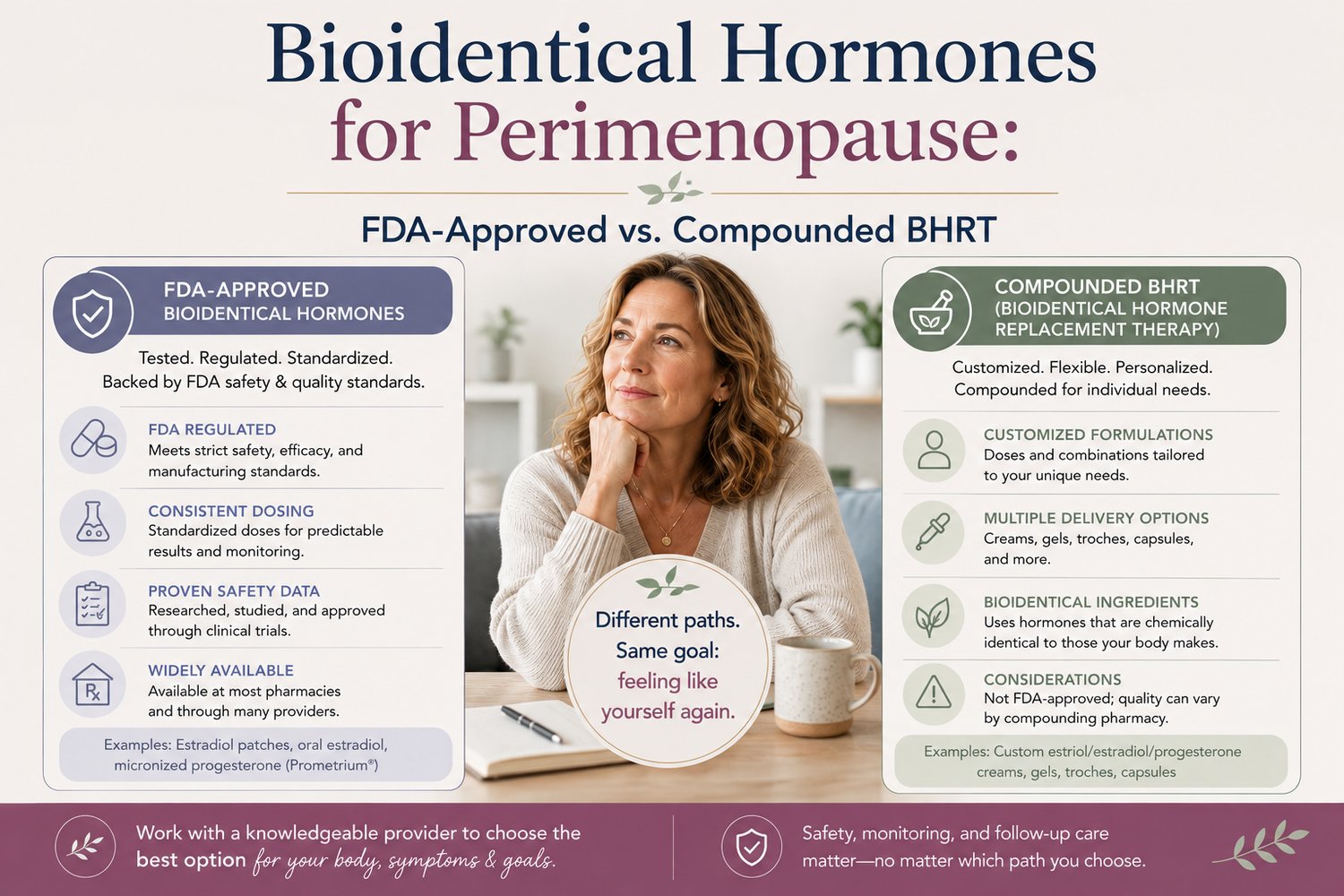
Bioidentical Hormones for Perimenopause: FDA-Approved vs. Compounded BHRT
Bioidentical hormones for perimenopause are often marketed as more natural, more personalized, or safer than conventional hormone therapy.
That framing is misleading.
The word bioidentical does not mean:
- Compounded
- Safer
- More effective
- More personalized
- Better absorbed
- Free of hormone-therapy risks
It simply refers to hormones that are chemically and molecularly identical to hormones produced by the human body.
And here's the part menopause marketing often leaves out:
FDA-approved bioidentical hormone therapies already exist.
Estradiol and micronized progesterone are examples.
Custom-compounded bioidentical hormone therapy, often shortened to compounded BHRT, is a different category. Compounded medications can have legitimate uses, but they are not FDA-approved, and major medical organizations do not consider them inherently safer or more effective than approved hormone therapies. The FDA explicitly says it does not have evidence that compounded “bioidentical hormones” are safer or more effective than FDA-approved menopause hormone therapy.
So if you're considering “bioidentical HRT,” the first question shouldn't be:
“Are bioidentical hormones good?”
It should be:
“Is this an FDA-approved hormone product or a custom-compounded one?”
That distinction matters much more.
For the broader treatment picture, read Perimenopause Treatment Options: Hormonal, Nonhormonal & Lifestyle Treatments Explained.
If you're comparing hormonal and nonhormonal routes, also read HRT vs. Nonhormonal Treatments for Perimenopause: Benefits, Risks & How to Choose.
What Does “Bioidentical Hormone” Actually Mean?
A bioidentical hormone has the same chemical and molecular structure as a hormone naturally produced by the body.
Examples can include:
- Estradiol
- Progesterone
The term sounds reassuring because “identical to your body's hormones” feels intuitively safer than “synthetic hormone.”
But molecular structure alone doesn't answer questions about:
- Dose
- Route
- Safety
- Effectiveness
- Product quality
- Manufacturing consistency
- Whether the treatment is appropriate for you
Those factors matter enormously.
The Menopause Society specifically notes that many FDA-approved hormone products already meet the common definition of bioidentical and are available in multiple doses and formulations.
So:
bioidentical does not equal compounded.
That is the most important point in this entire article.
Are FDA-Approved Hormones Bioidentical?
Yes.
Some FDA-approved menopausal hormone therapies contain hormones that are identical to those naturally produced in the body.
The FDA specifically notes that approved drugs exist containing hormones identical to those naturally produced during the reproductive years.
Examples include FDA-approved formulations containing:
- Estradiol
- Micronized progesterone
These products have gone through FDA review for:
- Safety
- Effectiveness
- Quality
- Manufacturing
- Dose consistency
That doesn't make them risk-free.
It means their risks, benefits, dosing, and manufacturing standards have been formally evaluated.
What Is Compounded BHRT?
Compounded bioidentical hormone therapy is custom-prepared by a compounding pharmacy based on a prescription.
A compounded formulation may combine or customize:
- Estradiol
- Estriol
- Progesterone
- Testosterone
- Other hormones
depending on the prescription.
Compounded medications can also be prepared in different forms, including:
- Creams
- Gels
- Capsules
- Troches
- Suppositories
- Other customized dosage forms
The key regulatory distinction is:
Compounded medications are not FDA-approved products.
The FDA does not review each compounded formulation for safety, effectiveness, or manufacturing consistency before it is dispensed. The agency also notes that compounded BHRT products have often been marketed as more natural, safer, or superior without strong evidence supporting those claims.
Why Does Compounding Exist?
Because sometimes standardized commercial products don't meet a patient's needs.
Compounding can have a legitimate role when someone needs something such as:
- A dosage form that isn't commercially available
- A formulation without a specific inactive ingredient
- A specific strength unavailable in an approved product
- Another clinically justified customized preparation
That's what makes the conversation more nuanced than:
“Compounded hormones are bad.”
They're not automatically bad.
The problem is when compounding is marketed as inherently better than FDA-approved therapy without a specific medical reason.
Compounding should solve an actual treatment problem.
It should not simply function as luxury branding for hormones.
Are Compounded Bioidentical Hormones Safer?
There is no good evidence that they are inherently safer.
The FDA says it does not have evidence showing compounded “bioidentical” hormones are safe and effective or safer or more effective than FDA-approved menopause hormone therapy.
The Menopause Society similarly states that custom-compounded hormones have not been shown to be safer or more effective than approved bioidentical hormone products.
This matters because “bioidentical” marketing can create a false contrast:
Compounded bioidentical hormones = natural
versus
FDA-approved hormone therapy = synthetic
That is not an accurate way to compare them.
FDA-approved estradiol can be bioidentical too.
Are Compounded Hormones More Effective?
Again, there isn't strong evidence showing that custom-compounded BHRT works better than FDA-approved hormone therapy.
The National Academies reviewed compounded bioidentical hormone therapy for the FDA and concluded that rigorous evidence supporting its safety and effectiveness was lacking, with much of the available support coming from lower-quality evidence such as patient reports, anecdotes, and prescriber testimony.
That doesn't prove a particular compounded prescription cannot work.
It means claims such as:
“Compounded hormones work better because they're customized to you”
go beyond the evidence.
What Does “Personalized Hormone Therapy” Really Mean?
This phrase sounds persuasive.
But all competent medical treatment should already be personalized.
A clinician prescribing FDA-approved hormone therapy can individualize:
- Whether you should use hormone therapy
- Which hormone
- Whether you need progesterone
- Oral vs. transdermal delivery
- Dose
- Timing
- Symptom targets
- Follow-up
- Treatment duration
The Menopause Society notes that commercially available FDA-approved hormone therapies already come in multiple formulations and doses, allowing treatment to be individualized without requiring custom compounding.
So:
personalized treatment does not require a personalized pharmacy mixture.
Those are different concepts.
FDA-Approved Estradiol vs. Compounded Estradiol
Both may contain estradiol.
The molecule itself may be the same.
The difference is the product and regulatory pathway.
FDA-Approved Estradiol
Has undergone FDA evaluation for:
- Dose
- Quality
- Manufacturing consistency
- Safety
- Effectiveness
- Labeling
Compounded Estradiol
Is prepared for an individual prescription by a compounding pharmacy.
The finished compounded product itself has not undergone the same FDA approval process.
That's why saying:
“They're both estradiol, so they're basically identical.”
misses the important part.
The active ingredient may be chemically identical.
The evidence and quality-control pathway are not.
What About Micronized Progesterone?
Micronized progesterone is another good example of why “bioidentical” does not mean compounded.
FDA-approved micronized progesterone products exist.
Progesterone may be used alongside systemic estrogen in women with a uterus to protect the uterine lining.
That protection matters.
The Menopause Society specifically warns that unreliable progesterone exposure in a compounded regimen could leave the endometrium inadequately protected.
This is not just a theoretical labeling debate.
Dose consistency can have real clinical consequences.
Why Does Endometrial Protection Matter?
If someone with an intact uterus uses systemic estrogen, the uterine lining can be stimulated.
Without adequate progestogen protection, this can increase the risk of:
- Endometrial hyperplasia
- Endometrial cancer
That's why a hormone regimen needs to be medically sound—not merely “customized.”
If a compounded progesterone product delivers an inconsistent or inadequate amount, the issue isn't that compounding is philosophically wrong.
The issue is that the uterus may not be adequately protected.
That's a meaningful safety problem.
What About Estriol?
Estriol often appears in compounded BHRT formulas and is sometimes marketed as a gentler or safer estrogen.
The FDA says it does not have evidence that estriol-containing drugs are safe and effective or that estriol is a “safer form of estrogen.”
There are currently no FDA-approved estriol drugs in the United States; marketed estriol products are compounded.
That doesn't mean estriol has zero biological activity or can never be prescribed in a compounded formulation.
It means claims that estriol is inherently safer should not be accepted simply because a clinic says so.
What Is Bi-Est or Tri-Est?
You may encounter compounded products marketed as:
- Bi-Est
- Tri-Est
These typically combine multiple forms of estrogen.
For example, a formulation might include estradiol and estriol in a particular ratio.
The appeal is usually framed as:
“This mixture more closely matches your natural hormones.”
But a customized hormone ratio isn't automatically clinically superior.
The important questions are:
- Why is this combination being used?
- What evidence supports the specific formulation?
- Is an FDA-approved option available?
- How is appropriate dosing determined?
- How will safety and effectiveness be monitored?
A complicated formulation isn't automatically a better formulation.
What About Testosterone in Compounded BHRT?
Testosterone is sometimes included in menopause BHRT packages for complaints such as:
- Low libido
- Fatigue
- Brain fog
- Low motivation
- Weight gain
- Reduced muscle
That is a much broader use than current evidence supports.
Testosterone therapy in women has a much narrower evidence base, particularly around carefully diagnosed hypoactive sexual desire disorder (HSDD) in postmenopausal women.
It should not automatically be treated as a general midlife wellness hormone.
And this area remains active and unsettled enough that the FDA has scheduled a September 17, 2026 public workshop specifically to examine testosterone use in menopausal women, including evidence gaps in sexual function, cognition, mood, musculoskeletal health, and long-term safety.
That is not the landscape of a universally established anti-aging treatment.
Is Testosterone FDA-Approved for Menopause Symptoms in Women?
There is currently no FDA-approved testosterone product specifically indicated for treating menopause symptoms in women in the United States.
That does not mean clinicians never prescribe testosterone.
Off-label prescribing exists.
But off-label treatment and FDA-approved treatment are not the same thing.
And:
“not FDA-approved”
doesn't automatically mean:
“wrong.”
It means the evidence, regulatory status, dosing, and monitoring deserve a more careful discussion.
What About Saliva Testing for Hormone Dosing?
This is one of the most common marketing claims around compounded BHRT.
A clinic may collect saliva or blood hormone measurements and say it will create a formula precisely matched to your current hormone levels.
That sounds extremely scientific.
The problem is that perimenopause hormone levels fluctuate substantially.
One measurement does not create a stable blueprint for the next several months of ovarian function.
The broader treatment goal is usually:
control symptoms safely
not:
recreate one laboratory number from your reproductive years.
Routine customization based on repeated saliva testing has not been shown to make compounded hormone therapy safer or more effective than approved treatment.
Do You Need Hormone Testing Before Starting HRT?
Often, no.
For otherwise healthy women over 45 with typical perimenopause symptoms and menstrual changes, perimenopause is usually identified clinically rather than through routine hormone testing.
Hormone levels can fluctuate considerably.
Testing can still be useful in specific situations, including:
- Symptoms at a younger age
- Diagnostic uncertainty
- Suspicion of another medical condition
- Certain treatment questions
But testing should answer a real clinical question.
“Optimize the numbers” is not automatically one.
What About Urine Hormone Testing?
Some wellness clinics offer extensive urine hormone panels marketed as ways to:
- Map estrogen metabolism
- Customize BHRT
- Optimize hormone pathways
- Identify hormone imbalance
These tests can measure real compounds.
That doesn't automatically mean the results improve treatment decisions.
A laboratory test can be analytically interesting without being clinically necessary.
Before paying for complex hormone testing, ask:
What treatment decision will change based on this result?
If nobody can answer that clearly, the test may be generating information rather than useful care.
Is “Natural” Hormone Therapy Safer?
No treatment becomes safer because its marketing uses the word natural.
The FDA specifically warns consumers that natural does not automatically mean safe.
Estradiol can produce real biological effects.
Progesterone can produce real biological effects.
Testosterone can produce real biological effects.
That's why these medications can be useful.
It's also why they can have:
- Benefits
- Side effects
- Contraindications
- Drug interactions
- Long-term risks
A hormone doesn't become harmless because its structure resembles something your body naturally makes.
Your body naturally makes insulin too.
Dose still matters.
Does FDA Approval Mean a Hormone Is Completely Safe?
No.
This distinction matters just as much.
FDA approval means a product has been evaluated for safety, effectiveness, quality, dosing, and manufacturing for an approved use.
It does not mean:
- No side effects
- No contraindications
- No serious risks
- Appropriate for everyone
Systemic hormone therapy can still carry risks involving:
- Blood clots
- Stroke
- Breast cancer with certain regimens and durations
- Gallbladder disease
- Endometrial cancer if estrogen is inadequately opposed in someone with a uterus
The FDA updated menopausal hormone-therapy labeling in February 2026, including removing cardiovascular disease, breast-cancer and probable-dementia statements from boxed warnings on the first six updated products. That change reflects more nuanced risk information; it does not mean systemic hormone therapy suddenly became risk-free.
The point is not:
FDA-approved = perfectly safe.
It's:
FDA-approved = formally evaluated and standardized in a way compounded finished products are not.
Why Did Hormone Therapy Warnings Change in 2026?
Hormone therapy has carried broad warnings dating back to interpretations of older studies such as the Women's Health Initiative.
Over time, evidence has shown that risk depends heavily on:
- Age
- Time since menopause
- Hormone type
- Whether estrogen is used alone or with a progestogen
- Route
- Dose
- Medical history
In February 2026, FDA approved labeling changes for the first six menopausal hormone-therapy products that removed certain cardiovascular, breast-cancer, and probable-dementia statements from boxed warnings.
The Menopause Society continues to emphasize individualized assessment and notes that systemic hormone-therapy risks tend to be lower in younger, healthier women initiating treatment closer to the menopause transition.
This matters because both extremes are wrong:
“HRT is extremely dangerous.”
and
“HRT risks were fake all along.”
Neither is a serious interpretation.
Why Are Compounded Hormones Still Popular?
Several reasons.
“Natural” Sounds Better
Marketing matters.
Personalized Care Is Appealing
People understandably want treatment designed around them.
Traditional Menopause Care Has Often Been Poor
Many women genuinely have had symptoms dismissed or received little useful guidance.
That creates demand for clinics willing to spend time discussing menopause.
Telehealth Is Convenient
Online care can make treatment easier to access.
Hormone Therapy Itself Can Be Effective
When someone improves after starting a compounded hormone regimen, that improvement may be very real.
The problem is assuming the improvement proves:
compounding itself was superior.
If estradiol improves hot flashes, estradiol is doing something biologically meaningful.
That doesn't show an FDA-approved estradiol patch could not have worked too.
Does Feeling Better Prove Compounded BHRT Is Better?
No.
This is another important reasoning trap.
Suppose someone has severe hot flashes.
They begin compounded estradiol and progesterone.
Their hot flashes improve dramatically.
That tells us hormone therapy probably helped.
It does not demonstrate that:
- Compounding was necessary
- The exact customized ratio was superior
- Saliva testing improved treatment
- FDA-approved estradiol wouldn't have worked
- The formulation is safer
A positive outcome can establish that a treatment helped without proving every marketing claim surrounding that treatment.
Are Pellets Better Than Patches or Pills?
Hormone pellets are another treatment format sometimes marketed as convenient, personalized, and long lasting.
Pellets are implanted under the skin and release hormones over time.
One practical limitation is obvious:
once implanted, you cannot simply remove tomorrow's dose.
If the dose is too high or side effects develop, treatment cannot necessarily be adjusted as easily as stopping a pill or removing a patch.
This doesn't mean pellets are inherently dangerous.
It means the route has different practical tradeoffs.
Claims that pellets are automatically superior because they provide “steady hormones” deserve the same scrutiny as any other marketing claim.
Compounded Hormones vs. FDA-Approved HRT: The Real Comparison
Let's simplify the distinction.
FDA-Approved Hormone Therapy
Advantages:
- Evaluated for safety and effectiveness
- Standardized dose
- Manufacturing oversight
- Established prescribing information
- Multiple estradiol and progesterone options
- Multiple routes and doses
Limitations:
- Not every conceivable formulation exists
- Some patients may have intolerance to specific ingredients
- Insurance and cost vary
Compounded BHRT
Potential advantages:
- Can create a dosage form not commercially available
- Can omit certain ingredients
- Can provide individualized formulations when medically necessary
Limitations:
- Finished compounded products aren't FDA-approved
- Less rigorous evidence for safety and effectiveness
- Greater uncertainty around dose consistency and absorption
- Often marketed using claims stronger than the evidence
That is a much more useful comparison than:
natural vs. synthetic.
When Might Compounded Hormones Actually Make Sense?
A legitimate example might involve someone who cannot use available commercial products because of:
- A specific allergy
- A needed dosage form that isn't available
- A clinically necessary formulation unavailable commercially
Then compounding can solve an actual medical problem.
A weaker reason is:
“The clinic only prescribes compounded hormones.”
That isn't individualized medicine.
That's a business model.
Questions to Ask Before Using Compounded BHRT
If you're considering a compounded product, ask:
- Which exact hormones are in it?
- What dose am I receiving?
- Why is this formulation being recommended?
- Is an FDA-approved alternative available?
- If so, why isn't that being used?
- How will symptoms be monitored?
- How will endometrial protection be ensured if I have a uterus?
- Are hormone levels actually necessary for treatment decisions?
- What evidence supports this specific formulation?
- Which pharmacy compounds it?
- What side effects should I watch for?
- What happens if the dose is too high or too low?
If a provider becomes defensive when you ask those questions, that's useful information too.
Red Flags in BHRT Marketing
Be cautious when a clinic promises:
- Perfect hormone balance
- Anti-aging benefits
- Guaranteed weight loss
- Brain-fog reversal
- Dementia prevention
- Cardiovascular protection
- Improved energy for everyone
- Testosterone optimization for all women
- Customized treatment entirely from saliva testing
- Hormones with none of the risks of conventional HRT
- Compounded hormones that are safer because they're “natural”
A treatment can be legitimate while the marketing around it is not.
Hormone therapy is real medicine.
It doesn't need miracle claims.
What If You Specifically Want Bioidentical Hormones?
That's perfectly reasonable.
Ask your clinician about FDA-approved bioidentical options first.
You may be able to use:
- FDA-approved estradiol
- FDA-approved micronized progesterone
depending on your symptoms and medical needs.
If an approved formulation can meet your needs, you may get the molecular characteristics you're looking for without moving into custom compounding.
The Menopause Society specifically notes that FDA-approved bioidentical products are already commercially available in multiple doses.
What If You Prefer Compounded BHRT Anyway?
You are allowed to have preferences.
The goal of evidence-based care isn't to remove patient choice.
It's to make sure the choice is informed.
Understand that:
- The product isn't FDA-approved
- Claims of superior safety aren't established
- Claims of superior effectiveness aren't established
- Dose consistency may be less predictable
- There may still be legitimate individual reasons to use it
Then discuss those tradeoffs with a qualified clinician.
Informed preference is different from marketing-driven assumption.
Considering Strut Health for BHRT?
Affiliate disclosure: HabitLogics may earn a commission if you use this link, at no additional cost to you.
Strut uses an online medical questionnaire reviewed by a U.S. physician and describes its prescription offerings as physician-prescribed and pharmacy-compounded. Its site also explicitly states that compounded drug products are not FDA-approved or evaluated by the FDA for safety, effectiveness, or quality.
That transparency is useful.
But the same question still applies:
Why compounded treatment rather than an FDA-approved hormone product?
If a Strut clinician recommends compounded BHRT, ask what specific reason makes that option appropriate for you.
That is not being difficult.
That's an informed medical question.
Does Telehealth Change the Evidence Standard?
No.
Telehealth changes:
- Convenience
- Geography
- Scheduling
- Access
It should not change:
- Appropriate medical screening
- Contraindication review
- Treatment evidence
- Risk discussions
- Follow-up
- Medication transparency
An online provider should be held to the same core standard as an in-person clinic.
What If Your Doctor Won't Discuss Hormone Therapy?
This is one reason telehealth and menopause specialists have become popular.
Some clinicians are very comfortable treating menopause.
Others aren't.
If your symptoms are being dismissed or you're not getting useful answers, reasonable options include:
- Asking for a referral
- Seeing a clinician with menopause expertise
- Getting a second opinion
- Using a reputable telehealth menopause service
You deserve an informed treatment discussion.
You do not automatically need compounded BHRT to get one.
Do You Need a Menopause Specialist?
Not necessarily.
Many:
- Primary-care clinicians
- OB-GYNs
- Nurse practitioners
- Other qualified clinicians
can competently manage perimenopause.
For more complex situations, a clinician with deeper menopause expertise may be especially useful.
Examples include:
- Significant contraindications
- Complex bleeding
- Cancer history
- Severe symptoms
- Unusual age at symptom onset
- Complicated treatment history
The quality of the evaluation matters more than the clinic's branding.
Frequently Asked Questions
What are bioidentical hormones?
Bioidentical hormones have the same chemical and molecular structure as hormones naturally produced by the human body.
The term does not automatically mean the medication is compounded.
Are bioidentical hormones FDA-approved?
Some are.
FDA-approved products containing bioidentical estradiol and progesterone are available.
Custom-compounded bioidentical hormone products themselves are not FDA-approved.
Are compounded bioidentical hormones safer than regular HRT?
There is no strong evidence that compounded BHRT is safer or more effective than FDA-approved menopause hormone therapy. The FDA specifically says it lacks evidence supporting those superiority claims.
Is bioidentical HRT more natural?
“Bioidentical” refers to molecular structure.
It doesn't establish safety or effectiveness.
FDA-approved estradiol can be just as bioidentical at the molecular level as compounded estradiol.
Is estradiol bioidentical?
Yes.
Estradiol is the primary estrogen produced during the reproductive years, and FDA-approved estradiol products exist.
Is micronized progesterone bioidentical?
Yes.
Micronized progesterone has the same molecular structure as naturally occurring progesterone, and FDA-approved products are available.
Is estriol FDA-approved?
No FDA-approved estriol drug is currently available in the United States. FDA says it does not have evidence that estriol-containing compounded drugs are safer forms of estrogen.
Are Bi-Est and Tri-Est FDA-approved?
Custom compounded Bi-Est and Tri-Est formulations are not FDA-approved products.
They combine different estrogens in customized ratios.
Do I need saliva testing for bioidentical hormones?
Routine saliva testing has not been shown to make compounded BHRT safer or more effective.
Hormone levels fluctuate during perimenopause, limiting the usefulness of trying to “balance” treatment around a single measurement.
Are hormone pellets bioidentical?
They may contain bioidentical hormones depending on the formulation.
That doesn't automatically establish that the pellet route is safer or more effective than FDA-approved alternatives.
Why do doctors prescribe compounded hormones?
Legitimate reasons can include a needed dosage form, strength, or ingredient profile unavailable in commercially approved products.
Compounding can serve a real medical role.
Is compounded BHRT bad?
Not automatically.
The important issue is whether there is a good medical reason to use a compounded formulation and whether the patient understands the additional uncertainty compared with FDA-approved products.
Can you get bioidentical hormones without using compounded BHRT?
Yes.
FDA-approved estradiol and micronized progesterone options are available.
Does FDA approval mean HRT has no risks?
No.
FDA-approved hormone therapy still has risks, contraindications, and side effects.
Approval means the product has undergone formal evaluation for safety, effectiveness, quality, and manufacturing—not that it is universally safe.
Key Takeaways
- Bioidentical hormones for perimenopause are not automatically the same thing as compounded BHRT.
- “Bioidentical” describes molecular structure—not regulatory status, safety, or effectiveness.
- FDA-approved bioidentical estradiol and progesterone products already exist.
- Compounded hormone products are not FDA-approved.
- FDA does not have evidence that compounded bioidentical hormone therapy is safer or more effective than approved menopause hormone therapy.
- Compounding has legitimate medical uses when commercially available products cannot meet an individual's needs.
- “Personalized hormone therapy” does not inherently require custom compounding.
- Estriol is not an FDA-approved menopause hormone drug in the United States.
- Routine saliva testing has not established an advantage for customizing menopause hormone therapy.
- Compounded progesterone dosing matters because inadequate endometrial protection can carry real risk.
- Testosterone should not automatically be bundled into menopause therapy for vague wellness goals.
- FDA-approved treatment is not risk-free; it is more formally studied and standardized.
- In February 2026, FDA approved important labeling changes to menopausal hormone-therapy products, reflecting a more individualized understanding of systemic HT risk.
- If a provider recommends compounded BHRT, asking why an FDA-approved alternative isn't being used is a reasonable and useful question.
Continue Learning
For the broader treatment roadmap, read Perimenopause Treatment Options: Hormonal, Nonhormonal & Lifestyle Treatments Explained.
If you're comparing treatment routes, read HRT vs. Nonhormonal Treatments for Perimenopause: Benefits, Risks & How to Choose.
For a deeper look at standard menopausal hormone therapy, read Hormone Therapy for Perimenopause: Benefits, Risks, Types & Who It May Help.
Or return to the Complete Perimenopause Guide.
Affiliate Disclosure
HabitLogics may earn a commission from qualifying services purchased through affiliate links in this article, including Strut Health, at no additional cost to you. Affiliate relationships do not change how FDA-approved and compounded therapies are evaluated.
Educational Disclaimer
This article is intended for educational purposes only and is not medical advice, diagnosis, or individualized treatment guidance. Hormone therapy has potential benefits, risks, contraindications, and side effects that vary by patient and formulation. Compounded prescriptions can have legitimate medical uses but are not FDA-approved products. Discuss hormone treatment decisions with a qualified healthcare professional.