

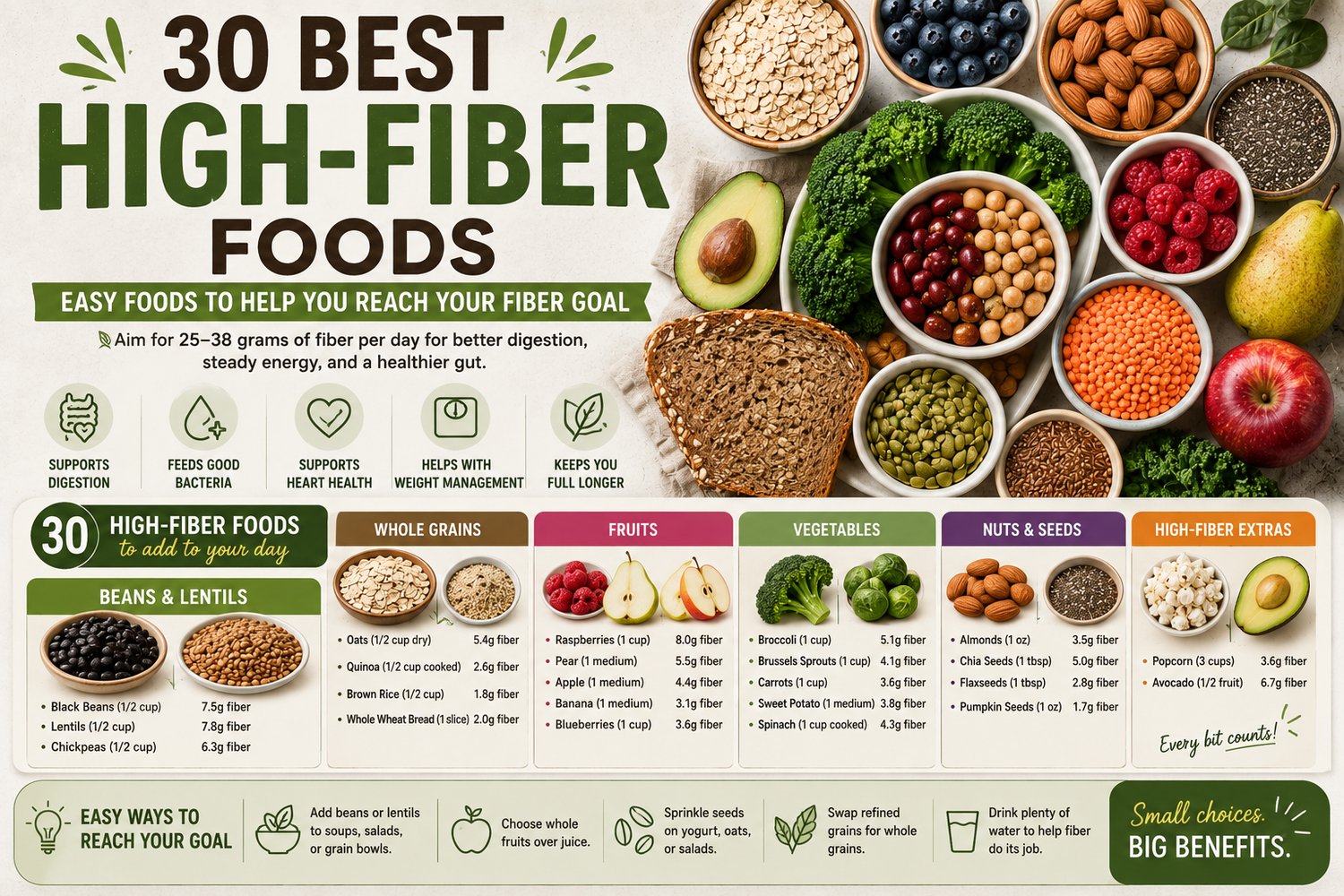
30 Best High-Fiber Foods: Easy Foods to Help You Reach Your Fiber Goal
Complete Fiber & Gut Health Guide Hub
Knowing you need more fiber is easy.
Actually getting enough every day?
That's where people get stuck.
You may know that vegetables contain fiber.
You eat some broccoli with dinner.
Maybe an apple during the afternoon.
Then you check your intake and somehow you're still nowhere near your target.
The problem usually isn't that you need to eat an enormous salad.
You need to understand which foods actually contribute meaningful amounts of fiber and spread several of them across the day.
The FDA's Daily Value for dietary fiber is 28 grams per day on a 2,000-calorie diet.
More individualized targets can differ by age, sex and calorie intake, which we covered in How Much Fiber Do You Need Per Day? A Practical Guide for Men & Women.
The good news?
You have an enormous number of options.
Fiber-rich foods include:
- Beans
- Lentils
- Whole grains
- Fruit
- Vegetables
- Nuts
- Seeds
USDA's current Dietary Guidelines fiber tables contain foods from all of these categories, including lentils, beans, raspberries, pears and seeds among particularly useful sources.
So you do not need to live on bran cereal.
You don't need a fiber supplement at every meal.
And you don't have to make every food you eat high in fiber.
You simply need enough fiber-rich foods appearing throughout your normal diet.
If you're starting from the beginning, read Fiber for Gut Health: Why It Matters & What It Actually Does first.
Now let's build the grocery list.
The Best High-Fiber Foods Usually Have Something Else Going for Them Too
One reason I prefer a food-first approach to fiber is that fiber-rich foods rarely provide only fiber.
Beans also provide:
- Protein
- Iron
- Potassium
- Folate
Fruit provides:
- Vitamins
- Minerals
- Water
- Plant compounds
Whole grains provide:
- Carbohydrates
- Vitamins and minerals
- Different fiber types
Nuts and seeds provide:
- Healthy fats
- Protein
- Minerals
This matters because the goal isn't simply:
Get 28 grams onto a nutrition tracker.
The goal is improving the overall quality and variety of what you eat.
Fiber is one excellent marker of that.
How Much Fiber Makes a Food “High Fiber”?
The Nutrition Facts label gives you a simple shortcut.
The FDA considers:
5% Daily Value or less of a nutrient per serving low.
20% Daily Value or more high.
Because the fiber Daily Value is 28 grams:
- 2 grams = about 7% DV
- 3 grams = about 11%
- 4 grams = about 14%
- 5 grams = about 18%
- 6 grams = about 21%
So once a serving gets into the 5–6+ gram range, it is making a very meaningful contribution to your day.
But don't dismiss foods with 2–4 grams.
Eat several of those across meals and they add up quickly.
Fiber Amounts Vary
One warning before we start:
The exact fiber content of a food depends on:
- Variety
- Serving size
- Preparation
- Brand
- Whether skins are included
- How the food is processed
USDA FoodData Central maintains nutrient information from multiple food-data sources, and specific values can vary between entries.
So think of the amounts below as practical approximations, not laboratory guarantees.
If you need exact numbers for a packaged food, use its Nutrition Facts label.
1. Lentils
Lentils are one of the easiest ways to move a low-fiber meal into high-fiber territory.
They provide:
- Fiber
- Plant protein
- Carbohydrates
- Iron
- Folate
USDA's fiber guidance specifically highlights lentils among high-fiber food sources.
Use lentils in:
- Soup
- Chili
- Grain bowls
- Curry
- Salads
- Taco filling
You can even mix lentils with ground meat.
Instead of:
100% ground beef
try:
ground beef + lentils.
More fiber.
More food volume.
Very little change to the basic meal.
2. Black Beans
Black beans are another fiber workhorse.
They're easy to add to:
- Tacos
- Burritos
- Rice bowls
- Chili
- Salads
- Eggs
And canned beans are perfectly fine.
You don't need to soak dried beans overnight to qualify for good nutrition.
Drain.
Rinse if desired.
Eat.
Beans are especially useful because they're simultaneously a fiber source and a protein source.
3. Navy Beans
Navy beans are among the fiber-rich foods highlighted in USDA dietary guidance.
They're excellent in:
- Soups
- Bean bowls
- White chili
- Side dishes
If your current legume rotation consists entirely of black beans, changing the bean occasionally is also an easy way to increase plant variety.
4. Chickpeas
Chickpeas—or garbanzo beans—are extremely versatile.
Use them:
- Roasted
- In salads
- In bowls
- In soups
- Mashed into sandwiches
- As hummus
Hummus isn't quite as fiber-dense per typical serving as eating a large portion of whole chickpeas, but it still gives you another way to work legumes into your week.
5. Split Peas
Split pea soup may not have a glamorous wellness brand behind it.
It doesn't need one.
Split peas provide a substantial amount of dietary fiber along with plant protein.
Soup is also an easy format for combining multiple fiber sources:
split peas + carrots + celery + onions
One meal.
Several plants.
Lots of fiber.
6. Raspberries
Fruit is not always incredibly high in fiber.
Raspberries are an exception.
USDA specifically highlights raspberries among notable fruit sources of fiber.
They're easy to add to:
- Greek yogurt
- Oatmeal
- Smoothies
- Cottage cheese
- Cereal
This makes berries particularly useful at breakfast, which is often one of the lowest-fiber meals of the day.
7. Blackberries
Blackberries are another fiber-rich berry.
USDA FoodData Central's recent data inventory specifically includes total dietary fiber measurements for blackberries.
Like raspberries, they're useful because you can increase fiber without really changing the structure of your meal.
Already eat yogurt?
Add berries.
Already eat oatmeal?
Add berries.
That's how sustainable nutrition improvements happen.
8. Pears
Pears are surprisingly useful for fiber.
USDA's Dietary Guidelines fiber list specifically includes pears among meaningful fruit sources.
They're also incredibly easy.
No cooking.
No recipe.
No supplement.
Wash.
Eat.
Keeping the edible skin provides additional fiber.
9. Apples
Apples are not the highest-fiber food on this list.
They're here because they're practical.
An apple:
- Travels easily
- Requires no preparation
- Stores well
- Pairs with protein or healthy fat
Try:
Apple + Greek yogurt
or:
Apple + peanut butter
instead of trying to invent a specialized high-fiber snack every afternoon.
10. Oranges
Whole oranges provide fiber along with vitamin C and water.
USDA includes oranges among fruit sources contributing dietary fiber.
Important distinction:
Whole orange
Contains meaningful fiber.
Orange juice
Much of that fiber is removed.
Juice isn't forbidden.
It's simply not nutritionally identical to the whole fruit.
11. Avocado
Avocado is unusual because it combines:
- Fiber
- Mostly unsaturated fat
- Potassium
- Other nutrients
USDA FoodData Central tracks avocado specifically as a meaningful total-fiber food.
Add it to:
- Eggs
- Toast
- Tacos
- Bowls
- Sandwiches
- Salads
The one caveat is calories.
Avocado is nutritious and relatively calorie-dense.
Healthy doesn't mean portions no longer matter.
12. Bananas
Bananas aren't the highest-fiber fruit available.
But they're cheap, portable and easy to eat.
USDA includes bananas among fruits contributing dietary fiber.
Pair one with:
- Greek yogurt
- Peanut butter
- Cottage cheese
and you've got a simple snack containing fiber plus protein.
Not every food needs to be the fiber champion.
13. Artichokes
Artichokes are one of the more fiber-dense vegetables and appear prominently in USDA's fiber food lists.
They're less convenient than grabbing an apple, obviously.
But canned or jarred artichoke hearts can make them much easier to use.
Add them to:
- Salads
- Pasta
- Grain bowls
- Eggs
- Pizza
Yes.
Pizza can contain a high-fiber vegetable.
Nutrition doesn't stop because you enjoy your food.
14. Green Peas
Peas are an underrated fiber source.
They're also:
- Cheap
- Frozen easily
- Quick to prepare
- Kid-friendly for many families
Add peas to:
- Rice
- Pasta
- Soup
- Potatoes
- Casseroles
Frozen vegetables absolutely count.
You don't receive extra nutritional credit because your peas came from a farmer's market.
15. Broccoli
Broccoli isn't going to single-handedly get you to 30 grams of fiber.
That's fine.
It contributes several grams depending on the serving and provides a range of nutrients alongside fiber.
The advantage is how easily it pairs with ordinary meals:
Chicken + potatoes + broccoli
Beef + rice + broccoli
Salmon + grain + broccoli
You don't need a separate “gut-health dinner.”
Just add plants to meals you already eat.
16. Brussels Sprouts
Brussels sprouts provide fiber along with a range of micronutrients and plant compounds.
Roast them.
Air fry them.
Add them to a sheet-pan dinner.
And no, gut health does not require boiling them until your entire house smells like 1987.
17. Carrots
Carrots provide a mixture of fiber types and are incredibly versatile.
Use them:
- Raw
- Roasted
- Steamed
- In soup
- In stir-fry
- With hummus
If raw vegetables create digestive discomfort, cooked vegetables are still vegetables.
You do not need to suffer through raw carrots because somebody told you raw food is more “gut healthy.”
18. Sweet Potatoes
Sweet potatoes provide:
- Fiber
- Potassium
- Beta-carotene
- Carbohydrates
Keep the edible skin when you enjoy it for additional fiber.
Try:
sweet potato + chicken + black beans
and suddenly one basic meal is carrying a significant portion of your daily fiber goal.
19. Regular Potatoes
Yes.
Regular potatoes.
They are plants.
They contain fiber.
Especially when the skin is eaten.
Potatoes don't stop being nutritious because somebody once served them as French fries.
Preparation matters.
A baked potato can fit beautifully into a high-fiber diet.
20. Oats
Oats are one of my favorite fiber foods because they're:
- Cheap
- Convenient
- Easy to customize
- Useful at breakfast
They contain beta-glucan, a soluble fiber that has been extensively studied for its cholesterol-lowering properties.
Plant foods such as oat cereals are recognized as useful sources of soluble fiber.
Build oatmeal with:
- Berries
- Chia
- Flax
- Nuts
and you can turn one simple breakfast into a serious fiber contributor.
21. Barley
Barley is criminally ignored.
It provides both soluble and insoluble fiber and can work in:
- Soup
- Grain bowls
- Side dishes
- Salads
Oregon State University's fiber review identifies barley among notable insoluble-fiber sources while plant foods generally contain mixtures of soluble and insoluble fibers.
Try swapping barley for rice occasionally.
That's plant variety without needing an entirely new recipe.
22. Whole-Wheat Bread
Whole-grain bread can be an easy fiber upgrade.
But don't trust the color of the bread.
Brown bread isn't automatically high fiber.
Read the label.
Compare:
- Fiber per serving
- Serving size
A bread containing several grams per serving can contribute meaningfully when you use two slices.
And because bread is something many people already eat, this is a very low-effort change.
23. Higher-Fiber Cereal
Cereal quality varies wildly.
One cereal may contain almost no fiber.
Another may contain a substantial amount.
Use the Nutrition Facts label.
And remember that the FDA considers 20% Daily Value or more per serving high.
Combine a higher-fiber cereal with:
- Milk
- Greek yogurt
- Berries
and you've got a much better breakfast than cereal alone.
24. Brown Rice
Brown rice provides more intact grain material than refined white rice and contributes fiber.
But here's something important:
You do not need to replace every grain with brown rice.
If you love white rice?
Eat white rice.
Add:
- Beans
- Vegetables
- Avocado
The fiber content of the entire meal matters more than proving loyalty to a specific grain.
25. Quinoa
Quinoa provides:
- Fiber
- Carbohydrate
- Protein
- Minerals
It's useful in:
- Grain bowls
- Salads
- Side dishes
And it's an easy way to rotate grains rather than eating rice every single day.
Variety matters more than turning quinoa into another superfood.
26. Chia Seeds
Chia seeds pack a lot of fiber into a small serving.
USDA fiber resources specifically identify seeds as an important high-fiber category, and FoodData Central maintains detailed total-fiber data for chia.
Use them in:
- Yogurt
- Oatmeal
- Smoothies
- Chia pudding
Start reasonably.
If you rarely eat fiber, dumping half a cup of chia into breakfast is not the gradual increase your digestive system was hoping for.
27. Ground Flaxseed
Flax provides:
- Fiber
- Alpha-linolenic acid
- Other plant compounds
Ground flax is generally easier to incorporate into foods than whole flaxseed.
Try:
- 1–2 tablespoons in oatmeal
- Yogurt
- Smoothies
Again, small additions can move your fiber intake noticeably.
28. Almonds
Almonds contribute:
- Fiber
- Protein
- Unsaturated fat
- Magnesium
They're especially practical as a snack.
But nuts are calorie-dense, so think:
reasonable serving
rather than:
unlimited because healthy.
A handful alongside fruit can create a satisfying fiber-containing snack.
29. Pistachios
Pistachios provide fiber along with:
- Plant protein
- Healthy fats
- Potassium
- Other nutrients
The shells can also slow you down when eating them.
That's sometimes helpful.
Unless you buy them pre-shelled and discover that pistachios apparently have no natural stopping point.
30. Popcorn
Yes.
Popcorn.
Popcorn is a whole grain.
That means it can contribute fiber.
The nutritional problem usually isn't the popcorn itself.
It's what sometimes gets added to it.
Air-popped or lightly seasoned popcorn can be a surprisingly useful high-volume, fiber-containing snack.
You do not need to snack on celery forever.
Honorable Mentions
Thirty foods sounds like a lot until you realize how many plant foods contribute fiber.
Other good options include:
- Edamame
- Lima beans
- Kidney beans
- Figs
- Kiwi
- Prunes
- Pumpkin
- Corn
- Cauliflower
- Green beans
- Pecans
- Peanuts
- Whole-grain pasta
- Bran cereal
The point isn't identifying the single best fiber food.
It's realizing you have options.
Which Foods Give You the Most Fiber for the Least Effort?
If your fiber intake is currently low, I'd prioritize five categories.
Beans and Lentils
Probably the easiest way to add a large amount quickly.
Berries
Excellent breakfast addition.
Oats
Cheap and convenient.
Chia or Flax
Easy to add to foods you already eat.
Fruit
Portable and requires almost no preparation.
Start there.
You don't need an exotic grocery list.
The Easiest Way to Build a High-Fiber Breakfast
Try this:
Oatmeal
Whole-grain fiber.
Raspberries
Fruit fiber.
Chia
Seed fiber.
Greek Yogurt
Protein.
Now you have:
fiber + protein + several plants
without eating an enormous breakfast.
If your current breakfast is:
Coffee + toast
this one change alone can move your daily fiber intake substantially.
Another Easy High-Fiber Breakfast
Try:
Eggs
Protein.
Whole-grain toast
Fiber.
Avocado
Fiber + healthy fat.
Fruit
More fiber.
No oatmeal required.
Fiber-rich eating doesn't require one specific breakfast.
Build a High-Fiber Lunch
Use this formula:
Protein + whole grain + legume + vegetable
For example:
Chicken.
Brown rice.
Black beans.
Peppers.
Salsa.
Suddenly you have a bowl containing several fiber sources.
And it still looks like normal food.
Build a High-Fiber Dinner
Try:
Salmon
Protein.
Potato with skin
Fiber + carbohydrate.
Broccoli
More fiber.
Lentils
Even more fiber + plant protein.
You don't need every component.
The point is layering two or three plant foods into a normal dinner.
High-Fiber Snacks Are Easier Than You Think
Instead of trying to invent a “fiber snack,” combine ordinary foods.
Apple + Almonds
Pear + Greek Yogurt
Berries + Cottage Cheese
Popcorn
Carrots + Hummus
Whole-Grain Toast + Peanut Butter
Fiber doesn't need its own product category.
The Protein + Fiber Combination Is Hard to Beat
One useful meal-building principle is:
Where's the protein?
and
Where's the fiber?
Examples:
Greek yogurt + berries
Protein + fiber.
Eggs + whole-grain toast
Protein + fiber.
Chicken + beans
Protein + fiber.
Salmon + vegetables + potato
Protein + fiber.
Lentils + Greek yogurt sauce
Protein + fiber.
This tends to produce meals that are satisfying and nutritionally well rounded.
For deeper protein guidance, you can use the Complete High-Protein Guide.
High-Fiber Doesn't Have to Mean Low-Calorie
This is important if your goal includes weight management.
Foods such as:
- Nuts
- Seeds
- Avocado
provide fiber.
They also provide significant calories.
That's perfectly fine.
But don't assume:
High fiber = unlimited portions.
A high-fiber diet can support fullness, but total calorie intake still matters.
Choose portions that fit your goals.
Beans Are Particularly Useful During Weight Loss
Legumes deserve extra attention because they combine:
- Fiber
- Protein
- Food volume
That can make meals very satisfying.
Try stretching:
Taco meat
with black beans.
Soup
with lentils.
Rice bowls
with chickpeas.
You're adding fiber without needing a separate side dish.
High Fiber Doesn't Mean You Need to Stop Eating Low-Fiber Foods
This is where people turn healthy eating into unnecessary restriction.
Eggs have essentially no fiber.
Still nutritious.
Chicken has no fiber.
Still useful.
Greek yogurt has little or no fiber.
Still excellent for protein.
Fish?
No fiber.
You don't need to remove these foods.
Pair them with fiber.
For example:
Eggs + whole-grain toast + fruit
instead of deciding eggs aren't “gut healthy.”
Different foods have different jobs.
White Rice Can Still Fit
Here's another example.
White rice is relatively low in fiber.
You don't need to ban it.
Try:
White rice.
Black beans.
Peppers.
Corn.
Avocado.
Now the meal has plenty of fiber even though the rice itself doesn't.
Nutrition is easier when you stop demanding every ingredient provide every nutrient.
Frozen Fruits and Vegetables Count
Absolutely.
Frozen:
- Berries
- Broccoli
- Peas
- Mixed vegetables
can be extremely convenient.
And convenience matters because the vegetable sitting in your freezer that you actually eat is more useful than the beautiful fresh kale decomposing in your produce drawer.
Use what works.
Canned Beans Count
Also yes.
Canned beans may be one of the easiest high-fiber convenience foods available.
Keep:
- Black beans
- Chickpeas
- Kidney beans
- Cannellini beans
in the pantry.
Now almost any:
- Salad
- Bowl
- Soup
- Taco meal
can get an instant fiber upgrade.
Canned and Frozen Foods Aren't “Bad for the Microbiome”
Food processing exists on a spectrum.
Canned beans and frozen berries are processed foods.
So is whole-grain bread.
That doesn't make them nutritionally equivalent to candy or chips.
Focus on what the food actually provides.
This is a much more useful framework than:
Processed = bad.
Should You Eat the Skin?
When the skin is edible and you enjoy it, keeping it can increase fiber.
Examples:
- Apples
- Pears
- Potatoes
But don't turn this into another rule.
If eating potato skin ruins the meal for you?
Peel the potato.
Then eat fiber somewhere else.
Consistency matters more than squeezing the final gram out of every food.
Smoothies Can Contain Plenty of Fiber
If you're blending the entire fruit or vegetable, much of the fiber remains.
That's different from juicing, where much of the fibrous material is removed.
A smoothie containing:
- Berries
- Chia
- Oats
can contribute substantial fiber.
Add:
- Greek yogurt
- Protein powder
- Milk
if you want more protein.
Don't Accidentally Triple Your Fiber Overnight
Now that you've got a list of 30 foods, don't eat all of them tomorrow.
MedlinePlus warns that increasing dietary fiber too quickly can cause gas, bloating and cramps, and NIDDK similarly recommends adding fiber a little at a time so the body can adjust.
If your current intake is low:
Add:
one or two fiber-rich foods
then adjust.
Not:
Beans + chia + lentils + bran + fiber powder + giant salad
on day one.
Your digestive system does not need a team-building exercise.
More Gas Doesn't Automatically Mean the Food Is Bad for You
Some fibers reach the large intestine, where intestinal microbes ferment them.
Gas can be produced during this process.
That means a food causing some increased gas—especially when newly introduced—doesn't necessarily indicate:
- Allergy
- Intolerance
- “Bad gut bacteria”
- A damaged microbiome
The dose and speed of increase matter.
Persistent or severe symptoms are different and may deserve evaluation.
Use Portions to Build Tolerance
Suppose beans make you uncomfortable.
Instead of deciding:
I can't eat beans.
try:
Week 1
¼ cup.
Week 2
⅓ cup.
Week 3
½ cup.
See what happens.
Some people tolerate smaller portions much better.
And you don't need a giant serving to benefit.
Hydration Matters Too
NIDDK lists inadequate fluid intake alongside low fiber and low physical activity among factors that can contribute to constipation.
So if you're deliberately increasing fiber:
Pay attention to fluids too.
You don't need to force gallons of water.
Just avoid:
high fiber + chronically poor hydration.
What If High-Fiber Foods Make You Bloated?
First look at:
- How quickly you increased fiber
- Which foods you added
- Portion sizes
- Whether you're constipated
- Whether one food repeatedly causes the problem
Don't immediately eliminate:
- Gluten
- Dairy
- Beans
- Vegetables
- Whole grains
all at once.
Change one variable.
Track the response.
If symptoms are persistent or disruptive, the Bloating, Digestion & Food Trigger Tracker can help you organize:
- Meals
- Fiber
- Timing
- Bloating
- Bowel habits
- Other symptoms
The tracker isn't meant to diagnose a gastrointestinal disorder.
It's meant to help you identify useful patterns.
Fiber Variety Matters Too
Remember our earlier discussion of the Gut Microbiome.
Different fiber-rich foods contain different:
- Fiber structures
- Resistant carbohydrates
- Polyphenols
- Micronutrients
Plant foods also generally contain mixtures of soluble and insoluble fiber rather than one isolated type.
That means the goal shouldn't be:
Find the one best fiber food and eat it every day forever.
Rotate.
Beans today.
Lentils tomorrow.
Raspberries.
Oats.
Broccoli.
Barley.
Different foods solve the same fiber problem in different ways.
Try to Get Fiber From Several Categories
Instead of thinking about 30 individual foods, use five groups.
Legumes
Beans, lentils, peas.
Whole Grains
Oats, barley, whole-grain bread, brown rice, quinoa.
Fruit
Berries, pears, apples, oranges.
Vegetables
Broccoli, peas, carrots, potatoes.
Nuts and Seeds
Chia, flax, almonds, pistachios.
If several groups appear during your day, you're probably building a pretty solid fiber pattern.
A Simple High-Fiber Grocery List
If you're overwhelmed by 30 choices, buy:
- Oats
- Raspberries
- Apples
- Black beans
- Lentils
- Whole-grain bread
- Broccoli
- Potatoes
- Chia
- Almonds
That's enough to start.
Next week, rotate in different foods.
Gut health doesn't require buying the produce department.
What About Fiber Supplements?
Fiber supplements can absolutely help.
But if your diet currently has very few:
- Fruits
- Vegetables
- Legumes
- Whole grains
- Nuts
- Seeds
I'd work on the food foundation first.
A fiber powder gives you fiber.
It doesn't automatically give you the:
- Plant variety
- Vitamins
- Minerals
- Polyphenols
- Food structure
that come with whole foods.
Use supplements as tools.
Not replacements for food.
How to Reach 25 Grams of Fiber With Real Food
Here's one example.
Breakfast
Oatmeal + berries
Lunch
Whole-grain sandwich + vegetables
Snack
Apple
Dinner
Potato + broccoli + beans
Depending on portions, you're now around a very reasonable daily fiber intake.
No supplement required.
How to Reach Around 30 Grams
Try:
Breakfast
Oats + raspberries + chia
Lunch
Chicken + black beans + vegetables
Snack
Pear
Dinner
Potato + broccoli
Now you've got:
- Whole grain
- Fruit
- Seeds
- Legumes
- Vegetables
That diversity is more interesting than simply hitting “30.”
Want to Make Reaching Your Goal Easier?
This is where planning helps.
The High-Fiber Meal Builder & 30-Day Fiber Tracker is specifically designed to help you:
- Set a daily fiber target
- Build fiber-rich meals
- Track intake
- See your consistency over 30 days
Instead of trying to remember:
Did I eat enough fiber today?
you can actually see the pattern.
Want the Meals Already Planned?
If your bigger problem is:
I know what foods contain fiber. I don't know what to make with them.
the High-Fiber Meal Plan & Recipe System provides:
- A 28-day meal plan
- Recipes
- Grocery lists
- Planning tools
- An Excel dashboard
That's the better fit if you want the implementation done for you rather than simply tracking grams.
Start Free if You're Not Sure Yet
You can also begin with the FREE 7-Day Fiber & Gut Health Kickstart.
Use it to establish:
- Your current fiber intake
- Your plant variety
- A few easy dietary changes
Then decide whether you actually need a more structured system.
Frequently Asked Questions
What foods are highest in fiber?
Some of the strongest food-based fiber sources include:
- Beans
- Lentils
- Split peas
- Raspberries
- Pears
- Artichokes
- Whole grains
- Chia seeds
- Flaxseed
USDA dietary guidance highlights legumes, certain fruits, vegetables and seeds among the most useful fiber sources.
What is the easiest food to eat for more fiber?
There isn't one best choice.
For convenience, I'd prioritize:
- Fruit
- Canned beans
- Oats
- Berries
- Chia or flax
- Higher-fiber bread
Those require very little additional cooking.
What fruit has a lot of fiber?
Raspberries, blackberries and pears are especially useful choices. USDA specifically identifies raspberries and pears among high-fiber fruit options.
What vegetables are high in fiber?
Useful options include:
- Artichokes
- Peas
- Broccoli
- Brussels sprouts
- Carrots
- Potatoes
- Sweet potatoes
USDA's current fiber tables include artichokes and several other vegetables among meaningful fiber sources.
Are beans high in fiber?
Yes.
Beans, peas and lentils are among the most useful fiber-rich food groups and also provide plant protein and other nutrients.
Are bananas high in fiber?
Bananas contain fiber but aren't among the absolute highest-fiber fruits.
They're still useful because they're inexpensive, portable and easy to include regularly.
You don't need every food you eat to be the highest-fiber option available.
Are potatoes high in fiber?
Potatoes provide dietary fiber, particularly when the skin is eaten.
They can absolutely fit into a high-fiber dietary pattern.
Pairing potatoes with legumes and vegetables makes the entire meal much more fiber-rich.
Is oatmeal high in fiber?
Oats provide dietary fiber, including beta-glucan soluble fiber.
Adding berries, chia, flax or nuts can substantially increase the fiber content of oatmeal.
Is popcorn a high-fiber snack?
Popcorn is a whole grain and provides dietary fiber.
Portion size and preparation influence its overall nutrition.
Lightly seasoned popcorn can be a practical fiber-containing snack.
How can I get 30 grams of fiber per day?
Instead of relying on one food, spread fiber throughout the day:
- Whole grain at breakfast
- Beans or lentils at lunch
- Fruit for a snack
- Vegetables and another plant food at dinner
- Nuts or seeds where convenient
For your specific daily target, use How Much Fiber Do You Need Per Day?.
Key Takeaways
- The FDA Daily Value for dietary fiber is 28 grams per day on a 2,000-calorie diet.
- High-fiber foods include legumes, whole grains, fruit, vegetables, nuts and seeds.
- Beans and lentils are especially efficient because they provide both fiber and plant protein.
- Raspberries, pears and other whole fruits make fiber easier to add without cooking.
- Oats, barley and higher-fiber whole-grain products can make breakfast and lunch significantly more fiber-rich.
- Vegetables contribute fiber, but you don't need to rely on vegetables alone.
- Chia and flax can add meaningful fiber in relatively small portions.
- Frozen vegetables, frozen fruit and canned beans absolutely count.
- Fiber-rich foods generally contain mixtures of soluble and insoluble fiber.
- You do not need every food in your diet to contain fiber.
- Pair low-fiber protein foods with fiber-rich plant foods.
- Increase fiber gradually because rapid increases can cause gas, bloating and cramping.
- Food variety matters in addition to the total number of fiber grams.
- A practical high-fiber diet can be built from inexpensive, ordinary grocery-store foods.
Final Thoughts
The best high-fiber food is probably not the one with the absolute highest number.
It's the one you'll actually eat regularly.
Maybe that's:
Beans.
Oatmeal.
Raspberries.
Apples.
Potatoes.
Chia.
Whole-grain bread.
Broccoli.
You don't need all 30 foods every week.
Pick:
five or six easy ones.
Build them into meals you already eat.
Then add variety over time.
That's much more sustainable than buying a refrigerator full of unfamiliar vegetables because you've decided Monday is the beginning of your new fiber lifestyle.
Your fiber target shouldn't require a separate diet.
It should gradually become part of the diet you already have.
Continue the Fiber & Gut Health Series
Already published:
- What Is Gut Health? A Beginner’s Guide to Your Microbiome, Digestion & Everyday Habits
- What Is the Gut Microbiome? How Your Gut Bacteria Affect Digestion & Health
- How to Improve Gut Health Naturally: 10 Habits That Actually Matter
- Fiber for Gut Health: Why It Matters & What It Actually Does
- How Much Fiber Do You Need Per Day? A Practical Guide for Men & Women
Coming next in the series:
How to Increase Fiber Without Bloating, Gas or Digestive Discomfort
Then we'll move into:
High-Fiber Breakfast Ideas
High-Fiber Snacks
How to Build a High-Fiber Meal
Useful HabitLogics resources:
- FREE 7-Day Fiber & Gut Health Kickstart
- High-Fiber Meal Builder & 30-Day Fiber Tracker
- High-Fiber Meal Plan & Recipe System
Educational Disclaimer
This article is intended for educational purposes only and should not be considered individualized medical or nutrition advice. Fiber needs and tolerance vary, especially for people with gastrointestinal disorders, bowel narrowing, chronic constipation, or other medical conditions. Increase fiber gradually, and seek medical evaluation for persistent, severe, or otherwise concerning gastrointestinal symptoms.