

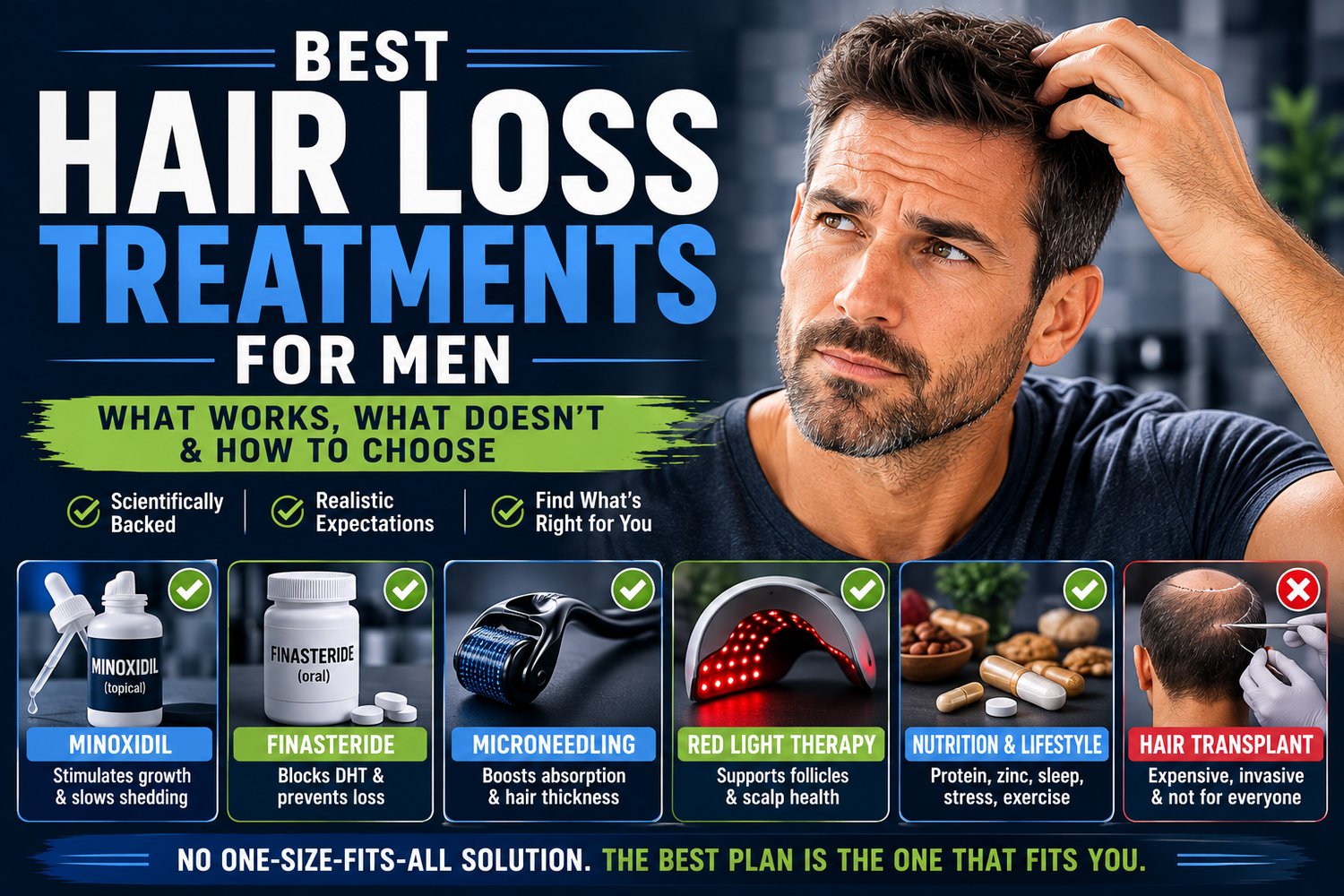
Best Hair Loss Treatments for Men: What Works, What Doesn't & How to Choose
Men have no shortage of hair-loss products.
Shampoos.
Gummies.
Serums.
Laser helmets.
Supplements.
Microneedling rollers.
DHT blockers.
Prescription medications.
Hair transplants.
Online clinics.
The hard part isn't finding something to buy.
It's figuring out:
Which treatments actually have meaningful evidence?
Which type of hair loss do they treat?
What risks and tradeoffs come with them?
And:
Which treatment makes sense for your stage of hair loss?
For ordinary male pattern baldness, also called androgenetic alopecia, the treatment landscape is actually much clearer than the marketing makes it seem.
The strongest foundation remains:
Finasteride
Topical minoxidil
or:
A combination of the two
For more advanced hair loss, hair transplantation can restore selected areas that medication may no longer be able to meaningfully regrow.
Other approaches—including:
- Low-level laser therapy
- PRP
- Microneedling
- Dutasteride
- Cosmetic fibers
- Scalp micropigmentation
- Hair systems
can also have roles.
But they don't all belong in the same evidence tier.
If you haven't already, start with:
Those explain what you're treating before we decide how to treat it.
First: Make Sure It's Actually Male Pattern Baldness
This is the part product pages often skip.
Hair loss can result from:
- Male pattern baldness
- Telogen effluvium
- Alopecia areata
- Thyroid disease
- Nutritional deficiencies
- Medication effects
- Major illness
- Rapid weight loss
- Scalp inflammation
- Scarring alopecia
- Other medical conditions
Those don't all respond to the same treatment.
Putting minoxidil on every kind of hair loss is like taking the same medication for every kind of headache.
Sometimes it fits.
Sometimes it doesn't.
Get evaluated rather than assuming ordinary male pattern baldness if hair loss is:
- Sudden
- Patchy
- Painful
- Rapidly progressing
- Associated with redness
- Associated with significant scaling
- Scarring
- Affecting your eyebrows or beard unexpectedly
Treatment starts with diagnosis.
The Best Treatments for Male Pattern Baldness: Quick Ranking
If we're talking specifically about typical androgenetic alopecia in men, I'd broadly organize the options like this.
Tier 1 — Established Medical Foundation
Finasteride
Topical minoxidil
Finasteride + minoxidil
These are where most men who genuinely want to preserve their hair should begin the treatment discussion.
Tier 2 — Strong Options for Specific Situations
Hair transplantation
Off-label oral minoxidil
Off-label dutasteride
These can be very useful, but they involve either:
- Surgery
- Greater systemic exposure
- Off-label prescribing
- Additional medical considerations
They aren't automatically the first step.
Tier 3 — Potential Adjuncts
- Low-level laser therapy
- Platelet-rich plasma
- Microneedling
These may add benefit in some treatment plans.
I'd generally view them on top of or alongside the established medical foundation rather than as the obvious first choice for ordinary male pattern baldness.
Tier 4 — Cosmetic Solutions
- Hair fibers
- Scalp micropigmentation
- Hair systems
These don't stop androgenetic alopecia.
But they can produce meaningful cosmetic improvement.
And if appearance is the goal, that still counts.
Tier 5 — Weak Primary Strategy
- Hair gummies
- Generic “DHT-blocking” supplements
- Miracle shampoos
- Oils marketed as medication replacements
Some may improve hair quality or correct a genuine deficiency.
They're generally poor substitutes for treatments aimed at the actual biology of male pattern baldness.
The Most Important Goal Is Usually Preservation
Men understandably focus on regrowth.
But with progressive male pattern baldness, the more important goal is often:
Keep the hair you still have.
Why?
Because medication generally works better on:
miniaturized but still viable follicles
than on:
areas that have been smooth and bald for years.
Earlier treatment gives you more hair to preserve.
So instead of asking only:
“What grows the most hair?”
ask:
“What gives me the best chance of slowing future loss?”
That changes the treatment discussion substantially.
Treatment #1: Finasteride
If we're ranking treatments specifically for male pattern baldness, finasteride belongs near the top.
Finasteride inhibits 5-alpha reductase, reducing conversion of testosterone into dihydrotestosterone, or DHT.
DHT is a major driver of follicle miniaturization in genetically susceptible men.
So finasteride directly targets a central mechanism of androgenetic alopecia.
That makes it especially useful when the goal is:
Preserve existing hair and slow progression.
For the direct comparison with minoxidil, read Minoxidil vs Finasteride.
Why Finasteride Is Such an Important Treatment
Male pattern baldness is largely a combination of:
genetics + androgen sensitivity + DHT
Finasteride can't change your genetics.
But it can reduce DHT exposure.
That may help miniaturized follicles remain productive longer.
Some men also experience:
- Increased density
- Thicker hair
- Partial regrowth
But preservation is often the biggest win.
The Finasteride Tradeoff
Finasteride is prescription medication.
Potential adverse effects can include:
- Reduced libido
- Erectile difficulty
- Ejaculatory changes
- Other sexual symptoms
- Mood-related concerns in some patients
That does not mean every man taking finasteride develops problems.
It also doesn't mean side effects should be dismissed.
The useful question is:
Are the likely hair-preservation benefits worth the possible risks for me?
That's an individual medical and quality-of-life decision.
Oral vs Topical Finasteride
This distinction matters.
Oral finasteride is FDA-approved for male pattern hair loss.
Compounded topical finasteride is increasingly offered through dermatology and telehealth services.
But FDA states that there is currently:
No FDA-approved topical finasteride formulation in the United States.
FDA has also warned that compounded topical finasteride can be absorbed through the skin into systemic circulation and has been associated with adverse-event reports.
So don't assume:
Topical = no systemic exposure
or:
Topical = risk-free finasteride.
It isn't that simple.
Strut's Topical Finasteride Hair-Loss Formula
Strut currently offers a compounded topical prescription formula for men.
Its formula may contain:
- Finasteride
- Minoxidil
- Tretinoin
- Fluocinolone
- Biotin
with the specific ingredients and strengths selected by the prescribing clinician.
That can be attractive if you're interested in:
- A topical prescription approach
- DHT reduction
- Growth stimulation
- Potentially combining finasteride and minoxidil in one application
But keep the regulatory distinction clear:
This is a compounded topical prescription treatment, not an FDA-approved topical finasteride product.
Explore Strut's Finasteride Hair Loss Formula →
HabitLogics may earn a commission if you purchase through this link, at no additional cost to you.
Treatment #2: Topical Minoxidil
Topical minoxidil is the easiest evidence-based treatment for many men to start.
It is:
- Available over the counter
- Widely sold
- Available generically
- Nonprescription
Unlike finasteride, minoxidil does not primarily work by reducing DHT.
Instead, it supports follicle activity and the hair-growth cycle.
Potential benefits include:
- Improved density
- Stronger miniaturized hair
- Some regrowth
- Slower visible thinning in responsive men
Its major advantage is accessibility.
Its major disadvantage is:
You have to keep applying it.
Minoxidil Requires Consistency
Topical minoxidil is not:
Apply for two months → permanently fix your hair.
Benefits generally depend on continued treatment.
Some men dislike:
- Scalp residue
- Waiting for it to dry
- Itching
- Irritation
- Daily application
That matters.
A treatment you abandon because you hate using it isn't a good long-term treatment for you.
Treatment #3: Finasteride + Minoxidil
For a man who strongly wants to preserve his hair and can appropriately use both medications, this combination is difficult to ignore.
Why?
Because the treatments attack different parts of the problem.
Finasteride
Reduces DHT-driven miniaturization.
Minoxidil
Supports follicle activity and growth.
Think:
Protect + stimulate.
That's why the “minoxidil vs finasteride” debate can be misleading.
For some men the better answer isn't:
one or the other.
It's:
both.
Combination Treatment Doesn't Mean Everyone Needs Two Drugs
No.
Some men have mild hair loss and are comfortable with one treatment.
Others don't want finasteride.
Others won't consistently apply minoxidil.
More treatment also means:
- More cost
- More complexity
- More potential adverse effects
The best regimen is the least complicated treatment plan that reasonably matches your goals.
Strut's Combination Approach
Strut's men's hair-loss lineup currently includes compounded formulations that combine DHT-targeting and growth-stimulating medications.
Its topical finasteride formula may contain both:
Finasteride + minoxidil
alongside other clinician-selected ingredients.
Strut also currently offers compounded oral hair-loss capsules combining finasteride and oral minoxidil, among other ingredients.
Those oral combination products introduce the additional systemic considerations of oral minoxidil, so I would not treat them as equivalent to ordinary topical minoxidil plus oral finasteride.
The exact formulation matters.
Exploring Online Men's Hair-Loss Treatment?
If your hair loss follows the typical male pattern and you're ready to discuss prescription treatment, Strut currently offers several men's hair-loss options through online clinician review.
Explore Strut Men's Hair Loss Options →
Medication-specific options:
Strut Finasteride Hair Loss Formula →
Strut Oral Minoxidil Tablets →
HabitLogics may earn a commission if you use these links and purchase treatment, at no additional cost to you.
Treatment #4: Oral Minoxidil
Low-dose oral minoxidil has become increasingly common in hair-loss treatment.
But it is not simply:
“Minoxidil without the annoying foam.”
Oral minoxidil creates systemic drug exposure.
The medication was originally developed to treat high blood pressure.
When prescribed for hair loss, oral minoxidil is used off-label.
That means clinicians need to consider factors such as:
- Cardiovascular history
- Blood pressure
- Other medications
- Fluid retention
- Heart-rate effects
- Other systemic risks
It's a legitimate treatment option.
It's just a different medical decision from topical minoxidil.
Strut Oral Minoxidil
Strut currently offers prescription oral minoxidil specifically through its men's hair-loss service and clearly identifies hair-loss use as off-label. Its current page lists a 1.25 mg daily option.
Explore Strut Oral Minoxidil Tablets →
This option may be worth discussing if:
- Topical application is difficult
- You haven't tolerated topical treatment
- A clinician thinks oral therapy fits your medical history
- You understand the systemic risks
Don't switch simply because pills feel easier.
Treatment #5: Hair Transplant Surgery
Medication tries to:
Preserve and strengthen follicles.
Hair transplantation:
Moves follicles.
Hair is generally harvested from donor areas around the sides and back of the scalp where follicles are more resistant to androgen-driven miniaturization.
Those follicles are relocated into areas such as:
- Hairline
- Temples
- Frontal scalp
- Crown
For appropriate candidates, the cosmetic improvement can be dramatic.
Hair Transplants Don't Create New Hair
A surgeon cannot manufacture additional follicles.
You have a finite donor supply.
That makes long-term planning extremely important.
A transplant strategy needs to consider:
- Donor density
- Current hair loss
- Likely future progression
- Hair caliber
- Age
- Desired hairline
- Previous procedures
This is why an aggressively low teenage-style hairline isn't always the smartest long-term choice for a young man with progressive baldness.
FUE vs FUT
Two major transplant approaches are commonly discussed.
FUE — Follicular Unit Extraction
Individual follicular units are extracted from the donor region.
Advantages can include:
- No long linear donor scar
- Greater flexibility with shorter hairstyles
Tradeoffs include:
- Cost
- Procedure time
- Donor management
FUT — Follicular Unit Transplantation
A strip of donor scalp is removed and follicles are dissected from it.
The major tradeoff is:
A linear donor scar.
Neither technique is automatically superior.
Surgeon skill and long-term planning matter enormously.
A Hair Transplant Doesn't Stop Balding
This point is critical.
Transplanted follicles may remain resistant.
Your surrounding native hair can continue miniaturizing.
Imagine restoring the frontal hairline at 28.
Then doing nothing about ongoing androgenetic alopecia.
Ten years later, you could have:
transplanted frontal hair + a progressively balding region behind it.
That's why medical stabilization often remains relevant even after surgery.
Treatment #6: Dutasteride
Dutasteride is another 5-alpha-reductase inhibitor.
It suppresses DHT more broadly than finasteride.
That makes it biologically attractive for male pattern hair loss.
In the United States, however, hair-loss use is generally off-label.
Some dermatologists use dutasteride for selected men—particularly when finasteride response is inadequate.
Strut's current men's hair-loss lineup also includes compounded dutasteride options.
But:
Stronger DHT suppression ≠ automatically better first-line treatment for everybody.
Treatment #7: Low-Level Laser Therapy
Laser caps and helmets sound like pure wellness marketing.
They're not completely made up.
Some low-level laser devices have FDA clearance for hereditary hair loss.
There is research showing improvements in hair density in some users.
But I'd still put laser therapy below finasteride and minoxidil for ordinary male pattern baldness because:
- Evidence is less established
- Device quality varies
- Cost can be substantial
- Long-term commitment is required
Think:
Possible adjunct
rather than:
Obvious first treatment.
Treatment #8: PRP
Platelet-rich plasma involves:
- Drawing blood.
- Concentrating platelet-rich plasma.
- Injecting it into the scalp.
The theory is that platelet-associated growth factors may support follicle activity.
Research suggests possible benefit in androgenetic alopecia.
But PRP has a major practical weakness:
It's poorly standardized.
Different clinics use different:
- Preparation methods
- Platelet concentrations
- Injection techniques
- Treatment schedules
- Maintenance protocols
That makes outcomes harder to compare.
And treatment can become expensive.
Where PRP Fits
I wouldn't put PRP ahead of:
- Finasteride
- Minoxidil
for the average man with male pattern baldness.
I'd consider it an adjunct for someone who:
- Already has a solid treatment foundation
- Wants another option
- Understands the cost
- Has realistic expectations
Expensive doesn't automatically mean superior.
Treatment #9: Microneedling
Microneedling uses controlled needle injury in the scalp.
It has been studied:
- Alone
- In combination with minoxidil
There is evidence suggesting potential benefit.
But internet enthusiasm sometimes turns:
“Interesting adjunct”
into:
“Attack your scalp with needles constantly.”
Don't.
Potential problems include:
- Infection
- Excessive inflammation
- Irritation
- Scarring
- Medication exposure through damaged skin
Technique and hygiene matter.
Treatment #10: Ketoconazole Shampoo
Ketoconazole shampoo is mainly used for scalp conditions such as:
- Dandruff
- Seborrheic dermatitis
It may improve scalp health and has received interest as an adjunct in androgenetic alopecia.
But don't treat it as a substitute for:
- Finasteride
- Minoxidil
If your scalp is inflamed, treating that problem makes sense.
It does not mean shampoo becomes your primary baldness medication.
Cosmetic Treatment #1: Hair Fibers
Hair fibers don't stop hair loss.
They can still be extremely useful.
Fibers attach to existing hair and can make areas of reduced density appear much fuller.
They work especially well when:
- Hair still exists
- Density is reduced
- You want immediate improvement
They can be useful:
- While medication takes effect
- For events or photographs
- Even if you decide not to pursue medical treatment
Cosmetic improvement is still improvement.
Cosmetic Treatment #2: Scalp Micropigmentation
Scalp micropigmentation uses tattoo-like pigment to mimic the appearance of:
- Hair follicles
- A shaved hairline
- Greater scalp density
It can work particularly well for men who prefer very short hairstyles.
It doesn't grow hair.
But a good cosmetic result can dramatically change appearance.
Practitioner quality matters.
Bad micropigmentation is extremely difficult to ignore.
Cosmetic Treatment #3: Hair Systems
Modern hair systems can look dramatically better than the old stereotypical toupee.
Advantages include:
- Immediate coverage
- No medication
- No surgery
- Potentially dramatic cosmetic improvement
Tradeoffs include:
- Maintenance
- Adhesive
- Replacement costs
- Styling
- Ongoing appointments
For advanced hair loss, a high-quality system can sometimes produce a better cosmetic result than chasing supplements trying to regrow follicles that are no longer realistically recoverable.
What About Biotin?
Biotin has become synonymous with hair supplements.
Actual biotin deficiency can affect hair.
That doesn't mean high-dose biotin treats ordinary androgenetic alopecia.
If you have:
genetic hairline recession + crown thinning
your primary problem isn't likely:
“Not enough hair gummies.”
High-dose biotin can also interfere with certain laboratory tests.
Correct deficiencies when they exist.
What About Hair Vitamins?
Same rule.
Hair vitamins can be useful when someone has:
- A nutritional deficiency
- Severe dietary restriction
- Other legitimate nutritional problems
They generally don't rewrite the genetic/DHT mechanism behind male pattern baldness.
Treat the condition you actually have.
What About Collagen?
Collagen provides amino acids.
That's nutrition.
Evidence that collagen supplementation reverses androgenetic alopecia is weak.
If you enjoy collagen as part of your diet:
Fine.
Don't mistake it for finasteride.
What About Saw Palmetto?
Saw palmetto is commonly marketed as a:
“Natural DHT blocker.”
Some research exists.
The evidence is substantially weaker and less predictable than the evidence for finasteride.
If your reason for choosing saw palmetto is:
“I want finasteride without taking finasteride,”
understand that you're also choosing a treatment with much less established effectiveness.
What About Rosemary Oil?
Rosemary oil has become extremely popular online.
There is limited research suggesting possible hair-growth activity.
That's not the same thing as having the evidence base of minoxidil or finasteride.
Use it as an adjunct if you want.
Don't let progressive male pattern baldness run untreated for years because TikTok convinced you an essential oil is the equivalent of established medication.
What About “DHT-Blocking” Shampoo?
This category deserves skepticism.
Shampoo can help with:
- Hair appearance
- Scalp health
- Dandruff
But brief scalp contact from a rinse-off product is not automatically equivalent to clinically meaningful DHT suppression.
If shampoo produced finasteride-level preservation with no meaningful risk:
It wouldn't be hiding in the shampoo aisle.
Best Treatment by Stage of Hair Loss
Treatment priorities change with the stage of loss.
Early Hair Loss
Primary goal:
Preserve.
Strong options to discuss:
- Finasteride
- Topical minoxidil
- Combination treatment
This is the stage where preventing future loss can be particularly valuable.
Moderate Hair Loss
Primary goal:
Preserve + improve density.
Possible strategy:
- Finasteride
- Minoxidil
- Combination treatment
- Selected adjuncts if desired
If recession has already created cosmetically significant areas, transplant planning may eventually enter the discussion.
Advanced Hair Loss
Medication may still protect remaining native hair.
But if the main goal is dramatic cosmetic restoration, realistic options may include:
- Hair transplantation
- Scalp micropigmentation
- Hair systems
At some point:
restoration
becomes a different problem from:
preservation.
Medication can't move follicles into completely bald areas.
Best Treatment if You Mostly Want to Stop Future Loss
I'd put:
Finasteride
at the center of the discussion.
That's because it directly reduces the DHT pathway driving progression.
Minoxidil can still add value.
But if the priority is:
“Stop my existing hair from disappearing.”
finasteride deserves serious consideration.
Best Treatment if You Want a Nonprescription Starting Option
Topical minoxidil.
It's:
- Established
- Widely available
- Nonprescription
- Easy to obtain
The downside is the daily topical routine.
Best Treatment if Hair Preservation Is a Major Priority
If both are medically appropriate and well tolerated:
Finasteride + minoxidil
makes the strongest biological argument.
One reduces progression.
The other supports growth.
That's why combination therapy is so common.
Best Treatment if You Hate Topicals
This is where things become more medical.
Potential prescription discussions include:
- Oral finasteride
- Off-label oral minoxidil
- Compounded oral combination treatment
But moving from topical to oral medication changes the risk profile.
Convenience should not be the only factor.
Best Treatment if You're Already Significantly Bald
If a large area has been bare for years:
Medication alone may not give you the cosmetic restoration you want.
That doesn't mean medication is useless.
It may still preserve remaining native hair.
But the restoration conversation may move toward:
- Hair transplant
- Hair system
- Scalp micropigmentation
Be realistic about what living follicles remain.
How to Track Whether Treatment Is Working
Hair changes slowly.
Don't rely on memory.
Take photographs:
- Before treatment
- In consistent lighting
- At similar hair length
- With dry hair
- From consistent angles
Useful views include:
- Front
- Left temple
- Right temple
- Top
- Crown
Then compare every few months.
Not daily.
Stability Can Be a Successful Result
This gets overlooked.
Suppose you begin treatment at 32.
Three years later your hair looks:
basically the same.
You might think:
“Nothing happened.”
But if untreated androgenetic alopecia would have continued progressing:
Not getting worse may be the treatment success.
Preservation isn't as exciting as dramatic regrowth photos.
It may be more valuable long term.
Hair-Loss Treatment Is Usually Long-Term
Male pattern baldness is genetically programmed.
Treatment generally doesn't delete that susceptibility.
It manages it.
Before starting, ask whether you're comfortable with:
- Long-term medication
- Ongoing cost
- Potential adverse effects
- Daily routines
- Follow-up
That's much more useful than asking:
“Will this work for six months?”
What to Look for in an Online Hair-Loss Provider
Telehealth can make treatment much easier to access.
Convenience is valuable.
But before signing up, confirm:
- Exactly which medication you're receiving
- The dose
- Oral vs topical
- FDA-approved vs compounded
- Whether use is off-label
- Full recurring cost
- Clinical follow-up
- How side effects are handled
- How cancellation works
The medication matters more than the branding.
Strut currently offers a wide men's hair-loss lineup including topical finasteride-based formulas, oral minoxidil, finasteride-containing compounded capsules, and dutasteride-based options.
Explore Strut Men's Hair Loss Options →
Hair Loss Doesn't Diagnose a Testosterone Problem
Because this article sits inside a broader men's hormone cluster, this is worth repeating.
Going bald doesn't prove:
- Testosterone is too high
- Testosterone is too low
- TRT caused your hair loss
- You need a hormone panel
- You have a DHT “disorder”
Male pattern baldness mainly reflects genetically susceptible follicles responding to androgen activity.
If you also have symptoms genuinely associated with testosterone deficiency, investigate that separately.
Start with Low Testosterone Symptoms.
Your hairline isn't a hormone test.
When to See a Dermatologist
Professional evaluation becomes especially useful when:
- Diagnosis is uncertain
- Hair loss is sudden
- Loss is patchy
- Scalp is painful or inflamed
- Scarring is present
- First-line treatment isn't working
- You're considering oral minoxidil
- You're considering dutasteride
- You're considering PRP
- You're considering hair transplantation
A good diagnosis can save you from spending years treating the wrong problem.
Frequently Asked Questions
What Is the Best Hair Loss Treatment for Men?
For typical male pattern baldness, oral finasteride and topical minoxidil remain two of the most established treatments.
Finasteride targets DHT-driven progression.
Minoxidil supports hair growth.
Using both can make sense for some men.
What Is the Best Treatment for Stopping Male Pattern Baldness?
Finasteride deserves particularly strong consideration because it directly reduces the DHT pathway involved in follicle miniaturization.
Treatment needs to be individualized because finasteride can cause adverse effects.
Is Minoxidil or Finasteride Better?
They solve different parts of the problem.
Finasteride is generally more directly focused on slowing progression.
Minoxidil supports growth and density.
Read Minoxidil vs Finasteride.
Can You Use Minoxidil and Finasteride Together?
Yes.
They are commonly combined because they work through different mechanisms.
Some compounded topical formulations—including Strut's—may contain both ingredients.
Is Topical Finasteride FDA Approved?
No.
FDA states there is currently no FDA-approved topical finasteride formulation in the United States. Compounded topical finasteride can also be systemically absorbed.
Does Oral Minoxidil Work for Hair Loss?
Low-dose oral minoxidil is used off-label for hair loss by clinicians.
Because it produces systemic exposure, cardiovascular and medication considerations matter.
It should be treated as a prescription medical decision rather than an easier substitute for topical foam.
Is Dutasteride Better Than Finasteride?
Dutasteride suppresses DHT more broadly.
Its use for male pattern hair loss in the U.S. is generally off-label.
Greater DHT suppression doesn't automatically make it the best first treatment for every man.
Do Hair Transplants Last?
Transplanted follicles generally come from more androgen-resistant donor areas and can remain long term.
But untreated native hair can continue thinning.
Long-term planning still matters.
Do Laser Caps Work?
Some low-level laser devices have FDA clearance and may improve hair density.
I'd generally view laser treatment as an adjunct or alternative rather than putting it ahead of finasteride or minoxidil for ordinary androgenetic alopecia.
Does PRP Work?
PRP may improve density in some patients.
Results and protocols vary substantially.
It is generally more reasonable as an adjunct than as the obvious first treatment.
Do Hair Vitamins Work?
They can help when a genuine nutritional deficiency contributes to hair loss.
They do not reliably treat genetically driven male pattern baldness when nutrition is already adequate.
Key Takeaways
- The correct hair-loss treatment depends on the diagnosis.
- For male pattern baldness, finasteride and topical minoxidil remain the core evidence-based medications.
- Finasteride targets DHT-driven follicle miniaturization.
- Minoxidil supports follicle activity and growth.
- Using both can make sense when preserving hair is a high priority.
- Earlier treatment generally gives you more existing hair to preserve.
- Oral minoxidil and dutasteride are off-label options that require additional medical consideration.
- There is no FDA-approved topical finasteride formulation in the U.S.; compounded topical finasteride can still be systemically absorbed.
- Hair transplantation can restore selected areas but does not stop future native hair loss.
- Laser therapy, PRP, and microneedling may serve as adjuncts.
- Hair fibers, scalp micropigmentation, and hair systems can provide legitimate cosmetic improvement.
- Vitamins, oils, shampoos, and “natural DHT blockers” generally have weaker evidence as primary treatments for androgenetic alopecia.
- Long-term adherence matters because male pattern baldness is a progressive condition.
Final Thoughts
There isn't a secret cure hiding behind a $79 bottle of gummies.
For ordinary male pattern baldness, the treatment hierarchy is fairly clear.
If you want to preserve the hair you still have:
Finasteride deserves serious consideration.
If you want to support growth and density:
Minoxidil deserves consideration.
If preserving your hair matters a lot and both are appropriate:
Using both may make sense.
If substantial hair is already gone:
A transplant or cosmetic solution may eventually produce more visible restoration than piling on another supplement.
Everything else belongs somewhere around that foundation.
The smartest strategy isn't:
Use every treatment.
It's:
Identify the cause → understand your stage → decide how much preserving your hair matters → choose the least complicated evidence-based treatment that fits your goals and risk tolerance.
Continue the Men's Hair Loss Series
Start with the cause:
Compare the major medications:
Explore online treatment:
For the hormone connection:
For the broader men's-health pillar:
Affiliate Disclosure
Some links in this article are affiliate links. If you use one of these links and purchase treatment, HabitLogics may earn a commission at no additional cost to you. Affiliate relationships do not determine whether a treatment is medically appropriate.
Educational Disclaimer
This article is intended for educational purposes only and should not be considered medical advice. Hair loss can result from multiple conditions, and treatment should be based on the correct diagnosis. Finasteride, oral minoxidil, dutasteride, compounded medications, PRP, laser treatments, and hair-restoration surgery all have individual risks and considerations. Compounded topical finasteride is not FDA-approved and can result in systemic exposure. Discuss prescription medication, procedural treatment, fertility concerns, or unexplained hair loss with a qualified healthcare professional or dermatologist.