

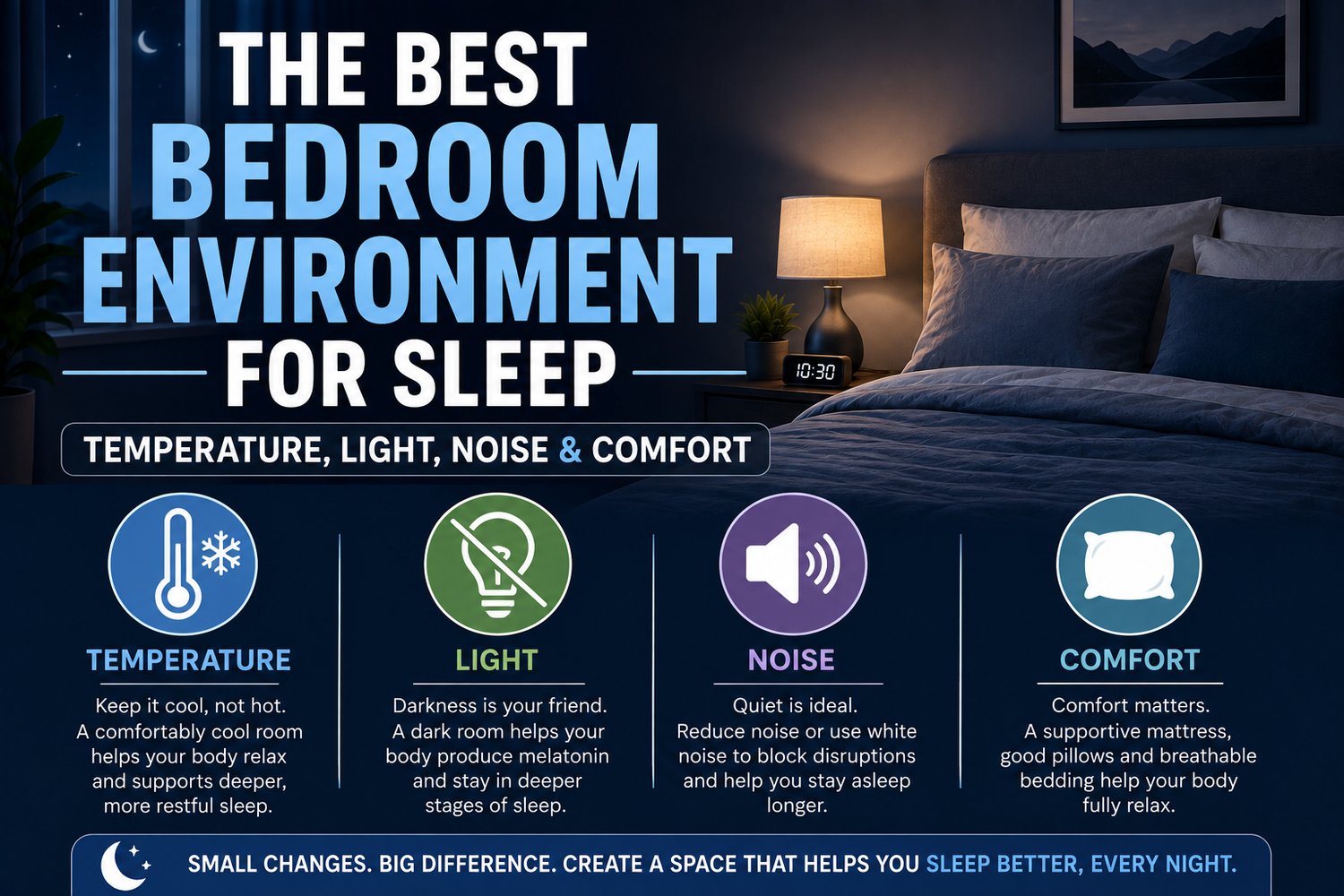
The Best Bedroom Environment for Sleep: Temperature, Light, Noise & Comfort
The Complete Sleep & Recovery Guide
You can have the perfect bedtime routine.
You can stop caffeine early.
You can exercise.
You can put your phone away.
And then lie down in a bedroom that is:
Too hot.
Too bright.
Too loud.
Uncomfortable.
At that point, your environment is working against you.
A good bedroom doesn't need to be fancy.
It just needs to remove obvious barriers to sleep.
Major sleep recommendations consistently emphasize the same basics: a bedroom that is quiet, dark, relaxing and comfortably cool. (cdc.gov)
That's the foundation.
Not a $4,000 mattress.
Not a climate-controlled bed.
Not a wall full of smart sleep gadgets.
Let's look at what actually matters.
Why Your Bedroom Environment Matters
Sleep is sensitive to your surroundings.
Light can signal wakefulness.
Noise can interrupt sleep.
Heat can make it harder to get comfortable.
An uncomfortable mattress or pillow can make it difficult to settle in.
Even if you don't fully wake, repeated disruptions can affect how continuous and refreshing your sleep feels.
As we explained in What Is Sleep Quality? How to Know If You’re Actually Sleeping Well, sleep quality is about more than total hours.
You also want your sleep to be reasonably continuous and restorative.
Your bedroom is part of that system.
The Four Biggest Bedroom Factors
For most people, the major environmental factors are:
Temperature
Light
Noise
Comfort
If those four are reasonably good, you're already covering most of what matters.
Everything else is secondary.
1. Keep the Bedroom Comfortably Cool
You’ve probably seen very specific recommendations online:
65°F is perfect.
Or:
67°F is ideal.
Or:
Never sleep above 68°F.
That level of precision is usually more confident than useful.
The better guideline is:
Keep the room comfortably cool rather than hot or stuffy.
The CDC recommends a bedroom at a comfortable, cool temperature, while NHLBI similarly recommends a cool sleep environment. (cdc.gov)
Your ideal temperature depends on things like:
- Bedding
- Clothing
- Humidity
- Airflow
- Personal preference
- Whether you share the bed
So instead of chasing a magic thermostat number, ask:
Am I waking hot?
Am I sweating?
Do I feel stuffy?
Am I tossing around trying to get comfortable?
If yes, cool the environment.
Why Temperature Affects Sleep
Your body temperature naturally changes across the sleep-wake cycle.
A cooler environment can support the normal drop in body temperature that occurs around sleep.
That doesn't mean your room should feel cold enough to make you miserable.
Comfort still matters.
If you're shivering, you've gone too far.
The goal is:
Cool enough to support sleep.
Not:
Refrigerated.
Easy Ways to Make the Room Cooler
Before buying expensive sleep technology, start cheap.
Try:
- Lowering the thermostat
- Using a fan
- Improving airflow
- Switching to lighter bedding
- Wearing lighter sleep clothing
- Removing heavy blankets
- Using breathable sheets
If those solve the problem, great.
No need to turn your mattress into a NASA cooling project.
2. Make the Room Dark
Darkness is one of the simplest environmental signals associated with nighttime.
The CDC and NHLBI both recommend keeping the bedroom dark. (cdc.gov)
Common sources of nighttime light include:
- Streetlights
- Outdoor security lights
- Hallway lights
- TVs
- Alarm clocks
- Charging indicators
- Phones
- Early sunrise
If your room is obviously bright, that's worth fixing.
Are Blackout Curtains Worth It?
Sometimes, yes.
Blackout curtains make the most sense if:
- Streetlights shine directly into the room
- You work night shift
- Sunrise wakes you earlier than intended
- Your bedroom receives a lot of outdoor light
If your room is already very dark, blackout curtains probably aren't going to transform your sleep.
This is a good example of a broader rule:
Fix the problem you actually have.
Don't buy solutions because they're on a sleep checklist.
What About an Eye Mask?
An eye mask can be a cheap, simple option if making the entire room dark is difficult.
It can be especially useful for:
- Travel
- Shift work
- Shared bedrooms
- Apartments with poor light control
- Early summer sunrises
Again, comfort matters.
If the mask annoys you all night, it's not helping.
Tiny Electronics Lights: Do They Matter?
Maybe.
But don't become ridiculous about it.
If there's a bright blue LED shining directly at your face, cover it.
If a tiny charging light across the room doesn't bother you, you probably don't need to spend 45 minutes taping over every electronic device in the house.
The goal is a generally dark environment.
Not absolute photon elimination.
3. Reduce Disruptive Noise
Noise can interfere with sleep in obvious and less obvious ways.
You may fully wake.
Or noise may create smaller disruptions that fragment sleep without leaving a clear memory.
Common sources include:
- Traffic
- Neighbors
- Dogs
- Snoring
- HVAC systems
- Trains
- Sirens
- TVs
- Household members
- Early morning activity
If noise repeatedly wakes you, address it directly.
Earplugs for Sleep
Earplugs can be useful when you can't control the source of noise.
They're particularly practical for:
- Apartment living
- Travel
- Shift work
- Snoring partners
- Street noise
The main issue is comfort.
If standard foam earplugs hurt, different shapes or materials may work better.
But if you need to hear alarms, children or emergency sounds, think carefully about how much sound reduction is appropriate.
White Noise, Fans and Background Sound
Steady background noise can help mask intermittent sounds.
Examples include:
- A fan
- White noise
- Pink noise
- Air purifier
- Steady ambient sound
This can be useful when the problem is unpredictable noise.
A constant fan may make occasional traffic less noticeable.
But you do not need a particular "frequency" of sound to unlock deeper sleep.
If simple background noise helps, use it.
If silence works better, use silence.
Is White Noise Proven to Improve Sleep?
The evidence is not strong enough to say everyone should use it.
Research on white noise and sleep has produced mixed results, and the effects likely depend on the person and the environment.
The practical view is:
White noise is a tool for masking disruptive sound.
That's different from saying:
White noise biologically improves sleep for everyone.
If it helps you block unpredictable noise, great.
If not, skip it.
4. Make the Bed Comfortable
This sounds obvious.
But comfort matters.
If your mattress or pillow causes pain, pressure or constant repositioning, sleep may suffer.
That doesn't mean everyone needs a premium mattress.
You need something that lets you lie down without repeatedly becoming uncomfortable.
Ask:
Do I wake with pain?
Am I constantly repositioning because the bed feels wrong?
Is the mattress sagging badly?
Is the pillow forcing my neck into an uncomfortable position?
Those are real problems.
Solve those before worrying about mattress marketing.
How Often Should You Replace a Mattress?
There isn't one perfect replacement schedule that applies to everyone.
Wear depends on:
- Mattress quality
- Materials
- Body weight
- Usage
- Sleeping position
- Whether the mattress is visibly sagging
- Whether you're still comfortable
Don't replace a mattress simply because a calendar says it's old.
Replace it when it is clearly no longer supporting comfortable sleep.
Does Mattress Firmness Matter?
Yes—but personal preference matters a lot.
Some people sleep better on firmer surfaces.
Others prefer softer ones.
Your sleeping position, body size and pain issues can affect what's comfortable.
The important question isn't:
What firmness is universally best?
It's:
Can I sleep comfortably without pain or constant repositioning?
That's more useful.
Pillow Choice Matters Too
Your pillow should support a comfortable head and neck position.
Side sleepers, back sleepers and stomach sleepers may have different preferences.
Again, don't overcomplicate it.
If you're waking with neck pain or constantly adjusting your pillow, that's worth addressing.
If you're comfortable, you may not need a special orthopedic sleep-engineered foam wedge shaped by aerospace scientists.
5. Keep the Bedroom Relaxing
The CDC recommends making the bedroom quiet and relaxing. (cdc.gov)
That doesn't mean the room needs to look like a spa.
But clutter, work equipment, bright lights and constant notifications can make the space feel less sleep-oriented.
If possible, make the bedroom feel like a place where the day winds down.
Simple improvements can include:
- Clearing obvious clutter
- Removing work materials from the bed
- Reducing bright lighting
- Silencing notifications
- Keeping the room visually calm
- Making the bed reasonably comfortable
Again:
This isn't interior design.
It's sleep friction reduction.
Should You Work in Bed?
Ideally, no.
Especially if you're already struggling with sleep.
Behavioral sleep treatments such as stimulus control aim to strengthen the association between bed and sleep rather than wakeful activities.
If your bed becomes:
office
movie theater
scrolling station
meal table
argument zone
and
sleep space
the association becomes less clear.
This matters most for people with insomnia.
If you can work elsewhere, do.
What About Watching TV in Bed?
Same idea.
If you sleep well and occasionally watch TV in bed, this isn't automatically a crisis.
But if you're struggling to fall asleep, spending hours awake in bed watching television may work against a strong bed-sleep association.
The question is not:
Is TV morally bad?
It's:
Is this behavior helping or hurting your sleep?
6. Control Phone Notifications
This may be one of the easiest wins.
If your phone:
Vibrates.
Lights up.
Dings.
Buzzes.
Or flashes notifications all night...
fix that.
Use:
- Do Not Disturb
- Sleep mode
- Silent mode
- Charging away from the bed
- Emergency-contact exceptions if needed
You don't need to let Instagram announce itself at 2:17 a.m.
Your sleep does not require social media updates.
7. Think About Air Quality and Ventilation
A stuffy room can feel uncomfortable.
Improving airflow can make the room feel cooler and more pleasant.
If outdoor conditions allow:
Crack a window.
Use a fan.
Run appropriate ventilation.
If you have allergies, asthma or other respiratory conditions, indoor air quality may deserve more specific attention.
But don't assume you need an expensive air purifier purely for sleep unless you have a reason.
What About Humidity?
Extremely dry or humid rooms can be uncomfortable.
Dry air may irritate the nose or throat.
High humidity can make the room feel hotter and stuffier.
The goal, again, is comfort.
You don't need to optimize humidity to the decimal point.
If the room feels obviously uncomfortable, fix that.
8. Keep Pets in Mind
This is potentially controversial. 😂
Pets can be comforting.
They can also:
Move around.
Snore.
Kick.
Take over the bed.
Wake you.
Demand to go outside.
Some people sleep perfectly well with pets.
Others don't.
Don't make a rule based on what you're "supposed" to do.
Ask:
Is my pet actually disrupting my sleep?
If yes, experiment with a different sleeping arrangement.
If no, carry on.
9. Partner Sleep Matters Too
Your bedroom environment may be shared.
That creates tradeoffs.
One person wants:
62°F
The other wants:
74°F and three blankets.
One likes white noise.
The other hates it.
One snores.
The other is considering legal action.
Shared sleep requires compromise.
Potential solutions include:
- Separate blankets
- Different pillow setups
- Earplugs
- Fans
- White noise
- Adjusting room temperature
- Addressing snoring if it is persistent or severe
And persistent loud snoring—especially with gasping or choking—can be a sign of obstructive sleep apnea and should not be dismissed as merely annoying.
10. Don't Ignore Snoring and Gasping
This is important.
A "bad bedroom environment" and an underlying sleep disorder are not the same thing.
If you or your partner experiences:
- Loud habitual snoring
- Gasping
- Choking
- Breathing pauses
- Significant daytime sleepiness
- Waking unrefreshed despite adequate sleep opportunity
talk with a healthcare professional.
No amount of blackout curtains will fix untreated sleep apnea.
Know when you've moved beyond environmental troubleshooting.
What About Aromatherapy?
Lavender and other scents are often marketed for sleep.
If you find a scent relaxing and enjoy using it, that's fine.
But scent isn't a foundational sleep requirement.
Think of aromatherapy as:
Optional comfort
not:
Core sleep treatment
If your room is too bright, too hot and too loud, fix those things first.
What About Weighted Blankets?
Some people enjoy them and find them calming.
That doesn't mean everyone sleeps better with one.
They're also warmer than standard bedding, which may be counterproductive if overheating is already a problem.
If you like the sensation:
Great.
If you don't:
Skip it.
No sleep points lost.
What About Cooling Mattresses and Bed Systems?
These can be useful for people who genuinely struggle with overheating.
But they're expensive.
So start with cheaper interventions:
- Lower thermostat
- Fan
- Lighter bedding
- Breathable sheets
- Different sleepwear
If none of those solve the problem and temperature remains a major issue, then a more expensive cooling system may be reasonable.
Don't jump directly to the $2,000 solution.
What About Sunrise Alarm Clocks?
Sunrise alarms can be useful for some people, especially when waking before natural daylight.
They gradually increase light before wake time.
But they're not required for healthy sleep.
If you wake easily and get normal daytime light, you probably don't need one.
If dark winter mornings are difficult, it may be worth experimenting with.
The Best Bedroom Environment for Shift Workers
Shift workers have a tougher job because the external environment may be screaming:
DAYTIME
while you're trying to sleep.
That makes environmental control especially important.
Useful strategies can include:
- Blackout curtains
- Eye masks
- Earplugs
- White noise
- Silencing phones
- Communicating sleep hours to household members
- Keeping the room cool
- Reducing interruptions
Protecting the sleep period becomes a major priority.
If shift-work sleepiness significantly affects functioning or safety, professional guidance may be appropriate.
A Simple Bedroom Sleep Audit
Walk into your bedroom tonight and ask:
Is it too hot?
If yes, cool it.
Is it too bright?
If yes, darken it.
Is it too noisy?
If yes, reduce or mask the noise.
Is the bed uncomfortable?
If yes, identify why.
Does my phone wake me?
If yes, silence it.
Is work happening in bed?
If possible, move it elsewhere.
Does a partner or pet repeatedly wake me?
If yes, experiment with solutions.
Am I still exhausted despite fixing obvious problems?
If yes, the issue may not be environmental.
Simple.
What Should You Fix First?
Fix the largest obvious problem.
If your room is roasting hot:
Don't buy a sleep mask.
Cool the room.
If headlights shine directly onto your pillow:
Don't buy a new mattress.
Block the light.
If your neighbor's dog barks every night:
Address the noise.
If you wake with back pain:
Look at the bed.
If everything seems fine but you still sleep terribly:
Stop endlessly modifying the room and investigate other causes.
This is the same HabitLogics approach we've used throughout the pillar:
Track → Identify → Adjust → Repeat.
Don't Build a $5,000 Sleep Cave
This is worth saying plainly.
The sleep industry is very good at convincing people they need expensive products.
You don't.
A good bedroom environment can be created with:
- Curtains
- A fan
- Comfortable bedding
- Earplugs
- A sleep mask
- Phone settings
Sometimes that's enough.
A simple room that is:
dark
quiet
cool
and
comfortable
beats a futuristic sleep chamber paired with terrible habits.
Your Bedroom Can't Compensate for a Bad Sleep Schedule
This is another important limitation.
A perfect room cannot fix:
Five hours of sleep opportunity.
Late caffeine.
Chronic insomnia.
Untreated sleep apnea.
Constant schedule changes.
Heavy alcohol use before bed.
Environment is one part of the system.
Not the whole system.
Our broader guide, Sleep Hygiene: What It Is, What Actually Works & What’s Overrated, covers the larger collection of behaviors that support healthy sleep.
Pair Environment With a Bedtime Routine
The best bedroom works even better when it's part of a repeatable evening system.
Our article on How to Build a Better Bedtime Routine for Sleep explains how to create that transition without turning bedtime into an elaborate ritual.
Think:
Day winds down
↓
Lights dim
↓
Phone goes quiet
↓
Basic routine
↓
Enter dark, cool, comfortable bedroom
↓
Sleep
That's a system.
Don't Forget the Daytime Side
Your bedroom isn't the only environment that matters.
Your daytime light, movement and schedule influence nighttime sleep too.
That's why Morning Habits for Better Sleep: Why Your Daytime Routine Matters at Night focused on:
- Wake-time consistency
- Daylight
- Physical activity
- Caffeine timing
- Naps
- Weekend schedule shifts
Sleep is a 24-hour system.
Not an eight-hour event.
Track Whether Bedroom Changes Actually Help
If you're changing your sleep environment, don't change six things at once.
Try one or two obvious improvements.
Then track:
- How long it takes to fall asleep
- Nighttime awakenings
- Morning energy
- Daytime energy
- Whether the environment felt comfortable
- Whether the problem actually improved
The FREE 7-Day Sleep Reset | Sleep & Recovery Starter Kit can help you establish a baseline before making changes.
Then you can actually compare:
Before
and
after.
That's better than assuming a purchase worked because you wanted it to.
Longer-Term Sleep Environment Tracking
If you're experimenting with several variables over time—temperature, routines, caffeine, energy and sleep consistency—the Sleep Recovery Planner | Sleep Tracker and Energy Journal gives you a structured way to track those patterns using a fillable PDF and Excel dashboard.
You may discover:
Your bedroom wasn't the main problem.
Or:
Cooling the room made a noticeable difference.
Or:
Noise was the issue.
Or:
Your environment is fine, but your schedule is inconsistent.
That's the value of tracking.
You stop guessing.
Frequently Asked Questions
What is the best bedroom environment for sleep?
A good sleep environment is generally:
- Dark
- Quiet
- Relaxing
- Comfortably cool
- Physically comfortable
These are consistent with recommendations from the CDC and NHLBI. (cdc.gov)
What is the best temperature for sleep?
There isn't one universally perfect thermostat setting.
Major sleep recommendations suggest keeping the bedroom comfortably cool. Your ideal temperature depends on bedding, clothing, humidity and personal comfort. (cdc.gov)
Is a colder bedroom better for sleep?
Cooler is generally preferable to excessively hot or stuffy conditions, but colder isn't always better.
You still need to be comfortable.
If you're shivering, the room is not helping.
Should a bedroom be completely dark?
A dark bedroom supports sleep, and both the CDC and NHLBI recommend reducing nighttime light. (cdc.gov)
Complete darkness is not mandatory for every person, but obvious disruptive light is worth reducing.
Are blackout curtains worth it?
They can be useful if outside light enters your room, especially for shift workers or people who wake too early from sunrise.
If your room is already dark, they may provide little benefit.
Does white noise help sleep?
White noise may help by masking unpredictable environmental sounds.
Evidence is mixed, so it shouldn't be treated as universally necessary.
If it helps you, use it.
Is a fan good for sleep?
A fan can help by cooling the room and providing steady background noise.
If those are problems you have, it's a simple and inexpensive option.
Does mattress quality affect sleep?
Comfort matters.
If a mattress causes pain, sagging or constant repositioning, replacing it may help.
You do not need the most expensive mattress available.
Should I keep my phone outside the bedroom?
You don't have to.
But if notifications or scrolling repeatedly interfere with sleep, moving the phone away from the bed may help.
Can a better bedroom fix insomnia?
Not necessarily.
A better environment can support sleep, but chronic insomnia may require structured treatment such as CBT-I.
Persistent sleep problems deserve more than endless environmental tweaks.
Key Takeaways
The best bedroom for sleep is not necessarily expensive.
It is:
Dark enough.
Quiet enough.
Cool enough.
Comfortable enough.
That's the target.
Start with obvious problems.
If the room is hot, cool it.
If it's bright, darken it.
If it's noisy, reduce or mask the noise.
If the bed hurts, fix the comfort issue.
If your phone wakes you, silence it.
And if none of those are the real problem:
Don't keep buying sleep products.
Look elsewhere.
Your bedroom should support sleep, not become another optimization project.
Improve the Room You Already Have
You don't need to redesign everything tonight.
Walk into your bedroom and identify one obvious source of friction.
Fix that first.
Then track what changes.
The FREE 7-Day Sleep Reset | Sleep & Recovery Starter Kit gives you a simple way to track sleep, energy and daily habits while you test improvements.
Previously in the Sleep & Recovery series:
What Is Sleep Quality? How to Know If You’re Actually Sleeping Well
How Much Sleep Do You Need? A Practical Guide by Age & Lifestyle
Sleep Stages Explained: REM, Deep Sleep & What Happens While You Sleep
Deep Sleep vs. REM Sleep: What’s the Difference & How Much Do You Need?
How to Sleep Better Naturally: 12 Habits That Actually Matter
Sleep Hygiene: What It Is, What Actually Works & What’s Overrated
How to Build a Better Bedtime Routine for Sleep
Morning Habits for Better Sleep: Why Your Daytime Routine Matters at Night
Next in the Sleep & Recovery series:
Caffeine and Sleep: How Long Does Caffeine Last & When Should You Stop Drinking It?
Medical Disclaimer: This article is for educational and informational purposes only and is not intended as medical advice, diagnosis or treatment. Persistent insomnia, excessive daytime sleepiness, loud snoring, gasping during sleep or other concerning sleep symptoms should be discussed with a qualified healthcare professional.