

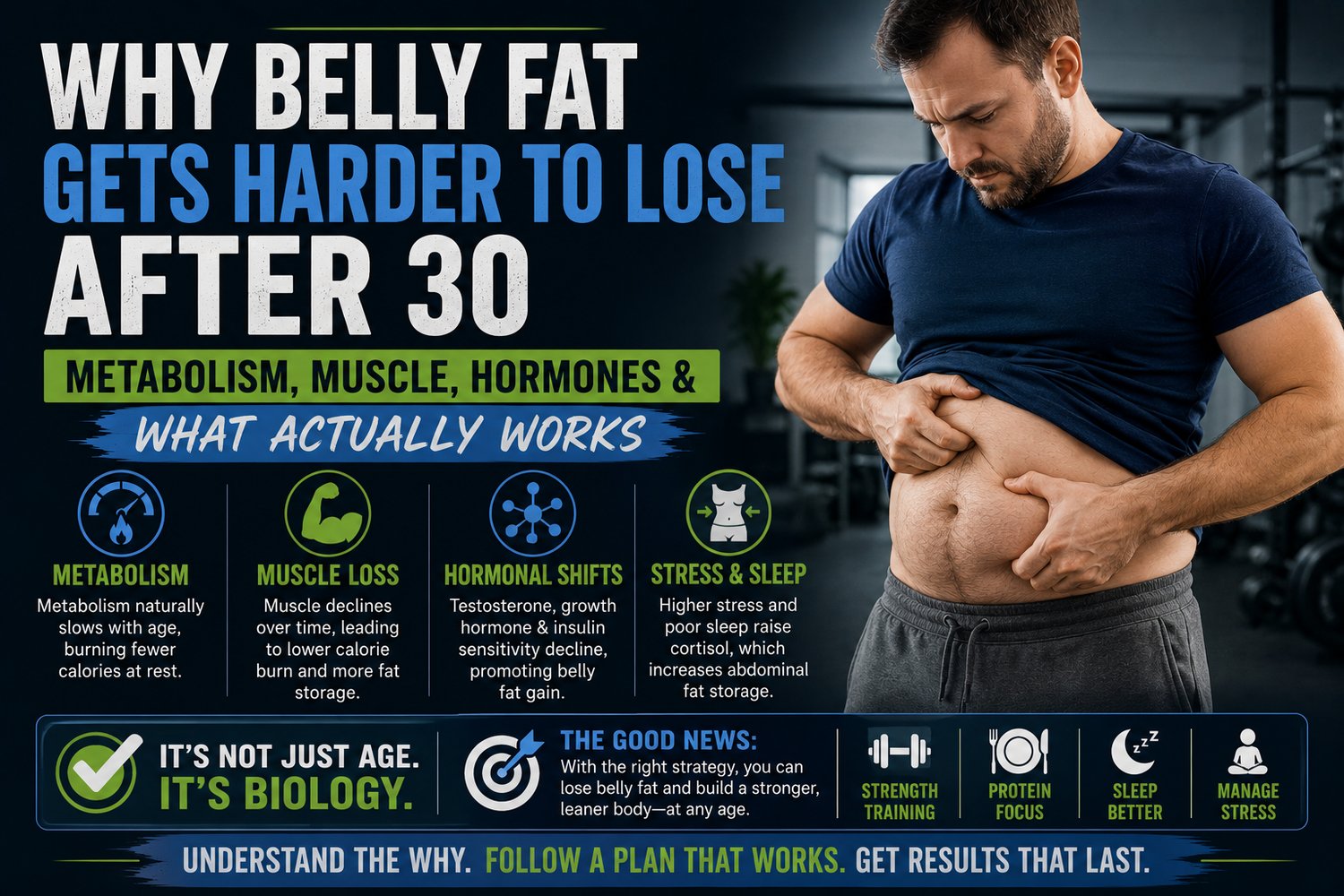
Why Belly Fat Gets Harder to Lose After 30: Metabolism, Muscle, Hormones & What Actually Works
A lot of men hit their 30s or 40s and notice something frustrating.
The weight goes on more easily.
The waist gets thicker.
And getting lean feels harder than it used to.
That often leads to one conclusion:
“My metabolism is shot.”
Usually, that isn't the whole story.
Belly fat often becomes harder to manage after 30 because several smaller changes start stacking together: you move less, sit more, lose muscle if you stop training, sleep worse, eat slightly more, drink more calories, experience more stress, and have less time to exercise.
Those changes can quietly shift energy balance for years.
Meanwhile, abdominal fat matters for more than appearance.
Visceral fat—fat stored deeper in the abdomen around internal organs—is associated with increased risk of type 2 diabetes, cardiovascular disease, high blood pressure, and other metabolic problems.
So this isn't really an article about getting shredded for summer.
It's about:
- Why your waist may change with age
- What belly fat actually is
- Whether metabolism really slows after 30
- How muscle and testosterone fit into the picture
- What actually works for reducing abdominal fat
If you're new to the men's-health pillar, start with What Is Men's Wellness?.
First: Belly Fat Isn't One Thing
When men talk about belly fat, they're usually combining two different types of fat.
Subcutaneous Fat
This is the softer fat located underneath the skin.
It's the fat you can usually pinch around your waist.
Visceral Fat
Visceral fat sits deeper inside the abdomen around internal organs.
This type of abdominal fat is more strongly associated with metabolic and cardiovascular health risk.
You can't accurately determine your visceral-fat level simply by looking in the mirror.
But waist circumference can provide a useful practical clue.
Why Waist Circumference Matters
Body weight tells you how much you weigh.
It doesn't tell you where that weight is stored.
That's why waist circumference can add useful information.
CDC guidance identifies a waist circumference above approximately 40 inches in men as being associated with increased health risk.
That doesn't mean:
39.9 inches = perfectly healthy
and:
40.1 inches = suddenly dangerous.
It's a screening threshold.
Waist circumference should be considered alongside other information such as:
- Blood pressure
- Blood glucose
- Cholesterol
- Body weight
- Physical activity
- Smoking
- Family history
- Overall metabolic health
The trend can be particularly useful.
If your waist has gradually moved from:
34 inches → 37 → 40
over several years, that's worth noticing even if the scale hasn't changed dramatically.
Does Your Metabolism Really Slow After 30?
Not nearly as dramatically as popular culture suggests.
One of the largest studies of human energy expenditure across the lifespan found that, after accounting for body size and composition, daily energy expenditure remained relatively stable from approximately age 20 through age 60 before declining later in life.
That's a pretty important finding.
It means turning:
30
35
40
doesn't automatically cause some major metabolic collapse.
So why does weight gain become more common?
Often because the rest of life changes.
Your 42-Year-Old Life May Burn Fewer Calories Than Your 22-Year-Old Life
Think about your early 20s.
Maybe you:
- Walked across a college campus
- Played recreational sports
- Worked a more active job
- Went out more
- Had fewer family obligations
- Spent less time sitting
Now imagine your 40s.
You may:
- Drive to work
- Sit at a desk
- Sit in meetings
- Drive home
- Eat dinner
- Sit on the couch
- Spend weekends driving kids somewhere
Nothing dramatic happened to your metabolism.
Your daily movement environment changed.
And that can matter substantially over years.
Muscle and Body Composition Change Too
Muscle contributes to your:
- Strength
- Physical capacity
- Body composition
- Energy expenditure
If you gradually stop resistance training and lose muscle while gaining body fat, your body composition changes even if your total body weight doesn't initially change much.
This doesn't mean:
“Muscle loss destroyed my metabolism.”
That's another exaggeration.
But preserving muscle becomes increasingly valuable because it supports:
- Strength
- Training ability
- Healthy aging
- Better body composition
- Lean-mass preservation during weight loss
Read Strength Training for Men Over 30.
And if you're already in midlife, use Building Muscle After 40.
You Probably Move Less Than You Think
Formal exercise is only part of daily activity.
The rest includes ordinary movement:
- Walking
- Standing
- Taking stairs
- Household work
- Moving around at work
- Running errands
A man can lift weights three days per week and still spend the vast majority of his waking hours sitting.
That's why walking is so useful.
It adds activity without creating enormous fatigue or recovery demands.
Read Walking for Men's Health.
For a deeper weight-management strategy, use the Complete Walking for Weight Loss Guide.
Calories Still Matter
Weight regulation is complicated.
Energy balance still matters.
Long-term fat gain requires energy intake to exceed energy expenditure over time.
The tricky part is that the difference doesn't need to feel dramatic.
You might gradually add calories through:
- Larger restaurant portions
- Alcohol
- Sugary drinks
- Evening snacks
- Weekend meals
- Takeout
- Calorie-dense “healthy” foods
- Eating while distracted
No massive binge is required.
That's why someone can honestly say:
“I don't eat that much.”
while still consuming slightly more energy than his current activity level requires.
Calories aren't a moral judgment.
They're simply part of the physiology.
Don't Obsess Over “100 Extra Calories = X Pounds”
You'll sometimes see calculations suggesting that eating exactly 100 extra calories every day will automatically produce a predictable amount of yearly fat gain.
Real human weight regulation isn't that linear.
As weight changes, energy expenditure changes too.
Appetite changes.
Movement can change.
The useful point is simply:
Small imbalances repeated consistently can add up over time.
You don't need fake mathematical precision to understand that.
Protein Makes Fat Loss Easier
Protein does not specifically burn belly fat.
But it helps with several parts of weight management:
- Fullness
- Muscle preservation
- Training recovery
- Meal structure
For many active men, protein intake somewhere around:
1.2–1.6 g/kg/day
can be a practical range depending on goals, body size, and health.
Protein becomes particularly useful during weight loss because you want to lose excess fat while preserving as much useful lean tissue as possible.
Read Protein for Men.
For meals and broader nutrition guidance, use the Complete High-Protein Guide.
Belly Fat and Testosterone Have a Two-Way Relationship
This gets oversimplified constantly.
You'll hear:
“Low testosterone causes belly fat.”
There is some truth in that.
Testosterone deficiency can influence body composition.
But the relationship can also work in the opposite direction.
Obesity is associated with lower testosterone in many men, and obesity-related suppression of the reproductive hormone system can sometimes improve when excess weight is reduced.
So the useful takeaway isn't:
“Belly fat means low testosterone.”
It's:
Body composition and testosterone can influence one another.
Belly Fat Doesn't Diagnose Low Testosterone
Suppose a man gains 25 pounds after:
- Stopping exercise
- Sleeping six hours
- Working at a desk
- Drinking more
- Eating takeout frequently
Do we need a hormone disorder to explain that?
Not necessarily.
The lifestyle changes already explain quite a bit.
Testosterone becomes more relevant when additional symptoms appear, such as:
- Persistent low libido
- Fewer spontaneous erections
- Erectile changes
- Other signs compatible with testosterone deficiency
If that's happening, start with:
Don't use your waistband as a testosterone test.
TRT Is Not a Belly-Fat Treatment
Testosterone replacement therapy may improve body composition in some men with appropriately diagnosed hypogonadism.
But TRT is not an obesity medication.
And it isn't a shortcut for losing abdominal fat in men with normal testosterone.
If obesity is contributing to lower testosterone, addressing excess weight may itself be an important part of treatment.
Read What Is TRT? Testosterone Replacement Therapy Explained.
If you've already completed appropriate evaluation and are researching treatment providers, you can compare online TRT options.
HabitLogics may earn a commission if you purchase through links on our TRT provider page, at no additional cost to you.
Sleep Can Make Weight Management Harder
Poor sleep doesn't magically create belly fat overnight.
It can make healthy weight management considerably harder.
When you're exhausted, you may:
- Move less
- Feel hungrier
- Crave more calorie-dense food
- Skip workouts
- Rely more heavily on caffeine
- Make worse food decisions
CDC's current healthy-weight guidance specifically includes adequate sleep and stress management, alongside nutrition and physical activity, as components of sustainable weight management.
That's why Sleep for Men belongs in a body-composition strategy.
Sleep Apnea Can Complicate Everything
Obesity, sleep apnea, fatigue, sexual symptoms, and testosterone can overlap.
A man might experience:
- Weight gain
- Loud snoring
- Poor sleep
- Daytime fatigue
- Reduced libido
and conclude:
Low testosterone.
But sleep apnea may be contributing significantly.
If you're:
- Snoring loudly
- Gasping during sleep
- Experiencing witnessed breathing pauses
- Waking exhausted
- Struggling with severe daytime sleepiness
get evaluated.
Don't try to treat a possible breathing disorder with caffeine or testosterone.
Stress Matters—But “Cortisol Belly” Is Oversimplified
Chronic stress affects health.
But internet claims that:
“Cortisol specifically puts fat on your belly”
often oversimplify a much messier situation.
Stress can lead to:
- Poorer sleep
- Increased alcohol use
- Less exercise
- Convenience eating
- More snacking
- Less meal structure
CDC also notes that chronic stress can change appetite, energy, sleep, decision-making, and substance use.
Those changes can make weight management harder.
You probably don't need a “cortisol detox.”
You need practical ways to manage the stress that's affecting your behavior and health.
Alcohol Can Quietly Destroy a Calorie Deficit
Alcohol creates several problems for fat loss.
It adds calories.
It can reduce food restraint.
It can worsen sleep.
And it often brings friends.
A few drinks may become:
Beer + wings + pizza + terrible sleep + skipped Saturday workout.
That whole pattern matters far more than obsessing over whether alcohol temporarily alters some fat-burning hormone.
If progress is stalled, look honestly at alcohol intake.
Weekend Calories Still Count
A classic pattern:
Monday–Thursday
Very reasonable eating.
Friday
Dinner out.
Saturday
Breakfast out.
Drinks.
Takeout.
Snacks.
Sunday
Brunch.
Suddenly the weekly calorie deficit disappears.
You don't need to eat perfectly seven days per week.
But your body doesn't reset the calorie ledger Monday morning.
A sustainable plan has to survive weekends too.
You Cannot Spot-Reduce Belly Fat
Sit-ups do not selectively burn abdominal fat.
Neither do:
- Planks
- Crunches
- Ab machines
- Waist trainers
- Sweat belts
You can absolutely strengthen your abdominal muscles.
You should.
But fat loss occurs throughout the body.
Where fat comes off first and last depends heavily on genetics and individual fat distribution.
For many men, the waist is stubborn.
Stubborn doesn't mean impossible.
It means you may need patience.
Ab Training Still Matters
Train your core because it's muscle.
A stronger trunk can support:
- Lifting
- Stability
- Athletic performance
- Physical function
Just understand that:
Building the abdominal muscles
and:
Removing the fat covering them
are two different goals.
What Actually Works for Losing Belly Fat?
Unfortunately, the winning strategy is extremely boring.
Eat slightly fewer calories.
Eat enough protein.
Strength train.
Walk and do aerobic activity.
Sleep enough.
Repeat long enough.
That's basically it.
No testosterone booster.
No detox.
No waist trainer.
No “cortisol belly” supplement.
The difficult part isn't discovering the secret.
It's creating a system you can maintain.
Step 1: Establish Your Baseline
Before changing everything, observe what you're already doing.
For one week, track some combination of:
- Weight
- Waist circumference
- Steps
- Meals
- Protein
- Sleep
- Alcohol
- Exercise
You may discover the main issue immediately.
Maybe you're:
- Averaging 3,500 steps
- Drinking more calories than expected
- Eating enormous restaurant portions
- Sleeping five hours
- Barely eating protein
Data turns:
“Why isn't this working?”
into:
“Okay, there's the problem.”
The FREE Men's Hormone & Energy Starter Kit provides a simple way to begin tracking sleep, nutrition, strength, habits, energy, and bloodwork.
Step 2: Create a Moderate Calorie Deficit
You don't need to crash diet.
You need enough of a deficit that body weight trends downward over time without creating:
- Constant hunger
- Terrible workouts
- Major lean-mass loss
- A lifestyle you hate
CDC recommends gradual, steady weight loss and notes that modest weight reduction can improve blood pressure, cholesterol, and blood glucose.
You don't necessarily need to count calories forever.
You can create a deficit through changes such as:
- Smaller portions
- Fewer liquid calories
- Leaner protein choices
- More vegetables and fruit
- Less frequent snacking
- Reduced alcohol
- Fewer restaurant meals
Tracking can simply teach you where the calories are coming from.
Step 3: Prioritize Protein
Build each major meal around an obvious protein source.
Breakfast
Eggs + Greek yogurt
Lunch
Chicken + vegetables + rice
Dinner
Fish + potatoes + vegetables
Snack
Cottage cheese + fruit
You don't need bland bodybuilding food.
You need repeatable meal structure.
That helps with:
- Fullness
- Muscle preservation
- Recovery
Read Protein for Men.
Step 4: Strength Train
During weight loss, resistance training provides an important signal:
Keep this muscle.
A simple program performed two or three times per week can be enough to make resistance training a meaningful part of your body-composition plan.
Use:
depending on where you are.
Step 5: Walk More
Walking is one of the easiest activity variables to increase because it usually doesn't create much recovery burden.
You can:
- Increase your normal step count gradually
- Add a 20–30 minute walk
- Walk after meals
- Break walking into shorter sessions
For example:
10 minutes after breakfast
10 minutes after lunch
10 minutes after dinner
That's 30 additional minutes without needing another traditional workout.
Read Walking for Men's Health.
Step 6: Fix the Sleep Problem
If you're sleeping terribly, put sleep inside the weight-loss plan.
Not beside it.
Work on:
- Consistent sleep schedule
- Enough sleep opportunity
- Earlier caffeine cutoff
- Better evening routine
- Reducing excessive alcohol
- Evaluation for sleep apnea when symptoms suggest it
CDC's current guidance explicitly includes sleep as part of healthy weight management.
Fat loss is already difficult.
Don't deliberately make every decision while exhausted.
Step 7: Measure the Trend
Scale weight fluctuates.
Short-term changes can reflect:
- Water
- Glycogen
- Sodium
- Food volume
- Bowel contents
You can gain several pounds overnight without gaining several pounds of body fat.
Instead, consider looking at:
- Several weigh-ins averaged together
- Waist measurements under similar conditions
- Monthly trends
The question is:
Where is the trend going?
Not:
Why was Tuesday 1.8 pounds heavier?
Don't Judge Progress Only by the Scale
If you're strength training while losing fat, useful progress may include:
- Smaller waist
- Better-fitting clothes
- Increased strength
- Better fitness
- Lower blood pressure
- Improved laboratory markers
Weight matters.
It isn't the entire outcome.
A man who loses only eight pounds but removes four inches from his waist while becoming significantly stronger has accomplished quite a bit.
GLP-1 and Other Obesity Medications Can Be Appropriate for Some Men
Lifestyle habits remain important.
But obesity is also a chronic medical condition, and some men appropriately use prescription anti-obesity medications as part of treatment.
GLP-1–based and related medications have changed obesity treatment significantly.
They aren't appropriate for everyone, and treatment decisions should consider:
- Medical history
- Current weight and health risk
- Other medications
- Side effects
- Cost
- Individual treatment goals
If you're researching that route, start with the Complete GLP-1 Success Guide.
Medication doesn't eliminate the need for:
- Protein
- Resistance training
- Adequate nutrition
- Sleep
- Sustainable habits
In fact, preserving lean mass becomes especially important during substantial weight loss.
Weight-Loss Medication Isn't an Eight-Pound Ab Shortcut
There's a difference between:
Treating obesity and reducing health risk
and:
Using prescription medication because you'd like the last eight pounds off your lower abs.
Obesity medications are medicine.
They involve:
- Eligibility considerations
- Potential adverse effects
- Cost
- Ongoing treatment decisions
- Individual medical risk
Treat them like medical treatment.
Not a physique supplement.
Skip the “Fat Burner”
Most over-the-counter fat burners are far less impressive than their marketing.
Many rely heavily on:
- Caffeine
- Other stimulants
- Herbal ingredients
They may produce:
- More energy
- Lower appetite
- Higher heart rate
That's not the same as creating some powerful new fat-loss pathway.
If your budget is limited, spending money on:
- Better food
- A gym membership
- Comfortable walking shoes
may produce a much better return.
Testosterone Boosters Won't Melt Belly Fat Either
Be skeptical of a product claiming it can simultaneously:
Boost testosterone + burn belly fat + build muscle + improve libido.
That's not a supplement label.
That's a list of male insecurities.
If you're worried about testosterone:
Evaluate testosterone.
If you're worried about body composition:
Address body composition.
Don't combine unrelated problems because a marketing department did.
Read Testosterone Myths.
Build a 90-Day System
Body composition responds much better to systems than weekend motivation.
A useful 90-day structure might include:
Nutrition
- Protein with major meals
- Mostly nutrient-dense foods
- Moderate calorie deficit
Strength
- Resistance training 2–3 times weekly
Walking
- Daily movement
Sleep
- Consistent routine
Tracking
- Weight trend
- Waist
- Exercise
- Other useful metrics
Review
Adjust every few weeks based on actual results.
The 90 Day Dad Fitness Planner combines workout, nutrition, habit, and fitness tracking.
For broader health and body-composition tracking, use the Men's Health & Performance Dashboard.
Frequently Asked Questions
Why Do Men Gain Belly Fat After 30?
Usually because several factors gradually overlap:
- Less daily movement
- More sitting
- Reduced muscle if resistance training stops
- Higher calorie intake
- Worse sleep
- Stress
- Alcohol
- Other lifestyle changes
Hormones and medical conditions can contribute in some men, but metabolism does not simply collapse at age 30.
Does Metabolism Slow Down After 30?
Not dramatically simply because you turned 30.
Large-scale research found that adjusted daily energy expenditure remains relatively stable from approximately age 20 through 60.
Changes in activity, body composition, food intake, health, and lifestyle often explain more of the midlife weight-gain picture.
Is Belly Fat Dangerous for Men?
Excess visceral abdominal fat is associated with increased risk of cardiovascular and metabolic disease.
Waist circumference is one practical screening tool, with waist measurements above roughly 40 inches in men associated with higher health risk.
Can Low Testosterone Cause Belly Fat?
Low testosterone can affect body composition.
But excess body fat can also contribute to lower testosterone in some men.
The relationship can work in both directions.
Belly fat by itself doesn't diagnose low testosterone.
Will TRT Help Me Lose Belly Fat?
TRT is not a weight-loss treatment.
Men with appropriately diagnosed hypogonadism may experience some body-composition changes during treatment, but nutrition, physical activity, sleep, and overall energy balance remain important.
Can Walking Reduce Belly Fat?
Walking can contribute to overall calorie expenditure and fat loss.
It cannot selectively remove fat from the abdomen.
What Is the Best Exercise for Belly Fat?
There is no special belly-fat exercise.
A strong plan generally combines:
- Resistance training
- Walking and/or other aerobic activity
- Appropriate calorie intake
- Adequate protein
How Quickly Should I Lose Belly Fat?
There isn't one perfect rate for everyone.
CDC recommends gradual, steady weight loss rather than extremely rapid loss because slower approaches are generally easier to maintain.
Focus on trends over months rather than trying to force dramatic weekly changes.
Key Takeaways
- Belly fat often becomes harder to manage after 30 because lifestyle, activity, sleep, body composition, calorie intake, stress, and sometimes hormones change together.
- Your metabolism does not simply collapse when you turn 30.
- Large-scale research suggests adjusted energy expenditure remains relatively stable through much of adulthood.
- Visceral abdominal fat carries greater metabolic and cardiovascular risk than ordinary subcutaneous fat.
- Waist circumference provides useful information beyond scale weight alone.
- A waist above roughly 40 inches in men is associated with increased health risk.
- You cannot spot-reduce belly fat.
- Strength training helps preserve muscle while losing weight.
- Walking provides additional activity with relatively little recovery burden.
- Protein can support fullness and lean-mass preservation.
- Poor sleep, stress, alcohol, and weekends can quietly undermine a calorie deficit.
- Low testosterone and obesity can influence one another, but belly fat doesn't diagnose low T.
- TRT isn't a weight-loss treatment.
- Prescription obesity treatment can be appropriate for some men and should be treated as medical care.
- Sustainable fat loss usually comes from boring habits repeated long enough to work.
Final Thoughts
Your body probably didn't suddenly stop working when you turned 30.
Your life changed.
Maybe you:
Sit more.
Move less.
Sleep less.
Drink a little more.
Train less consistently.
Eat slightly larger portions.
Do that for ten years and the difference can become substantial.
The solution usually doesn't require declaring war on carbohydrates or finding a hormone hack.
Start with the boring stuff.
Lift.
Walk.
Eat enough protein.
Create a reasonable calorie deficit.
Sleep.
Track your waist.
Give it time.
And if something genuinely doesn't make sense—such as rapid unexplained weight gain, significant fatigue, sexual symptoms, or other major health changes—get evaluated rather than assuming age explains everything.
You're not trying to recreate your 22-year-old metabolism.
You're building habits that work for the body and life you have now.
Continue the Men's Wellness Series
For body composition:
- Protein for Men
- Building Muscle After 40
- Strength Training for Men Over 30
- Walking for Men's Health
- Complete High-Protein Guide
- Complete Walking for Weight Loss Guide
For testosterone:
- Low Testosterone Symptoms
- What Causes Low Testosterone?
- How Testosterone Is Tested and Diagnosed
- How to Support Testosterone Naturally
- What Is TRT?
For GLP-1 weight-management resources:
For tracking:
- FREE Men's Hormone & Energy Starter Kit
- Men's Health & Performance Dashboard
- 90 Day Dad Fitness Planner
For the broader pillar:
Affiliate Disclosure
Some links in this article may be affiliate links. If you purchase through one of these links, HabitLogics may earn a commission at no additional cost to you. Recommendations are included only where they naturally fit the topic.
Educational Disclaimer
This article is intended for educational purposes only and should not be considered medical or individualized weight-management advice. Weight and body-composition changes can be influenced by diet, physical activity, sleep, medications, medical conditions, genetics, hormones, and other factors. Consult a qualified healthcare professional for rapid or unexplained weight changes, suspected endocrine or metabolic conditions, or individualized obesity treatment.