

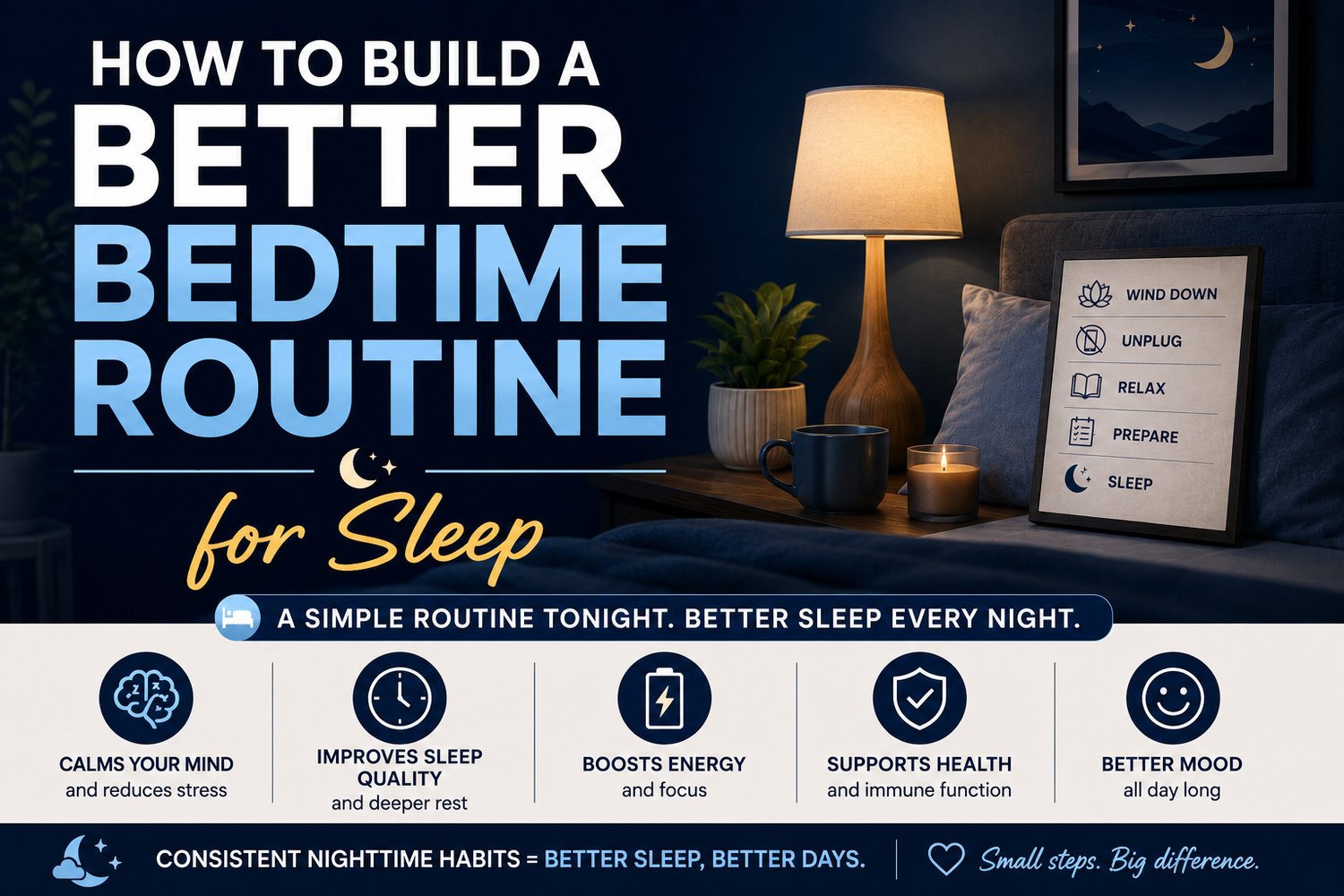
How to Build a Better Bedtime Routine for Sleep
The Complete Sleep & Recovery Guide
Your bedtime routine does not need to look like this:
8:00 p.m. — Herbal tea.
8:15 — Hot bath.
8:30 — Meditation.
8:45 — Gratitude journaling.
9:00 — Stretching.
9:15 — Read 20 pages.
9:45 — Breathwork.
10:00 — Lights out while surrounded by lavender and the gentle sounds of Himalayan singing bowls.
If you genuinely enjoy all of that, great.
But if your current bedtime routine is:
Phone → phone → phone → "HOW IS IT MIDNIGHT ALREADY?" → bed
you probably don't need to jump directly to a two-hour wellness ceremony.
A good bedtime routine has a much simpler job:
Help you transition from being awake and active to being ready for sleep.
NHLBI recommends using the hour before bed for quieter activities, while the CDC recommends consistent sleep times and reducing electronics before bedtime.
That doesn't mean everyone needs exactly 60 minutes.
It means your brain may benefit from something between:
full-speed daytime mode
and
go unconscious immediately.
Let's build a routine you might actually keep.
What Is a Bedtime Routine?
A bedtime routine is a predictable sequence of activities you regularly perform before going to sleep.
It might include things like:
- Lowering the lights
- Finishing household tasks
- Taking a shower
- Brushing your teeth
- Preparing for tomorrow
- Putting away electronics
- Reading
- Listening to quiet music
- Doing something relaxing
- Going to bed around a consistent time
NHLBI specifically suggests following a routine that helps you relax before bed, giving examples such as reading, listening to soothing music or taking a hot bath.
The specific activities matter less than people sometimes think.
You aren't searching for the perfect routine.
You're trying to establish a repeatable pattern that tells your brain:
We're done for the day.
Why Can a Bedtime Routine Help?
Your body doesn't operate on bedtime because the clock says:
10:30 p.m.
Several biological processes influence when you feel sleepy, including your circadian rhythm and the accumulation of sleep pressure across the day.
Your environment and behavior provide additional signals.
Bright light says:
Stay alert.
Work says:
Solve problems.
An exciting video says:
Pay attention.
An argument on social media says:
Apparently this stranger must be proven wrong immediately.
Then you put the phone down and expect:
Instant sleep.
Sometimes that works.
Sometimes your brain hasn't gotten the memo.
A routine gives you a transition period.
NHLBI recommends spending the hour before bed doing quiet activities and avoiding bright artificial light during that time.
The purpose isn't to sedate yourself through ritual.
It's to stop repeatedly doing things that keep you alert right up until bedtime.
How Long Should a Bedtime Routine Be?
There isn't one required duration.
You don't need exactly:
60 minutes
or
37 minutes
or whatever number someone on social media has decided is optimal this week.
For many people, somewhere around 30–60 minutes is a practical wind-down window.
The CDC specifically recommends turning off electronic devices at least 30 minutes before bedtime, while NHLBI recommends using the final hour for quieter activities.
But if 60 minutes sounds impossible, start smaller.
Even 15–20 minutes of intentional transition may be more useful than designing an elaborate routine you abandon after three nights.
The best bedtime routine is not the longest.
It's the one you actually repeat.
Step 1: Start With Your Wake Time
Before building your bedtime routine, determine when you need to wake up.
This is more useful than choosing some arbitrary "healthy bedtime."
If you need to wake at:
6:00 a.m.
and you generally need around:
7½–8 hours of sleep
then a routine beginning at 11:30 p.m. probably isn't going to solve your problem.
You're simply starting too late.
Our guide to How Much Sleep Do You Need? A Practical Guide by Age & Lifestyle explains how to think about your personal sleep needs.
Once you have a realistic sleep target, work backward.
For example:
6:00 a.m. wake time
↓
10:00 p.m. target sleep time
↓
9:15–9:30 p.m. begin winding down
Now the routine has a purpose.
Step 2: Choose a Bedtime You Can Actually Maintain
Your ideal bedtime isn't necessarily the earliest possible bedtime.
It's one that:
- Gives you enough sleep opportunity
- Fits reasonably well with your schedule
- Can be repeated most nights
The CDC recommends keeping bedtime and wake time consistent from day to day.
That doesn't mean never staying out late again.
It means avoiding a default pattern like:
Monday: 10 p.m.
Tuesday: midnight.
Wednesday: 9:30 p.m.
Thursday: 1:30 a.m.
Friday: 2 a.m.
Saturday: Who knows?
Your body doesn't need military precision.
It does benefit from some predictability.
Step 3: Create a "Day Is Done" Trigger
Most routines work better when something clearly starts them.
Pick a simple trigger.
Maybe it's:
9:30 p.m. alarm
After the evening news
When the kids go to bed
After you take the dog out
After you finish cleaning the kitchen
When that event occurs, you're officially moving into wind-down mode.
This is less about biology than behavior.
You're removing the nightly decision:
Should I start getting ready for bed yet?
Make the decision ahead of time.
Step 4: Lower the Stimulation Level
Your wind-down routine should generally become less stimulating as bedtime approaches.
That doesn't mean you need absolute silence.
It means this probably isn't the ideal time to:
- Begin working
- Tackle your most stressful problem
- Start an intense workout
- Get into an argument
- Read upsetting news for an hour
- Play a highly stimulating game
- Watch "one quick video" that turns into 48 videos
NHLBI recommends quieter activities before bed and avoiding intense exercise and bright artificial light during the wind-down period.
Think of it as gradually reducing RPMs.
You're not slamming on the brakes.
Step 5: Dim the Lights
You don't need to live by candlelight after sunset.
But bright light late in the evening can provide an alerting signal when you're trying to transition toward sleep.
NHLBI recommends reducing bright artificial light during the hour before bed.
So as bedtime approaches:
Turn off unnecessary overhead lights.
Use softer lamps.
Reduce screen brightness.
Make nighttime actually look different from daytime.
This creates a simple environmental signal:
Things are winding down.
Step 6: Put Tomorrow Somewhere Other Than Your Head
A surprisingly useful bedtime habit has nothing directly to do with sleep physiology.
Prepare for tomorrow.
That might mean:
- Set out clothes
- Pack lunch
- Put your work bag near the door
- Check tomorrow's schedule
- Write down the three things you need to remember
- Set your alarm
Why?
Because many people get into bed and suddenly their brain becomes the world's least helpful personal assistant.
Don't forget the dentist.
You need gas.
Send that email.
What are you making for dinner tomorrow?
Did you pay that bill?
Writing those things down doesn't magically eliminate stress.
But it gives your brain somewhere else to store them.
Instead of repeatedly rehearsing:
Don't forget. Don't forget. Don't forget.
you've created a system.
Step 7: Do the Boring Bedtime Stuff Early Enough
Brush your teeth.
Wash your face.
Take medications as directed.
Take a shower if that's part of your routine.
Change clothes.
Take the dog out.
Lock the doors.
Whatever your normal nighttime maintenance looks like.
Doing these things before you're completely exhausted helps prevent the classic problem:
You're nearly asleep on the couch.
Then remember:
I still have to get ready for bed.
Suddenly the lights are back on, you're walking around the house, brushing your teeth and becoming alert again.
Build those tasks into the routine rather than treating them as obstacles between you and sleep.
Step 8: Pick One Quiet Activity You Enjoy
Now choose something low-key.
Options might include:
Reading
A physical book works well for many people.
Your choice of book matters.
A relaxing novel?
Great.
An intense thriller that makes you say:
ONE MORE CHAPTER
until 1 a.m.?
Perhaps less ideal. 😂
Listening to Music
Quiet music can be part of a wind-down routine. NHLBI lists soothing music among examples of relaxing pre-bed activities.
Taking a Warm Shower or Bath
NHLBI also lists a hot bath as one possible relaxation strategy before bed.
You do not need to measure your bath temperature or calculate the perfect number of minutes.
We're taking a bath.
Not conducting an experiment for NASA.
Gentle Stretching
If you enjoy light stretching and find it relaxing, it can fit well here.
Just don't turn your nighttime routine into a surprise CrossFit session.
Relaxation or Breathing Exercises
Some people find meditation, relaxation exercises or slow breathing useful.
Again:
Optional.
Not required.
If meditating makes you more annoyed than relaxed, congratulations—you've discovered something about yourself.
Choose something else.
Step 9: Deal With Your Phone Strategically
Phones are probably the biggest practical obstacle in many modern bedtime routines.
Not because touching a phone after 9 p.m. automatically destroys your sleep.
Because phones are exceptionally good at keeping you awake.
The CDC recommends turning off electronic devices at least 30 minutes before bedtime.
If your phone isn't currently causing problems, you don't necessarily need to create extreme rules.
But if this sounds familiar:
10:00: I'll check something quickly.
10:12: Still scrolling.
10:43: Apparently watching a video about how cruise ships dispose of garbage.
11:21: Somehow researching a celebrity you haven't thought about since 2004.
11:48: WHY AM I STILL AWAKE?
then yes.
Your phone deserves a boundary.
Try:
- Charging it across the room
- Putting it on Do Not Disturb
- Setting an app limit
- Using a real alarm clock
- Creating a specific "phone goes away" time
- Keeping it out of bed
This isn't about becoming anti-technology.
It's about preventing a device engineered to capture attention from repeatedly stealing sleep opportunity.
Step 10: Don't Go to Bed Stuffed
A bedtime routine doesn't need a strict food cutoff.
But very heavy meals close to bedtime can create discomfort for some people.
Both the CDC and NHLBI recommend avoiding large or heavy meals close to bedtime.
That doesn't mean:
Never eat after 7 p.m.
Your schedule matters.
If you're hungry, a small snack can be reasonable; NHLBI specifically notes that a light snack before bed is okay.
The goal is simply to avoid routinely going to bed:
painfully full
or
so hungry you can't sleep.
We'll dig into food timing much more when we get to the dedicated article on eating before bed.
Step 11: Watch the Nighttime Alcohol Habit
Alcohol often becomes part of people's wind-down routine because it can make them feel sleepy.
But sedation and healthy sleep aren't identical.
NHLBI advises avoiding alcohol before bed as part of healthy sleep habits.
If alcohol is part of your evening routine, pay attention to the entire night.
Not just:
Did I fall asleep quickly?
Also ask:
Did I wake repeatedly?
Did I sleep restlessly?
How did I feel in the morning?
That's more useful than assuming something improves sleep simply because it makes you sleepy.
Step 12: Don't Sneak Late Caffeine Into Your Routine
Coffee isn't the only caffeine source.
Your evening may include:
- Coffee
- Energy drinks
- Pre-workout
- Soda
- Tea
- Chocolate
- Certain medications
If you're struggling to fall asleep, caffeine timing deserves a look.
NHLBI notes that caffeine's effects can last for hours and recommends avoiding it late in the day when it interferes with sleep.
We're going to devote a full article to caffeine and sleep later in this series.
For now:
If your bedtime routine includes a 7 p.m. energy drink, perhaps begin the investigation there before ordering a $200 weighted blanket.
Step 13: Make Your Bedroom the Final Step
Once the routine is complete, move into an environment that supports sleep.
The CDC recommends keeping the bedroom quiet, relaxing and comfortably cool.
NHLBI similarly recommends a bedroom that is quiet, cool and dark.
Again, solve obvious problems first.
Light pouring through your window?
Darken it.
TV blasting?
Turn it off.
Room excessively warm?
Cool it down.
Phone buzzing every four minutes?
Silence it.
You don't need the perfect sleep environment.
You want to remove the obvious reasons not to sleep.
A Simple 30-Minute Bedtime Routine
Here's what this can look like without turning into a lifestyle project.
30 Minutes Before Bed
Put your phone on charge.
Dim the lights.
Finish any last household tasks.
20 Minutes Before Bed
Brush teeth.
Wash up.
Get clothes ready for tomorrow.
Check your alarm.
10–15 Minutes Before Bed
Read something relaxing.
Listen to quiet music.
Do light stretching.
Or simply sit somewhere comfortable.
Bedtime
Lights out.
That's it.
No moon water required.
A 60-Minute Bedtime Routine
If you enjoy a longer transition:
60 Minutes Before Bed
Stop work and stimulating tasks.
Dim lights.
Finish kitchen cleanup or basic household tasks.
45 Minutes Before Bed
Shower.
Brush teeth.
Prepare clothes, lunch or your work bag for tomorrow.
30 Minutes Before Bed
Phone goes away.
Do Not Disturb turns on.
20 Minutes Before Bed
Read, listen to music or do another quiet activity.
Bedtime
Bedroom dark.
Room comfortable.
Lights out.
Simple enough to repeat.
What If You Have Kids?
Your bedtime routine may not look remotely peaceful.
That's okay.
You may be dealing with:
Homework.
Baths.
Lunches.
Backpacks.
Children suddenly remembering at 9:17 p.m. that they need poster board tomorrow.
The answer isn't pretending you live in a spa.
Instead, create the smallest repeatable adult wind-down period you realistically can.
Maybe your routine is only:
Kids settled → shower → prepare tomorrow → 15 minutes reading → bed.
That's still a routine.
Don't compare your actual life to somebody else's perfectly staged evening.
What If You Work Late?
Same principle.
Your routine doesn't need to start at the same clock time as everyone else's.
If work ends late, build a short transition after work.
For example:
Arrive home
↓
Light meal if needed
↓
Shower
↓
Prepare tomorrow
↓
20 minutes of quiet activity
↓
Bed
The key is preserving enough total sleep opportunity.
A flawless routine cannot compensate for regularly giving yourself five hours to sleep.
What If You're a Shift Worker?
Shift work is more complicated because your sleep schedule may conflict with normal light-dark patterns.
A generic 10 p.m. bedtime routine isn't particularly helpful if you're getting home from work at 7 a.m.
But the same broad principles still apply:
- Create a predictable pre-sleep routine
- Control light when possible
- Keep the bedroom dark and quiet
- Limit disruptions
- Manage caffeine strategically
- Give yourself adequate sleep opportunity
Shift-work sleep deserves more individualized consideration because circadian timing becomes especially important.
If persistent sleepiness or sleep problems are affecting your safety or functioning, talk with a qualified healthcare professional.
Should You Take a Hot Shower Before Bed?
You can.
You don't have to.
NHLBI lists a hot bath among strategies that may help people relax before bedtime.
The useful part is often simply:
It's relaxing.
If a warm shower makes you feel calm and helps establish a routine, include it.
If you hate showering at night, there is no need to force yourself because some sleep influencer said it optimizes thermoregulation.
Your routine must belong to you.
Should You Read Before Bed?
Reading can be an excellent wind-down activity if it relaxes you.
NHLBI specifically lists reading a book as an example of a routine that may help you wind down.
The main practical questions are:
Does reading make you relaxed?
and
Does it help you stop doing more stimulating activities?
If yes, great.
But if your "15-minute reading habit" repeatedly becomes a two-hour reading marathon, adjust accordingly.
Sleep still needs to happen eventually.
What About Meditation?
Meditation can be useful for some people.
NHLBI includes meditation among relaxation strategies that a healthcare provider may recommend.
But meditation is not mandatory for healthy sleep.
If it helps you unwind, use it.
If lying in silence causes your brain to create a meeting agenda for every mistake you've made since middle school, try reading instead.
Different people relax differently.
Do You Need to Journal Before Bed?
No.
But it can be useful if your biggest bedtime problem is:
Your brain won't stop listing things.
Try something extremely simple.
Write:
Tomorrow:
- Call dentist
- Finish report
- Pick up groceries
Done.
This isn't a memoir.
The goal is to get unfinished tasks out of working memory so you don't have to mentally rehearse them all night.
What If You Can't Fall Asleep Anyway?
This is important.
A bedtime routine creates favorable conditions for sleep.
It does not guarantee sleep.
And if you're lying awake, adding more effort can backfire.
You don't want bedtime to become:
TRY HARDER TO SLEEP.
If you're clearly awake and increasingly frustrated, getting out of bed and doing something quiet until you feel sleepier may be preferable to spending hours fighting with sleep.
CDC sleep guidance similarly advises doing something relaxing elsewhere if you cannot sleep.
Persistent difficulty falling asleep is different from an occasional rough night.
Chronic insomnia often requires more than basic sleep hygiene or a bedtime routine.
If the problem continues, professional evaluation may be appropriate.
Don't Turn Your Routine Into Another Source of Stress
This is the danger with sleep optimization.
You create rules.
Then you become anxious when you break them.
Oh no.
It's 9:47.
I was supposed to start reading at 9:30.
My sleep is ruined.
No.
Your body is more resilient than that.
A bedtime routine should reduce friction.
Not create another performance metric.
Aim for:
mostly consistent
rather than:
perfectly executed.
One late night doesn't destroy anything.
The pattern matters.
Don't Add 10 New Habits at Once
If you currently don't have a bedtime routine, start with three things.
For example:
1. Phone away 30 minutes before bed
2. Basic preparation for tomorrow
3. Read for 15 minutes
Do that consistently.
Then decide whether anything else needs changing.
This is the same philosophy we used in How to Sleep Better Naturally: 12 Habits That Actually Matter.
You don't improve a system by making it so complicated that you stop using it.
Bedtime Routine vs. Sleep Hygiene
These terms overlap but aren't identical.
Your bedtime routine is the sequence of behaviors immediately leading into sleep.
Your sleep hygiene includes a much larger collection of daytime and nighttime behaviors.
That includes:
- Wake time
- Daytime exercise
- Light exposure
- Caffeine
- Alcohol
- Sleep schedule
- Bedroom environment
- Meal timing
- Your actual bedtime routine
If you haven't already, read Sleep Hygiene: What It Is, What Actually Works & What’s Overrated for the broader picture.
A good bedtime routine is one tool within a larger sleep system.
Track Whether Your Routine Actually Helps
Don't assume a routine works just because it sounds healthy.
Test it.
For one to two weeks, track:
- When your routine started
- When you went to bed
- How difficult it was to fall asleep
- Nighttime awakenings
- Morning energy
- Daytime energy
- Whether you followed the routine
You may discover:
Reading helps.
Your phone cutoff helps even more.
Showering makes no noticeable difference.
Late caffeine overwhelms everything else.
Good.
Now you know something.
If you'd like a structured place to start, the FREE 7-Day Sleep Reset | Sleep & Recovery Starter Kit helps you track your sleep and several daily behaviors for one week so you can identify the patterns that actually matter.
Build Your Own Bedtime Routine
Don't copy mine.
Don't copy a celebrity's.
Don't copy a wellness influencer who apparently has no job, children, pets, dishes or unexpected responsibilities.
Build yours.
Use this formula:
Step 1: Choose Your Target Sleep Time
Work backward from your required wake time.
Step 2: Choose a Wind-Down Window
Try roughly 30–60 minutes, or start smaller if necessary.
Step 3: Remove One Stimulating Habit
Maybe that's:
Phone.
Work.
TV.
Gaming.
Late caffeine.
Step 4: Complete Tomorrow's Preparation
Clear the practical clutter from your brain.
Step 5: Choose One Relaxing Activity
Read.
Shower.
Stretch.
Listen to music.
Do breathing exercises.
Whatever actually works for you.
Step 6: Go to Bed
This step is surprisingly important.
Don't finish your routine and then watch another episode.
😂
Example: The Minimalist Bedtime Routine
If you want the simplest version possible:
30 minutes before bed: phone away.
20 minutes before bed: brush teeth, prepare tomorrow.
15 minutes before bed: read.
Bedtime: lights out.
That's a bedtime routine.
It doesn't need to be more impressive.
Example: The "My Brain Won't Shut Off" Routine
If mental clutter is the problem:
45 minutes before bed: stop work and email.
35 minutes before bed: write tomorrow's task list.
30 minutes before bed: phone away.
20 minutes before bed: shower.
10 minutes before bed: read something light.
Bedtime: lights out.
The task list becomes particularly important here because you're giving unfinished thoughts somewhere else to live.
Example: The "I Stay Up Too Late" Routine
If you're not really struggling to sleep—you simply don't go to bed:
45 minutes before bedtime: alarm says WIND DOWN.
30 minutes before bed: phone goes on charger across room.
20 minutes before bed: prepare tomorrow and brush teeth.
15 minutes before bed: read.
Bedtime: go to bed whether you're tempted to keep scrolling or not.
This isn't really a relaxation problem.
It's a boundary problem.
Treat it accordingly.
When You Want More Than a 7-Day Reset
Once you have a routine, longer-term tracking can help determine whether you're actually becoming more consistent.
The Sleep Recovery Planner | Sleep Tracker and Energy Journal includes a fillable PDF and Excel dashboard for tracking sleep, energy, evening routines and caffeine patterns over time.
That can help answer:
Am I starting my routine consistently?
Is bedtime becoming more predictable?
Am I falling asleep more easily?
Is morning energy improving?
Which parts of the routine actually seem useful?
That's what tracking is for.
Not achieving a perfect score.
Frequently Asked Questions
What is the best bedtime routine for adults?
There isn't one perfect routine.
A good routine is simple, calming and repeatable. It might include dimming lights, completing basic nighttime tasks, reducing electronics and spending some time reading or doing another quiet activity before bed.
NHLBI recommends quiet pre-bed activities and offers reading, soothing music and a hot bath as examples of ways to wind down.
How long should a bedtime routine be?
There isn't a required duration.
Roughly 30–60 minutes can be practical for many people, but a shorter routine is fine if that's what you can consistently maintain. CDC recommends turning electronics off at least 30 minutes before bedtime, while NHLBI recommends using the final hour for quiet time.
What should I do 30 minutes before bed?
Consider:
- Putting away your phone
- Dimming lights
- Finishing basic nighttime tasks
- Preparing for tomorrow
- Reading
- Listening to quiet music
- Doing another relaxing activity
Keep it simple.
Should I shower before bed?
You can if you find it relaxing. NHLBI lists a hot bath among possible wind-down strategies.
It isn't mandatory.
Should I read before bed?
Reading can be a useful quiet activity and is specifically mentioned by NHLBI as one example of a relaxing bedtime routine.
Choose something that doesn't encourage you to stay awake much longer than intended.
Should I stop using my phone before bed?
If your phone keeps you awake or makes it difficult to wind down, yes, creating a cutoff can help. The CDC recommends turning electronic devices off at least 30 minutes before bedtime.
What time should I go to bed?
Work backward from your required wake time and the amount of sleep you generally need.
There isn't one universal bedtime.
Why am I still unable to sleep even with a good bedtime routine?
A bedtime routine can improve sleep conditions, but it isn't treatment for every sleep problem.
Persistent difficulty falling asleep or staying asleep may involve insomnia, another sleep disorder, medication effects, medical issues or other factors.
If sleep problems persist or significantly affect daytime functioning, speak with a qualified healthcare professional.
Key Takeaways
A good bedtime routine does not need to be complicated.
It needs to do four things:
Create a predictable transition into bedtime.
Reduce stimulation.
Help you stop accidentally staying awake.
Support enough sleep opportunity.
Start with:
A realistic bedtime
↓
A 30–60 minute wind-down period
↓
Dimmer lights
↓
Phone boundary
↓
Basic preparation for tomorrow
↓
One quiet activity
↓
Bed
That's enough.
You can add other things if they genuinely help.
But don't mistake complexity for effectiveness.
Your bedtime routine should make sleep easier.
Not become another project you need to complete perfectly.
Build Your Routine This Week
If you don't know what your evenings actually look like yet, track them before trying to redesign everything.
The FREE 7-Day Sleep Reset | Sleep & Recovery Starter Kit gives you a simple framework for tracking your sleep, evening habits and energy for one week.
Then build your routine around the problems you actually have.
Not the problems the internet says you're supposed to have.
Previously in the Sleep & Recovery series:
What Is Sleep Quality? How to Know If You’re Actually Sleeping Well
How Much Sleep Do You Need? A Practical Guide by Age & Lifestyle
Sleep Stages Explained: REM, Deep Sleep & What Happens While You Sleep
Deep Sleep vs. REM Sleep: What’s the Difference & How Much Do You Need?
How to Sleep Better Naturally: 12 Habits That Actually Matter
Sleep Hygiene: What It Is, What Actually Works & What’s Overrated
Next in the Sleep & Recovery series:
Morning Habits for Better Sleep: Why Your Daytime Routine Matters at Night
Medical Disclaimer: This article is for educational and informational purposes only and is not intended as medical advice, diagnosis or treatment. Persistent difficulty falling asleep or staying asleep, excessive daytime sleepiness, loud snoring, gasping during sleep or other concerning sleep symptoms should be discussed with a qualified healthcare professional.