

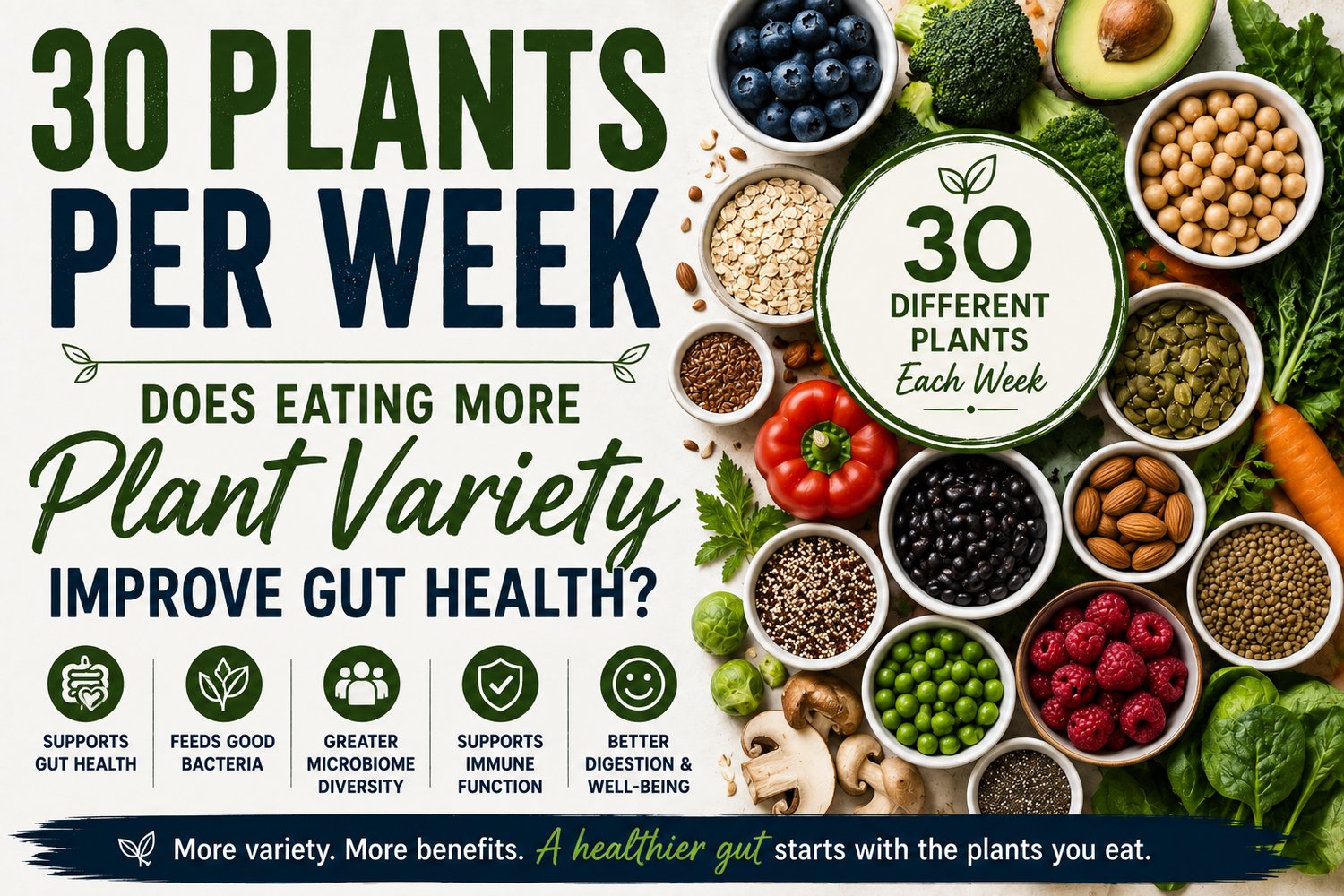
30 Plants Per Week: Does Eating More Plant Variety Improve Gut Health?
Complete Fiber & Gut Health Guide Hub
You've been working on fiber.
You've learned how much you need.
You've found high-fiber foods.
You've built better breakfasts and snacks.
You've learned how to build a high-fiber meal.
And maybe you've even started using a high-fiber meal plan.
Now we're going to change the question.
Instead of asking:
“How many grams of fiber did I eat?”
ask:
“How many different plants did I eat?”
That's the idea behind the increasingly popular:
30 plants per week challenge.
The concept largely traces back to research from the American Gut Project, a large citizen-science microbiome project.
Researchers found that people reporting more than 30 different plant types per week had greater gut microbial diversity than those reporting 10 or fewer.
Interesting?
Absolutely.
Proof that everyone needs exactly 30 plants every week?
No.
And that distinction matters.
So let's look at what the research actually found, what counts as a plant, and how you can use the idea without turning your grocery list into a competitive sport.
Where Did the “30 Plants Per Week” Idea Come From?
The number didn't originate with a wellness influencer.
It came from the American Gut Project, a large-scale citizen-science effort examining the human microbiome.
The 2018 research included microbiome samples and extensive lifestyle and dietary information from thousands of participants.
One of the findings that received considerable attention involved plant diversity.
Researchers compared people at opposite ends of plant consumption:
- More than 30 different plant types per week
- 10 or fewer different plant types per week
The people consuming more than 30 had differences in their gut microbial communities, including greater microbial diversity.
That finding eventually turned:
“People eating >30 plant types had greater microbial diversity than people eating ≤10”
into the much catchier:
“Eat 30 plants a week.”
But 30 Is Not a Magic Number
This needs to be clear.
The research does not establish that:
29 plants = unhealthy gut
while:
30 plants = healthy gut.
The original finding was an association comparing groups with very different levels of plant diversity.
It was not a randomized clinical trial demonstrating that increasing someone from 29 to 30 plants causes a specific health benefit.
A later systematic scoping review similarly described the evidence as an association between self-reported consumption of more than 30 plant foods and greater gut microbial diversity compared with 10 or fewer.
So don't treat 30 like a biological finish line.
Treat it as:
a useful challenge that encourages dietary variety.
Association Does Not Equal Causation
This is especially important with nutrition research.
People who eat:
30+ different plants every week
may differ from people who eat:
10 or fewer
in plenty of other ways.
They may have different:
- Overall diets
- Fiber intake
- Exercise habits
- Health behaviors
- Socioeconomic circumstances
- Food access
The American Gut Project was observational.
It found interesting relationships.
It did not randomly assign thousands of people to:
8 plants
versus:
34 plants
and prove that plant variety caused every microbiome difference.
That's why the appropriate takeaway is:
Greater plant variety appears to be associated with greater microbiome diversity.
Not:
30 plants will fix your gut.
Why Might Plant Variety Matter?
Your gut microbiome is an ecosystem.
Different microorganisms can use different dietary compounds.
And different plants provide different combinations of:
- Fibers
- Resistant starches
- Polyphenols
- Vitamins
- Minerals
- Other phytochemicals
Eating oats every day is useful.
Eating broccoli every day is useful.
Eating apples every day is useful.
But:
oats + broccoli + apples + lentils + walnuts + berries + barley + chickpeas
creates a much broader nutritional environment.
The Microsetta Initiative, which grew out of the American Gut research effort, explains that incorporating a greater diversity of plants contributes a wider pool of fiber types that may support a wider range of gut microbes.
That's the basic logic behind plant diversity.
Fiber Quantity and Plant Variety Are Different Goals
This is where things get interesting.
You could theoretically eat:
30 grams of fiber every day
from a relatively small group of foods.
For example:
- Oatmeal
- Beans
- Apples
- Broccoli
Repeat.
Repeat.
Repeat.
Your fiber intake could look excellent.
Your plant variety?
Not particularly impressive.
Conversely, someone could eat:
- Apple
- Banana
- Blueberries
- Spinach
- Tomato
- Pepper
- Onion
- Garlic
- Rice
- Oats
- Almonds
- Walnuts
- Chickpeas
and accumulate considerable variety.
These are related goals.
But they're not identical.
Don't Abandon Your Fiber Goal
Plant variety doesn't replace fiber.
This isn't:
“Stop counting fiber and count plants instead.”
Fiber remains an important part of a healthy dietary pattern.
Think of the two goals as complementary:
Fiber Goal
Am I eating enough fiber overall?
Plant Diversity Goal
Am I getting that fiber and other plant compounds from a variety of foods?
That's a much better framework.
What Counts as a Plant?
This is where people usually make the challenge unnecessarily difficult.
“Plant” does not mean:
vegetable.
Your weekly plant variety can come from multiple categories.
That includes:
Vegetables
Broccoli, carrots, spinach, peppers.
Fruit
Apples, pears, berries, bananas.
Legumes
Black beans, chickpeas, lentils, peas.
Whole Grains
Oats, barley, brown rice, whole wheat.
Nuts
Almonds, walnuts, pistachios.
Seeds
Chia, flax, pumpkin seeds, sunflower seeds.
Herbs and Spices
These are also plant foods, although there's no universally standardized scientific “plant point” scoring system for how every amount should be counted.
That's already a much bigger universe than:
“I have to eat 30 vegetables?”
No.
Thankfully.
Vegetables Count
This is the obvious category.
Examples:
- Broccoli
- Carrots
- Spinach
- Bell pepper
- Onion
- Tomato
- Brussels sprouts
- Asparagus
- Cabbage
- Cauliflower
Each different plant increases your variety.
And you don't need ten vegetables every week.
We're just showing how quickly the options add up.
Fruit Counts
Fruit makes the challenge dramatically easier.
Examples:
- Apple
- Banana
- Raspberry
- Blueberry
- Strawberry
- Pear
- Orange
- Kiwi
If you already eat fruit regularly, you may have more plant variety than you realize.
Instead of buying the same fruit every week, rotate.
Apples this week.
Pears next week.
Raspberries.
Oranges.
Kiwi.
Variety doesn't require larger portions.
It requires different foods.
Beans and Lentils Count
Legumes are especially useful because they provide:
fiber + plant protein + plant diversity.
Examples:
- Black beans
- Chickpeas
- Lentils
- Kidney beans
- Edamame
You don't need five cans open simultaneously.
Rotate them through meals.
Monday:
Black beans.
Wednesday:
Chickpeas.
Friday:
Lentils.
Suddenly you've added three plants.
Whole Grains Count Too
This is another category people forget.
Examples:
- Oats
- Barley
- Brown rice
- Whole wheat
- Quinoa
So your morning oatmeal?
Plant.
Your whole-grain bread?
Plant.
Your brown rice?
Plant.
The challenge gets much easier once you stop imagining 30 piles of vegetables.
Nuts and Seeds Count
Examples:
- Almonds
- Walnuts
- Pistachios
- Chia seeds
- Flaxseed
- Pumpkin seeds
A tablespoon of chia in breakfast and some almonds as a snack can increase variety without creating another meal.
That's exactly the kind of low-effort strategy we're looking for.
Herbs and Spices Can Add Variety
Herbs and spices come from plants too.
Think:
- Basil
- Oregano
- Parsley
- Cilantro
- Cinnamon
- Turmeric
- Cumin
- Paprika
But don't get obsessive about turning microscopic amounts of seasoning into a mathematical loophole.
If you're eating:
12 actual plant foods
and then counting 18 tiny sprinkles from the spice cabinet so you can declare victory?
You've probably missed the point.
The goal is:
a genuinely varied plant-rich diet.
Not winning at spreadsheet accounting.
Does Coffee Count?
Coffee comes from a plant.
Tea does too.
Cocoa does too.
But this is where “30 plant points” becomes fuzzier than people sometimes present it online.
The original American Gut research focused on reported plant types consumed, not a universally accepted scoring system defining exactly how coffee, spices, tiny portions and mixed foods must be counted.
So rather than debating whether coffee earns:
one point
or:
one-quarter point
I'd keep the challenge simple.
Focus primarily on meaningful variety from:
- Fruit
- Vegetables
- Whole grains
- Legumes
- Nuts
- Seeds
Then treat herbs, spices, coffee and tea as bonuses.
Does White Rice Count?
Rice is a plant.
But if the larger goal is improving dietary quality and fiber intake, whole grains generally provide more fiber than refined grains.
So yes:
Rice contributes plant variety.
But:
30 plant foods doesn't automatically mean a high-fiber diet.
That's another reason you should keep your fiber goal alongside your diversity goal.
Does Potato Count?
Yes.
Potatoes are plants.
So are:
- Sweet potatoes
- Corn
- Peas
You don't need to exclude starchy vegetables from the challenge because somebody on social media decided they're “basically carbs.”
Plants contain carbohydrates.
That's normal.
Do Different Colors of the Same Food Count Separately?
Don't make this harder than it needs to be.
Red bell pepper and yellow bell pepper are varieties of the same plant.
Different varieties can have different phytochemical profiles.
But again, there is no universally accepted official 30-plant scoring authority determining every edge case.
For practical tracking, I'd count:
bell pepper = one plant
and move on.
This keeps the system honest and simple.
What About Mixed Foods?
Mixed foods can make plant variety incredibly easy.
Consider chili containing:
- Kidney beans
- Black beans
- Tomato
- Onion
- Bell pepper
- Corn
- Garlic
That's:
seven different plants
in one meal.
A stir-fry might contain:
- Brown rice
- Broccoli
- Carrots
- Peppers
- Peas
- Onion
- Garlic
- Edamame
That's another large chunk of your weekly variety.
You don't need 30 separate meals.
You need varied ingredients.
Why Mixed Meals Are the Secret
This is probably the easiest way to make the challenge practical.
Think:
Chili
Multiple beans + vegetables.
Stir-Fry
Several vegetables + grain.
Oatmeal
Oats + berries + chia + nuts.
Salad
Greens + chickpeas + vegetables + seeds.
Tacos
Beans + corn + avocado + tomato + lettuce.
One meal can contribute:
4–8 plants
without being complicated.
Breakfast Can Get You Surprisingly Far
Example:
Oatmeal Bowl
Oats.
Raspberries.
Blueberries.
Chia.
Walnuts.
That's:
5 plants
before you've finished breakfast.
Tomorrow, change the toppings.
Oats.
Banana.
Strawberries.
Flax.
Almonds.
Now you've introduced four additional plants while keeping the same basic breakfast.
Stop Eating the Same “Healthy” Breakfast Every Day
This is a subtle problem.
You find a healthy breakfast you like:
oatmeal + blueberries + chia
and eat it 365 days per year.
Nothing wrong with those foods.
But if variety is the goal, occasionally rotate:
Fruit
Blueberries → raspberries → strawberries → banana → apple.
Nuts
Walnuts → almonds → pistachios.
Seeds
Chia → flax → pumpkin seeds.
Same breakfast structure.
More diversity.
Lunch Can Add Another 5–8 Plants
Example burrito bowl:
- Brown rice
- Black beans
- Corn
- Tomato
- Lettuce
- Bell pepper
- Avocado
- Cilantro
That's potentially:
eight plant foods
in one lunch.
Add chicken if you want.
Plant diversity does not require being vegetarian or vegan.
The original American Gut analysis found plant diversity to be informative beyond broad diet labels such as vegan or omnivore.
You Don't Have to Stop Eating Meat
This is worth emphasizing.
The 30-plants idea is about:
adding plant diversity.
Not necessarily:
removing animal foods.
You can eat:
Chicken + beans + rice + peppers.
Salmon + barley + broccoli.
Eggs + whole-grain toast + avocado.
Greek yogurt + oats + berries.
You're still increasing plant variety.
Dinner Can Do the Heavy Lifting
Dinner is perfect for:
- Soups
- Chili
- Stir-fries
- Grain bowls
- Tacos
- Pasta dishes
- Curries
These naturally combine multiple plants.
Instead of:
chicken + rice
try:
chicken + rice + black beans + peppers + corn + avocado.
Same basic dinner category.
Much more diversity.
Snacks Count Too
Your snack can add a plant without requiring any cooking.
Examples:
Monday
Apple.
Tuesday
Pear.
Wednesday
Pistachios.
Thursday
Carrots + hummus.
Friday
Popcorn.
Saturday
Orange.
Sunday
Almonds.
That's several different plants just from snacks.
And if you need more snack ideas, use High-Fiber Snacks: 25 Easy Ideas to Help You Reach Your Daily Fiber Goal.
A Sample 30-Plant Week
Let's make this concrete.
Suppose you eat these foods throughout the week:
Whole Grains
- Oats
- Brown rice
- Whole wheat
- Barley
- Corn
Legumes
- Black beans
- Chickpeas
- Lentils
- Kidney beans
- Edamame
Fruit
- Apple
- Banana
- Raspberry
- Blueberry
- Strawberry
- Pear
- Orange
Vegetables
- Broccoli
- Carrot
- Spinach
- Bell pepper
- Tomato
- Onion
- Brussels sprouts
- Avocado
Nuts & Seeds
- Almonds
- Walnuts
- Chia
- Flax
- Pumpkin seeds
Done.
And notice:
You didn't need 30 exotic ingredients.
Most of those foods are available in an ordinary grocery store.
You Only Need About 4–5 Different Plants Per Day
Thirty sounds enormous.
But spread across seven days:
30 ÷ 7 = about 4.3
Obviously, you don't need four completely new plants every day because foods will repeat.
But it shows why the goal is less intimidating than it sounds.
A single mixed meal might contain:
six different plants.
You're not eating 30 plants every day.
You're accumulating variety across the week.
Repetition Is Still Fine
Do not misunderstand the challenge.
If you love broccoli?
Keep eating broccoli.
If oatmeal is your favorite breakfast?
Keep eating oatmeal.
The goal isn't:
Never repeat a plant.
It's:
Keep your reliable foods while introducing additional variety around them.
Think:
core foods + rotation.
The “5 + 5 + 5 + 5 + 5 + 5” Method
Here's an easy way to think about 30.
Aim for roughly:
5 Fruits
Apple, banana, berries, pear, orange.
5 Vegetables
Broccoli, carrots, peppers, spinach, tomato.
5 Legumes
Black beans, chickpeas, lentils, kidney beans, edamame.
5 Grains
Oats, brown rice, barley, corn, whole wheat.
5 Nuts/Seeds
Almonds, walnuts, chia, flax, pumpkin seeds.
5 Extras
Avocado, onion, garlic, herbs, another fruit or vegetable.
There's your 30.
Not a rule.
Just an easy planning framework.
Start With 15 If 30 Sounds Ridiculous
This is probably the most important practical advice in the article.
If you currently eat:
8 different plants per week
don't decide you're failing because you didn't hit 30.
Try:
12.
Then:
15.
Then:
20.
The exact number isn't the point.
Moving toward greater variety is.
The American Gut research compared extremes—more than 30 versus 10 or fewer—rather than proving that 30 is a required threshold.
Your First Goal Should Be Your Baseline + 5
This is my favorite way to approach the challenge.
Track one normal week.
Suppose you eat:
13 different plants.
Next week aim for:
18.
How?
Add:
- Pear
- Chickpeas
- Walnuts
- Barley
- Brussels sprouts
Done.
That's much less intimidating than trying to rebuild your diet around 30 unfamiliar foods.
Rotate One Food From Each Category
Another easy strategy:
Instead of buying:
apples every week
rotate:
Apple → pear → orange → kiwi.
Instead of:
broccoli every night
rotate:
Broccoli → Brussels sprouts → carrots → asparagus.
Instead of:
black beans every time
rotate:
Black beans → chickpeas → lentils → kidney beans.
Your diet stays familiar.
Your plant diversity increases.
Buy Mixed Frozen Vegetables
This might be the easiest cheat code in the entire challenge.
A frozen vegetable blend may contain:
- Broccoli
- Carrots
- Peas
- Corn
- Green beans
- Peppers
One bag.
Six plants.
Use it in:
- Stir-fry
- Soup
- Rice bowls
- Pasta
You don't need six separate produce bags slowly dying in your refrigerator.
Buy Frozen Mixed Berries
Same idea.
Instead of:
only blueberries
buy a blend containing:
- Blueberries
- Raspberries
- Strawberries
- Blackberries
Add it to:
- Oatmeal
- Yogurt
- Smoothies
That's an extremely easy way to increase variety.
Mixed Nuts and Seeds Work Too
Instead of always buying almonds, try a mixture containing:
- Almonds
- Walnuts
- Pistachios
- Cashews
- Pumpkin seeds
Watch portion sizes because nuts and seeds are calorie-dense.
But for variety?
Very efficient.
Soup Is Another Plant-Diversity Shortcut
Imagine a soup containing:
- Lentils
- Tomato
- Carrot
- Celery
- Onion
- Garlic
- Spinach
- Barley
That's:
eight plant foods
in one bowl.
Make a large batch.
Eat it several times.
You only count each plant once for your weekly variety, but you're still repeatedly eating the fiber and nutrients those foods provide.
Chili Works the Same Way
A basic chili might contain:
- Kidney beans
- Black beans
- Tomato
- Onion
- Bell pepper
- Corn
- Garlic
That's seven.
Add:
- Avocado
- Cilantro
and you're at nine.
This is why you don't need 30 different recipes.
You need recipes containing multiple plants.
Don't Buy 30 Ingredients That You'll Throw Away
Please don't interpret this challenge as:
“Go buy 30 different fresh vegetables on Sunday.”
That's a fantastic way to:
Spend $120.
Eat nine of them.
Throw away the rest.
Instead use:
- Frozen produce
- Canned beans
- Whole grains
- Nuts
- Seeds
- Shelf-stable foods
Then add a manageable amount of fresh produce.
Plant diversity can be practical and inexpensive.
Use Your Pantry
You may already have plants you aren't counting.
Check for:
- Oatmeal
- Popcorn
- Rice
- Beans
- Lentils
- Peanut butter
- Nuts
- Seeds
- Whole-grain pasta
- Canned tomatoes
- Corn
You might discover you're closer to 30 than you thought.
Plant Variety Can Also Improve Nutrient Variety
Different plants provide different nutrient profiles.
For example:
Berries aren't nutritionally identical to beans.
Beans aren't identical to oats.
Oats aren't identical to broccoli.
Broccoli isn't identical to walnuts.
Increasing plant diversity naturally exposes you to a broader variety of:
- Vitamins
- Minerals
- Fibers
- Phytochemicals
That's another reason dietary variety is useful beyond simply chasing a microbiome number.
What Did the American Gut Study Actually Find Besides Diversity?
The study found several differences between people at the extremes of plant consumption.
Those consuming more than 30 plant types per week versus 10 or fewer had differences in:
- Microbial composition
- Fecal metabolites
- Antibiotic resistance genes
The researchers reported lower abundance of certain antibiotic resistance genes among the higher plant-diversity group.
That's scientifically interesting.
But again:
It doesn't mean eating broccoli, oats and 28 friends is a treatment for antibiotic resistance.
Observational findings generate useful hypotheses.
They don't justify exaggerated health promises.
More Microbiome Diversity Isn't Automatically “Better” in Every Situation
You'll often see:
more diverse microbiome = healthier microbiome
presented as an absolute rule.
Reality is more complicated.
Microbial diversity is one useful characteristic researchers study, but scientists still don't have a single universally accepted definition of the perfect healthy microbiome.
So the practical recommendation isn't:
Maximize bacterial diversity at all costs.
It's:
Eat a varied, fiber-rich diet because that's a well-supported dietary pattern, and greater plant variety may also support a more diverse gut microbial ecosystem.
Much more defensible.
Don't Turn Gut Health Into Another Restrictive Diet
This challenge should make your diet:
more varied.
Not more restrictive.
If you find yourself worrying because:
You only hit 27 plants this week...
you've taken a useful idea and turned it into unnecessary stress.
Eat the 27.
You're doing fine.
What If You Have Digestive Symptoms?
Increasing plant variety often means increasing:
- Fiber
- Fermentable carbohydrates
- Legumes
- Whole grains
If you increase all of those quickly, you may experience:
- Gas
- Bloating
- Changes in bowel movements
That doesn't necessarily mean plant variety is bad for you.
It may mean:
you changed too much too quickly.
Use the same gradual approach we discussed in How to Increase Fiber Without Bloating, Gas or Digestive Discomfort.
Don't Force Foods That Consistently Cause Problems
Plant diversity doesn't mean you must eat:
every plant.
If a particular food repeatedly causes significant symptoms, you don't get extra points for suffering through it.
Choose from the enormous number of other options.
And if digestive symptoms are persistent, severe or unexplained, discuss them with an appropriate healthcare professional rather than trying to solve everything with diet experiments.
Track Symptoms if You Need To
If you're increasing both fiber and plant variety and can't tell what causes digestive discomfort, the Bloating, Digestion & Food Trigger Tracker can help you track:
- Foods
- Fiber
- Symptoms
- Bowel habits
- Patterns over time
That can help you distinguish:
“Plant foods bother me”
from:
“Large servings of these two particular foods seem to bother me.”
Those are very different conclusions.
The 30 Plants Per Week Challenge
Want to try it?
Here's the rule:
For seven days, write down every different plant food you eat.
Count each plant once.
If you eat blueberries:
Monday + Tuesday + Thursday?
Still:
one plant.
If Wednesday you eat raspberries?
Now:
two.
Keep accumulating unique plants until the week ends.
Then count them.
Don't Change Anything During Week One
This is important.
For your first week:
just track.
Don't deliberately buy 30 foods.
Find your baseline.
Maybe you're already eating:
22 plants.
Then reaching 30 is easy.
Maybe you're eating:
9.
Then your next target doesn't need to be 30.
Aim for:
14–15.
This turns the challenge into useful information rather than another pass/fail diet.
Week Two: Add Five Plants
Once you know your baseline, choose five additions.
Example:
Plant 1
Raspberries.
Plant 2
Lentils.
Plant 3
Walnuts.
Plant 4
Barley.
Plant 5
Brussels sprouts.
That's it.
You don't need a new cookbook.
Week Three: Rotate Five More
Next week:
Swap a few foods.
Blueberries instead of raspberries.
Chickpeas instead of black beans.
Pistachios instead of almonds.
Quinoa instead of brown rice.
Pear instead of apple.
Now you're naturally building a broader rotation.
Make Plant Diversity a Game
This is one nutrition habit where gamification actually works pretty well.
Instead of:
“I can't eat that.”
the challenge becomes:
“What can I add?”
That's a much healthier framing.
You're looking for opportunities.
Not restrictions.
Keep a Running List on the Refrigerator
Write:
PLANTS THIS WEEK
Then list them:
- Oats
- Banana
- Blueberries
- Chia
- Almonds
- Broccoli
- Brown rice
Continue throughout the week.
Kids can participate too.
Suddenly grocery shopping becomes:
“We haven't had kiwi this week.”
rather than:
“We need to eat healthier.”
Much more actionable.
Want a Dedicated Tracker?
This is exactly what the 30 Plants Per Week Challenge | Gut Health Plant Diversity Tracker + Excel Dashboard is designed to do.
It gives you a structured way to track:
- Weekly plant variety
- Different plant foods
- Your progress toward 30
- Patterns over time
Instead of trying to remember whether you ate chickpeas on Tuesday, you can actually see your weekly variety.
Track Fiber and Plant Variety Together
This is where the system gets even more useful.
You could track:
Fiber
27 grams today
and:
Plant Variety
18 unique plants so far this week
Those numbers answer two different questions.
The High-Fiber Meal Builder & 30-Day Fiber Tracker can help with the fiber side.
The 30 Plants Per Week Challenge handles the diversity side.
Together, you're looking at both:
quantity + variety.
Or Start Free
If you're not ready for a full tracking system, the FREE 7-Day Fiber & Gut Health Kickstart includes tools to start paying attention to both fiber and plant variety.
Seven days is enough to establish your baseline.
Then decide whether you actually need anything more complicated.
Frequently Asked Questions
What is the 30 plants per week rule?
It's a popular gut-health challenge based largely on findings from the American Gut Project.
Researchers found that participants reporting more than 30 different plant types per week had greater gut microbial diversity than participants reporting 10 or fewer.
Thirty should be viewed as a practical diversity target rather than a proven biological requirement.
Do I need to eat 30 plants every week?
No evidence establishes that every person must eat exactly 30 different plants every week to be healthy.
The number comes from an observational comparison between people eating more than 30 versus 10 or fewer plant types.
Increasing variety from your current baseline can be a more practical goal.
What foods count toward 30 plants?
Plant foods can include:
- Vegetables
- Fruit
- Legumes
- Whole grains
- Nuts
- Seeds
- Herbs
- Spices
For practical tracking, focus primarily on meaningful portions of whole or minimally processed plant foods rather than obsessing over tiny amounts.
Do beans count toward 30 plants?
Yes.
Different legumes such as:
- Black beans
- Chickpeas
- Lentils
- Kidney beans
- Edamame
can all contribute to dietary plant variety.
They're especially useful because they also provide fiber and plant protein.
Do grains count as plants?
Yes.
Whole grains such as:
- Oats
- Brown rice
- Barley
- Whole wheat
- Quinoa
are plant foods and can contribute to dietary diversity.
Do nuts and seeds count?
Yes.
Examples include:
- Almonds
- Walnuts
- Pistachios
- Chia
- Flax
- Pumpkin seeds
They're easy ways to add variety, although portions matter because nuts and seeds can be calorie-dense.
Do herbs and spices count toward 30 plants?
Herbs and spices are plant foods.
However, there is no universally standardized scientific plant-point scoring system defining exactly how tiny quantities should be counted.
Use them to increase variety, but don't rely on tiny amounts of spices as the primary way to reach 30.
Does coffee count as a plant?
Coffee comes from a plant, as do tea and cocoa.
But rather than debating scoring technicalities, focus your challenge primarily on diverse fruits, vegetables, legumes, whole grains, nuts and seeds.
That's more consistent with the underlying goal.
Can I eat meat and still do the 30-plants challenge?
Absolutely.
You don't need to be vegan or vegetarian.
You can eat:
- Chicken
- Beef
- Fish
- Eggs
- Dairy
while increasing the variety of plant foods eaten alongside them.
The challenge is about adding diversity, not necessarily eliminating animal foods.
Is 30 plants per week better than eating enough fiber?
They're different goals.
Fiber intake measures the quantity of dietary fiber you consume.
Plant diversity measures the variety of plant foods in your diet.
Ideally, focus on both rather than treating one as a replacement for the other.
Key Takeaways
- The 30-plants-per-week idea largely comes from the American Gut Project.
- Researchers found that people consuming more than 30 different plant types per week had greater gut microbial diversity than people consuming 10 or fewer.
- The study was observational, so it does not prove that eating exactly 30 plants causes better health.
- Thirty is not a magic threshold.
- Plant diversity and fiber intake are related but different goals.
- Fruits count.
- Vegetables count.
- Legumes count.
- Whole grains count.
- Nuts and seeds count.
- Herbs and spices can contribute variety too.
- You do not need to eat 30 vegetables.
- You do not need to become vegetarian.
- Mixed meals such as chili, stir-fry, soups and grain bowls make plant diversity much easier.
- Frozen mixed vegetables and berries are easy shortcuts.
- Start by tracking your current plant variety.
- If you're nowhere near 30, try adding five new plants rather than changing everything at once.
- Increase fiber-rich foods gradually if your digestive system isn't accustomed to them.
- Plant diversity should encourage more variety, not create another restrictive diet.
Final Thoughts
Thirty plants sounds ridiculous when you first hear it.
Then you actually count.
Oats.
Blueberries.
Chia.
Walnuts.
Apple.
Whole wheat.
Black beans.
Rice.
Tomato.
Pepper.
Onion.
Avocado.
Broccoli.
Potato.
Carrots.
Suddenly you're halfway there without doing anything particularly strange.
And that's what I like about the concept.
Not the number.
The behavior it encourages.
Instead of asking:
“What's the one best food for gut health?”
you start asking:
“What else can I add?”
Another fruit.
A different bean.
A different grain.
A handful of nuts.
A vegetable you haven't eaten this week.
Over time, you create a diet that's not only higher in fiber but also broader and more varied.
And that's a far more useful goal than hunting for one magical gut-health food.
Continue the Fiber & Gut Health Series
Recent articles:
- How to Build a High-Fiber Meal: A Simple Formula for Breakfast, Lunch & Dinner
- High-Fiber Meal Plan: How to Eat More Fiber Without Overhauling Your Diet
Next in the series:
How to Eat More Plant Variety: Simple Ways to Add More Fruits, Vegetables, Beans, Grains, Nuts & Seeds
Then we'll move into:
Fiber and Bloating: Can Too Much Fiber Make You Bloated?
Educational Disclaimer
This article is intended for educational purposes only and should not be considered individualized medical or nutrition advice. Diet and fiber tolerance vary, particularly for people with gastrointestinal conditions or specific dietary restrictions. If increasing fiber or plant variety causes persistent or significant digestive symptoms, seek guidance from an appropriate healthcare professional.