

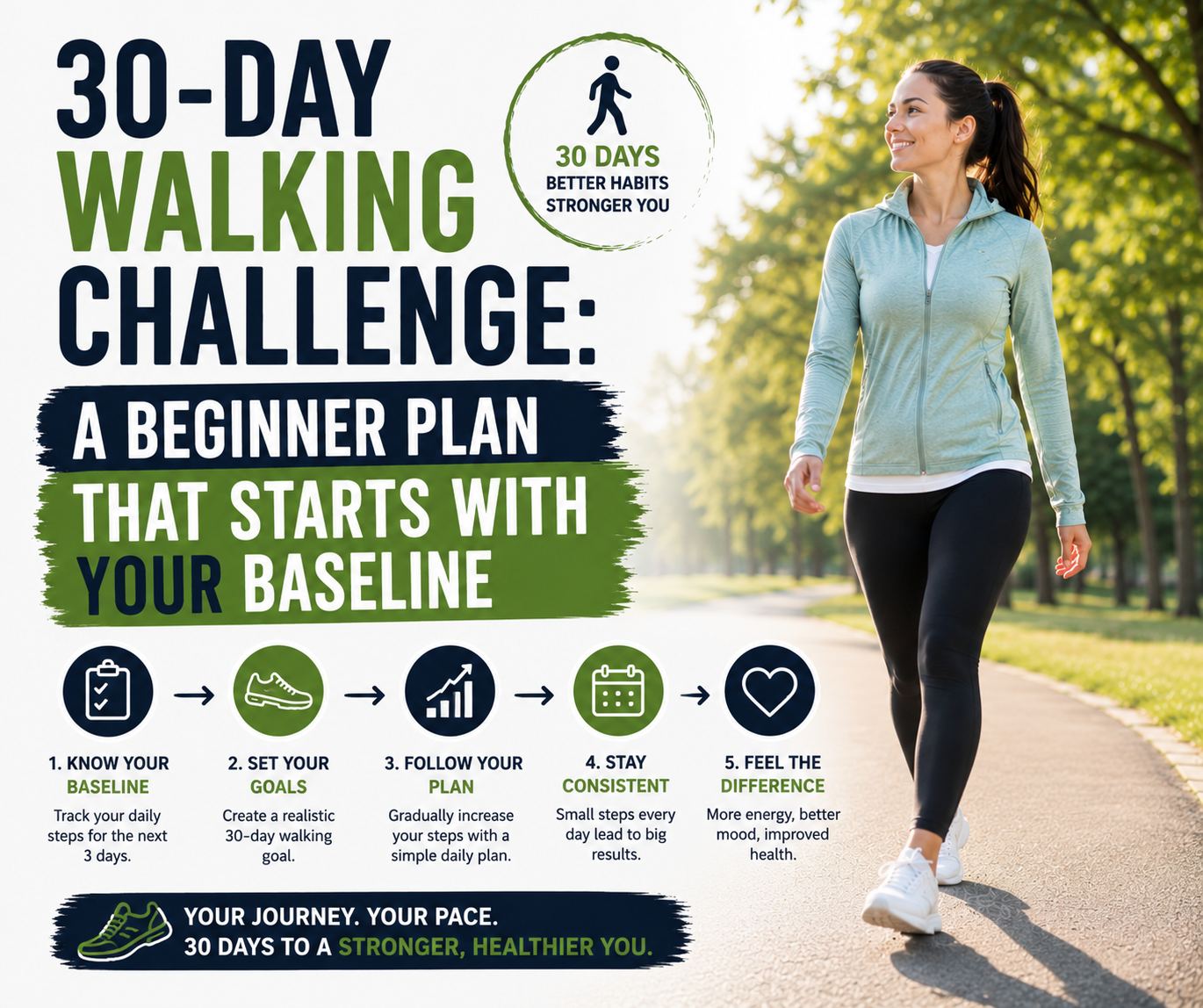
30-Day Walking Challenge: A Beginner Plan That Starts With Your Baseline
If you're looking for a 30-day walking challenge, you probably don't need another calendar telling everyone to walk the exact same number of minutes or steps.
Someone averaging 2,500 steps a day should not necessarily start with the same walking challenge as someone already averaging 8,000.
That's why this 30-day walking challenge starts differently:
First, figure out where you are now. Then choose the walking plan that fits your actual starting point.
Over the next 30 days, you'll gradually increase your walking without requiring 10,000 steps, hour-long workouts, or a perfect daily streak.
You'll choose one of three tracks:
Track A — Starting From Mostly Inactive
Track B — Already Moving Some
Track C — Already Walking Regularly
And at the end of 30 days, you won't simply declare:
Challenge complete!
You'll use what happened to decide what comes next.
Maintain → Progress → Adjust
That's the part most walking challenges forget.
Quick Answer: How Does This 30-Day Walking Challenge Work?
Start by tracking your normal activity for several days.
Then choose the track that most closely resembles your current walking level.
Track A is for people doing little purposeful walking now.
Track B is for people who already move somewhat but don't have a consistent walking routine.
Track C is for people already walking regularly who want more structure.
You then follow a gradual four-week progression while tracking your walking.
The goal is not to see how much walking you can survive for 30 days.
The goal is to leave Day 30 with a routine you could realistically continue on Day 31.
That approach lines up with current U.S. physical-activity guidance, which specifically recommends that people who are inactive start with smaller amounts and gradually build toward the recommended activity level rather than feeling obligated to begin immediately with 150 minutes per week.
Why Most 30-Day Walking Challenges Get This Wrong
A typical walking challenge might look something like:
Day 1: 5,000 steps
Day 10: 8,000 steps
Day 30: 12,000 steps
But why?
Where did those numbers come from?
And why should they apply equally to:
a sedentary beginner,
someone working on their feet all day,
and an experienced walker?
They shouldn't.
Research on walking interventions shows that goals and step monitoring can absolutely influence how much people move. Studies using pedometers, self-monitoring, and walking goals have successfully increased daily walking.
But that doesn't mean one universal step target is best for everybody.
So we're going to build the challenge around something much more useful:
your baseline.
Before Day 1: Establish Your Walking Baseline
Before you start deliberately walking more, spend several normal days observing what you're already doing.
Ideally, use about seven days so weekdays and weekends are represented.
If your phone or watch already tracks steps, record your daily totals.
Also notice:
How many purposeful walks are you taking?
How long can you comfortably walk now?
Does a 10-minute walk feel easy, moderate, or challenging?
When during your day is walking easiest?
What usually prevents you from walking?
Don't try to impress your tracker during baseline week.
If you normally average 4,200 steps, don't suddenly start pacing around the house because now someone is watching.
😂
We want your real starting point.
Calculate Your Baseline
Suppose your week looks like this:
Monday: 3,700 steps
Tuesday: 4,200
Wednesday: 3,900
Thursday: 4,600
Friday: 4,100
Saturday: 5,500
Sunday: 3,800
Your approximate daily average is:
4,257 steps
Call it roughly:
4,300 steps per day.
That's far more useful than automatically deciding you “should” walk 10,000.
Your starting point is:
4,300.
Now we build from there.
If you want the deeper evidence behind daily step targets and why 10,000 isn't a magic threshold, read How Many Steps Do You Actually Need?.
Choose Your 30-Day Walking Challenge Track
Use these as practical descriptions, not medical classifications.
Track A: Starting From Mostly Inactive
Choose this if purposeful walking is uncommon, your daily activity is relatively low, or even 15–20 continuous minutes currently feels like a meaningful workout.
Your challenge is primarily about:
building the walking habit and gradually increasing tolerance.
Track B: Already Moving Some
Choose this if you already accumulate some daily movement and can comfortably walk for roughly 20–30 minutes, but your walking is inconsistent or unstructured.
Your challenge is primarily about:
building consistent weekly walking volume.
Track C: Already Walking Regularly
Choose this if you already walk purposefully several days per week and can comfortably complete 30-minute sessions.
Your challenge is primarily about:
adding structure, progression, and variety rather than simply adding more steps.
Don't pick Track C because it sounds more advanced.
Pick the track that most closely matches what you're actually doing now.
Track A: 30-Day Beginner Walking Challenge
This is for the true beginner.
Your job during Month 1 is not to become an endurance athlete.
It's to make regular walking feel normal.
Days 1–7: Start Small
Walk for approximately:
10 minutes on four days this week.
Keep the pace comfortable.
Don't worry about:
speed,
Zone 2,
calories,
distance,
or how many steps your neighbor gets.
Finish feeling like:
I could have done a little more.
That's intentional.
You are building capacity, not testing your limits.
Days 8–14: Add a Little Time
Now aim for:
12–15 minutes on four days.
If 10 minutes still feels difficult, stay there longer.
There is no penalty for repeating the first week.
Federal guidance specifically notes that inactive adults benefit from beginning with small amounts and gradually building as fitness improves.
The goal is progression.
Not rushing.
Days 15–21: Reach 15–20 Minutes
This week:
Walk 15–20 minutes on four days.
Make one walk slightly more purposeful if you're comfortable doing so.
That could mean:
walking a little faster,
choosing a slightly hillier route,
or simply walking continuously without long pauses.
The other sessions can stay easy.
Days 22–30: Build Toward a Repeatable Routine
Aim for:
20 minutes on four or five days.
One session can be slightly longer or brisker if the previous weeks felt manageable.
But Day 30 does not require some heroic finale.
You don't need:
FINAL CHALLENGE: WALK 10 MILES THROUGH THE DESERT.
😂
Day 30 should look a lot like the routine you could continue afterward.
That's the point.
Track B: 30-Day Walking Challenge for Someone Already Somewhat Active
You're not starting from zero.
So your challenge can focus more on weekly structure.
Days 1–7
Complete:
Three 25-minute walks
plus:
one short 10–15 minute walk.
Keep most of them comfortable.
Your weekly purposeful walking total will be approximately:
85–90 minutes.
Days 8–14
Complete:
Three 30-minute walks
plus:
one short 10–15 minute walk.
Now you're around:
100 minutes of purposeful walking.
Notice that we're increasing gradually instead of instantly demanding 210 minutes because “30 minutes every day” sounds catchy.
Days 15–21
Complete:
Two 30-minute comfortable walks
one 30-minute brisk walk
and:
one 20-minute easier walk.
That's roughly:
110 minutes.
Now different walks have different purposes.
Days 22–30
Complete:
Two 30-minute walks
one 35-minute purposeful aerobic walk
and:
one 25-minute comfortable or recreational walk.
That's approximately:
120 minutes.
You may decide after the challenge to continue gradually building toward the general recommendation of at least 150 minutes of moderate aerobic activity per week.
But you don't need to arrive there by force on Day 30.
Track C: 30-Day Walking Challenge for Regular Walkers
If you're already walking, simply telling you:
Walk more!
isn't especially useful.
So this track introduces variation.
Days 1–7
Complete your normal walking routine.
But establish a baseline for:
weekly walking minutes, average daily steps, and one repeatable walking route.
Don't increase anything yet.
We're measuring.
Days 8–14
Keep most of your normal walking.
Make one session more purposeful.
That might mean:
a brisk walk,
a Zone 2-style aerobic walk,
or a hillier route.
If you're unsure whether your walking is actually reaching an appropriate aerobic intensity, read Does Walking Count as Zone 2 Cardio? How to Know If You’re Actually in Zone 2.
Days 15–21
Keep your normal walking volume.
Progress one variable.
Maybe add:
five minutes to one or two sessions,
a small amount of incline,
several brisk intervals,
or one additional short walk.
Not all four.
Days 22–30
This week is about stabilization.
Maintain your new structure rather than continuing to escalate.
Your routine might now contain:
easy walking,
one brisk session,
one longer session,
and possibly one structured aerobic or Zone 2-style session.
The goal is to see whether your slightly more structured program is something you can actually recover from and repeat.
What Counts as a Walking Day?
This challenge doesn't require every walk to be a formal workout.
A walking day might be:
30 minutes around your neighborhood
or:
15 minutes during lunch + 10 minutes after dinner.
Current physical-activity guidance allows aerobic activity to be accumulated throughout the week and does not require every useful bout to last 10 minutes or longer.
That gives you flexibility.
Because some days:
one long walk works.
Other days:
three short walks work better.
Both are movement.
What If You Prefer a Step-Based 30-Day Walking Challenge?
That's completely fine.
Instead of walking minutes, use your baseline step count.
Suppose your baseline is:
4,500 steps/day.
You might spend the first part of the challenge around:
5,000–5,500.
Then once that feels normal, gradually increase again.
There's no need to leap immediately to 10,000.
In fact, walking research using individualized or progressive step goals shows that monitoring steps and deliberately increasing them can effectively raise physical activity.
If you want an entire experiment built around one simple increase, use:
What Happens If You Add 1,000 Steps a Day? A Practical 30-Day Walking Experiment
What Should You Track During the Challenge?
You don't need to turn your walking challenge into an accounting job.
Track enough to answer:
Am I actually becoming more active, and is this routine working?
A simple 30-day record can include:
Date | Walking Minutes | Steps | Walk Completed? | Effort | Notes
Then once per week, record:
Weekly walking minutes
Average daily steps
Number of planned walks completed
Energy
Any recurring soreness or pain
Biggest barrier
Biggest win
That's enough data to learn something.
The HabitLogics Weekly Challenge Check-In
At the end of each week, don't just ask:
Did I complete every day?
Ask four better questions.
Did I complete most of what I planned?
If yes, your plan may be appropriately sized.
How difficult was the routine to fit into my life?
A physically easy routine can still be logistically impossible.
How well did I recover?
Look for accumulating fatigue, foot discomfort, joint irritation, or declining energy.
Could I repeat this exact week again?
This may be the most important question.
Because a walking challenge only matters if some version of it survives after the challenge ends.
Missing One Day Does Not Reset the Challenge
You will probably miss something.
Maybe it rains.
Maybe work explodes.
Maybe you're tired.
Maybe someone needs you.
Maybe you simply forget.
Don't turn:
one missed walk
into:
challenge failed.
Use a simple rule:
Return at the next reasonable opportunity.
You do not need to:
double tomorrow's walk,
restart at Day 1,
punish yourself,
or wait until Monday.
Thirty-day challenges sometimes accidentally teach people to protect streaks instead of build habits.
We're interested in something more useful:
how quickly can you return?
Use a Minimum Walk for Difficult Days
Create a smaller version of the challenge.
Maybe your normal session is:
25 minutes.
Your minimum might be:
5–10 minutes.
That minimum doesn't provide the same training effect as your full walk.
It isn't supposed to.
Its job is to give you an option between:
full workout
and:
zero.
This is especially useful for establishing the behavior.
For deeper consistency strategies, read How to Stay Consistent With Walking: 12 Strategies That Actually Work.
Create Your Weather Backup Now
If your challenge lasts 30 days, you're probably going to encounter inconvenient weather.
So decide ahead of time.
Rain?
Indoor walking.
Heat?
Earlier, later, shaded, or indoors.
Cold?
Appropriate clothing or indoor option.
Snow or ice?
Don't risk falling just to protect a walking streak.
Indoor options can include a treadmill, walking pad, mall, large store, indoor track, hallway, or simply walking through your house.
A challenge that works only in perfect weather isn't much of a plan.
Should You Walk Every Day for 30 Days?
You can.
But this challenge does not require it.
That matters.
Walking is often well tolerated, but daily purposeful walking isn't automatically necessary.
A challenge based around four or five walking days can still dramatically increase activity for someone currently doing almost none.
CDC guidance emphasizes the weekly activity total and says activity can be spread throughout the week.
So don't turn “30-day walking challenge” into:
30 mandatory workouts with no flexibility.
Thirty days describes the length of the experiment.
Not the number of required walking sessions.
How Hard Should You Walk?
Most of this challenge should feel manageable.
Use your breathing as a rough guide.
An easy walk should allow normal conversation with relatively comfortable breathing.
A purposeful moderate walk should increase breathing while still allowing you to speak.
A much harder effort makes conversation substantially more difficult.
You do not need every walking challenge session to be hard.
In fact, making every walk progressively harder is a great way to turn simple walking into another exercise program you eventually dread.
Can You Use Zone 2 Walking in the Challenge?
Absolutely.
But you don't need to.
For a beginner, simply establishing regular walking is enough.
For Track B or C, one purposeful aerobic session could be useful.
If you want to understand Zone 2 more deeply, use the Complete Zone 2 Walking Guide.
And if the specific question is whether your walk actually qualifies, read Does Walking Count as Zone 2 Cardio?.
Should You Walk 30 Minutes Every Day Instead?
That's another perfectly reasonable challenge.
Thirty minutes every day gives you a very simple standardized dose:
30 minutes × 30 days.
And we built a separate HabitLogics experiment around exactly that question.
If you'd rather test a consistent daily walking duration instead of following a progressive plan, read:
Walking 30 Minutes a Day: What Can Actually Change in 30 Days?
That experiment uses a Day 1 vs. Day 30 benchmark to compare walking distance, perceived effort, steps and optional heart rate.
What About 10,000 Steps During the Challenge?
You don't need them.
Ten thousand can be a perfectly good target for someone whose baseline makes it realistic.
But there is no universal requirement that a successful 30-day walking challenge end at 10,000 steps.
If your baseline is:
3,000
and after a month you're consistently averaging:
5,000
you've increased your normal movement substantially.
That deserves more credit than repeatedly chasing 10,000, missing it and quitting.
Walking Challenge for Weight Loss
Many people will find this article because weight loss is the goal.
Walking can absolutely contribute.
It increases your activity and energy expenditure.
But a 30-day walking challenge does not guarantee a specific amount of weight loss.
Your results also depend on things like:
nutrition,
total energy intake,
other daily movement,
sleep,
medications,
body size,
and individual physiology.
So avoid turning your challenge into:
I walked 8,000 steps. Why isn't the scale cooperating?!
Look at the whole system.
For the full breakdown, read Is Walking Enough to Lose Weight?.
Add Protein If Weight Loss Is Your Goal
If you're trying to lose weight, walking can address the movement side while protein can support meal satisfaction and lean-tissue retention.
That doesn't mean you need a protein shake after every walk.
It means your overall eating pattern matters too.
Read Walking and Protein for Weight Loss: Why They Work Better Together.
You can also use the Complete High-Protein Guide.
Don't Skip Strength Training Forever
Walking is excellent aerobic activity.
It is not a complete replacement for strength training.
Current adult guidelines recommend at least 150 minutes of moderate-intensity aerobic activity per week and muscle-strengthening work on at least two days per week.
You don't need to add two intense lifting sessions during Week 1 if you're completely inactive and overwhelmed.
But eventually, a well-rounded activity plan should include muscular work too.
Walking and strength training serve different purposes.
The Day 1 Walking Benchmark
Before the challenge starts, complete one walk that you can reasonably repeat at the end.
You could use:
20 minutes
or:
30 minutes
depending on your current ability.
Record:
Distance
Steps
Perceived effort from 1–10
How your breathing felt
Average heart rate if you already track it
How you felt afterward
Don't turn this into a maximal test.
This is your reference point.
Repeat the Benchmark on Day 30
Use approximately the same:
route,
duration,
terrain,
and treadmill settings if applicable.
Then compare.
Maybe:
Day 1 distance: 1.20 miles
Day 30 distance: 1.31 miles
or:
Day 1 effort: 7/10
Day 30 effort: 5/10
or:
same distance + similar pace + lower average heart rate
if you already monitor heart rate.
Those can all indicate that the same walking task has become easier.
That's much more informative than simply checking whether you completed a calendar.
The HabitLogics Day 30 Review
At the end of the challenge, evaluate four areas.
Activity
Did your average steps or walking minutes increase?
Capacity
Does walking farther or longer feel easier than it did at the beginning?
Routine
Did you identify a walking time, cue, or structure that fits your life?
Recovery
Did your body tolerate the increase without accumulating problematic pain or fatigue?
Now choose what comes next.
Option 1: Maintain
Choose this if the challenge increased your activity and your current routine still feels useful.
Don't increase your walking just because:
CHALLENGE OVER = MUST LEVEL UP.
You are allowed to stay at a productive activity level.
Option 2: Progress
If your current routine has become comfortably manageable and you want more, increase one variable.
That could be:
duration,
frequency,
pace,
incline,
distance,
or structured aerobic walking.
Don't increase all of them at once.
Option 3: Adjust
Maybe the challenge taught you:
morning walks don't work,
five days is too many,
step goals are annoying,
weather ruins your route,
or 30-minute walks don't fit your schedule.
Good.
That's useful information.
Change the system.
Maybe your next routine becomes:
three 30-minute walks + two short post-meal walks.
The exact format matters less than whether you can maintain it.
The HabitLogics Rule: Finish With a Routine, Not a Streak
This is the main principle of the challenge.
Most challenges are designed around:
Day 1 → Day 30
Then Day 31 arrives and nobody knows what to do.
We want:
Baseline → Build → Test → Continue
Your challenge succeeds if Day 30 leaves you with:
a higher activity baseline,
a realistic weekly walking target,
a reliable walking time,
a backup strategy,
and a clear next step.
That's far more valuable than:
“I didn't miss one day!”
followed by:
“I stopped walking in Week 5.”
Frequently Asked Questions
Is a 30-day walking challenge enough to improve fitness?
It can begin improving your walking capacity and activity level, especially if you're currently inactive.
However, 30 days is a starting period, not a finish line for long-term fitness.
How many steps should I walk during a 30-day challenge?
There is no universal number.
Start from your normal baseline and gradually increase rather than assuming everyone should immediately reach 10,000.
Should beginners walk every day?
Not necessarily.
Three to five walking days can be a perfectly reasonable starting structure depending on current fitness, duration and recovery.
Can I do only 10 minutes?
Absolutely.
If 10 minutes is appropriate for your current baseline, start there.
Gradually build rather than waiting until you're capable of a longer walk.
Can I split my walking throughout the day?
Yes.
Current physical-activity guidance allows activity to be accumulated in smaller bouts throughout the week.
Can I lose weight during a 30-day walking challenge?
Possibly.
Walking increases energy expenditure, but weight loss is influenced by your total energy balance and other individual factors.
Don't expect a guaranteed number of pounds from one month of walking.
What should I do if I miss three days?
Return with a manageable walk.
You don't need to restart the challenge unless you personally want to.
What should I do after Day 30?
Choose:
Maintain → Progress → Adjust.
Use what you learned instead of automatically starting another challenge.
Want a Simpler 30-Day Experiment?
Instead of following a progressive walking challenge, you can test one simple variable:
What Happens If You Add 1,000 Steps a Day? A Practical 30-Day Walking Experiment
Want to Test 30 Minutes Every Day?
We also built a standardized walking experiment around one consistent daily duration:
Walking 30 Minutes a Day: What Can Actually Change in 30 Days?
Build Your Long-Term Walking Routine
Once the challenge ends, use your results to create the permanent version:
How to Build a Sustainable Walking Routine You Can Maintain Long Term
Continue With the Complete Walking Guide
For the full HabitLogics Walking library:
Explore the Complete Walking Success Hub
Related Walking Guides
How Many Steps Do You Actually Need? · Does Walking Count as Zone 2 Cardio? · Is Walking Enough to Lose Weight? · Best Walking Speed for Fat Loss · Walking After Meals for Blood Sugar · How to Stay Consistent With Walking
Start With the Free Walking Starter Kit
Want a ready-made walking plan and trackers?
The Free HabitLogics Walking Weight Loss Starter Kit includes a progressive 30-day walking plan, daily tracking tools, a walking pace guide and habit-building resources.
Download the Free Walking Starter Kit
Track Your Challenge
If you want to monitor walking minutes, steps, weight, measurements and longer-term trends in one place, use the HabitLogics Walking Weight Loss Dashboard.
Explore the Walking Weight Loss Dashboard
This article is for general educational purposes and is not medical advice. If you have a medical condition, significant mobility limitations, recurring or worsening pain, or concerns about increasing your physical activity, talk with an appropriate healthcare professional.